Within Goal Difficulty
When Should You Make a Hard Goal Easier?
Feedback reveals whether a demanding goal is producing improvement or simply generating repeated misses that call for adjustment.
On this page
- Why difficult goals need performance feedback
- Distinguishing productive misses from poor calibration
- Adjusting targets without abandoning challenge
Page outline Jump by section
Introduction
A hard goal should become easier when feedback shows that the difficulty is no longer producing useful adaptation. One disappointing result is rarely enough: challenging goals are supposed to generate some misses. The stronger warning is a pattern in which the gap between target and actual performance stays large, performance is not improving, and further effort or reasonable strategy changes do not close it.

Feedback makes that distinction possible. Research on progress monitoring shows that tracking performance improves goal attainment on average, while newer research on goal revision finds that people systematically use the gap between goals and performance to adjust later targets. The practical lesson is not to lower a goal whenever it feels uncomfortable. It is to treat the target as a working calibration rather than a promise carved in stone.[PubMed]pubmed.ncbi.nlm.nih.govDoes monitoring goal progress promote goal attainment? A meta-analysis of the experimental evidence - PubMedFebruary 1, 2016…
Why difficult goals need performance feedback
A difficult goal creates a discrepancy: where you are is deliberately below where you intend to be. That gap can motivate attention, effort, persistence and strategy search, but only if you can see what happens to the gap over time. Feedback therefore turns goal difficulty from a guess into something that can be tested against actual performance.
This idea has deep roots in goal-setting research. In Miriam Erez’s 1977 experiment, the relationship between participants’ self-set goals and performance was substantially stronger when they received performance feedback than when they did not. Later summaries of goal-setting theory likewise identify feedback as an important condition because it enables people to monitor progress and adjust goal-directed behaviour.[ResearchGate]researchgate.netOpen source on researchgate.net.
There is also broader experimental evidence that monitoring itself matters. Benjamin Harkin and colleagues synthesised 138 studies involving 19,951 participants in which people were randomly assigned to interventions intended to increase progress monitoring or to control conditions. Monitoring interventions increased both the frequency of monitoring and subsequent goal attainment; the average effect on goal attainment was moderate, at d = 0.40. Effects were larger when progress was physically recorded and when outcomes were reported or made public.[PubMed]pubmed.ncbi.nlm.nih.govDoes monitoring goal progress promote goal attainment? A meta-analysis of the experimental evidence - PubMedFebruary 1, 2016…
For recalibrating a difficult goal, however, the useful unit is not simply “success” or “failure”. It is the goal–performance discrepancy: the distance between the target and what actually happened. Suppose your target is to complete five demanding practice sessions each week. Weeks of four, four, five and four sessions tell a different story from weeks of two, one, two and two, even though both records contain misses. The first target looks demanding but plausible; the second may be substantially beyond present capacity.
Recent research directly supports paying attention to that distance. A 2025 synthesis of 28 studies on goal revision found that people generally raised goals following success and lowered them following failure. More importantly, the size of the goal–performance discrepancy predicted the magnitude of subsequent goal revision, with a correlation of r =.51. The relationship was stronger when feedback explicitly provided information about both the goal and performance rather than performance alone.[DOI]doi.orgFull article: How (much) do people revise their goals after success and failure? The Triple-A model of goal revisionJuly 23, 2025…
That makes a simple written record surprisingly useful. “I did badly” is an emotional judgement. “My target was 20; my last four results were 13, 14, 14 and 15” is calibration information.
Productive misses or a badly calibrated goal?
Not every miss means a hard goal is too hard. If you immediately lower a target whenever you fall short, difficulty disappears precisely when it begins demanding adaptation. The more useful question is whether misses contain evidence of movement towards the target.
Research with competitive athletes illustrates why the size and pattern of the gap matter. In an eight-week study of 100 varsity track-and-field athletes, goal–performance discrepancies predicted goal revision: athletes were more likely to lower competition and season goals after missing them when the discrepancy was large. But the response also depended on how athletes interpreted the cause of the miss and how much time remained for reaching the goal.[PubMed]pubmed.ncbi.nlm.nih.govMissing the mark: effects of time and causal attributions on goal revision in response to goal-performance discrepancies - PubMed…
This suggests that a miss should trigger diagnosis before adjustment. Three patterns are especially informative:
- The gap is shrinking. If performance is trending towards the target, the difficulty may be doing its job. A runner aiming for a demanding time might miss it repeatedly while moving from 27:00 to 26:20 to 25:50. The binary result remains “goal not reached”, but the feedback says something important is improving.
- The gap is stable despite sensible changes. If repeated attempts produce roughly the same shortfall even after adequate practice and reasonable strategy adjustments, the target increasingly looks poorly calibrated to present capacity.
- The gap is widening or performance is deteriorating. That is stronger evidence for intervention, particularly when the target is causing compensatory behaviour that undermines the activity itself — for example, rushing work to hit an unrealistic volume target while quality falls.
This distinction also guards against a common error: interpreting all negative feedback as proof that you need more effort. Feedback research does not support the idea that feedback automatically improves performance. Kluger and DeNisi’s influential meta-analysis covered 607 effect sizes and 23,663 observations. Feedback interventions improved performance on average, but more than one-third produced worse performance. Their Feedback Intervention Theory argues that feedback is more useful when attention stays close to the task and less useful when it shifts towards self-focused concerns.[EBSCO OpenURL]openurl.ebsco.comEBSCO OpenURLThe effects of feedback interventions on performance: A historical review, a meta-analysis, and a preliminary feedback inter…
In practice, “You failed again” is poor calibration information. “Your accuracy improved from 72% to 81%, but speed has stopped improving” tells you what needs changing. Feedback should help decide whether to change effort, strategy or target, rather than merely delivering a verdict on the person.

Diagnose the shortfall before lowering the number
The same gap can have very different meanings. Missing a target because you practised inconsistently is not equivalent to missing it despite consistent practice. Nor is failure caused by a poor strategy equivalent to evidence that the final target is inherently unrealistic.
Research on goal revision supports this more careful interpretation. Experiments by Adam Tolli and Aaron Schmidt found that performance feedback interacted with people’s explanations for their outcomes to influence self-efficacy — their belief that they could perform the task — which in turn influenced subsequent goal revision. Feedback therefore does not mechanically produce a new goal. What you think the result says about future performance matters.[PubMed]pubmed.ncbi.nlm.nih.govThe role of feedback, casual attributions, and self-efficacy in goal revision - PubMed…
Before making a difficult goal easier, separate four possibilities:
- Execution problem: the target may still fit, but the planned behaviour is not actually happening.
- Strategy problem: effort is present, but the method is not producing improvement.
- Learning problem: the task requires skills or knowledge you do not yet possess, so an outcome target is putting pressure on results before the necessary capability has developed.
- Calibration problem: execution and strategy are reasonable, yet repeated evidence shows that the present target remains too far above achievable performance.
The third case is particularly important in self-improvement. Research distinguishing learning goals from performance goals argues that when a task primarily requires acquiring knowledge or discovering an effective strategy, a challenging learning goal can work better than insisting on a demanding outcome. The useful adjustment may therefore be to change what is being targeted, not simply to make the original number easier.[Academy of Management Journals]journals.aom.orgOpen source on aom.org.
Someone learning public speaking, for example, might repeatedly miss a target of delivering a polished 20-minute presentation without notes. The feedback may reveal that the bottleneck is not willingness to practise but losing the structure midway through the talk. A better recalibration is temporarily to target successful openings, transitions and conclusions in shorter practice runs. The challenge remains; it has moved closer to the mechanism that can improve performance.
Adjust the target without abandoning the challenge
Recalibration works best as a controlled adjustment rather than a retreat from ambition. The aim is to restore a credible connection between effort and progress.
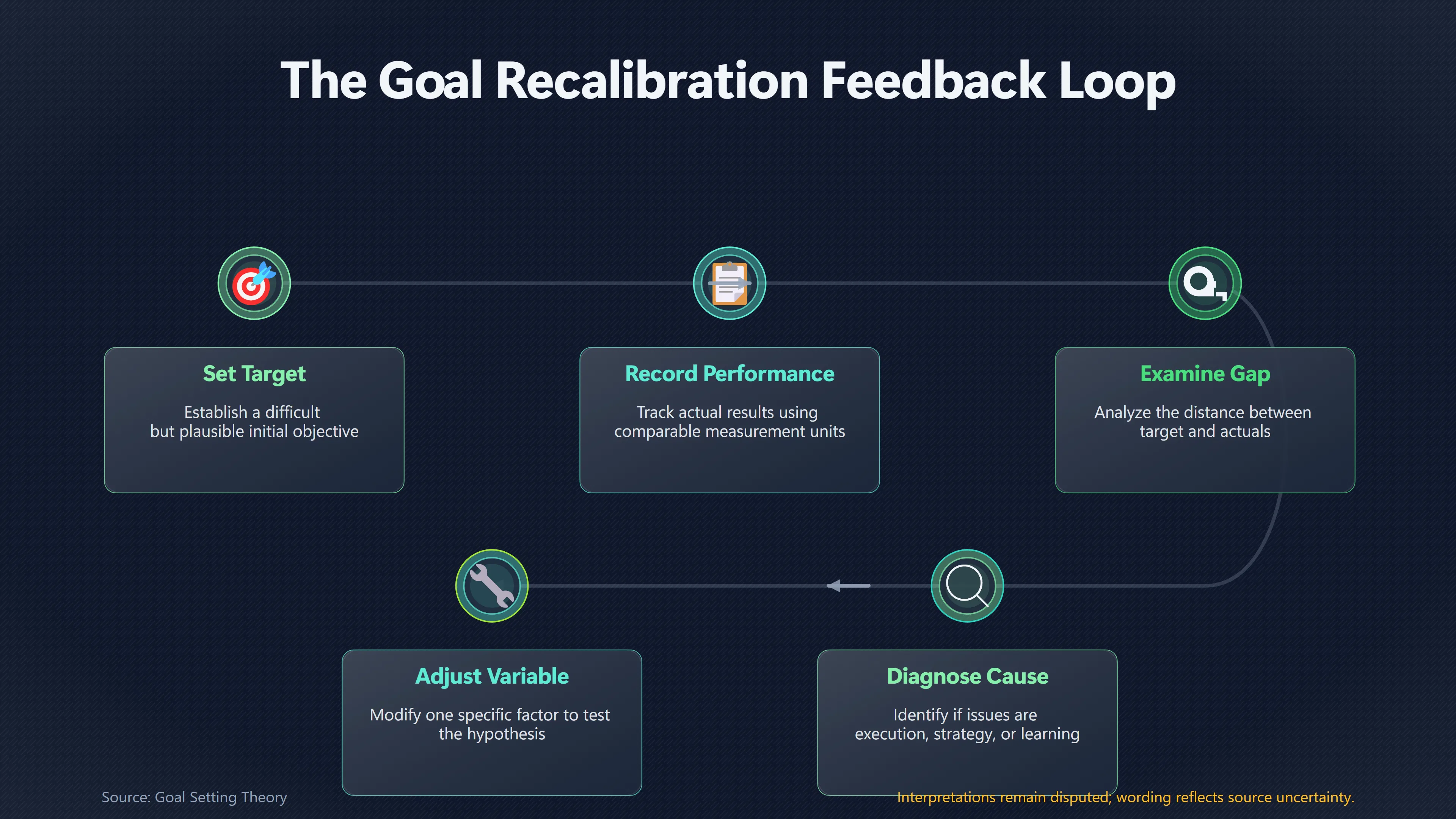
A practical feedback loop is:
Set the target → record comparable performance → examine the size and trend of the gap → diagnose the likely cause → change one important variable → collect another round of evidence.
That final step matters. After lowering a target, keep monitoring. An easier goal that is now reached comfortably on every attempt may have been reduced too far; repeated comfortable success can justify raising it again. This is consistent with the goal-revision literature: success tends to prompt upward revision, failure downward revision, and larger discrepancies tend to prompt larger changes.[DOI]doi.orgFull article: How (much) do people revise their goals after success and failure? The Triple-A model of goal revisionJuly 23, 2025…
The adjustment also need not be permanent. Imagine that someone wants to write 1,000 good words each weekday but, after several properly tracked weeks, consistently produces 550–650. Reducing the next block’s target to 750 is not equivalent to abandoning the original ambition. It creates a nearer performance standard against which improvement can be tested. If output rises towards 750 while quality holds, the target can later move upwards again. If output remains around 600, the feedback points towards investigating process, time, skill or competing demands rather than repeatedly announcing a higher number.
There is no research-backed universal rule such as “lower a goal after three failures” or “make every goal 10% easier”. The evidence instead supports responsiveness to the magnitude, trend and interpretation of the discrepancy. Even the recent meta-analysis of goal revision concludes that goal adjustment remains less well understood than initial goal setting, with individual differences and contextual factors influencing how strongly people respond to success and failure.[DOI]doi.orgFull article: How (much) do people revise their goals after success and failure? The Triple-A model of goal revision…
That uncertainty is a reason to use feedback more carefully, not less. Repeated measurements are generally more informative than a single unusually good or bad day, and comparable measurements are more useful than changing the test every time.

When persistence stops being the right response
There is an important outer boundary to recalibration. Sometimes the evidence does not say “make this goal slightly easier”; it says that the goal is no longer realistically attainable under current circumstances.
Research on unattainable goals challenges the assumption that persistence is always virtuous. Work by Carsten Wrosch and colleagues distinguishes continued effort towards a threatened but attainable goal from disengagement when opportunities for meaningful progress have become severely constrained. Their research associates the capacity to disengage from genuinely unattainable goals and re-engage with alternatives with aspects of better well-being; a later meta-analytic review of 31 samples likewise found associations between goal-adjustment capacities and quality of life.[PubMed Central (PMC)]pmc.ncbi.nlm.nih.govOpen source on nih.gov.
That is a more extreme decision than ordinary recalibration, and it should not be confused with lowering a challenging target after an uncomfortable week. Its relevance here is as a boundary condition: feedback should be allowed to change your mind. A goal that was reasonable six months ago can become unrealistic because resources, opportunities, constraints or priorities change.
The useful principle is therefore neither “never lower your standards” nor “make goals easier whenever you struggle”. Keep the challenge while the evidence shows adaptation is occurring. Change the method when the gap identifies a solvable process problem. Reduce or restructure the target when repeated, comparable feedback shows that present difficulty is producing persistent shortfalls without sufficient progress. And when circumstances make the underlying objective genuinely unattainable, redirecting effort can itself be effective self-regulation.[PubMed]pubmed.ncbi.nlm.nih.govOpen source on nih.gov.
For self-improvement that works, a difficult goal is best treated as a hypothesis about what you can productively reach next. Feedback is the test.
Amazon book picks
Further Reading
Books and field guides related to When Should You Make a Hard Goal Easier?. Use these as the next step if you want deeper reading beyond the article.
Measure What Matters
#1 New York Times Bestseller Legendary venture capitalist John Doerr reveals how the goal-setting system of Objectives and Key Results (O...

The Power of Habit
Rating: 4.0/5 from 145 Google Books ratings
In The Power of Habit, award-winning business reporter Charles Duhigg takes us to the thrilling edge of scientific discoveries that expla...
The Progress Principle: Using Small Wins to Ignite Joy, Engag...
Explains how to foster progress, shows how to remove obstacles, including meaningless tasks and toxic relationships that disrupt employee...
Atomic Habits
Rating: 3.5/5 from 7 Google Books ratings
The #1 New York Times bestseller. Over 25 million copies sold! Translated into 60+ languages! Tiny Changes, Remarkable Results No matter...
eBay marketplace picks
Marketplace Samples
Live-tested eBay searches with available results related to this page.
Selected fromgoal setting poster oneBay.co.uk.

Current eBay listing
Goal Setting Quote Framed Wall Art Poster Canvas Print Picture

Current eBay listing
Goal Setting Definition Framed Wall Art Poster Canvas Print Picture

Current eBay listing
Goal Setting Definition Framed Wall Art Poster Canvas Print Picture
Endnotes
1.
Source: doi.org
Link:https://doi.org/10.1080%2F00461520.2025.2533232
Source snippet
Full article: How (much) do people revise their goals after success and failure? The Triple-A model of goal revision...
2.
Source: researchgate.net
Link:https://www.researchgate.net/publication/232588300_Feedback_A_necessary_condition_for_the_goal_setting-performance_relationship
3.
Source: doi.org
Link:https://doi.org/10.1080/00461520.2025.2533232
Source snippet
Full article: How (much) do people revise their goals after success and failure? The Triple-A model of goal revisionJuly 23, 2025...
Published: July 23, 2025
4.
Source: openurl.ebsco.com
Link:https://openurl.ebsco.com/contentitem/pdh%3A1996-02773-003?crl=c&id=ebsco%3Apdh%3A1996-02773-003&sid=ebsco%3Aplink%3Ascholar
Source snippet
EBSCO OpenURLThe effects of feedback interventions on performance: A historical review, a meta-analysis, and a preliminary feedback inter...
5.
Source: researchgate.net
Title: Goal Setting Theory
Link:https://www.researchgate.net/publication/404925609_Goal_Setting_Theory
6.
Source: researchgate.net
Link:https://www.researchgate.net/publication/389381901_How_much_do_people_revise_their_goals_after_goal_success_and_failure_A_meta-analysis_and_research_agenda_on_goal_revision
7.
Source: doi.org
Title: Goal adjustment capacities and quality of life: A meta‐analytic review
Link:https://doi.org/10.1111/jopy.12492
8.
Source: researchgate.net
Title: 315808863 Effects of Changing Feedback Focus in [Physical Activity]({{ ‘physical-capacity/’ | relative_url }}) Applications
Link:https://www.researchgate.net/publication/315808863_Effects_of_Changing_Feedback_Focus_in_Physical_Activity_Applications
9.
Source: researchgate.net
Link:https://www.researchgate.net/publication/291335719_Does_Monitoring_Goal_Progress_Promote_Goal_Attainment_A_Meta-Analysis_of_the_Experimental_Evidence
10.
Source: researchgate.net
Title: Feedback | Research Gate
Link:https://www.researchgate.net/publication/313966765_Feedback
11.
Source: doi.org
Link:https://doi.org/10.1177/0146167203256921%C2%A0
12.
Source: doi.org
Link:https://doi.org/10.1002/%28SICI%291099-1379%28199907%2920%3A4%3C421%3A%3AAID-JOB896%3E3.0.CO%3B2-%23
13.
Source: researchgate.net
Title: (PDF) A Theory of Goal Setting & Task Performance
Link:https://www.researchgate.net/publication/232501090_A_Theory_of_Goal_Setting_Task_Performance
14.
Source: researchgate.net
Title: 232586681 Goal Setting and Task Performance 1969 1980
Link:https://www.researchgate.net/publication/232586681_Goal_Setting_and_Task_Performance
15.
Source: doi.org
Title: New Directions in Goal-Setting Theory
Link:https://doi.org/10.1111/j.1467-8721.2006.00449.x
16.
Source: doi.org
Link:https://doi.org/10.1037/mot0000127
17.
Source: researchgate.net
Link:https://www.researchgate.net/publication/284621413_Learning_versus_performance_goals_When_should_each_be_used
18.
Source: researchgate.net
Link:https://www.researchgate.net/publication/320609499_Goal_Setting_and_Goal_Orientation_An_Integration_of_Two_Different_yet_Related_Literatures
19.
Source: researchgate.net
Link:https://www.researchgate.net/publication/5396380_The_Role_of_Feedback_Causal_Attributions_and_Self-Efficacy_in_Goal_Revision
20.
Source: researchgate.net
Link:https://www.researchgate.net/figure/Interaction-between-attributions-and-feedback-on-goal-revision-Pos-FB-positive_fig3_5396380
21.
Source: researchgate.net
Link:https://www.researchgate.net/publication/306350937_Learning_goal_orientation_buffers_the_effects_of_negative_normative_feedback_on_test_self-efficacy_and_reattempt_interest
22.
Source: researchgate.net
Link:https://www.researchgate.net/publication/366273022_The_effect_of_changes_in_negative_feedback_on_task_performance_the_role_of_goal_orientation_and_feedback_utility
23.
Source: openurl.ebsco.com
Link:https://openurl.ebsco.com/contentitem/pdh%3A2015-47216-001?crl=f&id=ebsco%3Apdh%3A2015-47216-001&sid=ebsco%3Aplink%3Ascholar
24.
Source: openurl.ebsco.com
Link:https://openurl.ebsco.com/contentitem/gcd%3A20670718?crl=f&id=ebsco%3Agcd%3A20670718&jrnl=00219029&sid=ebsco%3Aplink%3Acrawler-gcd
25.
Source: pubmed.ncbi.nlm.nih.gov
Link:https://pubmed.ncbi.nlm.nih.gov/26479070/
Source snippet
Does monitoring goal progress promote goal attainment? A meta-analysis of the experimental evidence - PubMedFebruary 1, 2016...
Published: February 1, 2016
26.
Source: pubmed.ncbi.nlm.nih.gov
Link:https://pubmed.ncbi.nlm.nih.gov/12814288/
Source snippet
Missing the mark: effects of time and causal attributions on goal revision in response to goal-performance discrepancies - PubMed...
27.
Source: pubmed.ncbi.nlm.nih.gov
Link:https://pubmed.ncbi.nlm.nih.gov/18457497/
Source snippet
The role of feedback, casual attributions, and self-efficacy in goal revision - PubMed...
28.
Source: journals.aom.org
Link:https://journals.aom.org/doi/10.5465/ame.2005.15841964
29.
Source: journals.aom.org
Link:https://journals.aom.org/doi/abs/10.5465/ame.2005.15841964
30.
Source: pmc.ncbi.nlm.nih.gov
Link:https://pmc.ncbi.nlm.nih.gov/articles/PMC4145404/
31.
Source: pubmed.ncbi.nlm.nih.gov
Title: Pub Med Goal adjustment capacities and quality of life: A meta-analytic review
Link:https://pubmed.ncbi.nlm.nih.gov/31131441/
32.
Source: pubmed.ncbi.nlm.nih.gov
Link:https://pubmed.ncbi.nlm.nih.gov/15018681/
33.
Source: pubmed.ncbi.nlm.nih.gov
Title: Pub Med Goal Adjustment Capacities, Subjective Well-Being, and Physical Health
Link:https://pubmed.ncbi.nlm.nih.gov/25177358/
34.
Source: pmc.ncbi.nlm.nih.gov
Link:https://pmc.ncbi.nlm.nih.gov/articles/PMC13251835/
35.
Source: pmc.ncbi.nlm.nih.gov
Link:https://pmc.ncbi.nlm.nih.gov/articles/PMC12065060/
36.
Source: pmc.ncbi.nlm.nih.gov
Link:https://pmc.ncbi.nlm.nih.gov/articles/PMC10424097/
37.
Source: pmc.ncbi.nlm.nih.gov
Link:https://pmc.ncbi.nlm.nih.gov/articles/PMC10416154/
38.
Source: pmc.ncbi.nlm.nih.gov
Link:https://pmc.ncbi.nlm.nih.gov/articles/PMC11214152/
39.
Source: pmc.ncbi.nlm.nih.gov
Link:https://pmc.ncbi.nlm.nih.gov/articles/PMC9124288/
40.
Source: pmc.ncbi.nlm.nih.gov
Link:https://pmc.ncbi.nlm.nih.gov/articles/PMC8671316/
41.
Source: pmc.ncbi.nlm.nih.gov
Link:https://pmc.ncbi.nlm.nih.gov/articles/PMC8229705/
42.
Source: pmc.ncbi.nlm.nih.gov
Link:https://pmc.ncbi.nlm.nih.gov/articles/PMC8149892/
43.
Source: pmc.ncbi.nlm.nih.gov
Link:https://pmc.ncbi.nlm.nih.gov/articles/PMC8356298/
44.
Source: pmc.ncbi.nlm.nih.gov
Link:https://pmc.ncbi.nlm.nih.gov/articles/PMC7170595/
45.
Source: pmc.ncbi.nlm.nih.gov
Link:https://pmc.ncbi.nlm.nih.gov/articles/PMC7429262/
46.
Source: pmc.ncbi.nlm.nih.gov
Link:https://pmc.ncbi.nlm.nih.gov/articles/PMC6371234/
47.
Source: pmc.ncbi.nlm.nih.gov
Link:https://pmc.ncbi.nlm.nih.gov/articles/PMC8248448/
48.
Source: dictionary.apa.org
Title: goal setting
Link:https://dictionary.apa.org/goal-setting
49.
Source: journals.aom.org
Link:https://journals.aom.org/doi/10.5465/256353
50.
Source: journals.aom.org
Link:https://journals.aom.org/doi/10.5465/255962
51.
Source: journals.aom.org
Link:https://journals.aom.org/doi/pdf/10.5465/20159574
52.
Source: pmc.ncbi.nlm.nih.gov
Link:https://pmc.ncbi.nlm.nih.gov/articles/PMC5364185/
53.
Source: pmc.ncbi.nlm.nih.gov
Link:https://pmc.ncbi.nlm.nih.gov/articles/PMC4159987/
54.
Source: pmc.ncbi.nlm.nih.gov
Link:https://pmc.ncbi.nlm.nih.gov/articles/PMC3878579/
55.
Source: pmc.ncbi.nlm.nih.gov
Link:https://pmc.ncbi.nlm.nih.gov/articles/PMC3303967/
56.
Source: pmc.ncbi.nlm.nih.gov
Link:https://pmc.ncbi.nlm.nih.gov/articles/PMC3119533/
57.
Source: pmc.ncbi.nlm.nih.gov
Link:https://pmc.ncbi.nlm.nih.gov/articles/PMC4170834/
58.
Source: coachsci.sdsu.edu
Link:https://coachsci.sdsu.edu/csa/vol22/erez.htm
59.
Source: pubmed.ncbi.nlm.nih.gov
Link:https://pubmed.ncbi.nlm.nih.gov/15910142/
60.
Source: pubmed.ncbi.nlm.nih.gov
Link:https://pubmed.ncbi.nlm.nih.gov/17259585/
61.
Source: pubmed.ncbi.nlm.nih.gov
Link:https://pubmed.ncbi.nlm.nih.gov/19697230/
Additional References
62.
Source: cris.huji.ac.il
Link:https://cris.huji.ac.il/en/publications/the-effects-of-feedback-interventions-on-performance-a-historical/
Source snippet
The Hebrew University of JerusalemThe effects of feedback interventions on performance: A historical review, a meta-analysis, and a preli...
63.
Source: eprints.whiterose.ac.uk
Link:https://eprints.whiterose.ac.uk/id/eprint/91437/
Source snippet
White Rose Research OnlineDoes Monitoring Goal Progress Promote Goal Attainment? A Meta-Analysis of the Experimental Evidence - White Ros...
64.
Source: youtube.com
Title: Why Locke & Latham’s Theory is the Key to Goal Achievement
Link:https://www.youtube.com/watch?v=TGo7eUCoW_g
Source snippet
Goal setting feedback progress monitoring Locke Latham Edwin Locke: Goal-Setting Theory of Motivation...
65.
Source: youtube.com
Title: Self Regulation Theory: Positive and Negative Feedback Loops
Link:https://www.youtube.com/watch?v=hz_UTLxYuV8
Source snippet
Why Locke & Latham’s Theory is the Key to Goal Achievement...
66.
Source: sciencedirect.com
Title: ScienceDirect Goal Setting Theory
Link:https://www.sciencedirect.com/topics/social-sciences/goal-setting-theory
Source snippet
Goal Setting Theory - an overview | ScienceDirect Topics...
67.
Source: youtube.com
Title: Tools for Setting & Achieving Goals | Dr. Emily Balcetis
Link:https://www.youtube.com/watch?v=7YGZZcXqKxE
Source snippet
Self Regulation Theory: Positive and Negative Feedback Loops...
68.
Source: youtube.com
Title: Jordan B Peterson Clips
Link:https://www.youtube.com/watch?v=Bf9Wen-j5Zw
Source snippet
Feedback loops in self regulation and behavior change Homeostasis and Negative/Positive Feedback...
69.
Source: sciencedirect.com
Link:https://www.sciencedirect.com/science/article/abs/pii/S2215091919300148
70.
Source: sciencedirect.com
Link:https://www.sciencedirect.com/science/chapter/bookseries/pii/S2215091919300148
71.
Source: sciencedirect.com
Link:https://www.sciencedirect.com/science/article/abs/pii/S1469029207000076