Within Sleep Foundation
Why Hard Tasks Feel Harder After Too Little Sleep
Insufficient sleep can make demanding tasks feel more effortful and reduce willingness to keep investing effort toward a goal.
On this page
- How sleep loss changes perceived effort
- When incentives can partly compensate
- What this means for demanding self improvement plans
Page outline Jump by section
Introduction
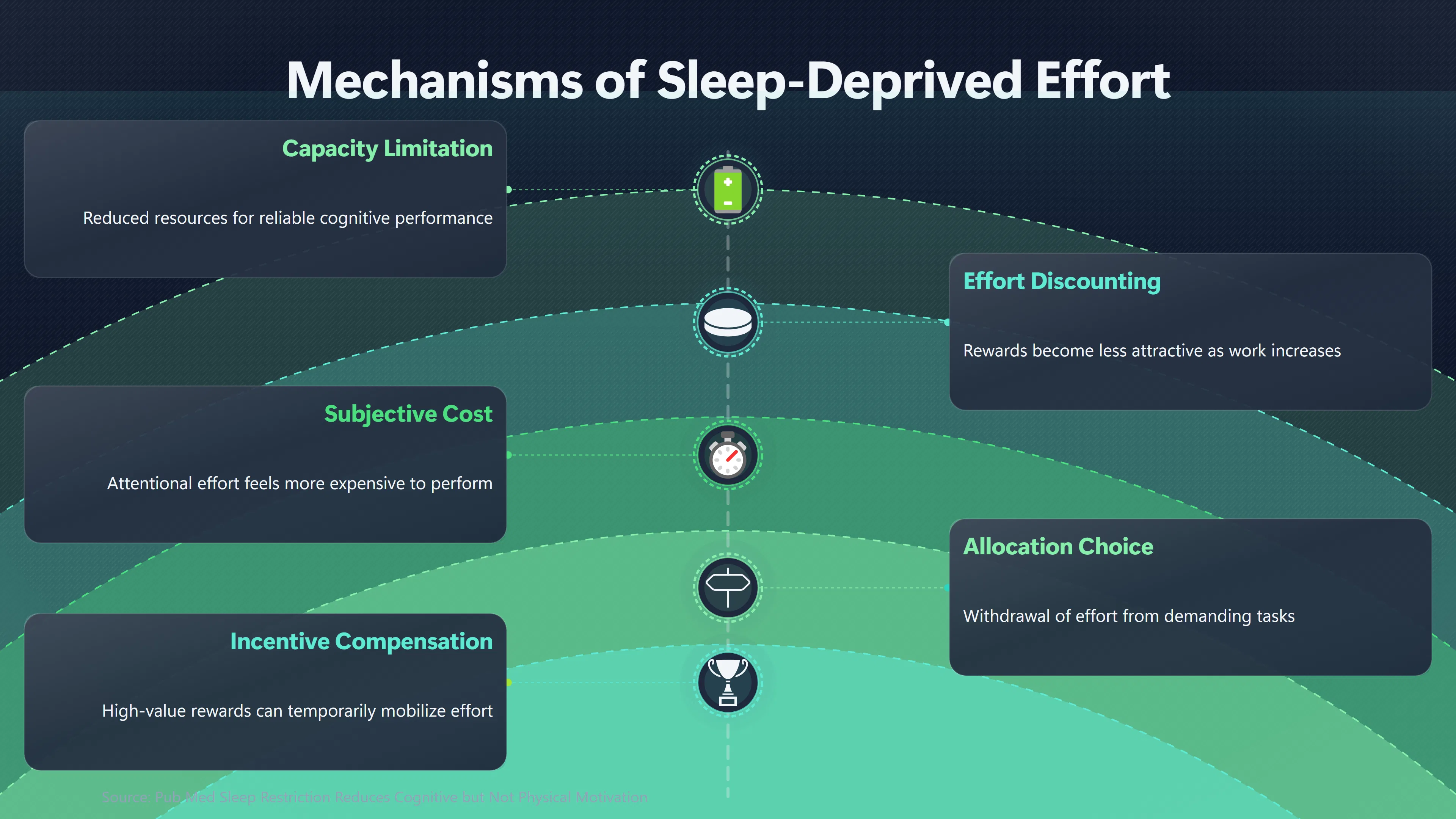
Too little sleep can change a difficult task in two ways at once: it can reduce the cognitive capacity available to do the task, and it can make spending that capacity feel less worthwhile. Laboratory studies suggest that sleep-deprived people become more reluctant to choose cognitively demanding work, discount rewards more sharply when those rewards require sustained effort, and experience attentional effort as more costly.[PubMed]pubmed.ncbi.nlm.nih.govSleep deprivation alters effort discounting but not delay discounting of monetary rewards - PubMedJune 1, 2013…

That distinction matters for self-improvement. A person may still possess the underlying skill to study, write, plan or solve a difficult problem, yet be less willing to keep paying the mental cost required to use it. The result can look like a motivation problem: choosing the easier task, abandoning a demanding session early or needing a much stronger incentive to persist. Rewards can sometimes draw out extra effort temporarily, but the evidence does not support treating motivation as a complete substitute for sleep.[PubMed]pubmed.ncbi.nlm.nih.govPub Med Sleep deprivation, effort allocation and performanceSleep deprivation, effort allocation and performance - PubMedApril 3, 2019…
How sleep loss changes perceived effort
One useful way to understand motivation is as a cost-benefit decision. A demanding action offers some expected benefit — finishing an assignment, earning money, making progress towards a goal — but it also carries an effort cost. As that cost rises, the benefit has to become more valuable before the action is worth choosing. Researchers call this effort discounting: rewards become subjectively less attractive when obtaining them requires more work.[PubMed Central (PMC)]pmc.ncbi.nlm.nih.govPubMed Central (PMC)Sleep Deprivation Alters Effort Discounting but not Delay Discounting of Monetary Rewards - PMCJune 1, 2013…
Sleep deprivation appears to shift this calculation against cognitively demanding options. In a 2013 Sleep study, researchers compared choices after normal sleep with choices after a night without sleep. Participants could obtain different monetary rewards by completing different amounts of effortful work, such as typing letter strings backwards. After sleep deprivation, participants showed greater effort discounting: they became more inclined to sacrifice some reward in exchange for doing less work. Importantly, the same experiments found no corresponding change in delay discounting — the preference for a smaller reward now rather than a larger reward later. The result therefore did not look like an indiscriminate change in every kind of reward-based choice.[PubMed]pubmed.ncbi.nlm.nih.govSleep deprivation alters effort discounting but not delay discounting of monetary rewards - PubMedJune 1, 2013…
A later experiment examined the mechanism using sustained attention. Participants performed a vigilance task after normal sleep and after sleep deprivation, with different payments available for fast responses. They then made choices involving rewards for maintaining attentional performance for periods ranging from one to 30 minutes. Longer tasks naturally reduced the attractiveness of the reward, but sleep deprivation made that duration-related discounting stronger. Performance and pupil measurements also shifted with incentives, leading the researchers to interpret sleep deprivation as increasing the perceived cost of sustained attentional effort rather than simply switching motivation off altogether.[PubMed]pubmed.ncbi.nlm.nih.govSleep deprivation increases the costs of attentional effort: Performance, preference and pupil size - PubMed…
This produces a more useful explanation than saying that tired people simply become “lazy”. The evidence points to an interaction between capacity and allocation. Sleep loss reduces the resources available for reliable cognitive performance, while effort-allocation processes determine how much of those scarcer resources a person is prepared to mobilise for the task in front of them. A major review of this literature argues that sleep-related performance deterioration can therefore contain both an involuntary capacity limitation and a motivational component in which people withdraw effort as its subjective cost rises.[PubMed]pubmed.ncbi.nlm.nih.govPub Med Sleep deprivation, effort allocation and performanceSleep deprivation, effort allocation and performance - PubMedApril 3, 2019…
There is also evidence that people can feel themselves compensating without fully restoring performance. In a study of 15 healthy young men undergoing five nights with five hours in bed, subjective effort increased during sleep restriction while alertness and motivation generally fell. Participants who suffered larger drops in motivation tended to show worse aspects of sustained-attention performance. Yet reported effort itself was not a straightforward indicator of preserved performance: feeling that one is trying harder does not mean sleep-related impairment has disappeared.[PubMed Central (PMC)]pmc.ncbi.nlm.nih.govPubMed Central (PMC)Changes in Subjective Motivation and Effort During Sleep Restriction Moderate Interindividual Differences in Attentio…
The effect may be especially cognitive
The claim should not be broadened into “sleep deprivation makes people unwilling to do anything difficult”. One of the more informative experiments directly compared cognitive and physical effort and found a more selective effect.
In that 2022 study, 24 healthy young adults completed two laboratory conditions: three consecutive nights with only a three-hour sleep opportunity, and a rested condition with nine hours available each night. Participants first learnt tasks spanning six levels of cognitive or physical effort. They then chose between options requiring different amounts of effort for different rewards. The researchers deliberately trained performance to very high levels before the choice phase, helping to separate being able to perform an effort level from being willing to choose it.[PubMed]pubmed.ncbi.nlm.nih.govPub Med Sleep Restriction Reduces Cognitive but Not Physical MotivationSleep Restriction Reduces Cognitive but Not Physical Motivation - PubMed…
Sleep restriction reduced willingness to choose greater cognitive effort, particularly beyond the lowest effort level. It did not produce an equivalent reduction in willingness to exert physical effort. Analyses also indicated that the cognitive result could not simply be explained by participants believing that they were less likely to succeed at harder levels.[PubMed Central (PMC)]pmc.ncbi.nlm.nih.govOpen source on nih.gov.
That finding is particularly relevant to self-improvement plans built around mentally demanding activities: studying after work, learning a language, writing, deliberate practice, complicated financial administration or completing a project requiring sustained concentration. After inadequate sleep, the barrier may not merely be poorer execution once the activity begins. The high-effort option itself can become less attractive.
The physical finding also supplies an important boundary. It comes from one small controlled study and should not be taken to mean that sleep loss never affects physical effort, exercise or perceived exertion. Rather, it shows why “motivation” should not be treated as one undifferentiated quantity. Sleep restriction can alter willingness to invest effort differently depending on what kind of effort is required.[PubMed Central (PMC)]pmc.ncbi.nlm.nih.govOpen source on nih.gov.

When incentives can partly compensate
Reduced willingness to exert effort is not the same thing as complete inability. If sleep deprivation raises the subjective price of cognitive work, increasing the value of the outcome can sometimes make paying that price worthwhile.
Experiments support this compensation effect. In the sustained-attention study, larger monetary incentives improved performance under sleep deprivation and changed physiological measures associated with arousal. Another experiment involving 24 participants found that increasing rewards for fast responses reduced a sleep-deprivation-related bias in attentional readiness; under sufficiently rewarded conditions, response speed on the relevant measure approached that of the unrewarded rested condition.[PubMed]pubmed.ncbi.nlm.nih.govSleep deprivation increases the costs of attentional effort: Performance, preference and pupil size - PubMed…
This helps explain why someone can sometimes perform surprisingly well when sleep-deprived during an exam, deadline or other high-stakes event. A sufficiently valuable and immediate outcome can mobilise effort that a routine task does not. Older experimental work similarly found that performance feedback and incentives could counter some effects of sleep deprivation and time-on-task.[PubMed]pubmed.ncbi.nlm.nih.govPub Med The effects of sleep deprivation and incentives on human performancePub Med The effects of sleep deprivation and incentives on human performance
But partial compensation is the important qualification. Motivation cannot reliably purchase rested performance. In one experiment, monetary incentives improved accuracy and reaction-time variability in both rested and sleep-deprived conditions and altered some physiological measures of effort and error processing. They did not eliminate the sleep-deprivation deficit in behavioural performance on a task demanding higher-level cognitive control.[PubMed]pubmed.ncbi.nlm.nih.govImpact of monetary incentives on cognitive performance and error monitoring following sleep deprivation - PubMed…
The broader research literature reaches much the same conclusion. Feedback, rewards, novelty, short tasks and high interest can sometimes support temporary compensation, whereas prolonged or monotonous performance exposes sleep-related impairment more readily. Even highly motivated research volunteers continue to show deficits after sleep loss, which is difficult to reconcile with the idea that impaired performance is merely a failure to care enough.[PubMed Central (PMC)]pmc.ncbi.nlm.nih.govPub Med Central (PMC)Sleep deprivation: Impact on cognitive performancePub Med Central (PMC)Sleep deprivation: Impact on cognitive performance
There is an important practical asymmetry here. A deadline can increase the benefit side of the effort calculation, but it does not remove the underlying sleep loss. The person may mobilise additional effort for a while precisely because the task has become important enough to justify its higher subjective cost. That is compensation, not restoration.
What this means for demanding self-improvement plans
The effort-cost evidence changes how a failed plan should be diagnosed. Suppose a person intends to spend 90 minutes studying a difficult subject every evening. After several short nights, they repeatedly choose easier activities instead. A conventional interpretation is that the goal is insufficiently motivating or that they lack discipline. Sleep research supports another possibility: the same 90-minute session may now carry a higher subjective cognitive cost, while the person’s capacity for sustained attention is simultaneously worse.[PubMed]pubmed.ncbi.nlm.nih.govSleep deprivation increases the costs of attentional effort: Performance, preference and pupil size - PubMed…
For implementation, that suggests several useful design principles:
- Do not routinely schedule the hardest cognitive work into sleep debt. When possible, place work requiring sustained concentration, complex decisions or prolonged self-directed effort after adequate sleep rather than assuming motivation will compensate.
- Reduce unnecessary effort costs on poorly slept days. A shorter predefined work interval, a prepared workspace and a clearly specified next action reduce the amount of cognitive effort that must be justified before useful work begins. This is a practical inference from the effort-cost evidence, rather than a claim that these techniques reverse sleep deprivation.
- Use incentives as support, not as sleep replacement. Immediate feedback, visible progress, deadlines and meaningful rewards can increase effort allocation, but laboratory evidence shows that incentives do not consistently abolish sleep-related performance deficits.[PubMed]pubmed.ncbi.nlm.nih.govPub Med The effects of sleep deprivation and incentives on human performancePub Med The effects of sleep deprivation and incentives on human performance
- Distinguish unwillingness from inability. Choosing the easier option after inadequate sleep does not necessarily show that the harder task has become impossible. Conversely, successfully forcing oneself through it does not demonstrate that cognitive performance is unimpaired.
- Treat repeated dependence on urgency as a warning sign. If demanding work becomes possible only when a deadline or large reward creates enough pressure, the plan may be relying on unusually strong incentives to overcome elevated effort costs rather than being sustainably designed.
This interpretation also argues against making self-improvement plans maximally demanding simply to prove commitment. A plan that requires repeated discretionary choices to exert high cognitive effort is vulnerable to nights when the subjective price of that effort rises. The more robust strategy is to protect sleep and lower avoidable friction around the behaviours that matter, leaving limited compensatory effort for occasions when it is genuinely needed.
The evidence is strongest for controlled experiments involving total sleep deprivation or substantial restriction, often in small samples of healthy young adults. It would therefore be too strong to claim that every modestly short night produces a predictable numerical reduction in motivation. Recent evidence on partial sleep restriction also shows that cognitive effects differ by outcome: a 2024 meta-analysis of 44 studies found clear increases in sleepiness and impairment of sustained attention after a single restricted night, but not significant impairment across every cognitive measure examined.[PubMed]pubmed.ncbi.nlm.nih.govOpen source on nih.gov.
Within those limits, the effort-allocation findings add an important piece to the self-improvement picture. Sleep does not merely affect how well the brain performs a demanding task once it has been chosen. Insufficient sleep can alter whether that task seems worth choosing and sustaining in the first place. Protecting sleep therefore supports follow-through on both sides of the equation: it helps preserve the capacity needed for difficult work and reduces the need to keep overcoming an inflated subjective cost of using that capacity.

Amazon book picks
Further Reading
Books and field guides related to Why Hard Tasks Feel Harder After Too Little Sleep. Use these as the next step if you want deeper reading beyond the article.
Why We Sleep
"Sleep is one of the most important but least understood aspects of our life, wellness, and longevity ... An explosion of scientific disc...
The Sleep Solution
With cutting-edge sleep science and time-tested techniques, The Sleep Solution will help anyone achieve healthy sleep and eliminate pills...
The Willpower Instinct
Based on Stanford University psychologist Kelly McGonigal's wildly popular course "The Science of Willpower," The Willpower Instinct is t...
The Motivation Myth
From Inc.com's most popular columnist, a counterintuitive--but highly practical--guide to finding and maintaining the motivation to achie...
eBay marketplace picks
Marketplace Samples
Live-tested eBay searches with available results related to this page.
Selected frommotivational wall art oneBay.co.uk.


Endnotes
1.
Source: pubmed.ncbi.nlm.nih.gov
Link:https://pubmed.ncbi.nlm.nih.gov/23729933/
Source snippet
Sleep deprivation alters effort discounting but not delay discounting of monetary rewards - PubMedJune 1, 2013...
Published: June 1, 2013
2.
Source: pubmed.ncbi.nlm.nih.gov
Link:https://pubmed.ncbi.nlm.nih.gov/29601889/
Source snippet
Sleep deprivation increases the costs of attentional effort: Performance, preference and pupil size - PubMed...
3.
Source: pubmed.ncbi.nlm.nih.gov
Title: Pub Med Sleep Restriction Reduces Cognitive but Not Physical Motivation
Link:https://pubmed.ncbi.nlm.nih.gov/36394069/
Source snippet
Sleep Restriction Reduces Cognitive but Not Physical Motivation - PubMed...
4.
Source: pubmed.ncbi.nlm.nih.gov
Title: Pub Med Sleep deprivation, effort allocation and performance
Link:https://pubmed.ncbi.nlm.nih.gov/31072557/
Source snippet
Sleep deprivation, effort allocation and performance - PubMedApril 3, 2019...
Published: April 3, 2019
5.
Source: pubmed.ncbi.nlm.nih.gov
Link:https://pubmed.ncbi.nlm.nih.gov/20394319/
Source snippet
Impact of monetary incentives on cognitive performance and error monitoring following sleep deprivation - PubMed...
6.
Source: pmc.ncbi.nlm.nih.gov
Link:https://pmc.ncbi.nlm.nih.gov/articles/PMC3649832/
Source snippet
PubMed Central (PMC)Sleep Deprivation Alters Effort Discounting but not Delay Discounting of Monetary Rewards - PMCJune 1, 2013...
Published: June 1, 2013
7.
Source: pmc.ncbi.nlm.nih.gov
Link:https://pmc.ncbi.nlm.nih.gov/articles/PMC8286723/
Source snippet
PubMed Central (PMC)Changes in Subjective Motivation and Effort During Sleep Restriction Moderate Interindividual Differences in Attentio...
8.
Source: pmc.ncbi.nlm.nih.gov
Link:https://pmc.ncbi.nlm.nih.gov/articles/PMC9642807/
9.
Source: pubmed.ncbi.nlm.nih.gov
Title: Pub Med Reward motivation normalises temporal attention after sleep deprivation
Link:https://pubmed.ncbi.nlm.nih.gov/30426584/
10.
Source: pubmed.ncbi.nlm.nih.gov
Title: Pub Med The effects of sleep deprivation and incentives on human performance
Link:https://pubmed.ncbi.nlm.nih.gov/8480005/
11.
Source: pmc.ncbi.nlm.nih.gov
Link:https://pmc.ncbi.nlm.nih.gov/articles/PMC2865224/
12.
Source: pmc.ncbi.nlm.nih.gov
Title: Pub Med Central (PMC)Sleep deprivation: Impact on cognitive performance
Link:https://pmc.ncbi.nlm.nih.gov/articles/PMC2656292/
13.
Source: pubmed.ncbi.nlm.nih.gov
Link:https://pubmed.ncbi.nlm.nih.gov/38759474/
14.
Source: pmc.ncbi.nlm.nih.gov
Link:https://pmc.ncbi.nlm.nih.gov/articles/PMC12672380/
15.
Source: pubmed.ncbi.nlm.nih.gov
Link:https://pubmed.ncbi.nlm.nih.gov/41425508/
16.
Source: pmc.ncbi.nlm.nih.gov
Link:https://pmc.ncbi.nlm.nih.gov/articles/PMC11996801/
17.
Source: pmc.ncbi.nlm.nih.gov
Link:https://pmc.ncbi.nlm.nih.gov/articles/PMC11601381/
18.
Source: pubmed.ncbi.nlm.nih.gov
Link:https://pubmed.ncbi.nlm.nih.gov/39488298/
19.
Source: pubmed.ncbi.nlm.nih.gov
Link:https://pubmed.ncbi.nlm.nih.gov/39427809/
20.
Source: pmc.ncbi.nlm.nih.gov
Link:https://pmc.ncbi.nlm.nih.gov/articles/PMC10296276/
21.
Source: pmc.ncbi.nlm.nih.gov
Link:https://pmc.ncbi.nlm.nih.gov/articles/PMC9398015/
22.
Source: pmc.ncbi.nlm.nih.gov
Link:https://pmc.ncbi.nlm.nih.gov/articles/PMC8455079/
23.
Source: pmc.ncbi.nlm.nih.gov
Link:https://pmc.ncbi.nlm.nih.gov/articles/PMC6143346/
24.
Source: pmc.ncbi.nlm.nih.gov
Link:https://pmc.ncbi.nlm.nih.gov/articles/PMC4608917/
25.
Source: pubmed.ncbi.nlm.nih.gov
Link:https://pubmed.ncbi.nlm.nih.gov/26483932/
Additional References
26.
Source: sciencedirect.com
Link:https://www.sciencedirect.com/science/article/pii/S0028393218301258
Source snippet
Sleep deprivation increases the costs of attentional effort: Performance, preference and pupil size - ScienceDirect...
27.
Source: youtube.com
Link:https://www.youtube.com/watch?v=cpTjRGJg5kE
Source snippet
The talk What is Cognitive Effort? – Andrew Westbrook directly examines the neurobiology of cognitive effort costs, effort discounting, a...
28.
Source: sciencedirect.com
Title: ScienceDirect Sleep deprivation, effort allocation and performance
Link:https://www.sciencedirect.com/science/chapter/bookseries/pii/S0079612319300378
Source snippet
Sleep deprivation, effort allocation and performance - ScienceDirect...
29.
Source: nature.com
Link:https://www.nature.com/articles/s41386
30.
Source: youtube.com
Title: Rewire Your Brain: Dopamine, Stress & Focus Explained
Link:https://www.youtube.com/watch?v=YYMBB7H1BPY
Source snippet
How to STOP PROCRASTINATING once and for all! The secret revealed by neuroscience...
31.
Source: youtube.com
Title: Why Bad Sleep Makes You Spend More, Save Less, and Risk Everything
Link:https://www.youtube.com/watch?v=9jRDgfW0ifk
Source snippet
How to Increase Motivation & Drive | Huberman Lab Essentials...
32.
Source: youtube.com
Title: How to Increase Motivation & Drive | Huberman Lab Essentials
Link:https://www.youtube.com/watch?v=OLQRAMZi–c
Source snippet
Rewire Your Brain: Dopamine, Stress & Focus Explained...
33.
Source: youtube.com
Title: What is Cognitive Effort? – Andrew Westbrook
Link:https://www.youtube.com/watch?v=jwIUGFMJeqY
Source snippet
Why Bad Sleep Makes You Spend More, Save Less, and Risk Everything...
34.
Source: researchgate.net
Link:https://www.researchgate.net/publication/385081858_A_systematic_and_meta-analytic_review_of_the_impact_of_sleep_restriction_on_memory_formation
35.
Source: researchgate.net
Link:https://www.researchgate.net/publication/337785342_Neurobehavioral_Correlates_of_How_Time-on-task_and_Sleep_Deprivation_Modulate_Deployment_of_Cognitive_Effort