Within Fix the System
Is Your Habit Scheduled at the Wrong Time?
A routine can fail repeatedly because its scheduled moment is unreliable, overloaded or mismatched to when you actually have capacity.
On this page
- How to spot a timing mismatch
- Stable events versus aspirational schedules
- Testing a better time without changing the habit
Page outline Jump by section
Introduction
A habit can be perfectly sensible and still fail because it has been assigned to the wrong part of the day. If the intended moment is routinely swallowed by meetings, childcare, commuting, fatigue or unpredictable finishing times, repeated failure is evidence about the schedule, not necessarily the behaviour itself.

Habit research gives timing a specific role: repetition in a sufficiently stable context helps a cue become associated with an action. But “stable” does not have to mean obeying an exact clock time. A recurring event such as finishing breakfast can provide a usable cue, and some behaviours may benefit from flexibility rather than a narrow time window. Studies comparing routine-based and clock-based cues have found that both can support habit formation when people actually repeat the planned behaviour.[PubMed Central (PMC)]pmc.ncbi.nlm.nih.govPubMed Central (PMC)Context Stability in Habit Building Increases Automaticity and Goal Attainment - PMCJune 10, 2022…
The practical troubleshooting question is therefore not simply, “What time should I do this?” It is: Which recurring moment in my real life reliably gives this behaviour a chance to happen?
How to spot a timing mismatch
Bad timing usually leaves a pattern. The habit does not fail randomly; it repeatedly collides with the same conditions. A planned 6 pm workout disappears whenever work runs late. Reading before bed works until tiredness makes the phone or sleep easier. Morning study succeeds at weekends but not on school-run weekdays.
That pattern matters because habits are context-sensitive. In a six-week study of university students, researchers deliberately varied versus stabilised the times and places in which participants practised new study habits. Greater context stability was associated with greater automaticity and better attainment of the participants’ repetition goals. A second dataset from a habit-building app showed the same general relationship.[PubMed Central (PMC)]pmc.ncbi.nlm.nih.govPubMed Central (PMC)Context Stability in Habit Building Increases Automaticity and Goal Attainment - PMCJune 10, 2022…
A useful timing diagnosis therefore looks beyond the scheduled hour. For seven to fourteen days, record four things: when the cue actually occurred, whether the habit started, what competed with it, and how much practical capacity you had at that point. You are looking for repeated collisions rather than isolated bad days.
Strong signs of a timing mismatch include:
- The habit works when done earlier or later. The behaviour is feasible, but its assigned slot is not.
- The same interruption repeatedly wins. Meetings, cooking, commuting or caring responsibilities occupy the supposedly available period.
- The cue itself moves around. “After work” is unreliable if work ends anywhere between 5 pm and 8 pm.
- You remember the habit but continually postpone it. That distinguishes a capacity or scheduling problem from simple forgetting.
- Weekdays and weekends behave differently. A cue tied to the working day may disappear when the structure of the day changes.
- Your available energy does not match the task. A demanding exercise or study session may repeatedly meet the lowest-capacity part of your day.
This last point should not be turned into a universal claim that everybody must exercise, study or meditate in the morning. Evidence suggests that individual timing can matter. A 2024 experiment involving 317 young women found that behavioural engagement sometimes differed according to morning–evening preference: for exercise, morning-oriented participants did better with morning cues and evening-oriented participants with evening cues. The finding is useful evidence for matching rather than a rule that establishes one ideal time for everyone.[PubMed]pubmed.ncbi.nlm.nih.govEvaluating the impact of individuals' morningness-eveningness on the effectiveness of a habit-formation intervention for a simple a…
The simplest diagnostic test is counterfactual: if exactly the same habit were moved to another recurring moment, would most of these failures disappear? If the answer is plausibly yes, test timing before redesigning the behaviour itself.
Stable events can beat aspirational schedules
An aspirational schedule describes the day you would like to have: “I will write at 7 am”, “I will exercise at 6 pm”, “I will read at 9.30 pm”. A stable event describes something your existing life already produces: “after I make breakfast”, “when I arrive home”, or “after I put the children to bed”.
The distinction matters because a clock time is useful only if life reliably leaves that time usable. A randomized controlled trial followed 192 adults for 84 days after assigning them to link an everyday nutrition behaviour either to a daily routine or to a specific time. Both approaches increased plan enactment and automaticity, with no significant advantage for one cue type over the other. Among participants who successfully developed habits, the estimated median time to peak automaticity was 59 days. Most importantly for troubleshooting, repeated enactment of the plan predicted automaticity.[UCL Discovery]discovery.ucl.ac.ukUCL DiscoveryHabit formation following routine-based versus time-based cue planning: A randomized controlled trial - UCL Discovery…
So “event-based is always better than time-based” goes beyond the evidence. A dependable 7.30 am may work perfectly well. The problem is false precision: choosing an exact time that repeatedly conflicts with the structure of the day.
There is also a reason to be cautious about making routines too rigid. In a field experiment involving 2,508 employees with access to workplace gyms, researchers compared incentives for exercising within a self-selected two-hour window with incentives that rewarded exercise regardless of timing. The narrowly scheduled incentives increased exercise within the chosen window, as intended, but produced fewer gym visits overall than flexible incentives. After incentives ended, the routine-incentive groups also exercised less than the flexible-incentive groups.[PubMed Central (PMC)]pmc.ncbi.nlm.nih.govPubMed Central (PMC)Creating Exercise Habits Using Incentives: The Tradeoff between Flexibility and Routinization - PMCJuly 1, 2021…
That result does not mean consistency is useless; substantial evidence associates stable contexts with habit development. It shows the trade-off. A rigid schedule can strengthen regularity at one moment while making the behaviour less likely when that moment becomes unavailable. In ordinary life, where meetings overrun and trains are late, a habit needs enough consistency to be learnable without becoming so brittle that one blocked slot cancels the day.
A practical compromise is often a stable anchor plus a bounded fallback. For example: walk after lunch when possible; if lunch is spent in a meeting, walk after finishing work. The primary cue remains consistent, but real life has somewhere to go when it fails.
Real life changes the cues
Sometimes a habit appears to have mysteriously weakened when the more precise explanation is that its supporting context has vanished. In qualitative research on people developing health-related habits, participants reported that routines established in work settings could be disrupted during weekends and holidays because their normal cues were absent; the habits often returned when the work context returned.[PubMed]pubmed.ncbi.nlm.nih.govPub Med Experiences of habit formation: a qualitative studyExperiences of habit formation: a qualitative study - PubMedAugust 1, 2011…
More broadly, research on “habit discontinuity” shows how sensitive established behaviours can be to contextual change. In an influential study of students transferring universities, behaviours such as exercising and newspaper reading were more likely to survive when relevant features of their previous performance context remained stable. Changing the circumstances disrupted habitual performance beyond what could be explained merely by changes in people’s intentions.[PubMed]pubmed.ncbi.nlm.nih.govPub Med Changing circumstances, disrupting habitsChanging circumstances, disrupting habits - PubMed…
This gives timing problems an important diagnostic twist. “After my commute” may have been an excellent exercise cue until remote working removed the commute. “After dropping the children at school” disappears during school holidays. “Before my first meeting” becomes unstable after a job change. The intention survives, but the event that organised the behaviour no longer does.
When a routine suddenly deteriorates after a change in work, family or daily structure, inspect the lost anchor before concluding that motivation has deteriorated. The repair may simply be to attach the same behaviour to a new stable event.

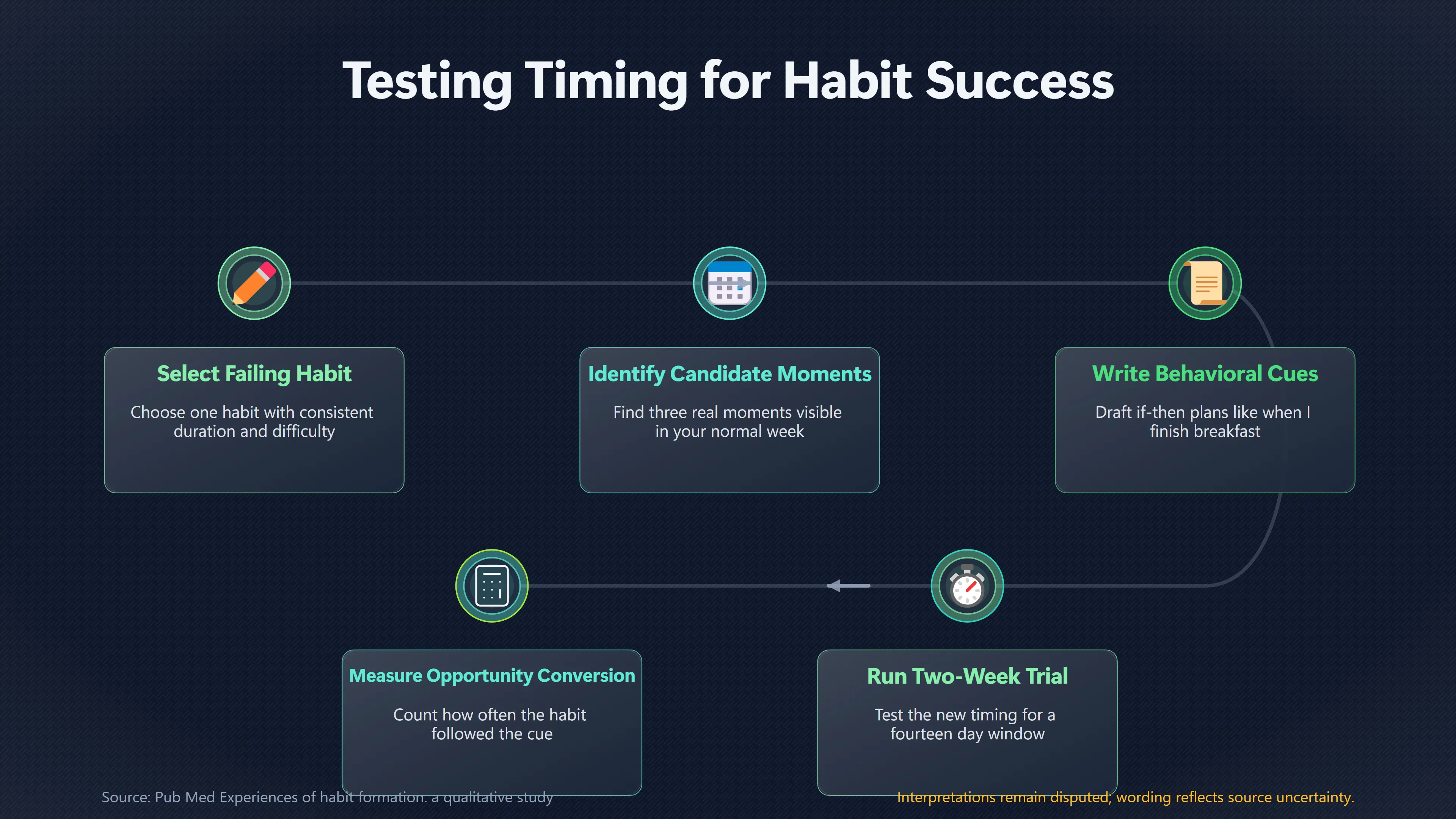
Test a better time without changing the habit
When timing is the suspected failure point, changing the time and shrinking the task and changing the cue and adding rewards makes the experiment difficult to interpret. Keep the behaviour substantially unchanged and move only its place in the day.
Implementation-intention research supports making that alternative explicit. These plans specify the situation in which an action will occur — essentially an “if this situation occurs, then I do this” connection. A 2024 meta-analysis covering 642 independent tests found beneficial effects across behavioural and other outcomes, with stronger effects for plans using a contingent if–then structure.[DOI]doi.orgOpen source on doi.org.
For timing troubleshooting, use that principle as a small experiment:
- Choose one repeatedly failing habit. Keep its duration and difficulty approximately the same.
- Identify two or three real candidate moments. Prefer moments already visible in your normal week, not imaginary gaps in an ideal diary.
- Choose the candidate with the best combination of reliability and capacity. “After breakfast” may beat “before work” if breakfast actually happens consistently; an evening slot may beat an early morning one if waking earlier repeatedly fails.
- Write the cue behaviourally. “When I finish breakfast, I will do my 15 minutes of practice” is more testable than “practise in the morning”.
- Run the new timing for roughly one to two weeks before making another design change. This is a troubleshooting window, not a claim that a habit should become automatic within that period.
- Compare enactment, not enthusiasm. Count how often the cue occurred and how often you then started the behaviour.
The key measure is opportunity conversion: when the chosen moment genuinely occurred, how often did the habit follow? A new slot that converts eight out of ten opportunities is more promising than one that converts three out of ten, even if the latter sounds more disciplined.
Do not over-interpret an occasional miss. Habit development is gradual, and studies report considerable person-to-person variation in how quickly automaticity develops. In the 84-day nutrition trial, repeated enactment was central to habit formation; in the context-stability research, stable circumstances were associated with stronger automaticity and goal attainment.[BPS PsycHub]bpspsychub.onlinelibrary.wiley.comOpen source on wiley.com. The point of a timing experiment is therefore to create conditions in which repetition becomes realistically available.
The best time is the time that survives your week
There is no evidence-based universal “perfect hour” for self-improvement habits. Morning routines can be effective, but so can evening routines; clock cues can work, but so can routine-event cues. Even evidence favouring consistency has to be balanced against the costs of excessive rigidity.[PubMed]pubmed.ncbi.nlm.nih.govEvaluating the impact of individuals' morningness-eveningness on the effectiveness of a habit-formation intervention for a simple a…
A more useful hierarchy is practical. First ask whether the moment actually occurs reliably. Then ask whether you normally have enough time, attention and control over that period to perform the behaviour. Next ask whether an existing event can serve as a recognisable cue. Finally, give the routine a fallback if the primary window is predictably vulnerable to disruption.
That turns “bad timing” from a vague excuse into a testable system fault. If the unchanged habit suddenly becomes much more repeatable after being moved from a chaotic evening slot to a dependable post-breakfast event, the experiment has identified something important: the earlier routine was asking willpower to compensate for a schedule that repeatedly removed the opportunity to act.
For self-improvement that lasts, consistency should serve real life rather than compete with it. A useful habit schedule is not the one that looks most impressive on paper. It is the one that keeps presenting a workable cue, on ordinary days, often enough for the behaviour to be repeated.
Amazon book picks
Further Reading
Books and field guides related to Is Your Habit Scheduled at the Wrong Time?. Use these as the next step if you want deeper reading beyond the article.
Atomic Habits
Rating: 3.5/5 from 7 Google Books ratings
The #1 New York Times bestseller. Over 25 million copies sold! Translated into 60+ languages! Tiny Changes, Remarkable Results No matter...
Tiny Habits
Improving your life is much easier than you think. Whether it’s losing weight, sleeping more, or restoring your work/life balance – the s...
The Power of Habit
Rating: 4.0/5 from 145 Google Books ratings
Duhigg takes us to the edge of scientific discoveries that explain why habits exist and how they can be changed. Distilling information i...
Good Habits, Bad Habits
'The world's leading expert on habits' - Matthew Syed, bestselling author of Black Box Thinking and Rebel IdeasWhat if you could harness...
eBay marketplace picks
Marketplace Samples
Live-tested eBay searches with available results related to this page.
Selected fromself improvement wall art oneBay.co.uk.

Current eBay listing
Self Improvement Quote Framed Wall Art Poster Canvas Print Picture

Current eBay listing
Self improvement Framed Wall Art Poster Canvas Print Picture
Endnotes
1.
Source: doi.org
Link:https://doi.org/10.1080/10463283.2024.2334563
2.
Source: doi.org
Link:https://doi.org/10.1007/s10865-022-00370-x
3.
Source: doi.org
Link:https://doi.org/10.1111/bjhp.12504
4.
Source: pmc.ncbi.nlm.nih.gov
Link:https://pmc.ncbi.nlm.nih.gov/articles/PMC9226889/
Source snippet
PubMed Central (PMC)Context Stability in Habit Building Increases Automaticity and Goal Attainment - PMCJune 10, 2022...
Published: June 10, 2022
5.
Source: pubmed.ncbi.nlm.nih.gov
Link:https://pubmed.ncbi.nlm.nih.gov/33405284/
Source snippet
Habit formation following routine-based versus time-based cue planning: A randomized controlled trial - PubMed...
6.
Source: pubmed.ncbi.nlm.nih.gov
Link:https://pubmed.ncbi.nlm.nih.gov/35756236/
Source snippet
Context Stability in Habit Building Increases Automaticity and Goal Attainment - PubMed...
7.
Source: pubmed.ncbi.nlm.nih.gov
Link:https://pubmed.ncbi.nlm.nih.gov/39014034/
Source snippet
Evaluating the impact of individuals' morningness-eveningness on the effectiveness of a habit-formation intervention for a simple a...
8.
Source: discovery.ucl.ac.uk
Link:https://discovery.ucl.ac.uk/id/eprint/10118622/
Source snippet
UCL DiscoveryHabit formation following routine-based versus time-based cue planning: A randomized controlled trial - UCL Discovery...
9.
Source: pmc.ncbi.nlm.nih.gov
Link:https://pmc.ncbi.nlm.nih.gov/articles/PMC8734590/
Source snippet
PubMed Central (PMC)Creating Exercise Habits Using Incentives: The Tradeoff between Flexibility and Routinization - PMCJuly 1, 2021...
Published: July 1, 2021
10.
Source: pubmed.ncbi.nlm.nih.gov
Link:https://pubmed.ncbi.nlm.nih.gov/35001975/
Source snippet
Creating Exercise Habits Using Incentives: The Tradeoff between Flexibility and Routinization - PubMed...
11.
Source: pubmed.ncbi.nlm.nih.gov
Title: Pub Med Experiences of habit formation: a qualitative study
Link:https://pubmed.ncbi.nlm.nih.gov/21749245/
Source snippet
Experiences of habit formation: a qualitative study - PubMedAugust 1, 2011...
Published: August 1, 2011
12.
Source: pubmed.ncbi.nlm.nih.gov
Title: Pub Med Changing circumstances, disrupting habits
Link:https://pubmed.ncbi.nlm.nih.gov/15982113/
Source snippet
Changing circumstances, disrupting habits - PubMed...
13.
Source: bpspsychub.onlinelibrary.wiley.com
Link:https://bpspsychub.onlinelibrary.wiley.com/share/SFKV2IDZIZUZFJF4X9N2?target=10.1111%2Fbjhp.12504
14.
Source: pubmed.ncbi.nlm.nih.gov
Link:https://pubmed.ncbi.nlm.nih.gov/42184900/
15.
Source: pubmed.ncbi.nlm.nih.gov
Link:https://pubmed.ncbi.nlm.nih.gov/42053513/
16.
Source: pmc.ncbi.nlm.nih.gov
Link:https://pmc.ncbi.nlm.nih.gov/articles/PMC13059544/
17.
Source: pubmed.ncbi.nlm.nih.gov
Link:https://pubmed.ncbi.nlm.nih.gov/41343394/
18.
Source: pubmed.ncbi.nlm.nih.gov
Link:https://pubmed.ncbi.nlm.nih.gov/41607684/
19.
Source: pubmed.ncbi.nlm.nih.gov
Link:https://pubmed.ncbi.nlm.nih.gov/41231202/
20.
Source: pmc.ncbi.nlm.nih.gov
Link:https://pmc.ncbi.nlm.nih.gov/articles/PMC11641623/
21.
Source: pmc.ncbi.nlm.nih.gov
Link:https://pmc.ncbi.nlm.nih.gov/articles/PMC11574773/
22.
Source: pmc.ncbi.nlm.nih.gov
Link:https://pmc.ncbi.nlm.nih.gov/articles/PMC11635918/
23.
Source: pmc.ncbi.nlm.nih.gov
Link:https://pmc.ncbi.nlm.nih.gov/articles/PMC11297519/
24.
Source: pmc.ncbi.nlm.nih.gov
Link:https://pmc.ncbi.nlm.nih.gov/articles/PMC11161714/
25.
Source: pubmed.ncbi.nlm.nih.gov
Link:https://pubmed.ncbi.nlm.nih.gov/38047612/
26.
Source: pubmed.ncbi.nlm.nih.gov
Link:https://pubmed.ncbi.nlm.nih.gov/38107165/
27.
Source: pmc.ncbi.nlm.nih.gov
Link:https://pmc.ncbi.nlm.nih.gov/articles/PMC10722958/
28.
Source: pubmed.ncbi.nlm.nih.gov
Link:https://pubmed.ncbi.nlm.nih.gov/36539157/
29.
Source: pubmed.ncbi.nlm.nih.gov
Link:https://pubmed.ncbi.nlm.nih.gov/36859292/
30.
Source: pmc.ncbi.nlm.nih.gov
Link:https://pmc.ncbi.nlm.nih.gov/articles/PMC9976678/
31.
Source: pubmed.ncbi.nlm.nih.gov
Link:https://pubmed.ncbi.nlm.nih.gov/36502286/
32.
Source: pubmed.ncbi.nlm.nih.gov
Link:https://pubmed.ncbi.nlm.nih.gov/36326985/
33.
Source: pmc.ncbi.nlm.nih.gov
Link:https://pmc.ncbi.nlm.nih.gov/articles/PMC10261239/
34.
Source: pmc.ncbi.nlm.nih.gov
Link:https://pmc.ncbi.nlm.nih.gov/articles/PMC9440859/
35.
Source: pmc.ncbi.nlm.nih.gov
Link:https://pmc.ncbi.nlm.nih.gov/articles/PMC9792630/
36.
Source: pmc.ncbi.nlm.nih.gov
Link:https://pmc.ncbi.nlm.nih.gov/articles/PMC12318445/
37.
Source: pubmed.ncbi.nlm.nih.gov
Link:https://pubmed.ncbi.nlm.nih.gov/35215466/
38.
Source: pubmed.ncbi.nlm.nih.gov
Link:https://pubmed.ncbi.nlm.nih.gov/34391207/
39.
Source: pubmed.ncbi.nlm.nih.gov
Link:https://pubmed.ncbi.nlm.nih.gov/34243167/
40.
Source: pubmed.ncbi.nlm.nih.gov
Link:https://pubmed.ncbi.nlm.nih.gov/34009435/
41.
Source: pmc.ncbi.nlm.nih.gov
Link:https://pmc.ncbi.nlm.nih.gov/articles/PMC8149892/
42.
Source: pubmed.ncbi.nlm.nih.gov
Link:https://pubmed.ncbi.nlm.nih.gov/32542355/
43.
Source: onlinelibrary.wiley.com
Link:https://onlinelibrary.wiley.com/doi/full/10.1002/job.2514
44.
Source: onlinelibrary.wiley.com
Link:https://onlinelibrary.wiley.com/doi/full/10.1111/cdoe.12624
45.
Source: bpspsychub.onlinelibrary.wiley.com
Link:https://bpspsychub.onlinelibrary.wiley.com/doi/abs/10.1111/bjhp.12504
46.
Source: pmc.ncbi.nlm.nih.gov
Link:https://pmc.ncbi.nlm.nih.gov/articles/PMC7492403/
47.
Source: pmc.ncbi.nlm.nih.gov
Link:https://pmc.ncbi.nlm.nih.gov/articles/PMC7429724/
48.
Source: pmc.ncbi.nlm.nih.gov
Link:https://pmc.ncbi.nlm.nih.gov/articles/PMC7980763/
49.
Source: pmc.ncbi.nlm.nih.gov
Link:https://pmc.ncbi.nlm.nih.gov/articles/PMC7106637/
50.
Source: pubmed.ncbi.nlm.nih.gov
Link:https://pubmed.ncbi.nlm.nih.gov/31396122/
51.
Source: pubmed.ncbi.nlm.nih.gov
Link:https://pubmed.ncbi.nlm.nih.gov/31267674/
52.
Source: pmc.ncbi.nlm.nih.gov
Link:https://pmc.ncbi.nlm.nih.gov/articles/PMC6348200/
53.
Source: pmc.ncbi.nlm.nih.gov
Link:https://pmc.ncbi.nlm.nih.gov/articles/PMC6378489/
54.
Source: pubmed.ncbi.nlm.nih.gov
Link:https://pubmed.ncbi.nlm.nih.gov/28650196/
55.
Source: pubmed.ncbi.nlm.nih.gov
Link:https://pubmed.ncbi.nlm.nih.gov/28734026/
56.
Source: pubmed.ncbi.nlm.nih.gov
Link:https://pubmed.ncbi.nlm.nih.gov/28244173/
57.
Source: pmc.ncbi.nlm.nih.gov
Link:https://pmc.ncbi.nlm.nih.gov/articles/PMC4847906/
58.
Source: pubmed.ncbi.nlm.nih.gov
Link:https://pubmed.ncbi.nlm.nih.gov/27120333/
59.
Source: bpspsychub.onlinelibrary.wiley.com
Link:https://bpspsychub.onlinelibrary.wiley.com/doi/10.1111/bjc.12086
60.
Source: pmc.ncbi.nlm.nih.gov
Link:https://pmc.ncbi.nlm.nih.gov/articles/PMC4216661/
61.
Source: pmc.ncbi.nlm.nih.gov
Link:https://pmc.ncbi.nlm.nih.gov/articles/PMC3505409/
62.
Source: pmc.ncbi.nlm.nih.gov
Link:https://pmc.ncbi.nlm.nih.gov/articles/PMC4407997/
63.
Source: onlinelibrary.wiley.com
Link:https://onlinelibrary.wiley.com/doi/10.1002/ejsp.674
64.
Source: pmc.ncbi.nlm.nih.gov
Link:https://pmc.ncbi.nlm.nih.gov/articles/PMC7872013/
65.
Source: psychology.iresearchnet.com
Link:https://psychology.iresearchnet.com/social-psychology/control/habits/
Additional References
66.
Source: youtube.com
Title: How to Stick to Habits and Routines Without Falling Off!
Link:https://www.youtube.com/watch?v=nhtQs2M-7rs
Source snippet
How to build habits that stick when life gets busy How to Stick to Habits and Routines Without Falling Off...
67.
Source: youtube.com
Title: How to Build Habits That Actually Last: A Neuroscience Approach
Link:https://www.youtube.com/watch?v=ObA4ne4TVsE
Source snippet
The Science of Good and Bad Habits with Dr. Wendy Wood...
68.
Source: youtube.com
Title: The Science of Good and Bad Habits with Dr. Wendy Wood
Link:https://www.youtube.com/watch?v=h71_r9ocI3A
Source snippet
How to Stick to Habits and Routines Without Falling Off...
69.
Source: researchgate.net
Link:https://www.researchgate.net/publication/37367696_Implementation_Intentions_and_Goal_Achievement_A_Meta-Analysis_of_Effects_and_Processes
70.
Source: researchgate.net
Link:https://www.researchgate.net/publication/378870694_The_When_and_How_of_Planning_Meta-Analysis_of_the_Scope_and_Components_of_Implementation_Intentions_in_642_Tests
71.
Source: sciencedirect.com
Link:https://www.sciencedirect.com/science/article/pii/S1574119213000989
72.
Source: sciencedirect.com
Link:https://www.sciencedirect.com/science/article/pii/S0272494407000898
73.
Source: kevinmichel.com
Link:https://www.kevinmichel.com/books/subconscious-advantage/chapters/05-cue-based-routines-that-stick/
74.
Source: behavioralpolicy.org
Link:https://behavioralpolicy.org/donate/
75.
Source: behavioralpolicy.org
Link:https://behavioralpolicy.org/block/event-block/