Within Work Prep
When Tomorrow's Morning Refuses to Follow the Plan
A restart plan tied to the first usable work block can remain actionable when meetings and interruptions make fixed schedules unreliable.
On this page
- Why rigid restart plans can fail
- Planning around usable work windows instead of perfect schedules
- Preparing a first task that can survive interruptions
Page outline Jump by section
Introduction
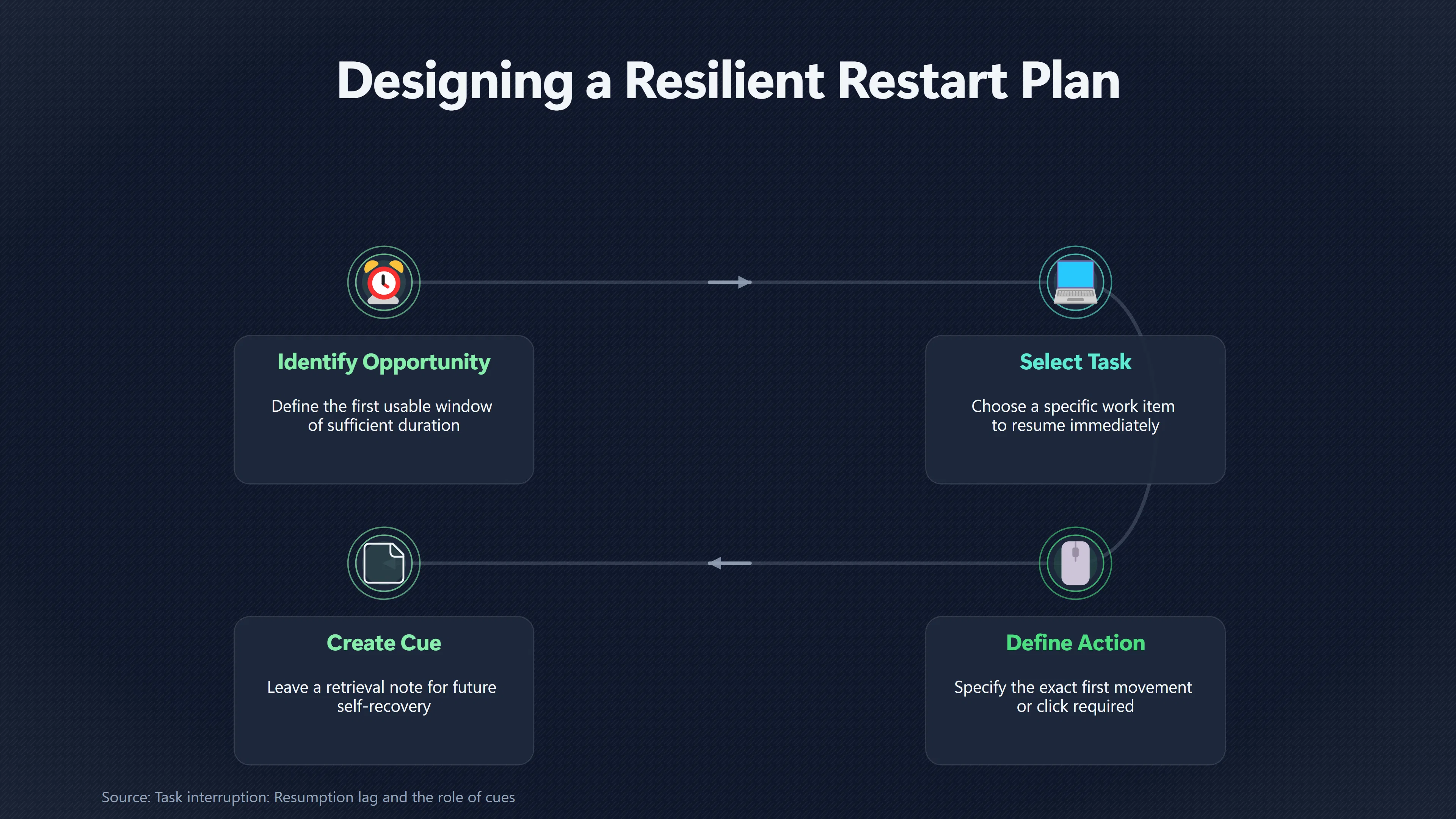
For workers whose mornings are routinely broken up by meetings, messages, handovers or urgent requests, a restart plan should not depend on starting at an ideal time. “At 09:00 I will work on the proposal” is brittle: once 09:00 disappears, the plan has lost its cue. A more resilient version attaches a concrete next action to the first usable work block: “When I get my first uninterrupted 20-minute window, I will open the proposal at the pricing section and resolve the three comments already marked there.”
That distinction is supported by two relevant research strands. Studies of daily work planning find that ordinary time-management plans become less useful as interruptions increase, whereas contingent planning—anticipating disruption and deciding how to respond—holds up better. Research on interrupted tasks also shows that preserving cues about where and how to resume can reduce the cognitive work of reconstructing a task afterwards.[nih.gov]pubmed.ncbi.nlm.nih.govWhen daily planning improves employee performance: The importance of planning type, engagement, and interruptions - PubMedNovember…
The practical aim, therefore, is not to protect a perfect morning. It is to make the important work easy to restart when the morning inevitably changes.
Why rigid restart plans can fail
A fixed-time plan can look admirably specific while containing a hidden weakness: its usefulness depends on the predicted schedule surviving contact with the real workday. That matters particularly in jobs where colleagues, customers, managers, patients or operational problems can claim the first hour without much warning.
A two-week experience-sampling study of employees makes this distinction unusually relevant. Researchers separated daily planning into time-management planning—prioritising tasks and deciding when and how to perform them—and contingent planning, in which workers anticipate possible interruptions and prepare responses. Time-management planning was associated with better engagement and performance, but its benefits weakened on days containing more interruptions. The benefits associated with contingent planning were not similarly dependent on low interruption levels.[PubMed]pubmed.ncbi.nlm.nih.govWhen daily planning improves employee performance: The importance of planning type, engagement, and interruptions - PubMedNovember…
That does not mean calendars or time blocking are useless. It means they solve a different problem. A schedule answers, “When should I work on this?” A restart plan for an interruption-heavy morning must also answer, “What happens if that time disappears?”
This exposes the weakness in plans such as:
- Brittle: “Start the analysis at 09:00.”
- Better: “Use the first 30-minute gap after the morning meetings to check the three anomalous rows already flagged in the analysis.”
- Brittle: “Write for an hour before email.”
- Better: “At the first usable writing window, open the draft at ‘Customer impact’ and turn the four notes underneath it into a paragraph.”
- Brittle: “Finish the forecast first thing.”
- Better: “When I next have a quiet block, reopen the forecast at the assumptions sheet and verify staffing costs before changing anything else.”
The change is small but important. The second kind of plan still specifies a cue and an action, but the cue is an event or opportunity that can recur, rather than a single clock time that can be missed.
This is consistent with the broader evidence on implementation intentions: plans linking a recognisable situation to a specified response can improve goal enactment. A 2006 meta-analysis covering 94 independent tests found a medium-to-large overall effect on goal attainment, while a much larger review published in 2024, covering 642 independent tests, found beneficial effects across cognitive, emotional and behavioural outcomes and reported stronger effects when plans actually used a contingent if–then structure.[ScienceDirect]sciencedirect.comImplementation Intentions and Goal Achievement: A Meta‐analysis of Effects and Processes - ScienceDirect…
There is an important limit to that evidence. Implementation intentions are not proof that any detailed schedule will work. Indeed, a field experiment involving 877 gym users found no benefit from simply asking people to specify the days and times they intended to exercise repeatedly over the following fortnight. Specificity alone is therefore not magic. The useful lesson for disrupted mornings is narrower: specify an actionable response to a cue that is realistically likely to occur, rather than making success depend on one predicted moment.[ScienceDirect]sciencedirect.comThe limits of simple implementation intentions: Evidence from a field experiment on making plans to exercise - ScienceDirect…
Plan around the first usable work window
A “usable work window” is not necessarily the first empty space on the calendar. It is the first period long and suitable enough for the prepared next action. That definition makes the restart plan responsive to the day rather than tied to an imaginary version of it.
Suppose tomorrow begins with a 09:00 team meeting. You intend to work on a difficult report at 09:30, but the meeting runs over, somebody asks for help immediately afterwards, and at 10:15 another call appears. Under a rigid plan, the planned start has already failed. The worker must now decide whether to squeeze in the report, postpone it, choose something easier or redesign the morning.
A flexible restart plan removes part of that replanning:
“At my first quiet block of at least 25 minutes, I will open the findings draft, read the final paragraph for context, and write the explanation of the retention drop using the chart already prepared.”
The important feature is not the wording. It is that three decisions have been made in advance: what opportunity qualifies, which task resumes, and what action starts it.
This approach also avoids an easy mistake: making the cue too vague. “When I get time, work on the report” leaves almost everything unresolved. Does a ten-minute gap count? What part of the report? Is there enough time to begin? What must be opened first? A useful restart plan reduces those questions rather than merely recording an aspiration.
The recent implementation-intention review is helpful here because it distinguishes different kinds of cues, including time-and-place cues and task-juncture cues. That supports a broader conception of planning than simply assigning actions to clock times.[DOI]doi.orgThe when and how of planning: Meta-analysis of the scope and components of implementation intentions in 642 tests: European Review of… For interruption-heavy work, practical cues can therefore be transitions such as “when the client call ends”, “after the urgent request is handed off” or “when the first 30-minute gap appears”.
There is also a reason not to over-engineer the system. If tomorrow’s plan contains a complicated tree of contingencies—“if the 09:00 meeting moves, do A, unless B arrives, in which case do C…”—the plan itself becomes another object to interpret. The objective is to reduce decisions at restart, not construct a miniature scheduling algorithm. Usually one primary rule and, where genuinely necessary, one fallback are enough.
Prepare a first task that survives interruption
Choosing the right work window solves only half the problem. The task itself must also be restartable.
Interruption research uses the term resumption lag for the delay between finishing an interruption and successfully getting back into the original task. Laboratory research by J. Gregory Trafton and colleagues found that people who received an eight-second warning before being interrupted prepared more and subsequently resumed the primary task faster than people interrupted immediately. Related experiments found that cues associated with the interrupted task could reduce the delay in getting back to work.[ScienceDirect]sciencedirect.comPreparing to resume an interrupted task: effects of prospective goal encoding and retrospective rehearsal - ScienceDirect…
The underlying problem is partly one of memory. Once attention has moved elsewhere, the worker must recover not merely the broad goal—“I was working on the forecast”—but the active state of the task: which assumption was being checked, what had already been ruled out, which document mattered and what was supposed to happen next. Research treating interruptions as prospective-memory tasks found that abrupt diversion can interfere with encoding the intention to return, while competing demands after the interruption can make the intended resumption harder to retrieve.[Wiley Online Library]onlinelibrary.wiley.comOnline Library Interruptions create prospective memory tasksOnline Library Interruptions create prospective memory tasks
Real-world evidence points in the same direction. In an intensive-care study using mobile eye tracking, longer interruptions and interruptions involving a change of physical location predicted longer resumption times. Researchers also observed behavioural strategies that substantially reduced or removed the prospective-memory burden of returning to interrupted work. The setting is obviously more consequential than ordinary office work, but it demonstrates that resumption is not merely a matter of personal discipline: the structure of the interruption and the cues available afterwards matter.[PubMed]pubmed.ncbi.nlm.nih.govOpen source on nih.gov.
For tomorrow-morning preparation, this suggests a simple design test: could the first task still tell you what to do if you were pulled away five minutes after starting it?
A task such as “work on presentation” performs badly on that test. “Draft the three bullets explaining why conversion fell, using the figures in rows 18–22” performs much better. If interrupted, the worker has a concrete target to recover.
Software development provides an especially clear example because programmers often need to reconstruct substantial mental context. In a study of 371 developers, researchers found heavy reliance on note-taking to support suspended work. In a subsequent controlled experiment, automated contextual cues improved successful task completion compared with note-taking alone; developers particularly preferred chronological cues showing relevant code snippets.[Microsoft]microsoft.comEvaluating Cues for Resuming Interrupted Programming TasksEvaluating Cues for Resuming Interrupted Programming Tasks The broader lesson is not that everyone needs specialised resumption software. It is that a useful restart cue preserves task state, not merely the task’s name.
For ordinary knowledge work, that might mean leaving tomorrow with “Next: reconcile the £14,200 discrepancy between tabs B and D”, rather than “budget”; “Next: answer reviewer comment 6 using the sensitivity analysis”, rather than “paper”; or “Next: decide between options B and C using implementation cost”, rather than “project plan”.
Make interruptions part of the restart plan
There is a second opportunity to protect the work: prepare for interruption after work has already begun.
Research on “ready-to-resume” plans found that briefly considering where and how to return to an interrupted task could reduce the attention left behind on that task and improve performance on the interrupting activity. The finding matters because worrying about getting back to unfinished work can itself make the interruption harder to handle.[PubsOnline]pubsonline.informs.orgOpen source on informs.org.
That suggests a compact rule for mornings where interruptions are expected:
If I have warning that I am about to be interrupted, I will leave one line saying exactly what comes next.
It might take only a few seconds: “Next: test whether removing the outlier changes the result.” The note is not a diary entry or progress report. It is a retrieval cue designed for the person who returns.
Where an interruption is completely abrupt, there may be no opportunity to leave that cue. That is another reason the initial preparation should be strong enough to survive on its own. The document can already be open at the relevant place; the required source can already be attached; the unfinished calculation can already carry a short annotation. Preparation made the previous day becomes insurance against an interruption that offers no warning.
There is also no need to treat every interruption as a productivity failure. Some interruptions are the work: a customer problem, clinical need, operational incident or colleague who genuinely requires an immediate decision. The goal of a restart plan is not to prevent those events. It is to prevent each legitimate interruption from forcing a complete reconstruction of the original task afterwards.

A restart plan should survive a bad morning
The strongest test of tomorrow’s preparation is not whether it works when everything goes to schedule. It is whether the plan remains meaningful after the schedule has been damaged.
Before finishing work, prepare one important task so that tomorrow’s version of you can answer four questions without replanning the morning: What am I returning to? What opportunity will trigger the return? What exactly do I do first? What cue will help me recover if I am interrupted again?
For example:
Priority: finish the client-risk section. Restart cue: first quiet block of at least 25 minutes after mandatory morning work. First action: open the draft at “Operational risk” and turn the three marked findings into the opening paragraph. If interrupted: leave a one-line “Next:” note at the cursor before switching away, when possible.
This is more robust than trying to predict a flawless 09:00 start. It preserves the useful part of advance planning—the pre-decided next action—while giving up unnecessary dependence on a fixed schedule.
That trade-off is particularly appropriate for interruption-heavy mornings. Daily-planning research indicates that conventional time-management planning is more vulnerable when interruptions multiply, while contingent planning is designed for precisely that variability. Interruption research adds the complementary lesson that task-state cues and brief resumption preparation can make returning easier.[nih.gov]pubmed.ncbi.nlm.nih.govWhen daily planning improves employee performance: The importance of planning type, engagement, and interruptions - PubMedNovember…
Work preparation that lowers tomorrow’s starting friction therefore need not mean controlling tomorrow morning. In unpredictable jobs, a better target is recoverability: leave an important task in a state that still has an obvious next move whenever the first genuinely usable work window finally arrives.
Amazon book picks
Further Reading
Books and field guides related to When Tomorrow's Morning Refuses to Follow the Plan. Use these as the next step if you want deeper reading beyond the article.
Getting Things Done
The personal productivity guru (Fast Company) delivers powerful methods that vastly increase your efficiency and creative results-at work...
Atomic Habits
Rating: 3.5/5 from 7 Google Books ratings
The #1 New York Times bestseller. Over 25 million copies sold! Translated into 60+ languages! Tiny Changes, Remarkable Results No matter...
Make Time
'If you want to achieve more (without going nuts), read this book.' - Charles Duhigg, bestselling author of The Power of Habit and Smarte...
Tiny Habits
The world's leading expert on habit formation shows how you can have a happier, healthier life: by starting small. Myth: Change is hard....
eBay marketplace picks
Marketplace Samples
Live-tested eBay searches with available results related to this page.
Selected frommotivational poster oneBay.co.uk.




Endnotes
1.
Source: sciencedirect.com
Link:https://www.sciencedirect.com/science/article/pii/S1071581903000235
Source snippet
Preparing to resume an interrupted task: effects of prospective goal encoding and retrospective rehearsal - ScienceDirect...
2.
Source: sciencedirect.com
Link:https://www.sciencedirect.com/science/article/abs/pii/S0065260106380021
Source snippet
Implementation Intentions and Goal Achievement: A Meta‐analysis of Effects and Processes - ScienceDirect...
3.
Source: doi.org
Link:https://doi.org/10.1080/10463283.2024.2334563
Source snippet
The when and how of planning: Meta-analysis of the scope and components of implementation intentions in 642 tests: European Review of...
4.
Source: sciencedirect.com
Link:https://www.sciencedirect.com/science/article/pii/S0167629618301991
Source snippet
The limits of simple implementation intentions: Evidence from a field experiment on making plans to exercise - ScienceDirect...
5.
Source: interruptions.net
Title: Task interruption: Resumption lag and the role of cues
Link:https://interruptions.net/literature/Altmann-CogSci04.pdf
6.
Source: onlinelibrary.wiley.com
Title: Online Library Interruptions create prospective memory tasks
Link:https://onlinelibrary.wiley.com/doi/abs/10.1002/acp.1441
7.
Source: microsoft.com
Title: Evaluating Cues for Resuming Interrupted Programming Tasks
Link:https://www.microsoft.com/en-us/research/publication/evaluating-cues-for-resuming-interrupted-programming-tasks/
8.
Source: onlinelibrary.wiley.com
Link:https://onlinelibrary.wiley.com/doi/full/10.1002/job.2833
9.
Source: blog.workday.com
Title: creating business resilience what if analysis planning
Link:https://blog.workday.com/en-gb/creating-business-resilience-what-if-analysis-planning.html
10.
Source: bpspsychub.onlinelibrary.wiley.com
Link:https://bpspsychub.onlinelibrary.wiley.com/doi/10.1111/joop.12430
11.
Source: blog.workday.com
Title: how continuous planning enables business agility
Link:https://blog.workday.com/en-us/how-continuous-planning-enables-business-agility.html
12.
Source: sciencedirect.com
Link:https://www.sciencedirect.com/science/article/pii/S0033298421000340
13.
Source: sciencedirect.com
Link:https://www.sciencedirect.com/science/article/pii/S0001691816303626
14.
Source: onlinelibrary.wiley.com
Link:https://onlinelibrary.wiley.com/doi/full/10.1002/acp.2960
15.
Source: onlinelibrary.wiley.com
Link:https://onlinelibrary.wiley.com/doi/abs/10.1002/acp.1002
16.
Source: sciencedirect.com
Link:https://www.sciencedirect.com/science/article/abs/pii/S1071581903000235
17.
Source: sciencedirect.com
Link:https://www.sciencedirect.com/science/article/pii/S002210311000003X
18.
Source: sciencedirect.com
Title: More than planned: Implementation intention effects in non-planned situations
Link:https://www.sciencedirect.com/science/article/pii/S0001691816304048
19.
Source: sciencedirect.com
Link:https://www.sciencedirect.com/science/article/pii/S0268401213000145
20.
Source: sciencedirect.com
Link:https://www.sciencedirect.com/science/chapter/bookseries/abs/pii/S0065260106380021
21.
Source: sciencedirect.com
Link:https://www.sciencedirect.com/science/article/abs/pii/S002210310600028X
22.
Source: sciencedirect.com
Link:https://www.sciencedirect.com/science/article/pii/S0277953620307097
23.
Source: microsoft.com
Title: Evaluating Cues for Resuming Interrupted Programming Tasks
Link:https://www.microsoft.com/en-us/research/publication/evaluating-cues-for-resuming-interrupted-programming-tasks/?locale=ja
24.
Source: workday.com
Link:https://www.workday.com/en-gb/topics/hr/workforce-planning.html
25.
Source: workday.com
Link:https://www.workday.com/en-us/customer-stories/i-p/public-trust-planning-agility-strengthens-decision-confidence.html
26.
Source: blog.workday.com
Title: continuous planning catapults finance forward
Link:https://blog.workday.com/en-gb/continuous-planning-catapults-finance-forward.html
27.
Source: doc.workday.com
Link:https://doc.workday.com/admin-guide/en-us/manage-workday/tenant-configuration/it-administrator-resources/performance-best-practices-for-large-scale-events/zqd1532473424679.html
28.
Source: workday.com
Link:https://www.workday.com/en-gb/topics/fpa/what-is-scenario-planning.html
29.
Source: doc.workday.com
Title: reference optimization engine performance best pr
Link:https://doc.workday.com/admin-guide/en-us/human-capital-management/workday-scheduling/schedule-generation-settings/labor-optimization-configuration/reference–optimization-engine-performance-best-pr.html?toc=10.2.6.8
30.
Source: pubmed.ncbi.nlm.nih.gov
Link:https://pubmed.ncbi.nlm.nih.gov/29154579/
Source snippet
When daily planning improves employee performance: The importance of planning type, engagement, and interruptions - PubMedNovember...
31.
Source: lbsresearch.london.edu
Link:https://lbsresearch.london.edu/id/eprint/894/1/Parke%20et%20al.%20%28JAP%29.pdf
32.
Source: pubmed.ncbi.nlm.nih.gov
Link:https://pubmed.ncbi.nlm.nih.gov/21198250/
33.
Source: pubsonline.informs.org
Link:https://pubsonline.informs.org/doi/pdf/10.1287/orsc.2017.1184
34.
Source: pmc.ncbi.nlm.nih.gov
Link:https://pmc.ncbi.nlm.nih.gov/articles/PMC12271330/
35.
Source: pmc.ncbi.nlm.nih.gov
Link:https://pmc.ncbi.nlm.nih.gov/articles/PMC10952538/
36.
Source: pubsonline.informs.org
Link:https://pubsonline.informs.org/doi/pdf/10.1287/msom.2021.1053
37.
Source: pubmed.ncbi.nlm.nih.gov
Link:https://pubmed.ncbi.nlm.nih.gov/30336306/
38.
Source: pubsonline.informs.org
Link:https://pubsonline.informs.org/doi/abs/10.1287/orsc.2017.1184?journalCode=orsc
39.
Source: pubmed.ncbi.nlm.nih.gov
Link:https://pubmed.ncbi.nlm.nih.gov/29144151/
40.
Source: pubmed.ncbi.nlm.nih.gov
Link:https://pubmed.ncbi.nlm.nih.gov/28552168/
41.
Source: pubmed.ncbi.nlm.nih.gov
Link:https://pubmed.ncbi.nlm.nih.gov/26892502/
42.
Source: pubmed.ncbi.nlm.nih.gov
Link:https://pubmed.ncbi.nlm.nih.gov/26882286/
43.
Source: pmc.ncbi.nlm.nih.gov
Link:https://pmc.ncbi.nlm.nih.gov/articles/PMC4500900/
44.
Source: pubmed.ncbi.nlm.nih.gov
Link:https://pubmed.ncbi.nlm.nih.gov/25965276/
45.
Source: pmc.ncbi.nlm.nih.gov
Link:https://pmc.ncbi.nlm.nih.gov/articles/PMC3240749/
46.
Source: pubmed.ncbi.nlm.nih.gov
Link:https://pubmed.ncbi.nlm.nih.gov/15574664/
47.
Source: pubmed.ncbi.nlm.nih.gov
Link:https://pubmed.ncbi.nlm.nih.gov/23795978/
48.
Source: pubmed.ncbi.nlm.nih.gov
Link:https://pubmed.ncbi.nlm.nih.gov/11708569/
49.
Source: pmc.ncbi.nlm.nih.gov
Link:https://pmc.ncbi.nlm.nih.gov/articles/PMC7872013/
50.
Source: cancercontrol.cancer.gov
Title: implementation intentions
Link:https://cancercontrol.cancer.gov/brp/research/constructs/implementation-intentions
Additional References
51.
Source: nature.com
Link:https://www.nature.com/articles/s41598-025-09358-4
52.
Source: youtube.com
Title: How Do You Time-block with a Job Requiring Deep Work and Reactive Parts?
Link:https://www.youtube.com/watch?v=gkrPQzfLC_4
Source snippet
5 Timely Tips for Managing Interruptions...
53.
Source: researchgate.net
Link:https://www.researchgate.net/publication/37367696_Implementation_Intentions_and_Goal_Achievement_A_Meta-Analysis_of_Effects_and_Processes
54.
Source: researchgate.net
Link:https://www.researchgate.net/publication/2876321_Interruptions_In_The_Tower_Of_London_Task_Can_Preparation_Minimise_Disruption
55.
Source: visualize.jove.com
Link:https://visualize.jove.com/29154579-when-daily-planning-improves-employee-performance-the-importance-of-planning-type-engagement-and-interruptions
56.
Source: guilfordjournals.com
Link:https://guilfordjournals.com/doi/10.1521/soco.2007.25.2.248
57.
Source: experts.umn.edu
Link:https://experts.umn.edu/en/publications/tasks-interrupted-how-anticipating-time-pressure-on-resumption-of/
58.
Source: smartsheet.com
Link:https://www.smartsheet.com/free-time-management-templates
59.
Source: frontiersin.org
Link:https://www.frontiersin.org/journals/psychology/articles/10.3389/fpsyg.2019.00154/full
60.
Source: sweetplanit.com
Link:https://www.sweetplanit.com/home/how-to-plan-your-day-when-everything-keeps-interrupting-you