Within Immediate Rewards
When Habit Rewards Start Working Against You
Points, treats and financial incentives can help, but poor reward design may become costly, distracting or incompatible with the goal.
On this page
- When external rewards are useful
- Common ways rewards create competing costs
- How to keep incentives compatible with the goal
Page outline Jump by section
Introduction
External rewards can make a delayed-benefit habit easier to repeat, but they become counterproductive when the incentive starts competing with the reason for doing the habit. A reward can cost more than the behaviour is worth, make an already enjoyable activity feel like paid work, encourage people to optimise the rewarded metric rather than the real goal, or create a routine that collapses as soon as the payments, points or treats disappear.
That does not mean rewards are inherently harmful. Research finds that financial and tangible incentives can produce meaningful behaviour change, particularly when the target behaviour is initially unattractive or infrequent. The problem is reward design. A useful incentive adds an immediate benefit without cancelling the delayed one. A badly chosen incentive can make the numbers look better while leaving the underlying habit weaker — or even offsetting the benefit it was supposed to produce.[PubMed Central (PMC)]pmc.ncbi.nlm.nih.govPubMed Central (PMC)When Do Financial Incentives Reduce Intrinsic Motivation? Comparing Behaviors Studied in Psychological and Economic L…
When external rewards are useful
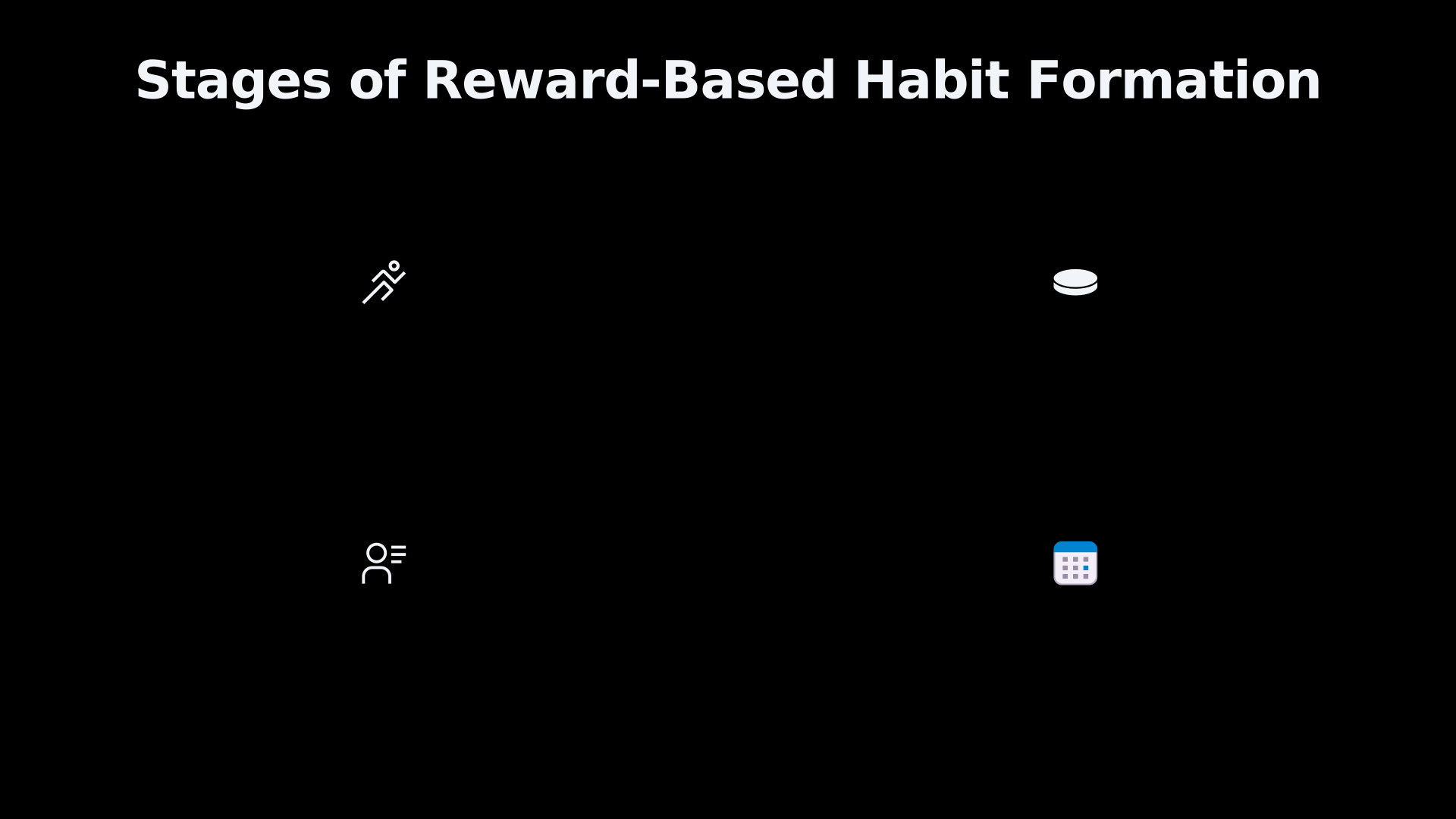
External incentives make most sense when the immediate experience of a worthwhile behaviour is not rewarding enough to compete with easier alternatives. In that situation, money, points, privileges or small treats can alter the short-term calculation: going for the walk, attending the gym or completing the study session now produces something desirable rather than merely promising a distant benefit.
There is good evidence that this can work. A systematic review and meta-analysis of personal financial incentives for habitual health behaviours found that incentives increased behaviour change, with effects detectable for some time after programmes began. Experimental exercise research likewise shows that incentives can increase activity while they are available. In one influential gym experiment, Gary Charness and Uri Gneezy found that paying previously irregular gym users to attend repeatedly increased attendance even after the intervention, suggesting that incentives can sometimes help people cross the difficult initiation stage into more regular behaviour.[PubMed Central (PMC)]pmc.ncbi.nlm.nih.govOpen source on nih.gov.
But persistence after incentives disappear is much less reliable. A workplace experiment by Heather Royer, Mark Stehr and Justin Sydnor found that a four-week financial incentive produced only small lasting increases in gym use by itself. Another experiment with new gym members found only small effects during six weeks of incentives and no effect on subsequent attendance trajectories. Across the wider literature, short-term behavioural gains are more dependable than evidence that temporary payments reliably create lasting habits.[AEA Publications]pubs.aeaweb.orgOpen source on aeaweb.org.
That distinction matters for self-improvement. A reward need not permanently transform motivation to be useful: getting someone through the difficult first month may itself have value. But if the plan assumes that thirty rewarded repetitions will automatically become an unrewarded habit, the evidence gives good reason for caution.
How rewards start creating competing costs
The central test is not simply whether a reward increases the target behaviour. It is whether the whole arrangement moves the person towards the underlying goal. Several common reward designs can fail that test.
The reward can become the reason for acting. The possibility that external rewards undermine intrinsic motivation has produced a long-running research dispute. A major meta-analysis by Edward Deci, Richard Koestner and Richard Ryan, covering 128 studies, concluded that expected tangible rewards could reduce subsequent free-choice engagement and reported interest under several conditions. Other meta-analyses have reached more qualified conclusions: Judy Cameron and colleagues argue that harmful effects are not pervasive and are concentrated particularly where an expected tangible reward is attached to an already interesting activity without being meaningfully tied to performance.[nih.gov]pubmed.ncbi.nlm.nih.govA meta-analytic review of experiments examining the effects of extrinsic rewards on intrinsic motivation - PubMed…
For practical habit design, the disagreement is more useful than a blanket rule that rewards either “destroy motivation” or “always work”. A review specifically examining financial incentives and health behaviour found strong evidence for undermining effects when tangible rewards were applied to simple tasks for which motivation was already high, but noted that many health behaviours begin from the opposite position: people are not doing enough of them in the first place.[PubMed]pubmed.ncbi.nlm.nih.govWhen do financial incentives reduce intrinsic motivation? comparing behaviors studied in psychological and economic literatures - P…
The risk is therefore greatest when an external reward is unnecessarily imposed on something a person already values for its own sake. Someone who has started to enjoy running may gain little from turning every run into a transaction worth £5. The payment can shift attention from “I run because I like being a runner” towards “Is this run worth £5?”, creating a motivational problem that did not previously exist.
The rewarded metric can displace the real objective. Incentives focus attention on whatever earns the reward, but measurable behaviour is often only a proxy for what matters. Ten thousand recorded steps are not synonymous with fitness; hours at a desk are not synonymous with learning; pages read are not synonymous with understanding.
Evidence from performance incentives outside personal habits demonstrates the mechanism clearly. In a natural field experiment involving factory workers, a bonus for measurable output increased attention to the incentivised quantity at the expense of non-incentivised quality.[National Bureau of Economic Research]nber.orgOpen source on nber.org. The personal-habit equivalent is easy to recognise: once points are awarded for a number, hitting the number can quietly replace pursuing the purpose behind it.
This is especially relevant to gamified habit systems. Points, badges, streaks and leaderboards can provide feedback and immediate reinforcement, but reviews of health gamification note that studies commonly combine several game elements, making it difficult to identify which component produces an effect or whether improvements persist. The existence of an engaging score should not be mistaken for evidence that the score accurately represents the desired outcome.[PubMed Central (PMC)]pmc.ncbi.nlm.nih.govOpen source on nih.gov.
The reward itself can offset the benefit. “I exercised, so I deserve this” is a particularly literal example. If every workout earns a large dessert or every productive week earns an expensive purchase, the incentive may impose a cost in the same domain in which the habit is supposed to help.
Experimental evidence shows that this is more than a hypothetical concern. In one study, people performed the same amount of exercise but were told that they had expended either 50 or 265 calories. Those given the higher estimate subsequently consumed more food, largely through greater cookie consumption — consistent with the exercise providing a perceived licence to eat.[PubMed]pubmed.ncbi.nlm.nih.govOpen source on nih.gov. A broader scoping review found that energy-dense post-exercise eating was particularly associated with experiencing exercise as less enjoyable, less autonomous or as hard work.[PubMed Central (PMC)]pmc.ncbi.nlm.nih.govOpen source on nih.gov.
Recent UK evidence illustrates the relevance outside the laboratory. A 2026 survey of 1,054 adults who exercised weekly found that 24% reported eating more in response to exercise, most often afterwards; stronger beliefs about food as an exercise reward were associated with this compensatory eating. Because the study was observational and relied on self-report, it does not show that rewards caused the eating, but it highlights a real route through which “treating yourself for exercising” can work against some health goals.[PubMed]pubmed.ncbi.nlm.nih.govOpen source on nih.gov.
The incentive can become an expensive dependency. A reward system that requires continually escalating spending is difficult to call a successful habit intervention. Financial incentives often work best while they are being offered. In a meta-analysis covering smoking, eating and physical-activity-related outcomes, benefits weakened over time and were not statistically sustained beyond three months after incentive removal overall. The authors therefore cautioned against assuming that incentives necessarily produce durable habits.[PubMed Central (PMC)]pmc.ncbi.nlm.nih.govOpen source on nih.gov.
This creates a useful distinction between a starter reward and a maintenance requirement. Paying yourself £2 for each of the first ten difficult study sessions may be a cheap experiment. Discovering six months later that studying feels pointless unless every session earns money means the external reinforcement has not solved the original motivational problem.

Better rewards reinforce the habit rather than compete with it
The safest design principle is compatibility: the immediate reward should make repetition more attractive while imposing as little conflict as possible with the habit’s underlying purpose.
One promising approach is to make the activity itself more enjoyable rather than attaching an unrelated prize afterwards. Katherine Milkman, Julia Minson and Kevin Volpp tested “temptation bundling”, in which participants combined exercise with access to tempting audiobooks. The important feature is structural: enjoyment occurs during the beneficial behaviour, so the immediate incentive and the delayed goal point in the same direction rather than cancelling each other out.[PubMed Central (PMC)]pmc.ncbi.nlm.nih.govOpen source on nih.gov. A later field experiment involving 6,792 participants found that providing audiobooks and encouraging temptation bundling increased weekly workouts during the programme, with effects observed during follow-up as well.[ScienceDirect]sciencedirect.comScienceDirect Teaching temptation bundling to boost exercise: A field experimentScienceDirect Teaching temptation bundling to boost exercise: A field experiment
External rewards can be screened with three practical questions:
- Would I still want the underlying outcome if the reward disappeared? If not, the system may be producing rented behaviour rather than supporting a personally valued goal.
- Does earning the reward require the behaviour I actually care about? Rewarding “two focused practice sessions” is harder to game than rewarding “two hours with the textbook open”.
- Does the reward preserve rather than offset the benefit? Entertainment during a walk is usually more compatible with a fitness goal than routinely using high-calorie food as payment for exercising; a relaxing evening after meeting a savings target is more compatible with saving than an expensive impulse purchase.
The size of the reward matters less than this alignment. Reviews of financial-incentive interventions find enormous variation in incentive magnitude and design, while also noting that the literature often provides surprisingly little rationale for why a particular reward structure was chosen. There is no well-supported universal formula saying that a certain cash amount, point value or prize schedule reliably produces durable habits.[PubMed Central (PMC)]pmc.ncbi.nlm.nih.govOpen source on nih.gov.
Aim for a habit that needs less bribery over time
An external reward has done its job when it helps bridge the period in which the delayed-benefit behaviour is difficult to repeat — not when it permanently becomes the only reason to continue.
That means watching what happens as the habit develops. If exercise becomes enjoyable, social or identity-consistent, adding increasingly elaborate prizes may be unnecessary. If a study routine begins producing visible mastery, that progress can increasingly supply its own immediate feedback. Conversely, if behaviour stops the moment the incentive disappears, that is useful information: repetition occurred, but the conditions needed for durable maintenance may not have developed.
There is also no need to treat every external reward as suspicious. The evidence does not justify the popular claim that rewarding behaviour inevitably destroys intrinsic motivation, and financial incentives can produce worthwhile behavioural improvements. The more defensible lesson is narrower: rewards are tools, and tools can optimise the wrong thing.[nih.gov]pmc.ncbi.nlm.nih.govPubMed Central (PMC)When Do Financial Incentives Reduce Intrinsic Motivation? Comparing Behaviors Studied in Psychological and Economic L…
For delayed-benefit habits, the best immediate incentive is therefore not necessarily the most exciting one. It is the one that makes today’s repetition easier while leaving tomorrow’s reason for continuing intact.

Amazon book picks
Further Reading
Books and field guides related to When Habit Rewards Start Working Against You. Use these as the next step if you want deeper reading beyond the article.
Drive
A book that will change how you think and transform how you live Forget everything you thought you knew about how to motivate people - at...
Atomic Habits
Rating: 3.5/5 from 7 Google Books ratings
The #1 New York Times bestseller. Over 25 million copies sold! Translated into 60+ languages! Tiny Changes, Remarkable Results No matter...
Punished by Rewards
Kohn argues against the practice of offering people rewards in order to persuade them to get good grades, do good work, or behave in a ce...
The Power of Habit
Rating: 4.0/5 from 145 Google Books ratings
Duhigg takes us to the edge of scientific discoveries that explain why habits exist and how they can be changed. Distilling information i...
eBay marketplace picks
Marketplace Samples
Live-tested eBay searches with available results related to this page.
Selected frommotivation poster oneBay.co.uk.
Current eBay listing
Motivation Quotes Framed Wall Art Poster Canvas Print Picture
Current eBay listing
Gym Motivation Quote Framed Wall Art Poster Canvas Print Picture
Current eBay listing
Gym Motivation Framed Wall Art Poster Canvas Print Picture

Current eBay listing
Motivation Art Quote Framed Wall Art Poster Canvas Print Picture
Endnotes
1.
Source: sciencedirect.com
Link:https://www.sciencedirect.com/science/article/pii/S016762961730601X
Source snippet
Can financial incentives help people trying to establish new habits? Experimental evidence with new gym members - ScienceDirect...
2.
Source: sciencedirect.com
Link:https://www.sciencedirect.com/science/article/pii/S0195666326000966
3.
Source: sciencedirect.com
Title: ScienceDirect Teaching temptation bundling to boost exercise: A field experiment
Link:https://www.sciencedirect.com/science/article/pii/S074959782030385X
4.
Source: sciencedirect.com
Link:https://www.sciencedirect.com/org/science/article/pii/S1438887122006215
5.
Source: sciencedirect.com
Title: Behavioral compensation before and after eating at the Minnesota State Fair
Link:https://www.sciencedirect.com/science/article/pii/S0195666317307377
6.
Source: sciencedirect.com
Link:https://www.sciencedirect.com/science/article/pii/S0092656609000816
7.
Source: sciencedirect.com
Link:https://www.sciencedirect.com/author/20433982500/katherine-l-milkman
8.
Source: sciencedirect.com
Title: Gamification for health and wellbeing: A systematic review of the literature
Link:https://www.sciencedirect.com/science/article/pii/S2214782916300380
9.
Source: sciencedirect.com
Link:https://www.sciencedirect.com/science/article/abs/pii/S0167487022000605
10.
Source: sciencedirect.com
Link:https://www.sciencedirect.com/science/article/pii/S1469029223001565
11.
Source: sciencedirect.com
Title: The limits of inconspicuous incentives
Link:https://www.sciencedirect.com/science/article/abs/pii/S0749597822000644
12.
Source: sciencedirect.com
Link:https://www.sciencedirect.com/science/article/pii/S1469029217301590
13.
Source: sciencedirect.com
Link:https://www.sciencedirect.com/science/article/abs/pii/S0195666310008421
14.
Source: sciencedirect.com
Link:https://www.sciencedirect.com/science/article/abs/pii/S0167268118300751
15.
Source: sciencedirect.com
Link:https://www.sciencedirect.com/science/article/abs/pii/S1469029217301590
16.
Source: pmc.ncbi.nlm.nih.gov
Link:https://pmc.ncbi.nlm.nih.gov/articles/PMC3906839/
Source snippet
PubMed Central (PMC)When Do Financial Incentives Reduce Intrinsic Motivation? Comparing Behaviors Studied in Psychological and Economic L...
17.
Source: pmc.ncbi.nlm.nih.gov
Link:https://pmc.ncbi.nlm.nih.gov/articles/PMC4728181/
18.
Source: pubmed.ncbi.nlm.nih.gov
Link:https://pubmed.ncbi.nlm.nih.gov/22478353/
Source snippet
Pervasive negative effects of rewards on intrinsic motivation: The myth continues - PubMed...
19.
Source: pmc.ncbi.nlm.nih.gov
Link:https://pmc.ncbi.nlm.nih.gov/articles/PMC4412849/
Source snippet
PubMed Central (PMC)The Impact of Incentives on Exercise Behavior: A Systematic Review of Randomized Controlled Trials - PMC...
20.
Source: doi.org
Title: Incentives to Exercise
Link:https://doi.org/10.3982/ECTA7416
Source snippet
Incentives to Exercise - Charness - 2009 - Econometrica - Wiley Online Library...
21.
Source: pubs.aeaweb.org
Link:https://pubs.aeaweb.org/doi/10.1257/app.20130327
22.
Source: pubmed.ncbi.nlm.nih.gov
Link:https://pubmed.ncbi.nlm.nih.gov/10589297/
Source snippet
A meta-analytic review of experiments examining the effects of extrinsic rewards on intrinsic motivation - PubMed...
23.
Source: journals.sagepub.com
Title: Sage Journals Reinforcement, Reward, and Intrinsic Motivation: A Meta-Analysis
Link:https://journals.sagepub.com/doi/10.3102/00346543064003363
Source snippet
Sage JournalsReinforcement, Reward, and Intrinsic Motivation: A Meta-Analysis - Judy Cameron, W. David Pierce, 1994...
24.
Source: pubmed.ncbi.nlm.nih.gov
Link:https://pubmed.ncbi.nlm.nih.gov/24001245/
Source snippet
When do financial incentives reduce intrinsic motivation? comparing behaviors studied in psychological and economic literatures - P...
25.
Source: nber.org
Link:https://www.nber.org/papers/w19660
26.
Source: pmc.ncbi.nlm.nih.gov
Link:https://pmc.ncbi.nlm.nih.gov/articles/PMC5073629/
27.
Source: pmc.ncbi.nlm.nih.gov
Link:https://pmc.ncbi.nlm.nih.gov/articles/PMC6096297/
28.
Source: pubmed.ncbi.nlm.nih.gov
Link:https://pubmed.ncbi.nlm.nih.gov/27554186/
29.
Source: pmc.ncbi.nlm.nih.gov
Link:https://pmc.ncbi.nlm.nih.gov/articles/PMC11811867/
30.
Source: pubmed.ncbi.nlm.nih.gov
Title: Pub Med Investigating the psychology of eating after exercise
Link:https://pubmed.ncbi.nlm.nih.gov/39943938/
31.
Source: pubmed.ncbi.nlm.nih.gov
Link:https://pubmed.ncbi.nlm.nih.gov/41796752/
32.
Source: pmc.ncbi.nlm.nih.gov
Link:https://pmc.ncbi.nlm.nih.gov/articles/PMC4381662/
33.
Source: pmc.ncbi.nlm.nih.gov
Link:https://pmc.ncbi.nlm.nih.gov/articles/PMC8447049/
34.
Source: pmc.ncbi.nlm.nih.gov
Link:https://pmc.ncbi.nlm.nih.gov/articles/PMC3949711/
35.
Source: GOV.UK
Title: www.gov.uk Better Health: Rewards
Link:https://www.gov.uk/government/publications/better-health-rewards-summary-of-pilot-results
36.
Source: GOV.UK
Title: www.gov.uk Better Health: Rewards pilot
Link:https://www.gov.uk/government/publications/better-health-rewards-summary-of-pilot-results/better-health-rewards-pilot-summary-of-results
37.
Source: GOV.UK
Title: www.gov.uk Annex A: supplementary physical activity analysis
Link:https://www.gov.uk/government/publications/better-health-rewards-summary-of-pilot-results/annex-a-supplementary-physical-activity-analysis
38.
Source: pmc.ncbi.nlm.nih.gov
Link:https://pmc.ncbi.nlm.nih.gov/articles/PMC12083105/
39.
Source: pubmed.ncbi.nlm.nih.gov
Link:https://pubmed.ncbi.nlm.nih.gov/39870214/
40.
Source: pmc.ncbi.nlm.nih.gov
Link:https://pmc.ncbi.nlm.nih.gov/articles/PMC11701442/
41.
Source: pubmed.ncbi.nlm.nih.gov
Link:https://pubmed.ncbi.nlm.nih.gov/38583084/
42.
Source: pubmed.ncbi.nlm.nih.gov
Link:https://pubmed.ncbi.nlm.nih.gov/37678644/
43.
Source: pmc.ncbi.nlm.nih.gov
Link:https://pmc.ncbi.nlm.nih.gov/articles/PMC10632955/
44.
Source: pubmed.ncbi.nlm.nih.gov
Link:https://pubmed.ncbi.nlm.nih.gov/37938843/
45.
Source: pmc.ncbi.nlm.nih.gov
Link:https://pmc.ncbi.nlm.nih.gov/articles/PMC10448467/
46.
Source: pubmed.ncbi.nlm.nih.gov
Link:https://pubmed.ncbi.nlm.nih.gov/36920917/
47.
Source: pmc.ncbi.nlm.nih.gov
Link:https://pmc.ncbi.nlm.nih.gov/articles/PMC10016725/
48.
Source: pubmed.ncbi.nlm.nih.gov
Link:https://pubmed.ncbi.nlm.nih.gov/36873308/
49.
Source: pmc.ncbi.nlm.nih.gov
Link:https://pmc.ncbi.nlm.nih.gov/articles/PMC9982638/
50.
Source: pmc.ncbi.nlm.nih.gov
Link:https://pmc.ncbi.nlm.nih.gov/articles/PMC10094952/
51.
Source: pubmed.ncbi.nlm.nih.gov
Link:https://pubmed.ncbi.nlm.nih.gov/36201384/
52.
Source: pmc.ncbi.nlm.nih.gov
Link:https://pmc.ncbi.nlm.nih.gov/articles/PMC11042509/
53.
Source: pmc.ncbi.nlm.nih.gov
Link:https://pmc.ncbi.nlm.nih.gov/articles/PMC8271358/
54.
Source: pubmed.ncbi.nlm.nih.gov
Link:https://pubmed.ncbi.nlm.nih.gov/34252688/
55.
Source: pubmed.ncbi.nlm.nih.gov
Link:https://pubmed.ncbi.nlm.nih.gov/34241628/
56.
Source: pubmed.ncbi.nlm.nih.gov
Link:https://pubmed.ncbi.nlm.nih.gov/33208166/
57.
Source: pubmed.ncbi.nlm.nih.gov
Link:https://pubmed.ncbi.nlm.nih.gov/32854799/
58.
Source: pmc.ncbi.nlm.nih.gov
Link:https://pmc.ncbi.nlm.nih.gov/articles/PMC8114404/
59.
Source: pubmed.ncbi.nlm.nih.gov
Link:https://pubmed.ncbi.nlm.nih.gov/34040864/
60.
Source: pubmed.ncbi.nlm.nih.gov
Link:https://pubmed.ncbi.nlm.nih.gov/31441936/
61.
Source: pmc.ncbi.nlm.nih.gov
Link:https://pmc.ncbi.nlm.nih.gov/articles/PMC6617915/
62.
Source: pmc.ncbi.nlm.nih.gov
Link:https://pmc.ncbi.nlm.nih.gov/articles/PMC6315457/
63.
Source: pmc.ncbi.nlm.nih.gov
Link:https://pmc.ncbi.nlm.nih.gov/articles/PMC6316787/
64.
Source: pubmed.ncbi.nlm.nih.gov
Link:https://pubmed.ncbi.nlm.nih.gov/30513806/
65.
Source: pmc.ncbi.nlm.nih.gov
Link:https://pmc.ncbi.nlm.nih.gov/articles/PMC6156024/
66.
Source: pmc.ncbi.nlm.nih.gov
Link:https://pmc.ncbi.nlm.nih.gov/articles/PMC5899425/
67.
Source: pubmed.ncbi.nlm.nih.gov
Link:https://pubmed.ncbi.nlm.nih.gov/29550665/
68.
Source: pubmed.ncbi.nlm.nih.gov
Link:https://pubmed.ncbi.nlm.nih.gov/28973115/
69.
Source: pubmed.ncbi.nlm.nih.gov
Link:https://pubmed.ncbi.nlm.nih.gov/28778813/
70.
Source: pmc.ncbi.nlm.nih.gov
Link:https://pmc.ncbi.nlm.nih.gov/articles/PMC5376078/
71.
Source: pubmed.ncbi.nlm.nih.gov
Link:https://pubmed.ncbi.nlm.nih.gov/31106034/
72.
Source: pmc.ncbi.nlm.nih.gov
Link:https://pmc.ncbi.nlm.nih.gov/articles/PMC6521883/
73.
Source: pubmed.ncbi.nlm.nih.gov
Link:https://pubmed.ncbi.nlm.nih.gov/30135818/
74.
Source: pubmed.ncbi.nlm.nih.gov
Link:https://pubmed.ncbi.nlm.nih.gov/27707829/
75.
Source: pubmed.ncbi.nlm.nih.gov
Link:https://pubmed.ncbi.nlm.nih.gov/27646508/
76.
Source: researchgate.net
Link:https://www.researchgate.net/publication/308670984_Incentives
77.
Source: pmc.ncbi.nlm.nih.gov
Link:https://pmc.ncbi.nlm.nih.gov/articles/PMC6134401/
78.
Source: pmc.ncbi.nlm.nih.gov
Link:https://pmc.ncbi.nlm.nih.gov/articles/PMC4893256/
79.
Source: pubmed.ncbi.nlm.nih.gov
Link:https://pubmed.ncbi.nlm.nih.gov/27274847/
80.
Source: pubmed.ncbi.nlm.nih.gov
Link:https://pubmed.ncbi.nlm.nih.gov/26812253/
81.
Source: pubmed.ncbi.nlm.nih.gov
Link:https://pubmed.ncbi.nlm.nih.gov/26881417/
82.
Source: pmc.ncbi.nlm.nih.gov
Link:https://pmc.ncbi.nlm.nih.gov/articles/PMC6029433/
83.
Source: pmc.ncbi.nlm.nih.gov
Link:https://pmc.ncbi.nlm.nih.gov/articles/PMC4837037/
84.
Source: pubmed.ncbi.nlm.nih.gov
Link:https://pubmed.ncbi.nlm.nih.gov/26431076/
85.
Source: nber.org
Link:https://www.nber.org/papers/w21406
86.
Source: pubmed.ncbi.nlm.nih.gov
Link:https://pubmed.ncbi.nlm.nih.gov/25843244/
87.
Source: nber.org
Link:https://www.nber.org/papers/w18580
88.
Source: nber.org
Title: 6418 evaluation temptation bundling
Link:https://www.nber.org/roybal/6418-evaluation-temptation-bundling
89.
Source: pmc.ncbi.nlm.nih.gov
Link:https://pmc.ncbi.nlm.nih.gov/articles/PMC3323849/
90.
Source: pubmed.ncbi.nlm.nih.gov
Link:https://pubmed.ncbi.nlm.nih.gov/21276218/
91.
Source: pmc.ncbi.nlm.nih.gov
Link:https://pmc.ncbi.nlm.nih.gov/articles/PMC3101962/
92.
Source: pubmed.ncbi.nlm.nih.gov
Link:https://pubmed.ncbi.nlm.nih.gov/19419671/
93.
Source: pubmed.ncbi.nlm.nih.gov
Link:https://pubmed.ncbi.nlm.nih.gov/19066383/
94.
Source: pubmed.ncbi.nlm.nih.gov
Link:https://pubmed.ncbi.nlm.nih.gov/10589298/
95.
Source: pubmed.ncbi.nlm.nih.gov
Link:https://pubmed.ncbi.nlm.nih.gov/25843979/
96.
Source: pmc.ncbi.nlm.nih.gov
Link:https://pmc.ncbi.nlm.nih.gov/articles/PMC2731358/
97.
Source: pubmed.ncbi.nlm.nih.gov
Link:https://pubmed.ncbi.nlm.nih.gov/?term=10589297
98.
Source: pubmed.ncbi.nlm.nih.gov
Link:https://pubmed.ncbi.nlm.nih.gov/10589299/
99.
Source: pubmed.ncbi.nlm.nih.gov
Link:https://pubmed.ncbi.nlm.nih.gov/21249462/
100.
Source: pubmed.ncbi.nlm.nih.gov
Link:https://pubmed.ncbi.nlm.nih.gov/24139781/
101.
Source: pubmed.ncbi.nlm.nih.gov
Link:https://pubmed.ncbi.nlm.nih.gov/10151623/
Additional References
102.
Source: youtube.com
Title: How Incentives Lead to Better Performance. Uri Gneezy
Link:https://www.youtube.com/watch?v=VG0O1fRPQEI
Source snippet
Overjustification effect rewards habit psychology The Reward MISTAKE Killing Your Discipline (Monks Never Used It)...
103.
Source: youtube.com
Link:https://www.youtube.com/watch?v=eYYc_gQc7xg
Source snippet
How Incentives Lead to Better Performance. Uri Gneezy...
104.
Source: youtube.com
Title: The School of Ireland
Link:https://www.youtube.com/watch?v=ZN-mQpv8-8E
Source snippet
The Overjustification Effect: Balancing Rewards and Motivation | Leadership & Psychology Series The Leadership Project...
105.
Source: youtube.com
Title: The puzzle of motivation | Dan Pink | TED
Link:https://www.youtube.com/watch?v=rrkrvAUbU9Y
Source snippet
RSA ANIMATE: Drive: The surprising truth about what motivates us...
106.
Source: researchgate.net
Link:https://www.researchgate.net/publication/12712628_A_Meta-Analytic_Review_of_Experiments_Examining_the_Effects_of_Extrinsic_Rewards_on_Intrinsic_Motivation
107.
Source: researchgate.net
Link:https://www.researchgate.net/publication/256040779_Holding_the_Hunger_Games_Hostage_at_the_Gym_An_Evaluation_of_Temptation_Bundling
108.
Source: nejm.org
Link:https://www.nejm.org/doi/full/10.1056/NEJMsa0806819
109.
Source: rankless.org
Link:https://www.rankless.org/hit-papers/10.1037/0033-2909.125.6.627
110.
Source: jamanetwork.com
Link:https://jamanetwork.com/journals/jamanetworkopen/fullarticle/2748659
111.
Source: jamanetwork.com
Link:https://jamanetwork.com/journals/jamanetworkopen/fullarticle/2781732