Within Spending Systems
Can Deleting Saved Cards Slow Impulse Spending?
Removing saved card details adds a small obstacle that can make payment more noticeable before an impulsive purchase is completed.
On this page
- Why friction disappears with stored payment details
- What payment salience research can and cannot prove
- Practical ways to make checkout less automatic
Page outline Jump by section
Introduction
Deleting saved card details can slow impulse spending, but the claim needs to be kept modest. The useful mechanism is not that typing a card number is inherently therapeutic. It is that stored credentials, autofill and one-click purchasing remove actions that once separated “I want this” from “I have bought this”. Restoring even a little checkout friction can create a decision point at exactly the stage where an impulsive purchase would otherwise become automatic.

The strongest direct evidence comes from research on one-click buying: when an online retailer reduced checkout to a single click, customers subsequently bought more often and purchased more items. Broader payment research also finds that less salient, cashless forms of payment can weaken the psychological sense of parting with money. What researchers have not established is a precise causal estimate for the personal-finance tactic “delete your saved cards”. That makes it best understood as a low-cost environmental intervention: deliberately make an unwanted behaviour slightly harder rather than relying on willpower at the moment of temptation.[PubsOnline]pubsonline.informs.orgPubs Online Fewer Clicks, More Purchases | Management ScienceFewer Clicks, More Purchases | Management ScienceFebruary 22, 2023…
Why stored cards remove a useful pause
A conventional online card payment contains several small pieces of work: finding the card, entering its number, checking the expiry date and security code, and confirming the transaction. None is difficult. Collectively, however, they consume time and attention. Saving the card moves that work into the past. Autofill reduces it further; one-click systems can make payment almost disappear from the shopping sequence.
That reduction in effort is deliberate. The UK Competition and Markets Authority’s review of online choice architecture notes that businesses can increase sales by shortening the interval between seeing an item and buying it, including by encouraging shoppers to save payment details and enabling one-click purchases. The same review stresses that convenient design is not inherently harmful: smoother online purchasing can genuinely benefit consumers. The issue for self-control is narrower. A feature optimised to remove obstacles from an intended purchase also removes obstacles from an unintended one.[GOV.UK]GOV.UKEvidence review of Online Choice Architecture and consumer and competition harmEvidence review of Online Choice Architecture and consumer and competition harm
The importance of those obstacles is unusually visible in Murat Unal and Young-Hoon Park’s study, “Fewer Clicks, More Purchases”. Using 35 months of quasi-experimental data surrounding an online retailer’s introduction of one-click buying, they found that adoption increased purchases persistently. Customers bought more frequently and bought more items, with purchasing expanding across product categories. Because this was a real retailer rather than a hypothetical shopping exercise, it provides particularly relevant evidence that reducing checkout effort can change actual purchasing behaviour.[PubsOnline]pubsonline.informs.orgPubs Online Fewer Clicks, More Purchases | Management ScienceFewer Clicks, More Purchases | Management ScienceFebruary 22, 2023…
That study does not show that every extra checkout field prevents an impulse purchase, nor does reversing one-click checkout necessarily reverse every effect the researchers observed. Their analysis also found increased site visits and page views among adopters, so the mechanism was richer than simply “one fewer click caused one more purchase”. Still, it demonstrates something important for a personal spending system: checkout convenience is not behaviourally neutral.[PubsOnline]pubsonline.informs.orgPubs Online Fewer Clicks, More Purchases | Management ScienceFewer Clicks, More Purchases | Management ScienceFebruary 22, 2023…
Stored credentials are already an established part of this convenience infrastructure. In the Reserve Bank of Australia’s 2019 Consumer Payments Survey, about 45% of respondents had used stored card details for an online payment during the previous year. The researchers described this as part of a trend towards increasingly seamless payments and noted that consumers might effectively “set and forget” their payment method.[Reserve Bank of Australia]rba.gov.auonline and automated paymentsReserve Bank of AustraliaOnline and Automated Payments | RDP 2020-06: Consumer Payment Behaviour in Australia: Evidence from the 2019 Con…
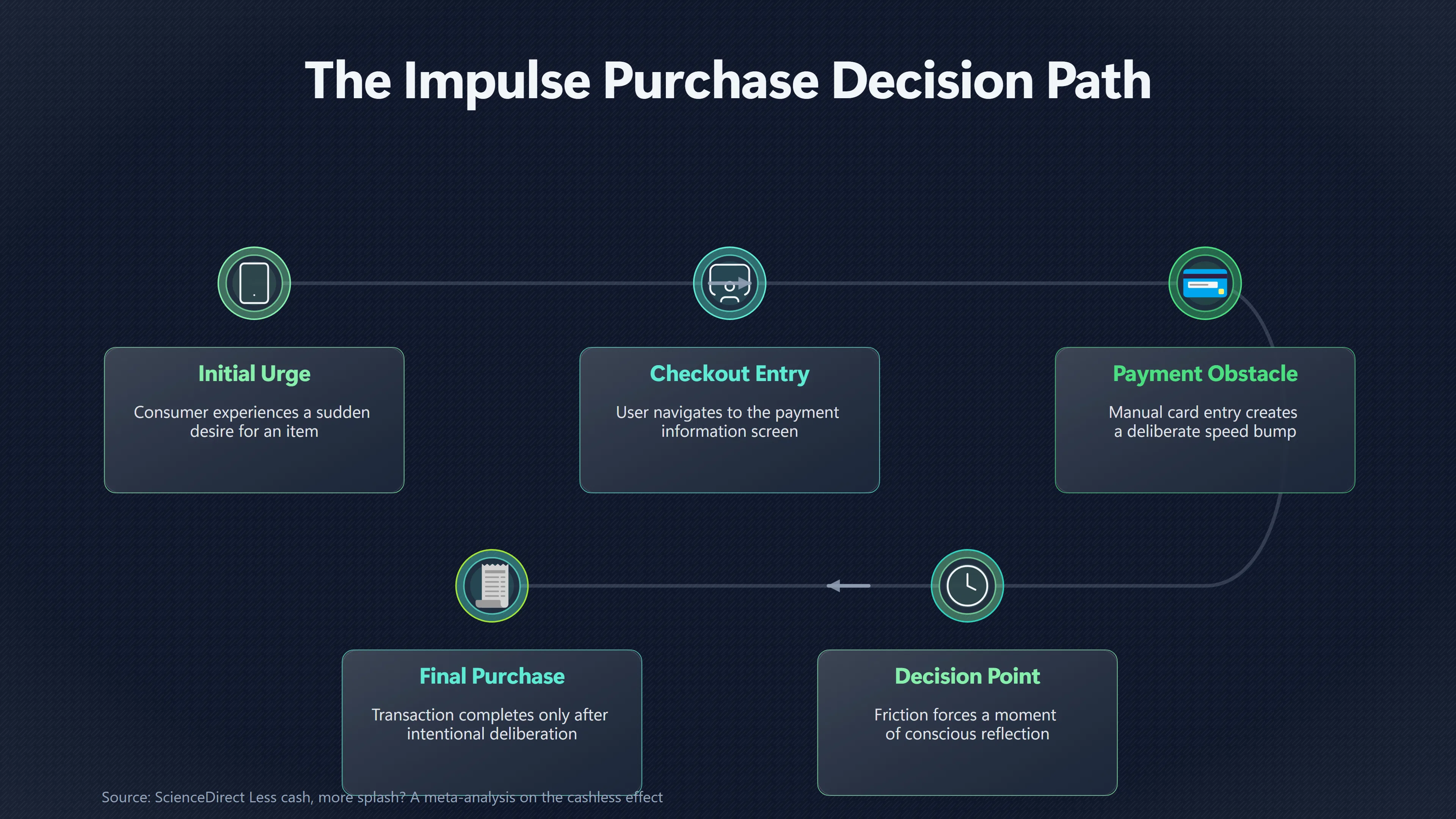
For someone repeatedly making regretted purchases, deleting the saved card changes that default. The sequence becomes:
urge → checkout → payment obstacle → decision → purchase
rather than:
urge → checkout → tap → purchase
The obstacle is valuable because it arrives before the transaction is irreversible, not because entering sixteen digits is difficult in itself.
Payment can become less noticeable as it becomes easier
Checkout friction and payment salience are related but distinct ideas. Friction concerns how much action is required to complete the transaction. Payment salience concerns how strongly the buyer experiences the fact that money is being surrendered.
Decades of research suggest that the form of payment can influence spending. In a well-known 2001 experiment involving genuine transactions, Drazen Prelec and Duncan Simester found that participants instructed to pay by credit card could be willing to pay more than participants instructed to use cash. The authors reported effects as large as 100% in some experimental conditions, although that striking figure should not be treated as a general estimate of how much cards increase everyday spending.[CiNii Research]cir.nii.ac.jpCiNii ResearchAlways Leave Home Without It: A Further Investigation of the Credit-Card Effect on Willingness to Pay | CiNii ResearchFebru…
Priya Raghubir and Joydeep Srivastava subsequently investigated what happens when payment feels less transparent. Across several experiments, participants were more willing to spend under less cash-like payment conditions. Importantly, the researchers could reduce differences between payment forms by making the act of parting with money more salient. In one experiment, asking people to estimate the individual components of an expense rather than think about the total holistically eliminated the observed cash-credit difference.[PubMed]nih.govPub Med Monopoly money: the effect of payment coupling and form on spending behaviorPubMedMonopoly money: the effect of payment coupling and form on spending behavior - PubMed
A 2024 meta-analysis provides a useful corrective to drawing too much from individual experiments. Lachlan Schomburgk, Alex Belli and Arvid Hoffmann synthesised 392 effect sizes from 71 papers spanning more than four decades. They found a statistically significant but small overall tendency for people to spend more with cashless payment methods than with cash. The size of the effect varied with circumstances, and the authors found that it had weakened over time.[ScienceDirect]sciencedirect.comScienceDirect Less cash, more splash? A meta-analysis on the cashless effectLess cash, more splash? A meta-analysis on the cashless effect - ScienceDirect…
That qualification matters. “Cards make people overspend” is too crude. Modern consumers are highly accustomed to cards and digital payments, and payment behaviour varies by person, purchase and setting. Deleting stored card details therefore should not be presented as a way to recreate some universally powerful “pain of paying” effect.
More recent mobile-payment experiments underline that complexity. Research has found higher purchase intentions with mobile rather than cash payment, but the proposed mechanisms are not limited to reduced pain. A 2024 study found that reduced pain of paying mediated the mobile-payment effect for higher-priced products but not lower-priced ones; another line of experiments suggests that fluent mobile payment may itself produce a positive response to the transaction. These are relatively small experimental studies, so their mechanisms remain less firmly established than the broader cashless-spending association.[nih.gov]pmc.ncbi.nlm.nih.govOpen source on nih.gov.
The practical interpretation is simpler than the psychology: when payment becomes nearly invisible, there are fewer cues forcing attention back onto cost. Re-entering payment information may restore both effort and attention, even if researchers cannot cleanly separate those two effects in everyday shopping.

What deleting a saved card can and cannot prove
There is an important evidence gap at the centre of this advice. Research directly randomising consumers to “saved card” versus “delete the card and type it manually for future purchases”, then measuring their real-world impulse spending over time, is sparse. Evidence for deleting saved cards therefore has to be inferred from stronger adjacent findings: one-click purchasing increases buying; less transparent payment can increase spending; and interventions that interrupt an online shopping episode can reduce the immediate urge to buy.[informs.org]pubsonline.informs.orgPubs Online Fewer Clicks, More Purchases | Management ScienceFewer Clicks, More Purchases | Management ScienceFebruary 22, 2023…
That last point comes from research specifically designed around online self-control. Yunha Han and colleagues tested interventions on a real-world e-commerce site with 107 participants. Prompts involving reflection, distraction, reducing desire and making cost salient all reduced impulse-buying urges, although users experienced the interventions differently. The study did not test card deletion, but it supports the broader mechanism that inserting an intervention between shopping desire and completion can change the immediate decision state.[IBM Research]research.ibm.comOpen source on ibm.com.
Other experimental work shows why the quality of the interruption matters. Research at the University of Michigan found that a 25-hour postponement reduced impulse-buying urge and purchase intention, while a ten-minute delay in a laboratory shopping task did not significantly reduce impulse purchases or impulsive spending; participants simply continued shopping during the wait. Reflection and distraction tasks lasting roughly three and a half minutes also reduced urge and purchase intention. Friction is therefore not magic. An obstacle helps when it creates reconsideration; an obstacle that a shopper mechanically bypasses may accomplish little.[Deep Blue]deepblue.lib.umich.eduDeep Blue Impulse Buying: Designing for Self-Control with E-commerceDeep Blue Impulse Buying: Designing for Self-Control with E-commerce
This is why deleting saved payment details is more plausible as a self-chosen behavioural speed bump than as a stand-alone cure for overspending. If retrieving the physical card makes you notice that you are about to spend £65 on something you had not intended to buy, the friction has done its job even if you eventually proceed. If you memorise the card number and enter it without reflection, its usefulness has largely disappeared.
Make checkout less automatic, not unnecessarily difficult
The most practical version of this intervention is selective. Removing every convenient payment method from every service can produce needless hassle for routine, planned spending. Instead, target the places where seamless checkout repeatedly turns a temporary urge into a regretted purchase.
A workable setup is:
- Remove stored cards from high-risk retailers first. Start with shopping sites or apps where you regularly make unplanned purchases. The aim is to put friction where your behaviour shows it is useful, rather than everywhere money changes hands.

-
Check browser autofill as well as retailer accounts. Deleting a card from one shop may achieve little if the browser immediately fills the same details. Chrome, for example, lets users delete saved payment information and turn off “Save and fill payment methods”; cards held in Google Wallet may need to be removed there separately. Google Support
- Do not immediately replace one shortcut with another. If removing a retailer’s saved card simply leads to using a wallet or another autofill system that restores one-tap payment, the intended friction has disappeared. This does not make digital wallets bad; it simply defeats this particular self-control mechanism.
-
Use the interruption as a decision cue. When checkout asks for payment information, treat that request as the point to ask whether the purchase was planned, whether its full price still seems worthwhile, and whether you would come back for it tomorrow. Research on payment transparency and online shopping interventions suggests that making cost or reasons for buying more salient is more meaningful than inconvenience for its own sake. PubMed
- Keep convenience where it solves a genuine problem. There is little behavioural advantage in making a planned grocery order, essential travel booking or other deliberate transaction unnecessarily cumbersome. The CMA explicitly recognises that smoother online choice architecture can benefit consumers. Friction is useful here only when it protects a prior intention from a predictable impulse. GOV.UK
The distinction is central to self-improvement that works. The objective is not to demonstrate discipline by tolerating an awkward checkout. It is to arrange the environment so that the easier behaviour is less likely to contradict the decision you made when you were not tempted.
The useful test is whether the pause changes the decision
Deleting saved cards is therefore best judged by behaviour, not by how inconvenient it feels. If an extra 30 seconds regularly causes you to reconsider purchases that would otherwise have gone through instantly, the intervention is functioning as intended. If it merely annoys you while you complete exactly the same purchases, stronger or different spending controls belong elsewhere.
The research supports the underlying logic more strongly than the specific tactic. One-click purchasing can increase real purchasing; cashless payments show a small overall association with greater spending; payment salience can influence decisions; and well-designed interruptions can reduce impulse-buying urges. But there is not yet strong direct evidence that deleting stored card credentials by itself produces a predictable reduction in a person’s monthly spending. PubsOnline+2ScienceDirect
That uncertainty is a reason for precision rather than dismissal. Removing a saved card costs little, is reversible and targets a clearly identifiable mechanism: the disappearance of the checkout pause. For purchases that repeatedly happen too quickly, restoring that pause can turn payment from an automatic final click back into a decision.
Amazon book picks
Further Reading
Books and field guides related to Can Deleting Saved Cards Slow Impulse Spending?. Use these as the next step if you want deeper reading beyond the article.
The Year of Less
The Year of Less In her late twenties, Cait Flanders found herself stuck in the consumerism cycle that grips so many of us: earn more, bu...
Nudge
Rating: 3.5/5 from 29 Google Books ratings
Thaler and Sunstein offer a groundbreaking discussion of how to apply the science of choice to nudge people toward decisions that can imp...
Predictably Irrational
Intelligent, lively, humorous, and thoroughly engaging, "The Predictably Irrational" explains why people often make bad decisions and wha...
Atomic Habits
Rating: 3.5/5 from 7 Google Books ratings
The #1 New York Times bestseller. Over 25 million copies sold! Translated into 60+ languages! Tiny Changes, Remarkable Results No matter...
eBay marketplace picks
Marketplace Samples
Example marketplace items related to this page. Use the search link to explore similar finds on eBay.
Selected fromgoal setting cards oneBay.co.uk.

Endnotes
1.
Source: sciencedirect.com
Title: ScienceDirect Less cash, more splash? A meta-analysis on the cashless effect
Link:https://www.sciencedirect.com/science/article/pii/S0022435924000216
Source snippet
Less cash, more splash? A meta-analysis on the cashless effect - ScienceDirect...
2.
Source: GOV.UK
Title: Evidence review of Online Choice Architecture and consumer and competition harm
Link:https://www.gov.uk/government/publications/online-choice-architecture-how-digital-design-can-harm-competition-and-consumers/evidence-review-of-online-choice-architecture-and-consumer-and-competition-harm
4.
Source: rba.gov.au
Title: online and automated payments
Link:https://www.rba.gov.au/publications/rdp/2020/2020-06/online-and-automated-payments.html
Source snippet
Reserve Bank of AustraliaOnline and Automated Payments | RDP 2020-06: Consumer Payment Behaviour in Australia: Evidence from the 2019 Con...
5.
Source: research.ibm.com
Link:https://research.ibm.com/publications/wait-lets-think-about-your-purchase-again-a-study-on-interventions-for-supporting-self-controlled-online-purchases
7.
Source: support.google.com
Title: Support Manage payment info in Google Wallet
Link:https://support.google.com/chrome/answer/16579565?hl=en-GB
8.
Source: sciencedirect.com
Link:https://www.sciencedirect.com/science/article/abs/pii/S3051064326001330
9.
Source: GOV.UK
Link:https://www.gov.uk/government/news/government-delivers-fairer-deal-for-shoppers-as-buy-now-pay-later-rules-come-into-force
10.
Source: gamblingcommission.gov.uk
Link:https://www.gamblingcommission.gov.uk/blog/post/financial-risk-assessments-update-july-2026
11.
Source: money.com
Title: Delete This Payment Habit Before It Costs You Real Money | Money
Link:https://money.com/payment-habit-costing-you-money/?apxa1=homepage
12.
Source: support.checkout.com
Title: 34282256010642 What is Visa s stored credential framework
Link:https://support.checkout.com/hc/en-us/articles/34282256010642-What-is-Visa-s-stored-credential-framework
13.
Source: GOV.UK
Title: www.gov.uk Agentic AI and consumers
Link:https://www.gov.uk/government/publications/agentic-ai-and-consumers/agentic-ai-and-consumers
14.
Source: sciencedirect.com
Link:https://www.sciencedirect.com/science/article/pii/S0022435926000059
15.
Source: sciencedirect.com
Link:https://www.sciencedirect.com/science/article/pii/S0969698925003650
16.
Source: GOV.UK
Link:https://www.gov.uk/government/publications/evaluation-of-the-help-to-save-scheme/research-report-evaluation-of-help-to-save-qualitative-interviews-with-users-and-eligible-non-users-of-help-to-save
17.
Source: GOV.UK
Title: www.gov.uk The prevalence and potential harm of defaults in online shopping
Link:https://www.gov.uk/government/publications/the-prevalence-and-potential-harm-of-defaults-in-online-shopping
18.
Source: sciencedirect.com
Title: Paying in a blink of an eye: it hurts less, but you spend more
Link:https://www.sciencedirect.com/science/article/pii/S0167268124001100
19.
Source: GOV.UK
Title: www.gov.uk Estimating the prevalence and impact of drip pricing
Link:https://www.gov.uk/government/publications/estimating-the-prevalence-and-impact-of-drip-pricing
20.
Source: competitionandmarkets.blog.gov.uk
Link:https://competitionandmarkets.blog.gov.uk/2023/03/31/urgency-and-price-reduction-claims-are-your-online-tactics-legal/
21.
Source: GOV.UK
Title: www.gov.uk CM A investigates online selling practices based on ‘urgency’ claims
Link:https://www.gov.uk/government/news/cma-investigates-online-selling-practices-based-on-urgency-claims
22.
Source: GOV.UK
Link:https://www.gov.uk/find-digital-market-research/online-choice-architecture-how-digital-design-can-harm-competition-and-consumers-2022-cma
23.
Source: GOV.UK
Link:https://www.gov.uk/find-digital-market-research/evidence-review-of-online-choice-architecture-and-consumer-and-competition-harm-2022-cma
24.
Source: competitionandmarkets.blog.gov.uk
Link:https://competitionandmarkets.blog.gov.uk/2022/04/07/online-choice-architecture-how-do-we-end-up-making-decisions-we-dont-want/
25.
Source: GOV.UK
Link:https://www.gov.uk/government/publications/online-choice-architecture-how-digital-design-can-harm-competition-and-consumers
26.
Source: GOV.UK
Title: algorithms how they can reduce competition and harm consumers 2021 cma
Link:https://www.gov.uk/find-digital-market-research/algorithms-how-they-can-reduce-competition-and-harm-consumers-2021-cma
27.
Source: gca.gov.uk
Link:https://www.gca.gov.uk/news/how-payment-initiation-service-providers-are-changing-the-way-citizens-pay-online
28.
Source: sciencedirect.com
Link:https://www.sciencedirect.com/science/article/pii/S0304394021005164
29.
Source: sciencedirect.com
Link:https://www.sciencedirect.com/science/article/pii/S0969698921000382
30.
Source: GOV.UK
Title: www.gov.uk Algorithms: How they can reduce competition and harm consumers
Link:https://www.gov.uk/government/publications/algorithms-how-they-can-reduce-competition-and-harm-consumers
31.
Source: sciencedirect.com
Link:https://www.sciencedirect.com/science/article/pii/S0022435919300417
32.
Source: rba.gov.au
Title: consumer payment behaviour in australia
Link:https://www.rba.gov.au/publications/bulletin/2020/mar/consumer-payment-behaviour-in-australia.html
33.
Source: ncsc.gov.uk
Title: Shopping and paying safely online | National Cyber Security Centre
Link:https://www.ncsc.gov.uk/guidance/shopping-online-securely
34.
Source: payments.ca
Title: Businesses stand to lose customers from payment friction at check-out | Payments
Link:https://www.payments.ca/businesses-stand-lose-customers-payment-friction-check-out
35.
Source: sciencedirect.com
Link:https://www.sciencedirect.com/science/article/abs/pii/S0969698913000118
36.
Source: support.google.com
Link:https://support.google.com/wallet/answer/9244912?hl=en-GB
37.
Source: support.google.com
Link:https://support.google.com/wallet/answer/9244912?hl=en
38.
Source: support.google.com
Title: fill in forms automatically computer
Link:https://support.google.com/chrome/answer/142893/fill-in-forms-automatically-computer?hl=en-GB
39.
Source: support.google.com
Link:https://support.google.com/chrome/answer/16580822?co=GENIE.Platform%3DAndroid&hl=en-ukanswer
40.
Source: support.google.com
Link:https://support.google.com/chrome/answer/142893?co=GENIE.Platform%3DDesktop&hl=en
41.
Source: support.google.com
Link:https://support.google.com/chrome/answer/16579565?hl=en
42.
Source: support.google.com
Link:https://support.google.com/chrome/answer/16580822?co=GENIE.Platform%3DAndroid&hl=en-gb
43.
Source: support.google.com
Link:https://support.google.com/chrome/answer/142893?hl=en-GBm&ref_topic=7439541
44.
Source: support.google.com
Link:https://support.google.com/chrome/answer/16598463?co=GENIE.Platform%3DAndroid&hl=EN-GB
45.
Source: support.google.com
Link:https://support.google.com/googlepay/answer/16579565?co=GENIE.Platform%3DDesktop&hl=en-GBYou
46.
Source: support.google.com
Link:https://support.google.com/chrome/answer/142893?co=GENIE.Platform%3DAndroid&hl=en-GB
47.
Source: support.google.com
Link:https://support.google.com/googlepay/answer/16579565?co=GENIE.Platform%3DDesktop&hl=en-GB
48.
Source: sciencedirect.com
Link:https://www.sciencedirect.com/science/article/pii/S0378720618301496
49.
Source: sciencedirect.com
Link:https://www.sciencedirect.com/science/article/abs/pii/S0378720618301496
50.
Source: sciencedirect.com
Link:https://www.sciencedirect.com/science/article/pii/S0747563220302569
51.
Source: sciencedirect.com
Link:https://www.sciencedirect.com/science/article/pii/S0148296320305609
52.
Source: sciencedirect.com
Title: Arvid Oskar Ivar Hoffmann | ScienceDirect* View PDF * View
Link:https://www.sciencedirect.com/author/25225739800/arvid-oskar-ivar-hoffmann
53.
Source: competitionandmarkets.blog.gov.uk
Link:https://competitionandmarkets.blog.gov.uk/category/online-choice-architecture/
54.
Source: rba.gov.au
Title: innovation in payments
Link:https://www.rba.gov.au/publications/rdp/2020/2020-06/innovation-in-payments.html
55.
Source: rba.gov.au
Link:https://www.rba.gov.au/publications/rdp/2020/2020-06/full.html
56.
Source: docs.payments.service.gov.uk
Title: payments.service.gov.uk Take recurring payments
Link:https://docs.payments.service.gov.uk/recurring_payments/
57.
Source: docs.payments.service.gov.uk
Title: payments.service.gov.uk Search agreements for recurring payments
Link:https://docs.payments.service.gov.uk/api_reference/search_agreements_reference/
58.
Source: docs.payments.service.gov.uk
Link:https://docs.payments.service.gov.uk/api_reference/single_agreement_reference/
59.
Source: pubsonline.informs.org
Title: Pubs Online Fewer Clicks, More Purchases | Management Science
Link:https://pubsonline.informs.org/doi/10.1287/mnsc.2023.4716
Source snippet
Fewer Clicks, More Purchases | Management ScienceFebruary 22, 2023...
Published: February 22, 2023
60.
Source: pubsonline.informs.org
Title: Pubs Online Fewer Clicks, More Purchases | Management Science
Link:https://pubsonline.informs.org/doi/abs/10.1287/mnsc.2023.4716
61.
Source: cir.nii.ac.jp
Link:https://cir.nii.ac.jp/crid/1360011146037792896
Source snippet
CiNii ResearchAlways Leave Home Without It: A Further Investigation of the Credit-Card Effect on Willingness to Pay | CiNii ResearchFebru...
63.
Source: pmc.ncbi.nlm.nih.gov
Link:https://pmc.ncbi.nlm.nih.gov/articles/PMC11444724/
64.
Source: pubmed.ncbi.nlm.nih.gov
Link:https://pubmed.ncbi.nlm.nih.gov/38752779/
65.
Source: pmc.ncbi.nlm.nih.gov
Link:https://pmc.ncbi.nlm.nih.gov/articles/PMC9640944/
66.
Source: deepblue.lib.umich.edu
Title: Deep Blue Impulse Buying: Designing for Self-Control with E-commerce
Link:https://deepblue.lib.umich.edu/items/b4da4889-a5bd-4fd5-a8c6-5b940df3b972
67.
Source: doi.org
Link:https://doi.org/10.3390/jtaer21070227
68.
Source: doi.org
Link:https://doi.org/10.3390/su18094613
69.
Source: doi.org
Link:https://doi.org/10.1016/j.ijhcs.2025.103697
70.
Source: pmc.ncbi.nlm.nih.gov
Link:https://pmc.ncbi.nlm.nih.gov/articles/PMC12580249/
71.
Source: pmc.ncbi.nlm.nih.gov
Link:https://pmc.ncbi.nlm.nih.gov/articles/PMC12174854/
72.
Source: pmc.ncbi.nlm.nih.gov
Link:https://pmc.ncbi.nlm.nih.gov/articles/PMC11939284/
73.
Source: doi.org
Link:https://doi.org/10.1177%2F09711023241312523
74.
Source: doi.org
Title: Paying in a blink of an eye: it hurts less, but you spend more
Link:https://doi.org/10.1016/j.jebo.2024.03.017
75.
Source: doi.org
Link:https://doi.org/10.1002/CB.2193
76.
Source: doi.org
Title: The pain of payment: A review and research agenda
Link:https://doi.org/10.1002/mar.21825
77.
Source: doi.org
Title: Fewer Clicks, More Purchases | Management Science
Link:https://doi.org/10.1287%2Fmnsc.2023.4716
78.
Source: researchgate.net
Title: Fewer Clicks, More Purchases
Link:https://www.researchgate.net/publication/368726566_Fewer_Clicks_More_Purchases
79.
Source: doi.org
Title: Heuristic price theory: A model of pluralistic price evaluations
Link:https://doi.org/10.1002/arcp.1087
80.
Source: pubmed.ncbi.nlm.nih.gov
Link:https://pubmed.ncbi.nlm.nih.gov/36389456/
81.
Source: pmc.ncbi.nlm.nih.gov
Link:https://pmc.ncbi.nlm.nih.gov/articles/PMC7892835/
82.
Source: pmc.ncbi.nlm.nih.gov
Link:https://pmc.ncbi.nlm.nih.gov/articles/PMC7351522/
83.
Source: doi.org
Link:https://doi.org/10.1108/IMDS
84.
Source: pmc.ncbi.nlm.nih.gov
Link:https://pmc.ncbi.nlm.nih.gov/articles/PMC6856651/
85.
Source: doi.org
Link:https://doi.org/10.1086%2F701901
86.
Source: pubmed.ncbi.nlm.nih.gov
Link:https://pubmed.ncbi.nlm.nih.gov/32934427/
87.
Source: doi.org
Link:https://doi.org/10.1016/j.jretconser.2022.103000
88.
Source: cir.nii.ac.jp
Link:https://cir.nii.ac.jp/crid/1360292621137298816
89.
Source: cir.nii.ac.jp
Link:https://cir.nii.ac.jp/crid/1360011146037792896?lang=ja
90.
Source: repository.hkust.edu.hk
Title: hkust.edu.hk Usage Metrics
Link:https://repository.hkust.edu.hk/ir/usage-metrics/download/1783.1-23614
Additional References
91.
Source: youtube.com
Title: Wait 24 Hours Before You Buy Anything
Link:https://www.youtube.com/watch?v=k6dtaT1oZpc
Source snippet
For practical techniques on deliberately introducing checkout barriers, see Friction Maxxing: The Psychological Trick to Stop Impulse Spe...
92.
Source: youtube.com
Link:https://www.youtube.com/watch?v=wAGf8x4KCoc
Source snippet
How Credit Cards Trick Your Brain (Psychology)...
93.
Source: nature.com
Link:https://www.nature.com/articles/s41599-023-02204-w
94.
Source: consumerfinance.gov
Link:https://www.consumerfinance.gov/archive/newsroom/cfpb-finalizes-strong-federal-protections-prepaid-account-consumers/
95.
Source: consumerfinance.gov
Link:https://www.consumerfinance.gov/archive/newsroom/cfpb-finds-billions-of-dollars-stored-on-popular-payment-apps-may-lack-federal-insurance/
96.
Source: consumerfinance.gov
Link:https://www.consumerfinance.gov/archive/newsroom/cfpb-orders-tech-giants-to-turn-over-information-on-their-payment-system-plans/
97.
Source: consumerfinance.gov
Link:https://www.consumerfinance.gov/archive/blog/how-parents-can-help-kids-be-smarter-about-money-everyday-situations/
98.
Source: consumerfinance.gov
Link:https://www.consumerfinance.gov/data-research/research-reports/issue-spotlight-analysis-of-deposit-insurance-coverage-on-funds-stored-through-payment-apps/full-report/
99.
Source: consumerfinance.gov
Link:https://www.consumerfinance.gov/archive/newsroom/prepared-remarks-of-cfpb-director-richard-cordray-on-the-paypal-credit-enforcement-action-press-call/
100.
Source: consumerfinance.gov
Link:https://www.consumerfinance.gov/ask-cfpb/what-should-i-know-before-i-finalize-a-car-or-auto-loan-en-2131/