Within Better Habits
Does Missing One Day Ruin a Habit?
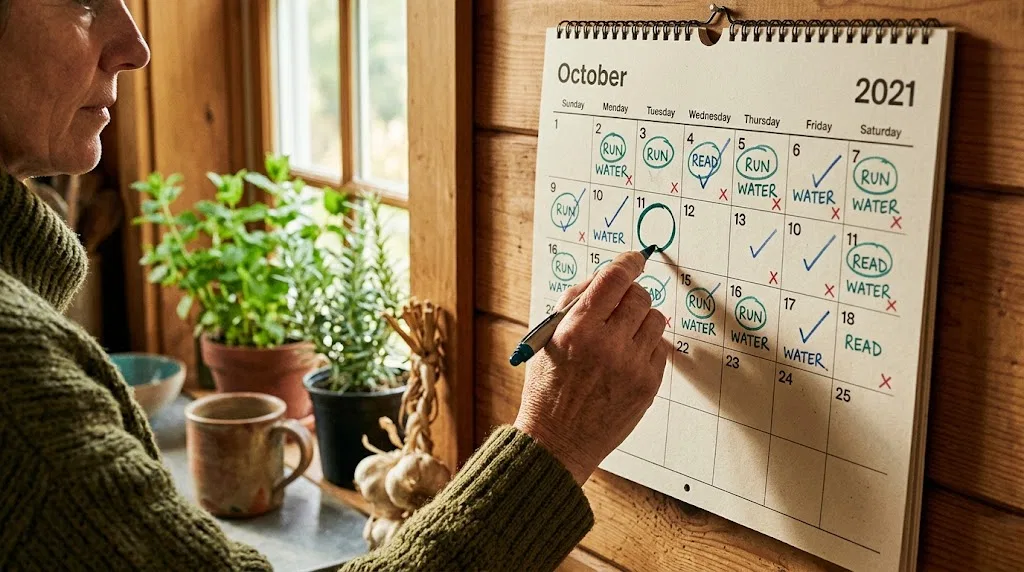
Missing one opportunity does not erase habit formation, so recovery matters more than treating a lapse as a total reset.
On this page
- What habit research found about lapses
- Why perfection is the wrong standard
- Returning at the next opportunity
Page outline Jump by section
Introduction
Missing one day does not mean a habit has gone back to zero. The clearest direct evidence comes from a 12-week habit-formation study in which people repeated a chosen eating, drinking or activity behaviour in the same daily context. Habit automaticity generally strengthened with repetition, and missing a single opportunity did not materially alter that growth process. What did matter was the broader pattern: people who performed the behaviour more consistently were more likely to develop the expected habit trajectory.[Wiley Online Library]onlinelibrary.wiley.comWiley Online LibraryHow are habits formed: Modelling habit formation in the real world - Lally - 2010 - European Journal of Social Psycho…
That distinction is important. Habit formation is not best understood as an unbroken streak in which every successful day earns a permanent point and one failure deletes the score. It is a gradual learning process in which repeated responses become increasingly associated with recurring cues. A lapse costs an opportunity for reinforcement, but the evidence does not support treating one missed occasion as a complete reset.[PubMed]pubmed.ncbi.nlm.nih.govPub Med Psychology of HabitPsychology of Habit - PubMedSeptember 10, 2015…
The practical priority after a missed day is therefore not to reconstruct a perfect streak. It is to return to the intended behaviour at the next suitable opportunity, preferably in the familiar context that has been training the habit.
What habit research found about lapses
The study behind the widely repeated claim about missed days was conducted by Phillippa Lally and colleagues at University College London. Ninety-six volunteers selected a new daily behaviour, such as eating fruit, drinking water or exercising, and linked it to a recurring situation such as after breakfast. They recorded both their performance and their experience of automaticity for 12 weeks.[Wiley Online Library]onlinelibrary.wiley.comWiley Online LibraryHow are habits formed: Modelling habit formation in the real world - Lally - 2010 - European Journal of Social Psycho…
The researchers found that automaticity tended to rise rapidly at first and then increase more slowly towards a personal plateau. Among participants for whom the growth curve could be modelled, the estimated time to reach 95% of that plateau varied enormously, from 18 to 254 days. The same study found that omitting one opportunity did not materially affect the habit-formation process.[Wiley Online Library]onlinelibrary.wiley.comWiley Online LibraryHow are habits formed: Modelling habit formation in the real world - Lally - 2010 - European Journal of Social Psycho…
That finding is stronger than the popular idea that missing one day automatically “breaks” a habit, but it should not be stretched into the opposite claim that missed days never matter. Lally herself summarised the result more carefully: one missed opportunity was not significant, whereas people who were very inconsistent generally did not succeed in developing habits. The study could not establish an exact percentage of successful repetitions that everyone must achieve.[University College London]ucl.ac.ukUniversity College London How long does it take to form a habit? | UCL NewsUniversity College LondonHow long does it take to form a habit? | UCL News - UCL – University College London…
More recent evidence reinforces that qualification. A 2024 systematic review and meta-analysis covering 20 experimental or quasi-experimental studies and 2,601 participants concluded that habit development varies substantially between people and behaviours. Repetition remains a central determinant, while stable contexts appear to support stronger habits; the review also noted that researchers still do not know precisely how much consistency is necessary.[PubMed Central (PMC)]pmc.ncbi.nlm.nih.govOpen source on nih.gov.
There is also some evidence that the length and pattern of interruptions may matter. In a six-week app-based study of study habits, 530 of 2,483 repetitions were preceded by a pause of at least a day. In that dataset, the length of the pause did not significantly predict automaticity, although pauses longer than one day were uncommon, limiting what can be concluded about longer breaks. A later analysis involving two habit-building datasets reported a negative association between time since the previous repetition and automaticity, illustrating that the science is not precise enough to declare every interruption harmless.[PubMed Central (PMC)]pmc.ncbi.nlm.nih.govPubMed Central (PMC)App-Based Habit Building Reduces Motivational Impairments During Studying – An Event Sampling Study - PMCFebruary 7…
The sensible interpretation is therefore narrower and more useful: a single lapse is compatible with continued habit formation; repeated or prolonged inconsistency can slow or undermine it.
Why perfection is the wrong standard
A streak counts consecutive performances. A habit, by contrast, is usually defined in behavioural research by the growing tendency for a cue or context to prompt a response automatically. Those are related concepts, but they are not the same measurement.[PubMed]pubmed.ncbi.nlm.nih.govPub Med Psychology of HabitPsychology of Habit - PubMedSeptember 10, 2015…
Imagine that someone has walked for 20 minutes after lunch on 24 of the past 27 working days. Missing Tuesday because of an appointment changes the streak from perhaps ten days to zero, but it does not erase the previous repetitions linking finishing lunch with going for a walk. Treating the numerical streak as though it were the underlying psychological habit exaggerates what one lapse means.
The shape of habit growth helps explain why. Lally’s work found diminishing gains from successive repetitions: early repetitions tended to produce larger increases in automaticity, while later ones added progressively less as the behaviour approached a plateau. Habit strength therefore did not behave like a simple counter that increased by one each day and returned to zero after an omission.[Wiley Online Library]onlinelibrary.wiley.comWiley Online LibraryHow are habits formed: Modelling habit formation in the real world - Lally - 2010 - European Journal of Social Psycho…
Later work also shows why the setting of repetitions matters. In one 2022 study, 95 students deliberately formed study habits over six weeks. Participants assigned to repeat their behaviour in a stable place and time developed greater automaticity and achieved more of their repetition goals than those instructed to keep changing their context. A second dataset involving 218 users and 308 habits showed the same general association between context stability, automaticity and performance.[PubMed Central (PMC)]pmc.ncbi.nlm.nih.govPubMed Central (PMC)Context Stability in Habit Building Increases Automaticity and Goal Attainment - PMC…
That changes how a missed day should be interpreted. The key question is not “Is my streak still intact?” but “Will I continue reinforcing the same useful cue–response relationship?” If the usual cue appears tomorrow and the behaviour resumes, the learning process can continue. If the lapse becomes the beginning of weeks of irregular performance, the problem is no longer one missed day but the loss of consistent repetition.
There is also a behavioural reason to avoid turning a lapse into a verdict on personal discipline. Research on relapse in other behaviour-change settings distinguishes a lapse, a temporary departure from the intended behaviour, from a sustained return to an unwanted pattern. The evidence comes especially from addiction research, so it should not be treated as direct proof about ordinary habits; nevertheless, it demonstrates an important general point: progression from an initial lapse to continuing failure is not inevitable. In smoking research, people who engaged in restorative coping after an initial lapse were less likely to lapse again on the same day, while feeling like giving up predicted faster progression to another lapse.[PubMed Central (PMC)]pmc.ncbi.nlm.nih.govOpen source on nih.gov.
For everyday self-improvement, this argues against the familiar “I have already ruined it, so today no longer counts” response. Whatever its emotional appeal, that conclusion is not how habit formation itself is measured.
Returning at the next opportunity
The most evidence-aligned response to a missed occasion is deliberately uneventful: resume the behaviour when its next normal cue arrives. You do not need to compensate for yesterday before today’s repetition can count.
Suppose the intended habit is “after I make my morning coffee, I will practise Spanish for ten minutes”. If Wednesday is lost to an early train, Thursday morning is not day one of a biologically or psychologically new process. The coffee cue and the practice response have already been paired repeatedly. Thursday provides another opportunity to strengthen that association. Habit research consistently places repeated behaviour in a stable context at the centre of automaticity development.[PubMed]pubmed.ncbi.nlm.nih.govPub Med Psychology of HabitPsychology of Habit - PubMedSeptember 10, 2015…
A useful recovery rule has three parts:
- Record the miss accurately. Acknowledge that the behaviour did not happen rather than redefining the target to preserve the streak.
- Keep the next cue intact. Return at the next normal opportunity instead of waiting for Monday, next month or another symbolic fresh start.
- Investigate patterns, not isolated noise. One unusual disruption may require no redesign. Repeated misses at the same point — every Friday evening, every day after late meetings, every time travel interrupts the routine — suggest that the cue, timing or effort required needs adjustment.
This approach preserves both sides of the evidence. It does not pretend that frequency is irrelevant: repeated behaviour is fundamental to habit formation, and higher consistency generally helps. But it also does not impose an unsupported perfection criterion in which 29 successful repetitions plus one miss are treated as equivalent to never having practised the behaviour at all.[University College London]ucl.ac.ukUniversity College London How long does it take to form a habit? | UCL NewsUniversity College LondonHow long does it take to form a habit? | UCL News - UCL – University College London…
There is an especially important difference between an exception and a new pattern. If illness, travel or an emergency causes one missed run, the main task is simply to restart when the normal opportunity returns. If someone repeatedly intends to run after work but misses three evenings each week because work ends unpredictably, the lesson is different: the behaviour may be attached to an unreliable cue. Evidence that stable contexts facilitate automaticity makes redesigning that cue more useful than repeatedly declaring a fresh start.[PubMed Central (PMC)]pmc.ncbi.nlm.nih.govPubMed Central (PMC)Context Stability in Habit Building Increases Automaticity and Goal Attainment - PMC…
When a missed day actually deserves attention
“Do not reset after one miss” should not become permission to ignore accumulating lapses. The research draws a distinction between occasional interruption and low consistency, even though it does not give a universal cut-off separating the two.[University College London]ucl.ac.ukUniversity College London How long does it take to form a habit? | UCL NewsUniversity College LondonHow long does it take to form a habit? | UCL News - UCL – University College London…
A missed occasion is particularly worth examining when it reveals something repeatable: the behaviour is too difficult for the available time; its cue is ambiguous; the context changes constantly; preparation is repeatedly missing; or the planned frequency does not fit ordinary life. Those are system problems rather than evidence that previous repetitions have vanished.
The 2024 systematic review is useful here because it resists a universal habit timetable. Across the literature, habit formation differed considerably between people, interventions and behaviours, and strengthening frequently continued beyond a month. That variation makes rigid rules such as “never miss a day” or “restart the count if you fail once” scientifically difficult to justify.[PubMed Central (PMC)]pmc.ncbi.nlm.nih.govOpen source on nih.gov.
The better standard is reliable return. Consistency remains valuable because habits are learned through repetition. Perfection is unnecessary because learning accumulated across earlier repetitions is not shown to disappear after one omission. The difference matters for self-improvement that works: a missed day is an event to recover from, not evidence that all previous progress has been cancelled.
Amazon book picks
Further Reading
Books and field guides related to Does Missing One Day Ruin a Habit?. Use these as the next step if you want deeper reading beyond the article.
Atomic Habits
Rating: 3.5/5 from 7 Google Books ratings
The #1 New York Times bestseller. Over 25 million copies sold! Translated into 60+ languages! Tiny Changes, Remarkable Results No matter...
Tiny Habits
Improving your life is much easier than you think. Whether it’s losing weight, sleeping more, or restoring your work/life balance – the s...
Good Habits, Bad Habits
'The world's leading expert on habits' - Matthew Syed, bestselling author of Black Box Thinking and Rebel IdeasWhat if you could harness...

The Power of Habit
Rating: 4.0/5 from 145 Google Books ratings
In The Power of Habit, award-winning business reporter Charles Duhigg takes us to the thrilling edge of scientific discoveries that expla...
eBay marketplace picks
Marketplace Samples
Live-tested eBay searches with available results related to this page.
Selected fromhabit tracker board oneBay.co.uk.

Endnotes
1.
Source: onlinelibrary.wiley.com
Link:https://onlinelibrary.wiley.com/doi/10.1002/ejsp.674
Source snippet
Wiley Online LibraryHow are habits formed: Modelling habit formation in the real world - Lally - 2010 - European Journal of Social Psycho...
2.
Source: onlinelibrary.wiley.com
Link:https://onlinelibrary.wiley.com/doi/abs/10.1002/ejsp.674?MixPanelId=15e3fe314440-0468d8411-64220f54-100000-15e3fe314460
Source snippet
Wiley Online LibraryHow are habits formed: Modelling habit formation in the real world - Lally - 2010 - European Journal of Social Psycho...
3.
Source: compass.onlinelibrary.wiley.com
Link:https://compass.onlinelibrary.wiley.com/doi/full/10.1111/spc3.12975
4.
Source: onlinelibrary.wiley.com
Link:https://onlinelibrary.wiley.com/doi/full/10.1002/jeab.894
5.
Source: onlinelibrary.wiley.com
Link:https://onlinelibrary.wiley.com/doi/10.1111/dar.13401
6.
Source: compass.onlinelibrary.wiley.com
Link:https://compass.onlinelibrary.wiley.com/doi/10.1111/spc3.12553
7.
Source: myscp.onlinelibrary.wiley.com
Link:https://myscp.onlinelibrary.wiley.com/doi/10.1016/j.jcps.2009.08.003
8.
Source: onlinelibrary.wiley.com
Link:https://onlinelibrary.wiley.com/doi/abs/10.1002/ejsp.674?msockid=2489864bf52b6612230d95d6f48167ef
9.
Source: onlinelibrary.wiley.com
Link:https://onlinelibrary.wiley.com/doi/abs/10.1002/ejsp.674
10.
Source: onlinelibrary.wiley.com
Link:https://onlinelibrary.wiley.com/doi/abs/10.1002/ejsp.674?msockid=038ed114f43667dd0790c4bef5146634
11.
Source: onlinelibrary.wiley.com
Link:https://onlinelibrary.wiley.com/doi/abs/10.1002/ejsp.674?538fcd4b_page=6&947f74f7_page=5
12.
Source: onlinelibrary.wiley.com
Link:https://onlinelibrary.wiley.com/doi/abs/10.1002/ejsp.674?cf_chl_jschl_tk=pmd_EwcJDaCFBR9OVEL1O_0qjioww0Gc86ZzpBvCBFhrDcE-1635261061-0-gqNtZGzNAjujcnBszQi9
13.
Source: onlinelibrary.wiley.com
Link:https://onlinelibrary.wiley.com/doi/10.1002/ejsp.674?538fcd4b_page=1&947f74f7page=3&=%2Fen-gt%2Four-commitment%23kI3HdLdDj7HLFW4BJlUYoy23RoHF9sl3JcIXrw%3D%3D
14.
Source: onlinelibrary.wiley.com
Link:https://onlinelibrary.wiley.com/doi/abs/10.1002/ejsp.674?aff_id=24772
15.
Source: onlinelibrary.wiley.com
Link:https://onlinelibrary.wiley.com/doi/abs/10.1002/ejsp.674?source=content_type%3Areact%7Cfirst_level_url%3Aarticle%7Csection%3Amain_content%7Cbutton%3Abody_link
16.
Source: onlinelibrary.wiley.com
Link:https://onlinelibrary.wiley.com/doi/10.1002/ejsp.674?2d235898_page=2&538fcd4b_page=6&d2101103_page=8&d73ad837_page=2
17.
Source: onlinelibrary.wiley.com
Title: j.1360 0443.1984.tb03867.x
Link:https://onlinelibrary.wiley.com/doi/10.1111/j.1360-0443.1984.tb03867.x
18.
Source: ucl.ac.uk
Title: University College London How long does it take to form a habit? | UCL News
Link:https://www.ucl.ac.uk/news/2009/aug/how-long-does-it-take-form-habit%20
Source snippet
University College LondonHow long does it take to form a habit? | UCL News - UCL – University College London...
19.
Source: pubmed.ncbi.nlm.nih.gov
Title: Pub Med Psychology of Habit
Link:https://pubmed.ncbi.nlm.nih.gov/26361052/
Source snippet
Psychology of Habit - PubMedSeptember 10, 2015...
Published: September 10, 2015
20.
Source: pmc.ncbi.nlm.nih.gov
Link:https://pmc.ncbi.nlm.nih.gov/articles/PMC11641623/
21.
Source: pubmed.ncbi.nlm.nih.gov
Link:https://pubmed.ncbi.nlm.nih.gov/39685110/
Source snippet
Time to Form a Habit: A Systematic Review and Meta-Analysis of Health Behaviour Habit Formation and Its Determinants - PubMed...
22.
Source: pmc.ncbi.nlm.nih.gov
Link:https://pmc.ncbi.nlm.nih.gov/articles/PMC7020232/
Source snippet
PubMed Central (PMC)App-Based Habit Building Reduces Motivational Impairments During Studying – An Event Sampling Study - PMCFebruary 7...
23.
Source: pmc.ncbi.nlm.nih.gov
Link:https://pmc.ncbi.nlm.nih.gov/articles/PMC9226889/
Source snippet
PubMed Central (PMC)Context Stability in Habit Building Increases Automaticity and Goal Attainment - PMC...
24.
Source: pubmed.ncbi.nlm.nih.gov
Link:https://pubmed.ncbi.nlm.nih.gov/35756236/
25.
Source: pmc.ncbi.nlm.nih.gov
Link:https://pmc.ncbi.nlm.nih.gov/articles/PMC3296289/
26.
Source: pubmed.ncbi.nlm.nih.gov
Link:https://pubmed.ncbi.nlm.nih.gov/8916628/
27.
Source: pubmed.ncbi.nlm.nih.gov
Link:https://pubmed.ncbi.nlm.nih.gov/42053513/
28.
Source: pubmed.ncbi.nlm.nih.gov
Link:https://pubmed.ncbi.nlm.nih.gov/41664447/
29.
Source: pubmed.ncbi.nlm.nih.gov
Link:https://pubmed.ncbi.nlm.nih.gov/39456116/
30.
Source: pmc.ncbi.nlm.nih.gov
Link:https://pmc.ncbi.nlm.nih.gov/articles/PMC11635905/
31.
Source: pubmed.ncbi.nlm.nih.gov
Link:https://pubmed.ncbi.nlm.nih.gov/38047612/
32.
Source: pmc.ncbi.nlm.nih.gov
Link:https://pmc.ncbi.nlm.nih.gov/articles/PMC12318445/
33.
Source: ucl.ac.uk
Title: Brits quit new sustainable habits after just 13 days | UCL News
Link:https://www.ucl.ac.uk/news/headlines/2022/jan/brits-quit-new-sustainable-habits-after-just-13-days
34.
Source: ucl.ac.uk
Link:https://www.ucl.ac.uk/population-health-sciences/news/2021/nov/how-cope-work-if-your-colleagues-start-leaving
35.
Source: pmc.ncbi.nlm.nih.gov
Link:https://pmc.ncbi.nlm.nih.gov/articles/PMC8137900/
36.
Source: pubmed.ncbi.nlm.nih.gov
Link:https://pubmed.ncbi.nlm.nih.gov/33405284/
37.
Source: ucl.ac.uk
Title: How to break bad habits | UCL News
Link:https://www.ucl.ac.uk/news/headlines/2020/jan/how-break-bad-habits
38.
Source: ucl.ac.uk
Title: Five ways to form a good habit | UCL News
Link:https://www.ucl.ac.uk/news/headlines/2019/aug/five-ways-form-good-habit
39.
Source: pubmed.ncbi.nlm.nih.gov
Link:https://pubmed.ncbi.nlm.nih.gov/31396122/
40.
Source: ucl.ac.uk
Title: Five steps for an attainable New Year resolution | UCL News
Link:https://www.ucl.ac.uk/news/headlines/2018/jan/five-steps-attainable-new-year-resolution
41.
Source: pmc.ncbi.nlm.nih.gov
Link:https://pmc.ncbi.nlm.nih.gov/articles/PMC4975085/
42.
Source: pubmed.ncbi.nlm.nih.gov
Link:https://pubmed.ncbi.nlm.nih.gov/26361052/?dopt=Abstract
43.
Source: pmc.ncbi.nlm.nih.gov
Link:https://pmc.ncbi.nlm.nih.gov/articles/PMC4287360/
44.
Source: pubmed.ncbi.nlm.nih.gov
Link:https://pubmed.ncbi.nlm.nih.gov/24937649/
45.
Source: pmc.ncbi.nlm.nih.gov
Link:https://pmc.ncbi.nlm.nih.gov/articles/PMC4566897/
46.
Source: pubmed.ncbi.nlm.nih.gov
Link:https://pubmed.ncbi.nlm.nih.gov/25207647/
47.
Source: pmc.ncbi.nlm.nih.gov
Link:https://pmc.ncbi.nlm.nih.gov/articles/PMC3505409/
48.
Source: pubmed.ncbi.nlm.nih.gov
Link:https://pubmed.ncbi.nlm.nih.gov/21749245/
49.
Source: pubmed.ncbi.nlm.nih.gov
Link:https://pubmed.ncbi.nlm.nih.gov/21787035/
50.
Source: pmc.ncbi.nlm.nih.gov
Link:https://pmc.ncbi.nlm.nih.gov/articles/PMC3163190/
51.
Source: pubmed.ncbi.nlm.nih.gov
Link:https://pubmed.ncbi.nlm.nih.gov/10709948/
52.
Source: pubmed.ncbi.nlm.nih.gov
Link:https://pubmed.ncbi.nlm.nih.gov/20658824/
53.
Source: pmc.ncbi.nlm.nih.gov
Link:https://pmc.ncbi.nlm.nih.gov/articles/PMC6760427/
54.
Source: pubmed.ncbi.nlm.nih.gov
Link:https://pubmed.ncbi.nlm.nih.gov/10890810/
55.
Source: ncbi.nlm.nih.gov
Link:https://www.ncbi.nlm.nih.gov/books/NBK601489/box/ch2.b9/?report=objectonly
56.
Source: pubmed.ncbi.nlm.nih.gov
Link:https://pubmed.ncbi.nlm.nih.gov/34851220/
57.
Source: pubmed.ncbi.nlm.nih.gov
Link:https://pubmed.ncbi.nlm.nih.gov/17678574/
58.
Source: pubmed.ncbi.nlm.nih.gov
Link:https://pubmed.ncbi.nlm.nih.gov/31662031/
Additional References
59.
Source: youtube.com
Title: The Real Reason You Can’t Stay Consistent (Even When You Try)
Link:https://www.youtube.com/watch?v=2-y3n3Hppno
Source snippet
For an empirical look at the psychology of streaks, [broken streaks]({{ 'broken-streaks/' | relative_url }}), and building resilience after a missed day, explore Hooked on Streaks...
60.
Source: youtube.com
Title: Hooked on Streaks: With Guests Chloë Hamilton & Jackie Silverman
Link:https://www.youtube.com/watch?v=STtXYkFD74U
Source snippet
How to Build Habits That Actually Last: A Neuroscience Approach...
61.
Source: youtube.com
Title: How to Build Habits That Actually Last: A Neuroscience Approach
Link:https://www.youtube.com/watch?v=ObA4ne4TVsE
Source snippet
Best Ways to Build Better Habits & Break Bad Ones | James Clear...
62.
Source: researchgate.net
Link:https://www.researchgate.net/publication/339099388App-Based_Habit_Building_Reduces_Motivational_Impairments_During_Studying-_An_Event_Sampling_Study
63.
Source: researchgate.net
Link:https://www.researchgate.net/publication/351373903_Self-Efficacy_in_Habit_Building_How_General_and_Habit-Specific_Self-Efficacy_Influence_Behavioral_Automatization_and_Motivational_Interference
64.
Source: doaj.org
Link:https://doaj.org/article/5e28c7cd6cc848099ff7ce3a555ff69f
65.
Source: frontiersin.org
Link:https://www.frontiersin.org/journals/psychology/articles/10.3389/fpsyg.2022.883795/full
66.
Source: frontiersin.org
Link:https://www.frontiersin.org/journals/psychology/articles/10.3389/fpsyg.2022.883795/full?infclid=98ed75048fad41069048c53e63b2394c
67.
Source: frontiersin.org
Link:https://www.frontiersin.org/journals/psychology/articles/10.3389/fpsyg.2021.643753/full
68.
Source: tandfonline.com
Link:https://www.tandfonline.com/doi/full/10.1080/08870446.2026.2626493