Within Temptation Bundling
Why Enjoyment Matters More Than Distant Rewards
Adding an immediate pleasure can make a worthwhile activity easier to start and sustain even when its main benefits are far away.
On this page
- How present bias makes beneficial activities easy to postpone
- Why enjoyment during the activity can improve persistence
- Choosing pleasures that complement rather than replace the goal
Page outline Jump by section
Introduction
Difficult beneficial habits often have a timing problem: the effort is immediate, while the payoff is remote. A workout is tiring now but may improve health months or years from now; studying requires concentration now while qualifications and career benefits arrive later. Immediate enjoyment changes that motivational arithmetic. When some pleasure occurs during the activity itself, the present contains a reason to continue rather than merely a cost to endure.
Research increasingly supports a useful distinction: distant benefits can help people decide which goals matter, but immediate rewards such as enjoyment are often more closely tied to whether they actually persist. Experiments on exercise and studying, research on New Year’s resolutions, and longer-term studies of intrinsic motivation all point in this direction.[nih.gov]pubmed.ncbi.nlm.nih.govPub Med Immediate Rewards Predict Adherence to Long-Term GoalsImmediate Rewards Predict Adherence to Long-Term Goals - PubMed… Temptation bundling exploits precisely this mechanism by moving some of a worthwhile activity’s reward into the moment when the difficult behaviour has to happen.
Why distant benefits lose to today’s effort
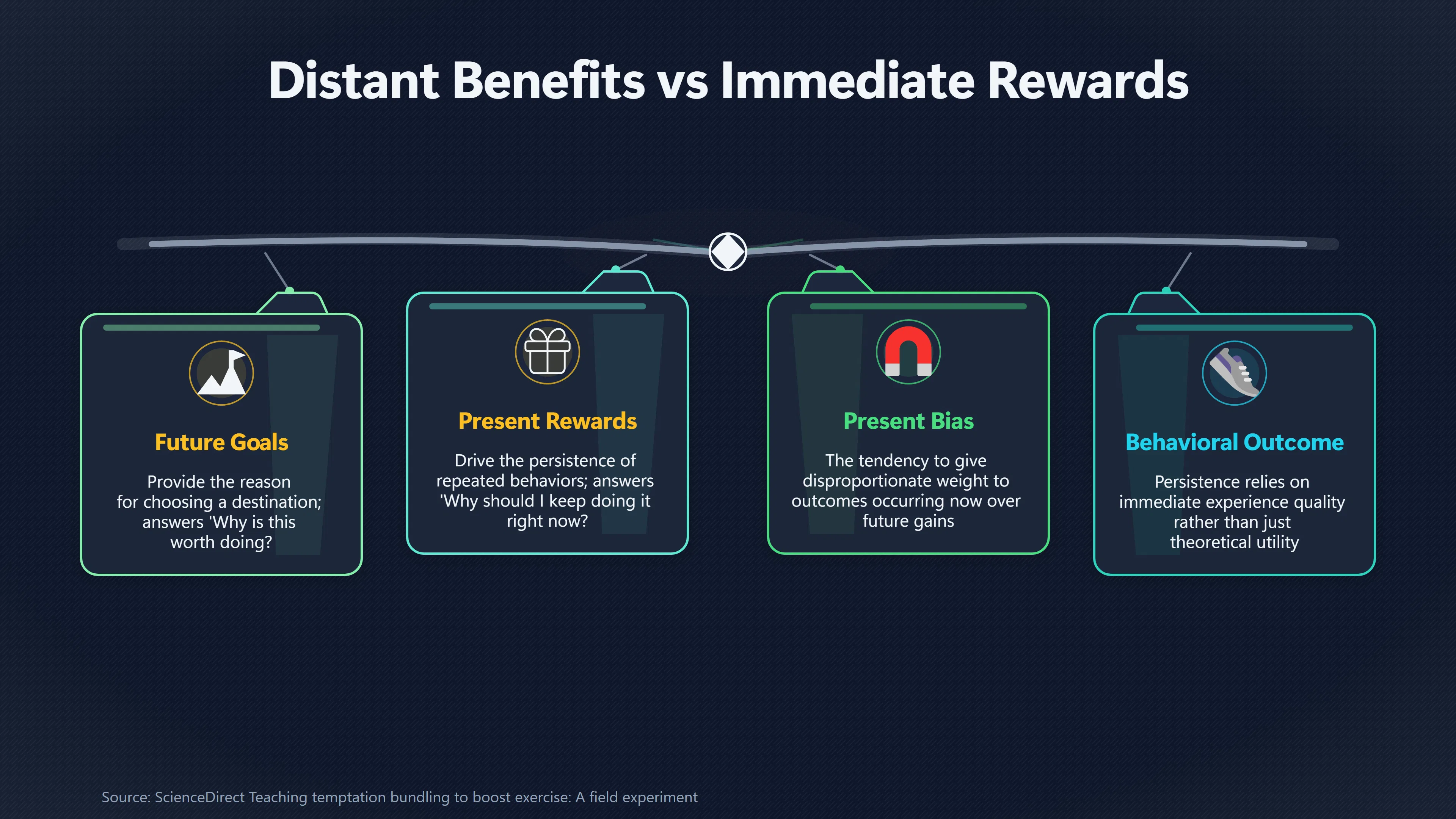
Present bias describes the tendency to give disproportionate weight to outcomes that occur now. This creates an especially awkward problem for beneficial activities whose cost and benefit arrive at different times. Physical activity, for example, requires an immediate expenditure of time and effort while many of its most important health benefits are delayed. A field study of employees found that greater present bias was associated with lower physical activity, although the observational relationship should not be treated as proof that present bias alone caused inactivity.[PubMed Central (PMC)]pmc.ncbi.nlm.nih.govPubMed Central (PMC)Association between time preference, present-bias and physical activity: implications for designing behavior change i…
The practical difficulty is not necessarily that people undervalue their future. Someone may genuinely care about being healthier next year and still prefer the sofa tonight. The decision made at the planning stage — “I want to exercise regularly” — is therefore different from the repeated decisions required to enact it. Each individual session again pits an immediate inconvenience against a largely delayed benefit.
That distinction helps explain an initially surprising set of findings from Kaitlin Woolley and Ayelet Fishbach. Across studies involving New Year’s resolutions, studying, exercising and other goal-directed activities, people often reported pursuing their goals for delayed benefits, yet immediate rewards such as enjoyment were stronger predictors of persistence. Their meta-analysis similarly found immediate rewards more closely associated with actual persistence than delayed rewards.[Sage Journals]journals.sagepub.comSage Journals Immediate Rewards Predict Adherence to Long-Term GoalsSage JournalsImmediate Rewards Predict Adherence to Long-Term Goals - Kaitlin Woolley, Ayelet Fishbach, 2017November 29, 2016…
This does not make future benefits irrelevant. They can supply the reason for choosing a destination: better health, greater knowledge or another valued outcome. But once a person is repeatedly performing the behaviour, the experience of doing it becomes important. A distant reward can answer “Why is this worth doing?” without necessarily supplying a compelling answer to “Why should I keep doing it right now?”
Enjoyment changes the experience of persistence
The important mechanism is more specific than simply “reward yourself”. Immediate enjoyment occurs while a person is paying the cost of goal pursuit. It can make the activity itself more attractive, so persistence requires less reliance on repeatedly choosing a future payoff over a present discomfort.
Woolley and Fishbach tested this idea experimentally. In one gym study, participants selected from equally effortful exercises either according to which they expected to enjoy or according to which seemed most useful. Those directed towards immediate enjoyment subsequently completed more sets. Other experiments in their research found similar benefits from making academic work more immediately enjoyable, including adding music and other pleasant features while students worked.[OUP Academic]academic.oup.comOUP AcademicFor the Fun of It: Harnessing Immediate Rewards to Increase Persistence in Long-Term Goals | Journal of Consumer Research | O…
That finding matters because it reverses a common intuition about serious goals. People may assume that the “best” beneficial activity is the option that maximises its instrumental value: the most efficient workout, the most useful study technique or the most austere version of a healthy routine. But if an optimised activity is sufficiently unpleasant that it is repeatedly avoided or abandoned, its theoretical advantage may never be realised. An option that is both effective enough and pleasant enough to repeat can have a behavioural advantage.
The broader evidence from exercise motivation points in the same direction, although it comes from a somewhat different theoretical tradition. A systematic review of 66 studies based on self-determination theory found consistent positive relationships between autonomous motivation and physical activity, with intrinsic motivation — doing something partly because the experience itself is satisfying — tending to be especially relevant to longer-term exercise adherence. The authors also cautioned that much of this literature was observational and that evidence differed across particular motivational constructs.[PubMed]pubmed.ncbi.nlm.nih.govExercise, physical activity, and self-determination theory: a systematic review - PubMedJune 22, 2012… A 2025 review of systematic reviews likewise identified intrinsic and other autonomous forms of regulation as positive determinants of physical activity.[PubMed]pubmed.ncbi.nlm.nih.govOpen source on nih.gov.
The pattern has now been tested over longer periods and beyond exercise. A 2025 Psychological Science paper followed personal resolutions across an entire year and found that intrinsic motivation predicted adherence better than extrinsic motivation, even though people often established resolutions for instrumental reasons. The researchers found related patterns in China, in objectively recorded walking over two weeks, and in an experiment where increasing intrinsic rather than extrinsic motivation improved engagement with a health goal.[nih.gov]pubmed.ncbi.nlm.nih.govPub Med Adherence to Personal Resolutions Across Time, Culture, and Goal DomainsAdherence to Personal Resolutions Across Time, Culture, and Goal Domains - PubMed…
Together, these findings suggest a division of motivational labour. Long-term value can be powerful for choosing a beneficial goal; enjoyment can be disproportionately important for continuing the behaviours that produce it.
Temptation bundling puts reward inside the activity
Temptation bundling is a particularly clear application because the enjoyable component accompanies the difficult one. Rather than promising yourself entertainment after exercise, for example, you might reserve an absorbing audiobook for walking or gym sessions. The pleasure and the beneficial behaviour then occur together.
The original field experiment by Katherine Milkman, Julia Minson and Kevin Volpp paired tempting audiobooks with gym attendance. Participants given gym-only access to the audiobooks initially visited the gym 51% more frequently than controls, while those encouraged to impose the restriction themselves initially visited 29% more frequently. The effects declined over time and were disrupted particularly strongly around the Thanksgiving break, so the experiment does not show that immediate enjoyment automatically creates a permanent habit. It does show that changing what exercise offers now can materially alter behaviour.[National Bureau of Economic Research]nber.org6418 evaluation temptation bundling6418 evaluation temptation bundling
A much larger later field experiment provides useful supporting evidence. In a four-week programme involving 6,792 gym members, supplying an audiobook and encouraging temptation bundling increased the probability of a weekly workout by about 10–14% and average weekly workouts by roughly 10–12%, with effects observed during the programme and for up to 17 weeks afterwards. Explicit bundling instructions produced only a modest advantage over simply providing an audiobook, possibly because receiving the audiobook itself suggested how it could be combined with exercise.[ScienceDirect]sciencedirect.comScienceDirect Teaching temptation bundling to boost exercise: A field experimentScienceDirect Teaching temptation bundling to boost exercise: A field experiment
These experiments illuminate two routes through which immediate enjoyment can help. Anticipation can make starting easier: wanting the next chapter creates something to look forward to before the workout. Consumption can make persistence easier once the workout has begun: the session now contains an experience the person actually likes. Temptation bundling can therefore influence both the decision to show up and the experience after arrival.
There is also evidence that the timing of rewards can affect how an activity itself feels. In experiments comparing earlier and delayed rewards, Woolley and Fishbach found that more immediate rewards increased intrinsic motivation. Their proposed mechanism was a stronger mental association between the activity and its reward; experimentally, immediacy influenced participants’ positive experience of the activity rather than how important they considered its eventual outcome.[PubMed]pubmed.ncbi.nlm.nih.govPub Med It's about time: Earlier rewards increase intrinsic motivationPub Med It's about time: Earlier rewards increase intrinsic motivation This does not mean every external reward becomes intrinsic motivation, but it helps explain why putting pleasure close to an effortful behaviour can work differently from promising a prize far in the future.
The pleasure has to complement the goal
The useful question is not simply, “What do I enjoy?” It is, “What enjoyment can coexist with this activity without undermining it?” The original temptation-bundling researchers described the approach in terms of complementary consumption: the desirable “want” and beneficial “should” need to work well together.[PubMed Central (PMC)]pmc.ncbi.nlm.nih.govOpen source on nih.gov.
That makes some pairings much stronger than others. An audiobook, podcast or favourite programme can accompany repetitive exercise because the entertainment does not necessarily prevent the movement. Music may make some forms of routine work more pleasant. A comfortable setting or enjoyable social company may improve an activity without changing its purpose. By contrast, an entertainment that demands the same attention required for difficult studying can compete with the goal rather than complement it.
A useful pairing therefore has three properties:
- It is genuinely enjoyable now. A nominal “reward” that the person barely values will not solve the timing problem.
- It can occur alongside the beneficial behaviour without materially degrading it. Pleasure should reduce the experiential cost, not remove the useful part of the activity.
- Some of its value remains linked to doing the behaviour. Reserving the next episode or chapter for the activity can preserve anticipation; consuming it freely elsewhere weakens that connection.
The third point helps explain why temptation bundling is more than merely making life pleasant. In the original experiment, restricting audiobook access to the gym deliberately linked an immediately attractive experience to attendance. Yet the declining effect and the disruption following a holiday also reveal the limitation of such arrangements: behavioural associations can weaken when routines are interrupted or when the pleasurable component loses its novelty.[PubMed]pubmed.ncbi.nlm.nih.govOpen source on nih.gov.
Enjoyment is not a substitute for effectiveness
There is an important boundary to the principle. Making an activity enjoyable is useful only while the activity still serves the underlying goal. Choosing a pleasant workout that is sufficiently demanding can improve persistence; replacing the workout with an enjoyable activity that provides little relevant exercise cannot. Likewise, making studying more pleasant is valuable when the pleasurable addition does not consume the attention required to learn.
This is why immediate enjoyment is best understood as a design constraint rather than the sole criterion for choosing a habit. The long-term outcome still determines what counts as a worthwhile behaviour. Immediate rewards help determine whether a person can live with repeating it.
Nor does the evidence establish that pleasure always beats discipline, planning or other behaviour-change techniques. The original temptation-bundling effect weakened over time, and wider research on exercise motivation contains substantial observational evidence alongside experiments.[PubMed]pubmed.ncbi.nlm.nih.govOpen source on nih.gov. Even the strongest recent findings are better interpreted as evidence that intrinsic motivation contributes importantly to adherence, not that future benefits cease to matter.[PubMed]pubmed.ncbi.nlm.nih.govPub Med Adherence to Personal Resolutions Across Time, Culture, and Goal DomainsAdherence to Personal Resolutions Across Time, Culture, and Goal Domains - PubMed…
The more defensible lesson is narrower and more useful: when two options both move you towards the same worthwhile outcome, immediate experience deserves serious weight. The version you enjoy enough to repeat may outperform the supposedly ideal version you continually postpone.
Why this matters for difficult habits
Self-improvement is often framed as learning to resist immediate gratification for the sake of the future. Temptation bundling points to another possibility: immediate gratification does not always have to be the enemy of a long-term goal. Properly chosen, it can become part of the machinery that keeps the goal moving.
The research on immediate rewards explains why. Future benefits help establish what is worth pursuing, but difficult habits are enacted in the present, one session at a time. Enjoyment changes the experience available at exactly that decision point. Studies of exercise, academic work and personal resolutions repeatedly find that immediate or intrinsic rewards are closely associated with persistence, while experiments show that introducing or emphasising such rewards can sometimes increase it.[nih.gov]pubmed.ncbi.nlm.nih.govPub Med Immediate Rewards Predict Adherence to Long-Term GoalsImmediate Rewards Predict Adherence to Long-Term Goals - PubMed…
That is the central mechanism behind effective temptation bundling. Instead of requiring today’s self to work entirely for tomorrow’s benefit, it gives today’s self something worthwhile too.
Amazon book picks
Further Reading
Books and field guides related to Why Enjoyment Matters More Than Distant Rewards. Use these as the next step if you want deeper reading beyond the article.
How to Change
Wall Street Journal bestseller “A welcome revelation.” --The Financial Times Award-winning Wharton Professor and Choiceology podcast host...
Atomic Habits
Rating: 3.5/5 from 7 Google Books ratings
The #1 New York Times bestseller. Over 25 million copies sold! Translated into 60+ languages! Tiny Changes, Remarkable Results No matter...
The Joy Choice
Learn to live a happier and healthier life with the help of this book—start changing behaviors and create new habits using fun and easy s...
The Power of Habit
Rating: 4.0/5 from 145 Google Books ratings
Duhigg takes us to the edge of scientific discoveries that explain why habits exist and how they can be changed. Distilling information i...
eBay marketplace picks
Marketplace Samples
Live-tested eBay searches with available results related to this page.
Selected fromfitness motivation poster oneBay.co.uk.

Current eBay listing
Gym Fitness Motivation Framed Wall Art Poster Canvas Print Picture

Current eBay listing
Fitness Motivation Framed Wall Art Poster Canvas Print Picture

Current eBay listing
Fitness Motivation Framed Wall Art Poster Canvas Print Picture
Endnotes
1.
Source: academic.oup.com
Link:https://academic.oup.com/jcr/article-abstract/42/6/952/2358882
Source snippet
OUP AcademicFor the Fun of It: Harnessing Immediate Rewards to Increase Persistence in Long-Term Goals | Journal of Consumer Research | O...
2.
Source: sciencedirect.com
Title: ScienceDirect Teaching temptation bundling to boost exercise: A field experiment
Link:https://www.sciencedirect.com/science/article/pii/S074959782030385X?c=METABOLISM
3.
Source: sciencedirect.com
Title: ‘Pleasureful [self-control]({{ ‘self-control/’ | relative_url }})’? A new perspective on old problems
Link:https://www.sciencedirect.com/science/article/pii/S2352250X24001015
4.
Source: sciencedirect.com
Link:https://www.sciencedirect.com/science/article/abs/pii/S1469029220308530
5.
Source: sciencedirect.com
Title: Present-bias, procrastination and deadlines in a field experiment
Link:https://www.sciencedirect.com/science/article/pii/S0899825619301757
6.
Source: sciencedirect.com
Link:https://www.sciencedirect.com/science/article/pii/S0749379713004364
7.
Source: sciencedirect.com
Link:https://www.sciencedirect.com/science/article/pii/S1469029220308530
8.
Source: pubmed.ncbi.nlm.nih.gov
Title: Pub Med Immediate Rewards Predict Adherence to Long-Term Goals
Link:https://pubmed.ncbi.nlm.nih.gov/27899467/
Source snippet
Immediate Rewards Predict Adherence to Long-Term Goals - PubMed...
9.
Source: pubmed.ncbi.nlm.nih.gov
Title: Pub Med Adherence to Personal Resolutions Across Time, Culture, and Goal Domains
Link:https://pubmed.ncbi.nlm.nih.gov/40663621/
Source snippet
Adherence to Personal Resolutions Across Time, Culture, and Goal Domains - PubMed...
10.
Source: pmc.ncbi.nlm.nih.gov
Link:https://pmc.ncbi.nlm.nih.gov/articles/PMC6300013/
Source snippet
PubMed Central (PMC)Association between time preference, present-bias and physical activity: implications for designing behavior change i...
11.
Source: pubmed.ncbi.nlm.nih.gov
Link:https://pubmed.ncbi.nlm.nih.gov/30567532/
12.
Source: journals.sagepub.com
Title: Sage Journals Immediate Rewards Predict Adherence to Long-Term Goals
Link:https://journals.sagepub.com/doi/pdf/10.1177/0146167216676480
Source snippet
Sage JournalsImmediate Rewards Predict Adherence to Long-Term Goals - Kaitlin Woolley, Ayelet Fishbach, 2017November 29, 2016...
Published: November 29, 2016
13.
Source: pubmed.ncbi.nlm.nih.gov
Link:https://pubmed.ncbi.nlm.nih.gov/22726453/
Source snippet
Exercise, physical activity, and self-determination theory: a systematic review - PubMedJune 22, 2012...
Published: June 22, 2012
14.
Source: pmc.ncbi.nlm.nih.gov
Link:https://pmc.ncbi.nlm.nih.gov/articles/PMC3441783/
Source snippet
PubMed Central (PMC)Exercise, physical activity, and self-determination theory: A systematic review - PMC...
15.
Source: pubmed.ncbi.nlm.nih.gov
Link:https://pubmed.ncbi.nlm.nih.gov/40256835/
16.
Source: journals.sagepub.com
Link:https://journals.sagepub.com/doi/10.1177/09567976251350960
17.
Source: journals.sagepub.com
Link:https://journals.sagepub.com/doi/full/10.1177/09567976251350960
18.
Source: nber.org
Title: 6418 evaluation temptation bundling
Link:https://www.nber.org/roybal/6418-evaluation-temptation-bundling
19.
Source: pubmed.ncbi.nlm.nih.gov
Link:https://pubmed.ncbi.nlm.nih.gov/25843979/
20.
Source: pubmed.ncbi.nlm.nih.gov
Title: Pub Med It’s about time: Earlier rewards increase intrinsic motivation
Link:https://pubmed.ncbi.nlm.nih.gov/29771568/
21.
Source: pmc.ncbi.nlm.nih.gov
Link:https://pmc.ncbi.nlm.nih.gov/articles/PMC4381662/
22.
Source: journals.sagepub.com
Link:https://journals.sagepub.com/toc/pssa/36/8
23.
Source: journals.sagepub.com
Link:https://journals.sagepub.com/doi/abs/10.1177/09567976251350960?af=R&ai=1gvoi&mi=3ricys
24.
Source: journals.sagepub.com
Link:https://journals.sagepub.com/doi/10.1177/03057356241296109
25.
Source: journals.sagepub.com
Link:https://journals.sagepub.com/doi/10.1177/03057356241296109?icid=int.sj-abstract.citing-articles.4
26.
Source: journals.sagepub.com
Link:https://journals.sagepub.com/doi/10.1177/1356336X241247757
27.
Source: pmc.ncbi.nlm.nih.gov
Link:https://pmc.ncbi.nlm.nih.gov/articles/PMC10773813/
28.
Source: pmc.ncbi.nlm.nih.gov
Link:https://pmc.ncbi.nlm.nih.gov/articles/PMC10366615/
29.
Source: pubmed.ncbi.nlm.nih.gov
Link:https://pubmed.ncbi.nlm.nih.gov/37496882/
30.
Source: pubmed.ncbi.nlm.nih.gov
Link:https://pubmed.ncbi.nlm.nih.gov/37169353/
31.
Source: journals.sagepub.com
Link:https://journals.sagepub.com/doi/10.1177/00315125211024212
32.
Source: pubmed.ncbi.nlm.nih.gov
Link:https://pubmed.ncbi.nlm.nih.gov/34112041/
33.
Source: pmc.ncbi.nlm.nih.gov
Link:https://pmc.ncbi.nlm.nih.gov/articles/PMC6232376/
34.
Source: pubmed.ncbi.nlm.nih.gov
Link:https://pubmed.ncbi.nlm.nih.gov/29874256/
35.
Source: pmc.ncbi.nlm.nih.gov
Link:https://pmc.ncbi.nlm.nih.gov/articles/5991400/
36.
Source: pmc.ncbi.nlm.nih.gov
Link:https://pmc.ncbi.nlm.nih.gov/articles/PMC6361262/
37.
Source: journals.sagepub.com
Link:https://journals.sagepub.com/doi/abs/10.1177/0146167216676480
38.
Source: pmc.ncbi.nlm.nih.gov
Link:https://pmc.ncbi.nlm.nih.gov/articles/PMC4412849/
39.
Source: nber.org
Link:https://www.nber.org/papers/w19874
40.
Source: pubmed.ncbi.nlm.nih.gov
Link:https://pubmed.ncbi.nlm.nih.gov/24139781/?dopt=Abstract
41.
Source: doi.org
Link:https://doi.org/10.1186/1479
42.
Source: pubmed.ncbi.nlm.nih.gov
Link:https://pubmed.ncbi.nlm.nih.gov/?term=22726453
43.
Source: pubmed.ncbi.nlm.nih.gov
Link:https://pubmed.ncbi.nlm.nih.gov/24139781/
44.
Source: pubmed.ncbi.nlm.nih.gov
Link:https://pubmed.ncbi.nlm.nih.gov/24307474/
45.
Source: lib.uchicago.edu
Link:https://www.lib.uchicago.edu/research/help/bibliographies/busfac/fishbach/
46.
Source: deepdyve.com
Link:https://www.deepdyve.com/browse/journals/0956-7976/2025/v36/i8
47.
Source: chicagobooth.edu
Link:https://www.chicagobooth.edu/review/tiny-course/ayelet-fishbach-get-it-done/intrinsic-motivation
48.
Source: chicagobooth.edu
Link:https://www.chicagobooth.edu/faculty/directory/f/ayelet%20fishbach
49.
Source: chicago.academia.edu
Title: Ayelet Fishbach
Link:https://chicago.academia.edu/AyeletFishbach
50.
Source: ouci.dntb.gov.ua
Link:https://ouci.dntb.gov.ua/en/works/lmeaj3Pl/
Additional References
51.
Source: youtube.com
Title: How to Change: Building Better Habits and Behaviors
Link:https://www.youtube.com/watch?v=7Dgy7vkUxR0
Source snippet
楽しい運動をしよう!【12分で解説】 専門医とうすけの糖尿病レベルアップチャンネル · 3.7K views How to get motivated even when you don’t feel like it...
52.
Source: kaitlinwoolley.com
Link:https://kaitlinwoolley.com/wp-content/uploads/2017/08/woolleyfishbachpspb.pdf
Source snippet
Kaitlin Woolley676480 PSPXXX10.1177/0146167216676480Personality and Social Psychology BulletinWoolley and Fishbach...
53.
Source: youtube.com
Title: Evidence-Based Strategies to Boost Motivation with Dr. Ayelet Fishbach
Link:https://www.youtube.com/watch?v=_7HheX0IhWk
Source snippet
The Science of Making & Breaking Habits | Huberman Lab Podcast...
54.
Source: psychologicalscience.org
Link:https://www.psychologicalscience.org/journals/psychological-science/09567976251350960/
55.
Source: youtube.com
Title: The Science of Getting Motivated | Ayelet Fishbach | TEDx Chicago
Link:https://www.youtube.com/watch?v=T8CegN1xssY
Source snippet
How to Get Motivated Even When You Don't Feel Like It...
56.
Source: youtube.com
Title: How to Get Motivated Even When You Don’t Feel Like It
Link:https://www.youtube.com/watch?v=II5h6uJPvvs
Source snippet
Evidence-Based Strategies to Boost Motivation with Dr. Ayelet Fishbach...
57.
Source: youtube.com
Title: The Science of Making & Breaking Habits | Huberman Lab Podcast
Link:https://www.youtube.com/watch?v=Wcs2PFz5q6g
Source snippet
How to Change: Building Better Habits and Behaviors...
58.
Source: researchgate.net
Link:https://www.researchgate.net/publication/256040779_Holding_the_Hunger_Games_Hostage_at_the_Gym_An_Evaluation_of_Temptation_Bundling
59.
Source: researchgate.net
Link:https://www.researchgate.net/publication/325363397_It%27s_about_time_Earlier_rewards_increase_intrinsic_motivation
60.
Source: researchgate.net
Link:https://www.researchgate.net/publication/346246007_Teaching_temptation_bundling_to_boost_exercise_A_field_experiment