Within Better Habits
How Long Does a Habit Really Take?
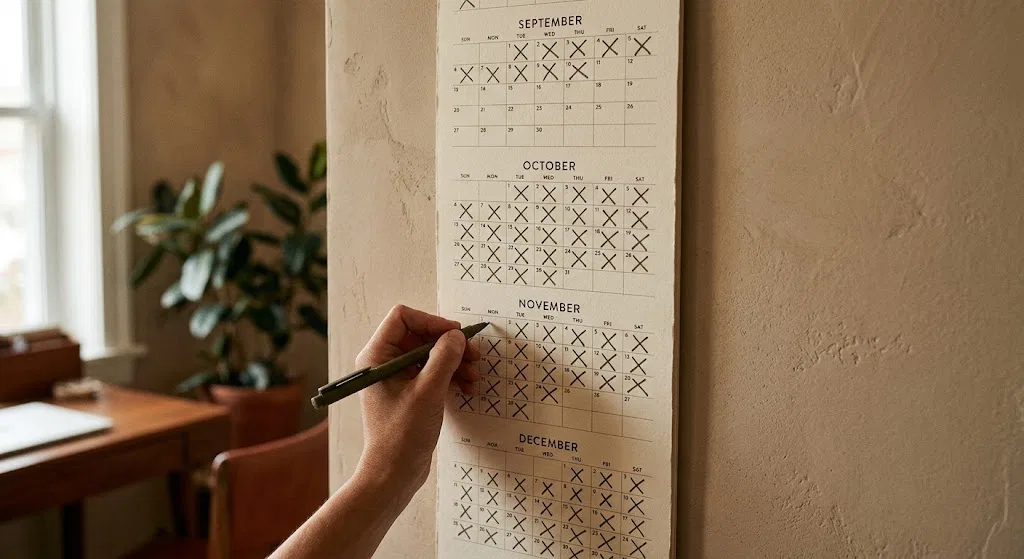
Habit formation has no universal deadline, and research finds wide variation between people and behaviours.
On this page
- Why 21 days is not a rule
- What modern reviews estimate
- Why individual timelines vary so much
Page outline Jump by section
Introduction
There is no scientifically established number of days after which a new behaviour suddenly becomes a habit. The familiar 21-day rule is not a finding from modern habit research, and even the better-known figure of 66 days should not be treated as a replacement deadline. Studies instead show a wide spread: some relatively simple behaviours become substantially automatic within weeks, while others take many months, and some people do not reach the researchers’ chosen habit threshold during the study at all.[Wiley Online Library]onlinelibrary.wiley.comWiley Online LibraryHow are habits formed: Modelling habit formation in the real world - Lally - 2010 - European Journal of Social Psycho…
The most useful lesson for self-improvement is therefore not “repeat this for exactly X days”. It is to expect a gradual learning process whose speed depends on the person, the behaviour and the circumstances in which it is repeated. A 2024 systematic review of health-related habits found median formation times of roughly two months in the studies that directly measured them, but individual estimates stretched from 4 to 335 days. Just as importantly, the review found that surprisingly few studies have actually measured how long habit formation takes.[PubMed Central (PMC)]pmc.ncbi.nlm.nih.govOpen source on nih.gov.
Why 21 days is not a rule
The 21-day claim can be traced largely to plastic surgeon Maxwell Maltz and his 1960 book Psycho-Cybernetics. Maltz described observations such as patients adjusting to changes in their appearance and argued that it generally took a minimum of about 21 days for a changed mental image to become familiar. The passage was about adjustment and self-image rather than a controlled experiment testing how long everyday behaviours take to become habitual.[Penguin Random House Canada]penguinrandomhouse.caOpen source on penguinrandomhouse.ca.
That distinction became blurred as the idea travelled through self-help culture. “A minimum of about 21 days” is easily transformed into the much simpler promise that doing something for 21 consecutive days creates a habit. But the two statements are not equivalent. Maltz was not establishing a universal behavioural threshold, and contemporary habit research does not support one.[Penguin Random House Canada]penguinrandomhouse.caOpen source on penguinrandomhouse.ca.
The deeper problem is the assumption that habit formation resembles crossing a finish line. In behavioural science, a habit is usually understood not merely as something done frequently but as a response that becomes increasingly automatically prompted by a recurring context or cue. Repeating an action in a sufficiently stable situation gradually strengthens the association between that situation and the response.[Taylor & Francis Online]tandfonline.comTaylor & Francis OnlinePromoting habit formation: Health Psychology Review: Vol 7, No sup1 - Get AccessOctober 11, 2011…
That learning process does not ordinarily jump from “not a habit” on day 20 to “habit” on day 21. In the influential real-world study by Phillippa Lally and colleagues, participants’ increases in automaticity were better represented by an asymptotic curve: gains tended to be larger earlier and then became progressively smaller as automaticity approached a plateau.[Wiley Online Library]onlinelibrary.wiley.comWiley Online LibraryHow are habits formed: Modelling habit formation in the real world - Lally - 2010 - European Journal of Social Psycho…
This makes fixed challenges easy to misunderstand. Completing 21 days of walking, reading or stretching can certainly establish useful repetition. It simply does not mean that the behaviour is now permanently automatic, nor that needing deliberate effort on day 22 represents failure.
What modern research actually estimates
The study responsible for the famous “66 days” figure followed 96 volunteers who selected a new eating, drinking or physical-activity behaviour and tried to perform it daily in the same context for 12 weeks. They repeatedly rated how automatic the behaviour felt. Among participants whose data could be modelled appropriately, estimated time to reach 95% of their eventual automaticity varied from 18 to 254 days. Later summaries report a median of about 66 days.[Wiley Online Library]onlinelibrary.wiley.comWiley Online LibraryHow are habits formed: Modelling habit formation in the real world - Lally - 2010 - European Journal of Social Psycho…
The range matters more than the headline number. Sixty-six days was a description of the middle of a highly variable distribution in a particular study, not a biological rule. Moreover, the mathematical habit-formation curve fitted only 62 participants’ data, and fitted particularly well for 39, another reason not to turn the estimate into a universal countdown.[Wiley Online Library]onlinelibrary.wiley.comWiley Online LibraryHow are habits formed: Modelling habit formation in the real world - Lally - 2010 - European Journal of Social Psycho…
Subsequent studies have produced similarly varied estimates. A 2024 systematic review and meta-analysis examined 20 studies involving 2,601 participants and health-related behaviours including physical activity, healthier eating, water consumption, flossing and reduced sedentary behaviour. Only four studies, however, directly reported a mean or median time to habit formation. Across those studies, medians were 59 to 66 days, while means ranged from 106 to 154 days. Individual estimates across relevant studies ranged from 4 to 335 days.[PubMed Central (PMC)]pmc.ncbi.nlm.nih.govOpen source on nih.gov.
Some examples show why one average conceals so much:
- In one healthy-eating study, those who reached the specified habit threshold did so in a median of 59 days, but estimates ranged from 4 to 335 days, and only about 23% of participants reached that threshold.[PubMed Central (PMC)]pmc.ncbi.nlm.nih.govOpen source on nih.gov.
- Lally and colleagues’ eating, drinking and activity study produced the frequently cited 66-day estimate, with individual modelled times ranging from 18 to 254 days.[Wiley Online Library]onlinelibrary.wiley.comWiley Online LibraryHow are habits formed: Modelling habit formation in the real world - Lally - 2010 - European Journal of Social Psycho…
- In a 90-day study of a daily stretching routine, researchers extrapolated the learning curves to estimate automaticity at roughly 106 days for morning stretching and 154 days for evening stretching.[PubMed]pubmed.ncbi.nlm.nih.govPub Med Effects of circadian cortisol on the development of a health habitEffects of circadian cortisol on the development of a health habit - PubMedNovember 1, 2017…
- Another study in the review, using participants’ own reports for healthy eating and self-weighing, produced a mean estimate of about 91 days, with substantial variation around that average.[PubMed Central (PMC)]pmc.ncbi.nlm.nih.govOpen source on nih.gov.
The 2024 review therefore concluded that health habits may commonly require roughly two to five months to develop substantial automaticity, while stressing the considerable person-to-person variation. That is a more defensible expectation than three weeks, but it still should not be interpreted as a guaranteed window.[PubMed Central (PMC)]pmc.ncbi.nlm.nih.govOpen source on nih.gov.
There is another reason for caution: the evidence base remains thinner than the confidence of popular habit advice might suggest. Of the 20 studies in that review, only four directly yielded formation-time estimates, and 11 were rated as having a high risk of bias. The authors explicitly identified the scarcity of studies directly measuring time to habit formation as an important research gap.[PubMed Central (PMC)]pmc.ncbi.nlm.nih.govOpen source on nih.gov.
So “science says it takes 66 days” is only marginally better than “science says 21 days”. The more accurate summary is that habit formation is gradual, measurable timelines vary enormously, and current research does not justify a single countdown for everyone or every behaviour.
Why individual timelines vary so much
Variation is not statistical noise that can simply be averaged away. It reflects meaningful differences in what people are trying to automate and the circumstances in which they repeat it.
One important factor is behavioural complexity. Drinking a glass of water after breakfast is a short, discrete response with a clear cue. “Exercise regularly” may involve changing clothes, travelling somewhere, choosing a workout and sustaining substantial effort. The 2024 review found that the type of behaviour was among the factors associated with habit development, and the wide estimates across eating, stretching, activity and other behaviours make clear that they cannot sensibly be assumed to share an identical timetable.[PubMed Central (PMC)]pmc.ncbi.nlm.nih.govOpen source on nih.gov.
A second factor is repetition in a stable context. Habit theory proposes that repeated behaviour becomes linked to situational cues. The cue might be finishing breakfast, arriving home, entering a particular room or completing another routine. Research examining context stability has found that more stable contexts are associated with greater automaticity and better goal attainment, supporting the idea that simply counting repetitions without considering where and when they occur misses part of the learning process.[PubMed Central (PMC)]pmc.ncbi.nlm.nih.govOpen source on nih.gov.
This helps explain why “I have done it 30 times” is not necessarily equivalent to “I have trained the same cue-response relationship 30 times”. Thirty repetitions scattered unpredictably across different situations may produce a different learning history from 30 repetitions consistently attached to the same recurring event.
Timing can matter too, although findings should not be overgeneralised from individual studies. In the stretching experiment, the morning group’s habit curve developed faster than the evening group’s, with researchers proposing a role for normal daily variation in cortisol. The 2024 review likewise identified timing among the factors associated with habit strength.[PubMed]pubmed.ncbi.nlm.nih.govPub Med Effects of circadian cortisol on the development of a health habitEffects of circadian cortisol on the development of a health habit - PubMedNovember 1, 2017…
Personal choice, enjoyment, behavioural regulation and frequency of performance also emerged as potentially relevant determinants in the review. These findings are useful partly because they undermine the notion of a standard human habit clock: two people performing nominally the same behaviour may experience different rewards, barriers, schedules and environmental cues.[PubMed Central (PMC)]pmc.ncbi.nlm.nih.govOpen source on nih.gov.
A missed day does not reset the clock
The deadline myth often comes with a second misconception: that uninterrupted streaks are essential and a single lapse sends progress back to zero.
Lally and colleagues found that missing one opportunity to perform the behaviour did not materially disrupt the habit-formation process. Automaticity accumulated through repeated experience rather than behaving like a streak counter that reset after a lapse.[Wiley Online Library]onlinelibrary.wiley.comWiley Online LibraryHow are habits formed: Modelling habit formation in the real world - Lally - 2010 - European Journal of Social Psycho…
That does not mean consistency is irrelevant. More consistent performance was associated with better-fitting habit-development curves, and repetition remains fundamental to the proposed learning mechanism. The important distinction is between occasional misses and persistent inconsistency. One missed walk or forgotten vitamin is not evidence that all previous learning has vanished; repeatedly failing to enact the behaviour in its intended context is a more consequential problem.[Wiley Online Library]onlinelibrary.wiley.comWiley Online LibraryHow are habits formed: Modelling habit formation in the real world - Lally - 2010 - European Journal of Social Psycho…
This is one of the most practically useful consequences of abandoning the 21-day model. A rigid deadline encourages binary thinking: either the streak survives or it has been “broken”. The research points instead towards accumulated learning. What matters is whether the cue-response association keeps receiving enough repeated reinforcement over time.
The better question is not “What day will it become automatic?”
Habit studies often need a numerical threshold so researchers can analyse data, but everyday life does not provide a single objective moment when an action officially qualifies as a habit. In research, automaticity is commonly measured with questionnaires and modelled as a continuous variable that rises with repetition. Reviews of the field also caution that habit measurement has relied heavily on self-report and that researchers have not always used the term “habit” consistently.[PubMed Central (PMC)]pmc.ncbi.nlm.nih.govPubMed Central (PMC)A review and analysis of the use of ‘habit’ in understanding, predicting and influencing health-related behaviour - PMC…
For self-improvement, it is therefore more useful to watch for changing effort than to await a particular date. A behaviour is moving in a habitual direction when the familiar situation increasingly prompts the action with less conscious negotiation: finishing breakfast starts to cue taking medication, shutting a laptop starts to cue laying out tomorrow’s work, or arriving home starts to cue a short walk.
The shape of Lally and colleagues’ results also suggests that early repetition deserves patience. Because automaticity tended to rise towards a plateau rather than appearing all at once, a behaviour can be meaningfully strengthening even while it still feels deliberate.[Wiley Online Library]onlinelibrary.wiley.comWiley Online LibraryHow are habits formed: Modelling habit formation in the real world - Lally - 2010 - European Journal of Social Psycho…
A more evidence-aligned expectation is therefore:
Think in months rather than in a three-week promise, but do not turn “two months” or “66 days” into a new myth. Simple behaviours may automate faster; demanding ones may take much longer; some people will progress unusually quickly or slowly; and not every attempt reaches high automaticity at all. The current evidence supports a range, not a deadline.[PubMed Central (PMC)]pmc.ncbi.nlm.nih.govOpen source on nih.gov.
What realistic timelines change
Replacing the 21-day promise with a variable timeline changes the interpretation of early difficulty. If a new behaviour still requires reminders after three or four weeks, that is not evidence that habit formation has failed. In the best-known longitudinal study, many modelled trajectories extended far beyond that point, and the recent systematic review places typical health-habit estimates substantially later.[Wiley Online Library]onlinelibrary.wiley.comWiley Online LibraryHow are habits formed: Modelling habit formation in the real world - Lally - 2010 - European Journal of Social Psycho…
It also changes what a useful commitment period looks like. A “21-day challenge” can be a convenient starting structure, but its end should not be confused with the end of habit formation. For behaviours that matter, continuing repetition for several months is more consistent with the empirical literature than assuming three weeks will make the behaviour effortless.[PubMed Central (PMC)]pmc.ncbi.nlm.nih.govOpen source on nih.gov.
Most importantly, the research redirects attention from counting days to building repeatable conditions. Habit formation is better understood as repeated learning in context than as serving a fixed sentence of willpower. The calendar still matters because learning requires time, but the evidence does not support a magic day on which discipline can safely be switched off.
For self-improvement that works, the useful milestone is therefore not day 21, day 66 or any other universal number. It is the point at which a well-chosen cue increasingly brings the desired behaviour to mind and makes starting it easier — a process that research suggests may take weeks for some behaviours, several months for many others, and substantially longer in some people.[Taylor & Francis Online]tandfonline.comTaylor & Francis OnlinePromoting habit formation: Health Psychology Review: Vol 7, No sup1 - Get AccessOctober 11, 2011…
Amazon book picks
Further Reading
Books and field guides related to How Long Does a Habit Really Take?. Use these as the next step if you want deeper reading beyond the article.
Atomic Habits
Rating: 3.5/5 from 7 Google Books ratings
The #1 New York Times bestseller. Over 25 million copies sold! Translated into 60+ languages! Tiny Changes, Remarkable Results No matter...
Good Habits, Bad Habits
'The world's leading expert on habits' - Matthew Syed, bestselling author of Black Box Thinking and Rebel IdeasWhat if you could harness...
Tiny Habits
Improving your life is much easier than you think. Whether it’s losing weight, sleeping more, or restoring your work/life balance – the s...
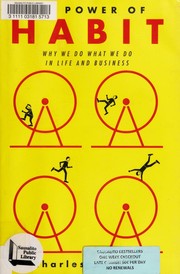
The Power of Habit
Rating: 4.0/5 from 145 Google Books ratings
Duhigg takes us to the edge of scientific discoveries that explain why habits exist and how they can be changed. Distilling information i...
eBay marketplace picks
Marketplace Samples
Live-tested eBay searches with available results related to this page.
Selected frommotivational poster oneBay.co.uk.

Current eBay listing
Motivational Quotes Framed Wall Art Poster Canvas Print Picture

Current eBay listing
Gym Motivational Posters Work Out Insperational Quotes Wall Art
Endnotes
1.
Source: onlinelibrary.wiley.com
Link:https://onlinelibrary.wiley.com/doi/10.1002/ejsp.674
Source snippet
Wiley Online LibraryHow are habits formed: Modelling habit formation in the real world - Lally - 2010 - European Journal of Social Psycho...
2.
Source: compass.onlinelibrary.wiley.com
Link:https://compass.onlinelibrary.wiley.com/doi/10.1111/spc3.12975
3.
Source: compass.onlinelibrary.wiley.com
Link:https://compass.onlinelibrary.wiley.com/doi/full/10.1111/spc3.12975
4.
Source: bpspsychub.onlinelibrary.wiley.com
Link:https://bpspsychub.onlinelibrary.wiley.com/doi/abs/10.1111/bjhp.12504
5.
Source: onlinelibrary.wiley.com
Link:https://onlinelibrary.wiley.com/doi/abs/10.1002/ejsp.674
6.
Source: onlinelibrary.wiley.com
Link:https://onlinelibrary.wiley.com/doi/abs/10.1002/ejsp.674?MixPanelId=15e3fe314440-0468d8411-64220f54-100000-15e3fe314460
7.
Source: onlinelibrary.wiley.com
Link:https://onlinelibrary.wiley.com/doi/abs/10.1002/ejsp.674?source=content_type%3Areact%7Cfirst_level_url%3Aarticle%7Csection%3Amain_content%7Cbutton%3Abody_link
8.
Source: onlinelibrary.wiley.com
Link:https://onlinelibrary.wiley.com/doi/abs/10.1002/ejsp.674?cf_chl_jschl_tk=pmd_EwcJDaCFBR9OVEL1O_0qjioww0Gc86ZzpBvCBFhrDcE-1635261061-0-gqNtZGzNAjujcnBszQi9
9.
Source: onlinelibrary.wiley.com
Link:https://onlinelibrary.wiley.com/doi/abs/10.1002/ejsp.674?msockid=17570258034862e732eb114c02616368
10.
Source: onlinelibrary.wiley.com
Link:https://onlinelibrary.wiley.com/doi/10.1002/ejsp.674?538fcd4b_page=1&947f74f7page=3&=%2Fen-gt%2Four-commitment%23kI3HdLdDj7HLFW4BJlUYoy23RoHF9sl3JcIXrw%3D%3D
11.
Source: onlinelibrary.wiley.com
Link:https://onlinelibrary.wiley.com/doi/full/10.1002/ejsp.674
12.
Source: pmc.ncbi.nlm.nih.gov
Link:https://pmc.ncbi.nlm.nih.gov/articles/PMC11641623/
13.
Source: penguinrandomhouse.ca
Link:https://www.penguinrandomhouse.ca/books/318795/psycho-cybernetics-by-maxwell-maltz-md-fics/9780399176135/excerpt
14.
Source: tandfonline.com
Link:https://www.tandfonline.com/doi/full/10.1080/17437199.2011.603640
Source snippet
Taylor & Francis OnlinePromoting habit formation: Health Psychology Review: Vol 7, No sup1 - Get AccessOctober 11, 2011...
Published: October 11, 2011
15.
Source: pmc.ncbi.nlm.nih.gov
Link:https://pmc.ncbi.nlm.nih.gov/articles/PMC4566897/
Source snippet
PubMed Central (PMC)A review and analysis of the use of ‘habit’ in understanding, predicting and influencing health-related behaviour - PMC...
16.
Source: doi.org
Link:https://doi.org/10.1111/bjhp.12504
Source snippet
Habit formation following routine‐based versus time‐based cue planning: A randomized controlled trial - Keller - 2021 - British Journa...
17.
Source: pubmed.ncbi.nlm.nih.gov
Title: Pub Med Effects of circadian cortisol on the development of a health habit
Link:https://pubmed.ncbi.nlm.nih.gov/28650196/
Source snippet
Effects of circadian cortisol on the development of a health habit - PubMedNovember 1, 2017...
Published: November 1, 2017
18.
Source: pmc.ncbi.nlm.nih.gov
Link:https://pmc.ncbi.nlm.nih.gov/articles/PMC9226889/
19.
Source: pubmed.ncbi.nlm.nih.gov
Link:https://pubmed.ncbi.nlm.nih.gov/39685110/
20.
Source: doi.org
Link:https://doi.org/10.3390/healthcare12232488
21.
Source: pmc.ncbi.nlm.nih.gov
Link:https://pmc.ncbi.nlm.nih.gov/articles/PMC11635918/
22.
Source: pmc.ncbi.nlm.nih.gov
Link:https://pmc.ncbi.nlm.nih.gov/articles/PMC10131734/
23.
Source: pubmed.ncbi.nlm.nih.gov
Link:https://pubmed.ncbi.nlm.nih.gov/35382707/
24.
Source: tandfonline.com
Link:https://www.tandfonline.com/doi/full/10.1080/23311908.2022.2041277
25.
Source: tandfonline.com
Link:https://www.tandfonline.com/doi/full/10.1080/08870446.2021.2003362
26.
Source: pubmed.ncbi.nlm.nih.gov
Link:https://pubmed.ncbi.nlm.nih.gov/33651994/
27.
Source: pubmed.ncbi.nlm.nih.gov
Link:https://pubmed.ncbi.nlm.nih.gov/33405284/
28.
Source: pmc.ncbi.nlm.nih.gov
Link:https://pmc.ncbi.nlm.nih.gov/articles/PMC3505409/
29.
Source: pubmed.ncbi.nlm.nih.gov
Link:https://pubmed.ncbi.nlm.nih.gov/22935297/
30.
Source: pmc.ncbi.nlm.nih.gov
Link:https://pmc.ncbi.nlm.nih.gov/articles/PMC3552971/
31.
Source: doi.org
Link:https://doi.org/10.1080/17437199.2011.603640%C2%A0
32.
Source: tandfonline.com
Link:https://www.tandfonline.com/doi/abs/10.1080/17437199.2011.603640
33.
Source: tandfonline.com
Link:https://www.tandfonline.com/doi/abs/10.1080/17437199.2011.603640?scroll=top&tab=permissions
Additional References
34.
Source: ucl.ac.uk
Title: University College London How long does it take to form a habit? | UCL News
Link:https://www.ucl.ac.uk/news/2009/aug/how-long-does-it-take-form-habit%20
Source snippet
University College LondonHow long does it take to form a habit? | UCL News - UCL – University College London...
35.
Source: youtube.com
Title: The 21-Day Habit is Killing Your Growth w/B.J Fogg
Link:https://www.youtube.com/watch?v=lXPy6IqrqQ0
Source snippet
For a direct breakdown of why the standard timeframe fails and what the science actually shows, check out Healthy Habits Take Time: Syste...
36.
Source: youtube.com
Title: The [21-day myth]({{ ‘21-day-myth/’ | relative_url }})? How Long Does It Really Take to Make or Break a Habit?
Link:https://www.youtube.com/watch?v=ualVvIyiHn8
Source snippet
Healthy Habits Take Time: Systematic Review Debunks 21-Day Habit Myth...
37.
Source: youtube.com
Title: Healthy Habits Take Time: Systematic Review Debunks 21-Day Habit Myth
Link:https://www.youtube.com/watch?v=y4bft0nAGQs
Source snippet
How Long Does It Take to Build a Habit? HINT: It's NOT 21 Days...
38.
Source: youtube.com
Title: How Long Does It Take to Build a Habit? HINT: It’s NOT 21 Days
Link:https://www.youtube.com/watch?v=cJ2gxIsScmk
Source snippet
The Science of Habits (And the 21 Day MYTH)...
39.
Source: researchgate.net
Link:https://www.researchgate.net/publication/348328187_Habit_formation_following_routine-based_versus_time-based_cue_planning_A_randomized_controlled_trial
40.
Source: researchgate.net
Link:https://www.researchgate.net/publication/386593213_Time_to_Form_a_Habit_A_Systematic_Review_and_Meta-Analysis_of_Health_Behaviour_Habit_Formation_and_Its_Determinants
41.
Source: surrey.ac.uk
Link:https://www.surrey.ac.uk/news/does-it-really-take-66-days-form-habit-we-asked-expert-dr-pippa-lally
42.
Source: arclifyapp.com
Link:https://arclifyapp.com/habits/how-long-does-it-take-to-build-a-habit
43.
Source: keepmewise.com
Link:https://keepmewise.com/blog/how-long-to-build-a-habit/