Within Accountability
Why Does Someone Else Seeing Progress Matter?
Making progress visible to someone else can strengthen the feedback loop between what you intended to do and what you actually did.
On this page
- From private monitoring to socially consequential monitoring
- What the progress monitoring meta analysis found
- Why visibility helps without requiring public posting
Page outline Jump by section
Introduction
Another person seeing your progress can improve follow-through because it changes monitoring from a purely private act into one with social consequences. Instead of simply noticing whether you did what you intended, you know that the result will be visible to somebody else. Experimental evidence suggests that this distinction matters.
The strongest broad evidence comes from a meta-analysis of 138 experimental studies involving 19,951 participants. Interventions that increased progress monitoring improved goal attainment overall, but the effects were larger when monitoring results were reported to another person or made public than when they remained private. Importantly, reporting to just one other person was enough to show this pattern; the evidence does not imply that broadcasting progress publicly is necessary.[PubMed]pubmed.ncbi.nlm.nih.govDoes monitoring goal progress promote goal attainment? A meta-analysis of the experimental evidence - PubMedFebruary 1, 2016…
That makes social visibility a potentially useful addition to self-improvement: not because another person must police the goal, but because the evidence of what happened becomes harder to overlook, reinterpret or quietly abandon.
From private monitoring to socially consequential monitoring
Progress monitoring already performs an important self-regulatory function. It tells you where your behaviour or outcome currently stands relative to where you want it to be. In the 2016 meta-analysis led by Benjamin Harkin and Thomas Webb, interventions designed to increase monitoring produced a very large increase in monitoring frequency, with an average effect size of d = 1.98. More importantly for actual goal pursuit, they produced a smaller but meaningful improvement in goal attainment, d = 0.40. Changes in monitoring frequency statistically mediated the improvement in attainment.[White Rose Research Online]eprints.whiterose.ac.ukOpen source on whiterose.ac.uk.
Social visibility appears to strengthen this basic feedback loop. The researchers distinguished three forms of monitoring: progress monitored publicly; progress monitored privately and then reported to at least one other person; and progress monitored privately without being reported. Their example of the middle category was deliberately ordinary: a person could weigh themselves privately and then telephone a research assistant with the result.[White Rose Research Online]eprints.whiterose.ac.ukOpen source on whiterose.ac.uk.
That distinction matters because it separates being accountable to somebody from performing a goal in front of an audience. A private spreadsheet sent to a coach, a weekly step count given to a friend or a completed-session total reported to a colleague can all make progress socially visible without making it broadly public.
Why might that alter behaviour? Harkin and colleagues proposed several possible explanations, including public commitment, personal accountability and concerns about how one’s performance will appear to others. The common feature is that the information no longer exists solely inside the person’s private self-assessment. Someone else can now observe whether actions and intentions match.[White Rose Research Online]eprints.whiterose.ac.ukOpen source on whiterose.ac.uk.
This interpretation fits the broader idea of supportive accountability developed by David Mohr and colleagues. Their model defines accountability around an expectation that a person may have to account for actions or inaction. It argues that human support is particularly useful when expectations are clear and process-focused and when the person receiving progress information is regarded as trustworthy, benevolent and credible.[JMIR]jmir.orgJournal of Medical Internet ResearchJournal of Medical Internet Research - Supportive Accountability: A Model for Providing Human Support to Enhance Adherence to eHealth…
The qualification is important. The social element is not simply “pressure”. Visibility can create a reason to keep tracking and acting, while the other person’s role can make that information consequential. The supportive-accountability model explicitly cautions against framing monitoring as threatening surveillance; it instead emphasises agreed expectations and a relationship that provides benefits to the person pursuing the goal.[JMIR]jmir.orgJournal of Medical Internet ResearchJournal of Medical Internet Research - Supportive Accountability: A Model for Providing Human Support to Enhance Adherence to eHealth…
What the progress-monitoring meta-analysis found
The most revealing result for social accountability lies in the meta-analysis’s moderator analysis. When progress was monitored privately and not reported, the estimated effect on goal attainment was d = 0.19. When monitoring was conducted privately but reported to at least one other person, the effect was d = 0.47. Public monitoring produced an estimated d = 0.55.[White Rose Research Online]eprints.whiterose.ac.ukOpen source on whiterose.ac.uk.
Those figures should not be treated as though the researchers ran one giant experiment randomly assigning nearly 20,000 people to private, reported and public tracking. They did not. These are subgroup estimates across different experiments whose interventions had different characteristics. The underlying studies were also highly heterogeneous, and the authors noted that better-quality studies generally tended to produce smaller effects.[White Rose Research Online]eprints.whiterose.ac.ukOpen source on whiterose.ac.uk.
So the evidence supports a careful conclusion: progress-monitoring interventions tended to work better when the resulting information became visible to someone else. It does not establish that visibility itself accounts for the entire difference between the subgroup effect sizes.
That caution is particularly important for the public-monitoring result. Only three studies, representing roughly 214 participants in the goal-attainment analysis, fell into the public category. By contrast, the private-but-reported estimate drew on 95 studies and more than 12,000 participants. The evidence base is therefore much stronger for the ordinary act of reporting progress than for conspicuously pursuing a goal in front of a group.[White Rose Research Online]eprints.whiterose.ac.ukOpen source on whiterose.ac.uk.
The authors themselves called for experiments directly comparing reported and unreported monitoring so researchers could identify whether mechanisms such as accountability, public commitment or presentational concerns actually explain the advantage. In other words, the meta-analysis identifies a strong and useful pattern, but it does not settle exactly why social visibility works.[White Rose Research Online]eprints.whiterose.ac.ukOpen source on whiterose.ac.uk.
Another result reinforces the general idea that progress becomes more consequential when it leaves the realm of fleeting private thought. Physically recording monitoring information was associated with a larger goal-attainment effect (d = 0.43) than not recording it (d = 0.29). The authors suggested that records may make progress easier to remember and harder to ignore or reinterpret.[White Rose Research Online]eprints.whiterose.ac.ukOpen source on whiterose.ac.uk.
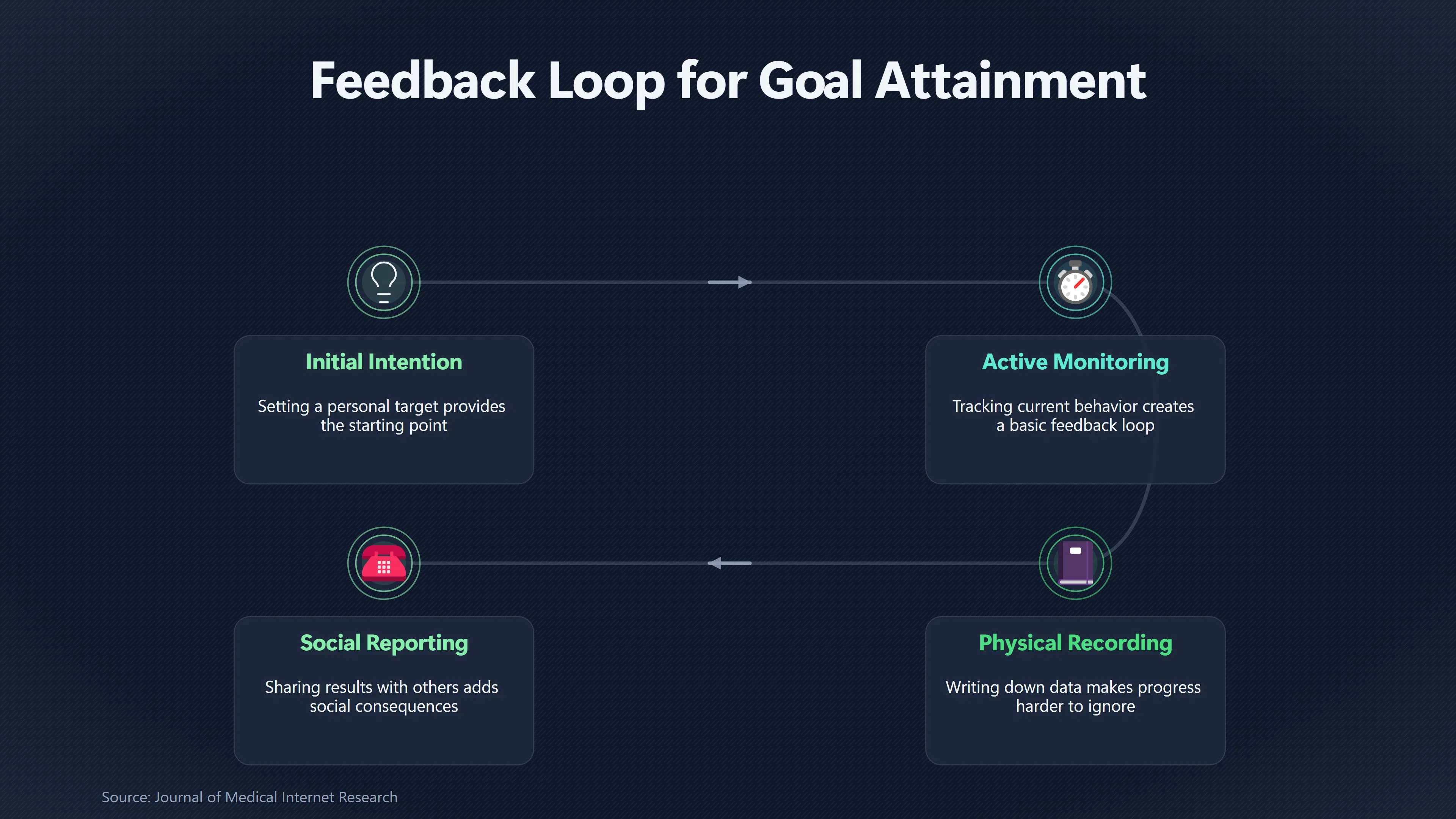
Taken together, these findings suggest a progression from weak to stronger feedback: merely intending to improve provides little information; monitoring creates feedback; recording preserves that feedback; and reporting it gives the feedback a social audience.
A direct test of someone else seeing the record
More recent experimental research offers a particularly clean example of this principle. A 2024 study in Obesity randomly assigned 322 adults taking part in a 12-week behavioural weight-loss programme to conditions that differed in whether their coaches could access their digital self-monitoring data. Everyone was asked to track weight, physical activity and food intake. In the “Coach Share ON” condition, coaches could regularly view information from participants’ wireless scales, activity sensors and food records through an online portal.[PubMed]pubmed.ncbi.nlm.nih.govCoach access to digital self-monitoring data: an experimental test of short-term effects in behavioral weight-loss treatment - PubM…
This is useful evidence because the crucial difference was not whether participants possessed tracking technology: both groups did. The manipulation concerned whether the person providing support could actually see what had been tracked.[PubMed Central (PMC)]pmc.ncbi.nlm.nih.govPubMed Central (PMC)Coach access to digital self-monitoring data: An experimental test of short-term effects in behavioral weight loss tr…
After 12 weeks, participants whose coaches had access to their records had lost an average 6.2% of their initial weight, compared with 5.3% among those whose coaches could not access the data. Dietary self-monitoring was also more consistent when coaches could see it: 98.05% versus 93.51% of days. Activity self-monitoring differed more modestly, at 98.70% versus 97.40% of days. Participants in the data-sharing condition also reported significantly greater supportive accountability.[PubMed]pubmed.ncbi.nlm.nih.govCoach access to digital self-monitoring data: an experimental test of short-term effects in behavioral weight-loss treatment - PubM…
Not everything changed. Actual measured physical activity did not significantly differ between groups, nor did programme attendance, working alliance with coaches or frequency of weight self-monitoring. That is informative because it argues against a simplistic interpretation in which coach visibility automatically improves every behaviour. Instead, making records visible produced selective improvements in monitoring and a modest improvement in the primary outcome.[PubMed]pubmed.ncbi.nlm.nih.govCoach access to digital self-monitoring data: an experimental test of short-term effects in behavioral weight-loss treatment - PubM…
The study also addresses an obvious concern about accountability: perhaps knowing that a coach can inspect your records makes the relationship uncomfortable and encourages avoidance. The researchers found no significant deterioration in working alliance, attendance or treatment satisfaction. Within this particular programme and population, making data visible increased perceived accountability without detectable damage to those measures of engagement or rapport.[PubMed Central (PMC)]pmc.ncbi.nlm.nih.govPubMed Central (PMC)Coach access to digital self-monitoring data: An experimental test of short-term effects in behavioral weight loss tr…
There are still limits to what this experiment proves. Coaches with access to detailed records could potentially provide better-informed feedback, goal-setting and problem-solving, so the effect cannot automatically be attributed entirely to the participant’s feeling of being observed. The authors themselves identify both supportive accountability and better-informed coaching as plausible explanations. The study was also short-term and conducted within a structured behavioural weight-management programme, so its precise effect sizes should not be generalised to every self-improvement goal.[PubMed Central (PMC)]pmc.ncbi.nlm.nih.govPubMed Central (PMC)Coach access to digital self-monitoring data: An experimental test of short-term effects in behavioral weight loss tr…
Even with those qualifications, it provides unusually concrete support for the core idea: holding the same sort of progress data is not necessarily equivalent to knowing that another person can see it.
Why visibility does not require public posting
The practical implication of this evidence is narrower than “tell everyone your goals”. The strongest dataset does not show that a large audience is necessary. In Harkin and colleagues’ analysis, privately collected progress that was subsequently reported to at least one person was associated with substantially better goal-attainment effects than private, unreported monitoring.[White Rose Research Online]eprints.whiterose.ac.ukOpen source on whiterose.ac.uk.
That means social visibility can remain discreet. Someone trying to establish a regular exercise habit might record completed sessions and send the weekly total to one friend. Someone studying could tell a tutor or colleague how many planned sessions were actually completed. The relevant change is not the size of the audience but the transition from “only I will see whether this happened” to “another person will also have access to the result”.
This also explains why reporting progress is different from announcing an intention. The evidence reviewed by Harkin and colleagues concerns monitoring information generated during goal pursuit: steps taken, weight measured, behaviours recorded, symptoms logged or other indicators of actual progress. What becomes socially visible is evidence about performance, not merely an aspirational statement made before any work has occurred.[White Rose Research Online]eprints.whiterose.ac.ukOpen source on whiterose.ac.uk.
For self-improvement, that distinction is valuable. An accountability arrangement does not need followers, a public streak or continual encouragement. It needs a sufficiently clear measure that another person can see whether the intended action occurred. The best-supported version is therefore quite modest: track something meaningful, preserve the result and make that result visible to someone whose involvement feels legitimate and supportive. The evidence suggests that this small shift from private monitoring to socially visible monitoring can strengthen the connection between intention and follow-through, while leaving plenty of room for privacy.[White Rose Research Online]eprints.whiterose.ac.ukOpen source on whiterose.ac.uk.

Amazon book picks
Further Reading
Books and field guides related to Why Does Someone Else Seeing Progress Matter?. Use these as the next step if you want deeper reading beyond the article.
The 12 Week Year
The guide to shortening your execution cycle down from one year to twelve weeks Most organizations and individuals work in the context of...
The Four Tendencies
NEW YORK TIMES BESTSELLER • Are you an Upholder, a Questioner, an Obliger, or a Rebel? From the author of Better Than Before and The Happ...

Influence
Rating: 3.9/5 from 68 Google Books ratings
This is a Summary of the original book, Influence: The Psychology of Persuasion by Robert Cialdini.The book is an authoritative work on t...
Atomic Habits
Rating: 3.5/5 from 7 Google Books ratings
The #1 New York Times bestseller. Over 25 million copies sold! Translated into 60+ languages! Tiny Changes, Remarkable Results No matter...
eBay marketplace picks
Marketplace Samples
Live-tested eBay searches with available results related to this page.
Selected frommotivational poster oneBay.co.uk.



Current eBay listing
Gym Motivational Posters Work Out Insperational Quotes Wall Art

Current eBay listing
Motivational Quotes Framed Wall Art Poster Canvas Print Picture
Endnotes
1.
Source: jmir.org
Title: Journal of Medical Internet Research
Link:https://www.jmir.org/2011/1/E30/
Source snippet
Journal of Medical Internet Research - Supportive Accountability: A Model for Providing Human Support to Enhance Adherence to eHealth...
3.
Source: jmir.org
Title: Journal of Medical Internet Research
Link:https://www.jmir.org/2011/1/e30/authors
4.
Source: jmir.org
Title: Journal of Medical Internet Research
Link:https://www.jmir.org/2011/1/E30/metrics
5.
Source: jmir.org
Title: Journal of Medical Internet Research
Link:https://www.jmir.org/2011/1/e30/citations
6.
Source: jmir.org
Title: Journal of Medical Internet Research
Link:https://www.jmir.org/2011/1/e30/tweetations
7.
Source: pubmed.ncbi.nlm.nih.gov
Link:https://pubmed.ncbi.nlm.nih.gov/26479070/
Source snippet
Does monitoring goal progress promote goal attainment? A meta-analysis of the experimental evidence - PubMedFebruary 1, 2016...
Published: February 1, 2016
8.
Source: eprints.whiterose.ac.uk
Link:https://eprints.whiterose.ac.uk/id/eprint/91437/
Source snippet
White Rose Research OnlineDoes Monitoring Goal Progress Promote Goal Attainment? A Meta-Analysis of the Experimental Evidence - White Ros...
9.
Source: eprints.whiterose.ac.uk
Link:https://eprints.whiterose.ac.uk/91437/8/3_PDFsam_Does%20monitoring%20goal.pdf
10.
Source: pubmed.ncbi.nlm.nih.gov
Link:https://pubmed.ncbi.nlm.nih.gov/21393123/
Source snippet
Supportive accountability: a model for providing human support to enhance adherence to eHealth interventions - PubMed...
11.
Source: pubmed.ncbi.nlm.nih.gov
Link:https://pubmed.ncbi.nlm.nih.gov/39358838/
Source snippet
Coach access to digital self-monitoring data: an experimental test of short-term effects in behavioral weight-loss treatment - PubM...
12.
Source: pmc.ncbi.nlm.nih.gov
Link:https://pmc.ncbi.nlm.nih.gov/articles/PMC11537830/
Source snippet
PubMed Central (PMC)Coach access to digital self-monitoring data: An experimental test of short-term effects in behavioral weight loss tr...
13.
Source: pmc.ncbi.nlm.nih.gov
Link:https://pmc.ncbi.nlm.nih.gov/articles/PMC11161849/
14.
Source: pmc.ncbi.nlm.nih.gov
Link:https://pmc.ncbi.nlm.nih.gov/articles/PMC9890352/
15.
Source: pmc.ncbi.nlm.nih.gov
Link:https://pmc.ncbi.nlm.nih.gov/articles/PMC8193990/
16.
Source: pmc.ncbi.nlm.nih.gov
Link:https://pmc.ncbi.nlm.nih.gov/articles/PMC7141666/
17.
Source: eprints.whiterose.ac.uk
Link:https://eprints.whiterose.ac.uk/id/eprint/87431/
18.
Source: pmc.ncbi.nlm.nih.gov
Link:https://pmc.ncbi.nlm.nih.gov/articles/PMC4520704/
19.
Source: pmc.ncbi.nlm.nih.gov
Link:https://pmc.ncbi.nlm.nih.gov/articles/PMC4711748/
20.
Source: pmc.ncbi.nlm.nih.gov
Link:https://pmc.ncbi.nlm.nih.gov/articles/PMC3221353/
21.
Source: pubmed.ncbi.nlm.nih.gov
Link:https://pubmed.ncbi.nlm.nih.gov/29189034/
Additional References
22.
Source: tandfonline.com
Link:https://www.tandfonline.com/doi/full/10.1080/17483107.2026.2677768
Source snippet
Current assistive-product use by self-reported disability status (N = 652). Download CSVDisplay Table Table 3. Assistive technology use b...
23.
Source: doi.org
Link:https://doi.org/10.1002/oby.24138
Source snippet
Coach access to digital self‐monitoring data: an experimental test of short‐term effects in behavioral weight‐loss treatment - Butryn...
24.
Source: youtube.com
Title: Thinkers vs. Do-ers: Why You Suck At Following Through
Link:https://www.youtube.com/watch?v=xSBGYoS6z68
Source snippet
Psychology of accountability social monitoring goal follow through Why Telling Everyone Your Goals Can Backfire | The Psychology of Motiv...
25.
Source: youtube.com
Link:https://www.youtube.com/watch?v=H1bDIREguok
Source snippet
The Science of Motivation & Achieving Goals - Dr Emily Balcetis, PhD...
26.
Source: youtube.com
Title: The Science of Motivation & Achieving Goals
Link:https://www.youtube.com/watch?v=_0ipg1_3Wec
Source snippet
The Psychology Of Human Motivation - Ayelet Fishbach...
27.
Source: youtube.com
Title: Keep your goals to yourself | Derek Sivers
Link:https://www.youtube.com/watch?v=NHopJHSlVo4
Source snippet
What to Do & Not Do When Setting Goals | Dr. Emily Balcetis & Dr. Andrew Huberman...
28.
Source: youtube.com
Title: The Psychology Of Human Motivation
Link:https://www.youtube.com/watch?v=N47G-mhMmO0
Source snippet
Thinkers vs. Do-ers: Why You Suck At Following Through...
29.
Source: researchgate.net
Link:https://www.researchgate.net/publication/4949001_Crime_control_policy_and_community_corrections_practice_Assessing_the_impact_of_gender_race_and_class
30.
Source: researchgate.net
Link:https://www.researchgate.net/publication/291335719_Does_Monitoring_Goal_Progress_Promote_Goal_Attainment_A_Meta-Analysis_of_the_Experimental_Evidence
31.
Source: visualize.jove.com
Link:https://visualize.jove.com/39358838-coach-access-to-digital-self-monitoring-data-an-experimental-test-of-short-term-effects-in-behavioral-weight-loss-treatment