Within Scale Up
Change One Part of a Habit at a Time
Raising duration, frequency, volume, difficulty, or quality one at a time makes it easier to see what the routine can sustain.
On this page
- The five common ways to make a habit harder
- Why simultaneous increases hide the cause of failure
- How to test whether the new version is sustainable
Page outline Jump by section
Introduction
Once a habit is consistent, the cleanest way to make it more ambitious is to change one demand at a time while leaving the rest of the routine as stable as practical. A 10-minute walk might become 15 minutes while staying on the same days and route; three weekly study sessions might become four while their length and difficulty remain unchanged. The point is not that research has established a universal “one-variable rule” for habits — it has not — but that gradual, isolated changes combine several evidence-backed principles: stable contexts support automaticity, graded tasks keep increases achievable, and monitoring one altered demand makes it easier to judge whether the new version can actually be maintained.[Frontiers]frontiersin.orgFrontiers Frontiers | Context Stability in Habit Building Increases Automaticity and Goal AttainmentFrontiersFrontiers | Context Stability in Habit Building Increases Automaticity and Goal AttainmentJune 10, 2022

This matters after consistency has been established because scaling creates a different problem from starting. The question is no longer simply “Can I do this behaviour?” but “How much more can I ask of this routine without making reliable repetition disappear?” Changing one variable turns that question into a practical test rather than a wholesale redesign.

The five common ways to make a habit harder
A stable routine can usually be expanded along five useful dimensions: duration, frequency, volume, difficulty and quality. These categories overlap in some activities, but separating them is useful because each imposes a somewhat different demand.
- Duration: make each occasion longer. A 10-minute reading session becomes 15 minutes; a 20-minute walk becomes 25.
- Frequency: add another occasion. Strength training twice a week becomes three times; reviewing vocabulary on four mornings becomes five.
- Volume: do more work within an occasion. Write 300 words instead of 200, practise 15 problems instead of 10, or complete four sets rather than three.
- Difficulty: keep roughly the same amount of activity but make it more demanding. Read harder material, use a more challenging exercise variation or practise more difficult problems.
- Quality: retain the broad workload while raising the standard of execution. Writing might include a deliberate editing pass; music practice might place greater emphasis on accuracy; study might shift from rereading towards retrieval and explanation.
These are practical distinctions rather than five scientifically standardised categories of habit progression. Behaviour-change research does, however, explicitly treats goals in terms such as frequency, duration and intensity, and the Behaviour Change Technique Taxonomy includes graded tasks: beginning with achievable tasks and making them progressively more difficult.[NCBI]nih.govNCBIBehaviour change techniques used in included studies (Behaviour Change Technique Taxonomy version 1An evidence synthesis and economic analysis - NCBI Bookshelf
The useful policy is therefore not “always increase by 10 per cent” or any other universal formula. The appropriate increment depends heavily on the behaviour. Exercise progression is constrained by physical adaptation, whereas adding five minutes to reading mainly creates a time and attention demand. UK physical-activity guidance, for example, recommends beginning with low durations and intensities and building up as the body adjusts, rather than abruptly imposing a full workload on someone unaccustomed to it.[GOV.UK]GOV.UKU K Chief Medical Officers' physical activity guidelinesUK Chief Medical Officers' physical activity guidelines - GOV.UKJuly 10, 2026…
The underlying habit research also argues against treating difficulty as irrelevant. A 2019 study covering 25 behaviours found that perceived behavioural complexity was negatively associated with automaticity, while frequency and context stability were positively associated with it. A 2026 preregistered reanalysis of a six-month longitudinal dataset similarly found habit trajectories differed with behavioural complexity, frequency and context stability, and that greater perceived difficulty was associated with weaker habit strength. These findings do not prove an ideal progression schedule, but they make a sudden jump in several kinds of difficulty at once a questionable way to protect an established routine.[Frontiers]frontiersin.orgFrontiersFrontiers | Habits, Quick and Easy: Perceived Complexity Moderates the Associations of Contextual Stability and Rewards With Beh…
Why simultaneous increases hide the cause of failure
Suppose someone reliably runs for 20 minutes on Monday, Wednesday and Friday. They decide to improve by running for 35 minutes, adding Saturday, choosing a hillier route and trying to run faster. If adherence collapses two weeks later, what went wrong?
Perhaps four sessions do not fit the week. Perhaps 35 minutes creates too much recovery demand. Perhaps the hills make the session unpleasant. Perhaps the faster pace is the real problem. Because all four variables changed together, the result supplies surprisingly little useful information.
Changing only duration — 20 minutes to 25, for example — creates a much more interpretable test. If the person continues starting reliably and completing the sessions, the established routine appears able to carry the extra five minutes. If consistency deteriorates repeatedly, duration is an obvious variable to reconsider. This is essentially a practical behavioural experiment: preserve as much of the existing system as possible, introduce one meaningful change and observe what happens.
That preservation matters because context is part of what makes habitual behaviour dependable. In a six-week study of 95 university students, alongside data from 218 users of a habit-building app, greater context stability predicted both stronger automaticity and greater attainment of the goal attached to each repetition. The experimental portion deliberately varied versus stabilised participants’ places and times, giving stronger grounds than a simple cross-sectional association for treating context stability as useful during habit building.[Frontiers]frontiersin.orgFrontiers Frontiers | Context Stability in Habit Building Increases Automaticity and Goal AttainmentFrontiersFrontiers | Context Stability in Habit Building Increases Automaticity and Goal AttainmentJune 10, 2022
So if the established pattern is “study after breakfast at my desk”, increasing study from 20 to 30 minutes is a relatively contained change. Moving it to the evening, switching location, increasing it to 45 minutes and replacing familiar exercises with substantially harder material is not merely a larger version of the same habit. It changes several elements that may have helped the old version work.
This distinction becomes especially important with complex behaviours. Research differentiates habitual instigation — automatically getting started — from habitual execution, in which the subsequent actions themselves are automatic. In a 2022 study spanning behaviours of differing complexity, habitual instigation predicted subsequent behaviour frequency whereas habitual execution did not. More recent work likewise found that complex behaviours can continue to require deliberate self-regulation even when their initiation is strongly habitual.[ScienceDirect]sciencedirect.comHabit and behavioural complexity: habitual instigation and execution as predictors of simple and complex behaviours - Scienc…
That means an established cue can remain valuable even when the activity after the cue becomes more sophisticated. Someone may automatically sit down to practise the piano at 18:00 while still having to think carefully through an increasingly difficult practice session. Scaling does not require making every component automatic; preserving the dependable start may be particularly valuable while deliberately upgrading what happens afterwards.
How to test whether the new version is sustainable
Treat a habit increase as a trial rather than an irreversible new minimum. The purpose is to discover whether the upgraded version fits ordinary life, not merely whether it can be completed once under favourable conditions.
A simple progression works well:[iaap-journals.onlinelibrary.wiley.com]iaap-journals.onlinelibrary.wiley.comSource details in endnotes.
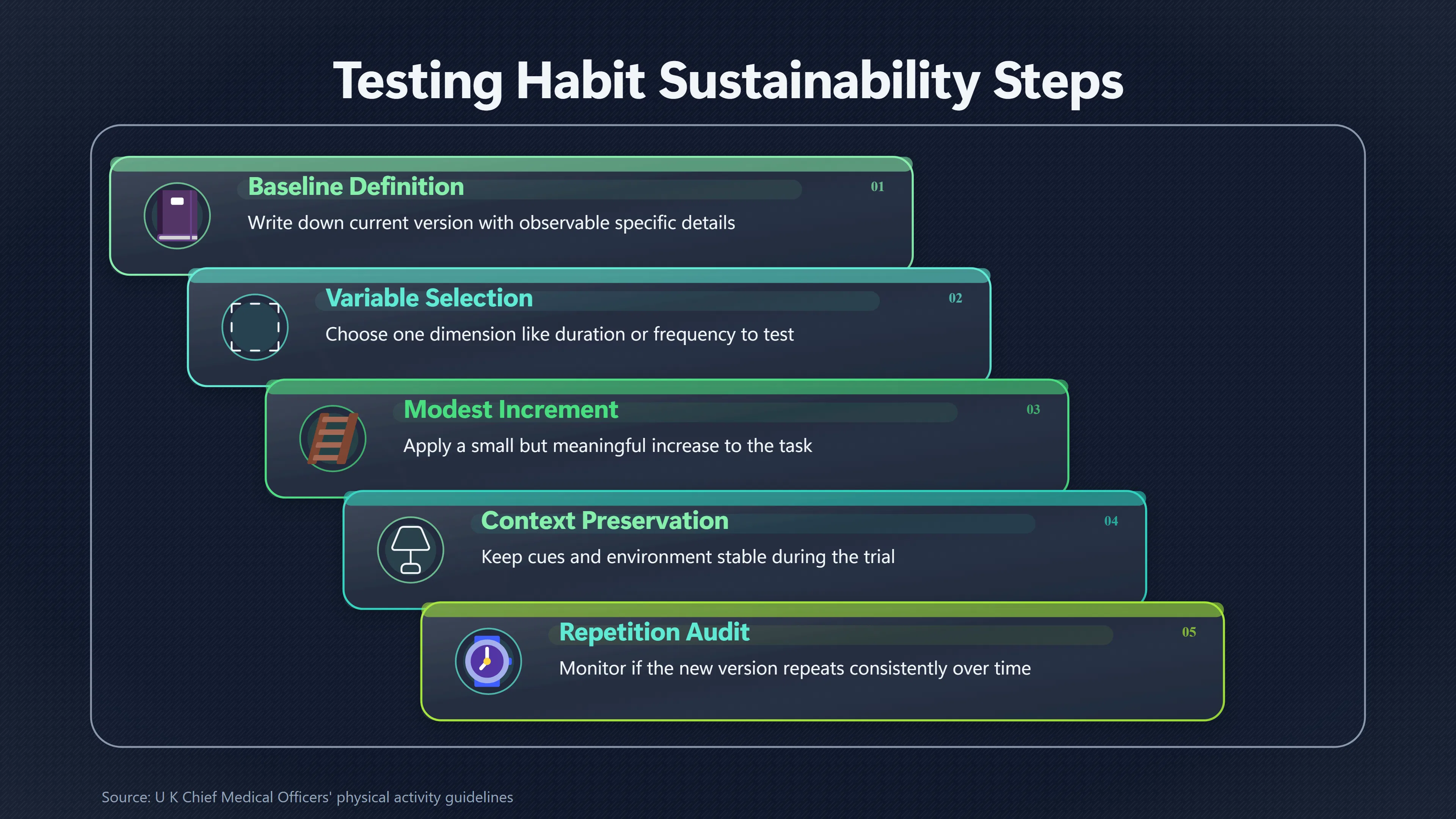
- Write down the current version. Specify enough to make the baseline observable: “Read for 20 minutes after breakfast on weekdays”, rather than “read regularly”.
- Choose one variable. Decide whether this test concerns duration, frequency, volume, difficulty or quality.
-
Make a modest, meaningful increase. It should be large enough to test additional capacity but not so large that the routine becomes a different undertaking overnight. Behaviour-change taxonomies explicitly recognise graded tasks — increasingly difficult but still achievable steps — as an intervention technique. NCBI
-
Keep the cue and unrelated variables steady where possible. If duration is being tested, avoid simultaneously changing the time, location, frequency and task difficulty. Stable contexts are associated with stronger automaticity and goal attainment. Frontiers
-
Watch repetition, not just performance. A spectacular first session says little about sustainability. The important question is whether the new version continues to happen on its intended occasions.
Amazon book picks
Further Reading
Books and field guides related to Change One Part of a Habit at a Time. Use these as the next step if you want deeper reading beyond the article.
Tiny Habits
Improving your life is much easier than you think. Whether it’s losing weight, sleeping more, or restoring your work/life balance – the s...
Atomic Habits
Rating: 3.5/5 from 7 Google Books ratings
The #1 New York Times bestseller. Over 25 million copies sold! Translated into 60+ languages! Tiny Changes, Remarkable Results No matter...
The One Thing
YOU WANT LESS. You want fewer distractions and less on your plate. The daily barrage of e-mails, texts, tweets, messages, and meetings di...
The Compound Effect
No gimmicks. No Hyperbole. No Magic Bullet. The Compound Effect is based on the principle that decisions shape your destiny. Little, ever...
eBay marketplace picks
Marketplace Samples
Live-tested eBay searches with available results related to this page.
Selected fromgoal tracker board oneBay.co.uk.


Endnotes
2.
Source: ncbi.nlm.nih.gov
Link:https://www.ncbi.nlm.nih.gov/books/NBK567039/
Source snippet
Developing an evidence-based online method of linking behaviour change techniques and theoretical mechanisms of action: a multiple method...
3.
Source: GOV.UK
Title: U K Chief Medical Officers’ physical activity guidelines
Link:https://www.gov.uk/government/publications/physical-activity-guidelines-uk-chief-medical-officers-report/uk-chief-medical-officers-physical-activity-guidelines
Source snippet
UK Chief Medical Officers' physical activity guidelines - GOV.UKJuly 10, 2026...
Published: July 10, 2026
4.
Source: sciencedirect.com
Link:https://www.sciencedirect.com/science/article/pii/S266651822200016X
Source snippet
Habit and behavioural complexity: habitual instigation and execution as predictors of simple and complex behaviours - Scienc...
5.
Source: onlinelibrary.wiley.com
Link:https://onlinelibrary.wiley.com/doi/10.1002/ejsp.674
6.
Source: onlinelibrary.wiley.com
Link:https://onlinelibrary.wiley.com/doi/full/10.1002/ejsp.674
7.
Source: doi.org
Link:https://doi.org/10.1080/10463283.2024.2334563
8.
Source: iaap-journals.onlinelibrary.wiley.com
Link:https://iaap-journals.onlinelibrary.wiley.com/doi/10.1111/aphw.12642
9.
Source: compass.onlinelibrary.wiley.com
Link:https://compass.onlinelibrary.wiley.com/doi/full/10.1111/spc3.12975
10.
Source: compass.onlinelibrary.wiley.com
Link:https://compass.onlinelibrary.wiley.com/doi/10.1111/spc3.12975?af=R
11.
Source: compass.onlinelibrary.wiley.com
Link:https://compass.onlinelibrary.wiley.com/doi/abs/10.1111/spc3.12975
12.
Source: onlinelibrary.wiley.com
Link:https://onlinelibrary.wiley.com/doi/abs/10.1111/jopy.12926
13.
Source: doi.org
Link:https://doi.org/10.1111/jopy.12926
14.
Source: doi.org
Link:https://doi.org/10.3758/s13428-023-02263-6
15.
Source: doi.org
Link:https://doi.org/10.1016/j.hlc.2023.06.854
16.
Source: doi.org
Title: JMI R m Health and u Health
Link:https://doi.org/10.2196/37234
17.
Source: sciencedirect.com
Link:https://www.sciencedirect.com/science/article/abs/pii/S146902921930130X
18.
Source: sciencedirect.com
Title: Redefining habits and linking habits with other implicit processes
Link:https://www.sciencedirect.com/science/article/pii/S1469029219304716
19.
Source: sciencedirect.com
Link:https://www.sciencedirect.com/science/article/pii/S0191886919304258
20.
Source: GOV.UK
Title: www.gov.uk Physical activity guidelines
Link:https://www.gov.uk/government/collections/physical-activity-guidelines
21.
Source: sciencedirect.com
Link:https://www.sciencedirect.com/science/article/abs/pii/S0738399118307699
22.
Source: sciencedirect.com
Title: The role of habit in compulsivity
Link:https://www.sciencedirect.com/science/article/pii/S0924977X15004162
23.
Source: bpspsychub.onlinelibrary.wiley.com
Link:https://bpspsychub.onlinelibrary.wiley.com/doi/10.1111/bjc.12086
24.
Source: doi.org
Link:https://doi.org/10.1080/17437199.2011.603640%C2%A0
25.
Source: sciencedirect.com
Link:https://www.sciencedirect.com/science/article/pii/S1836955310700539
26.
Source: onlinelibrary.wiley.com
Link:https://onlinelibrary.wiley.com/doi/abs/10.1002/ejsp.674?MixPanelId=15e3fe314440-0468d8411-64220f54-100000-15e3fe314460
27.
Source: onlinelibrary.wiley.com
Link:https://onlinelibrary.wiley.com/doi/abs/10.1002/ejsp.674
28.
Source: onlinelibrary.wiley.com
Link:https://onlinelibrary.wiley.com/doi/abs/10.1002/ejsp.674?msockid=17570258034862e732eb114c02616368
29.
Source: onlinelibrary.wiley.com
Link:https://onlinelibrary.wiley.com/doi/abs/10.1002/ejsp.674?aff_id=24772
30.
Source: onlinelibrary.wiley.com
Link:https://onlinelibrary.wiley.com/doi/abs/10.1002/ejsp.674?msockid=038ed114f43667dd0790c4bef5146634
31.
Source: onlinelibrary.wiley.com
Link:https://onlinelibrary.wiley.com/doi/abs/10.1002/ejsp.674?cf_chl_jschl_tk=pmd_EwcJDaCFBR9OVEL1O_0qjioww0Gc86ZzpBvCBFhrDcE-1635261061-0-gqNtZGzNAjujcnBszQi9
32.
Source: onlinelibrary.wiley.com
Link:https://onlinelibrary.wiley.com/doi/abs/10.1002/ejsp.674?538fcd4b_page=6&947f74f7_page=5
33.
Source: sciencedirect.com
Link:https://www.sciencedirect.com/science/article/abs/pii/S0065260106380021
34.
Source: sciencedirect.com
Link:https://www.sciencedirect.com/science/chapter/bookseries/abs/pii/S0065260106380021
35.
Source: sciencedirect.com
Link:https://www.sciencedirect.com/science/article/pii/S146902921930130X
36.
Source: onlinelibrary.wiley.com
Title: jeab.1996.65 5
Link:https://onlinelibrary.wiley.com/doi/10.1901/jeab.1996.65-5
37.
Source: bpspsychub.onlinelibrary.wiley.com
Link:https://bpspsychub.onlinelibrary.wiley.com/doi/10.1111/bjhp.12324
39.
Source: frontiersin.org
Link:https://www.frontiersin.org/journals/psychology/articles/10.3389/fpsyg.2019.01556/full
Source snippet
FrontiersFrontiers | Habits, Quick and Easy: Perceived Complexity Moderates the Associations of Contextual Stability and Rewards With Beh...
40.
Source: pubmed.ncbi.nlm.nih.gov
Link:https://pubmed.ncbi.nlm.nih.gov/35756236/
Source snippet
Context Stability in Habit Building Increases Automaticity and Goal Attainment - PubMed...
41.
Source: pubmed.ncbi.nlm.nih.gov
Link:https://pubmed.ncbi.nlm.nih.gov/38450535/
Source snippet
Some habits are more work than others: Deliberate self-regulation strategy use increases with behavioral complexity, even for estab...
42.
Source: pubmed.ncbi.nlm.nih.gov
Link:https://pubmed.ncbi.nlm.nih.gov/30279029/
43.
Source: pmc.ncbi.nlm.nih.gov
Link:https://pmc.ncbi.nlm.nih.gov/articles/PMC4444702/
44.
Source: pubmed.ncbi.nlm.nih.gov
Title: Pub Med Experiences of habit formation: a qualitative study
Link:https://pubmed.ncbi.nlm.nih.gov/21749245/
45.
Source: pubmed.ncbi.nlm.nih.gov
Link:https://pubmed.ncbi.nlm.nih.gov/35382707/
46.
Source: pubmed.ncbi.nlm.nih.gov
Link:https://pubmed.ncbi.nlm.nih.gov/42053513/
47.
Source: pmc.ncbi.nlm.nih.gov
Link:https://pmc.ncbi.nlm.nih.gov/articles/PMC13114073/
48.
Source: pmc.ncbi.nlm.nih.gov
Link:https://pmc.ncbi.nlm.nih.gov/articles/PMC12965823/
49.
Source: pmc.ncbi.nlm.nih.gov
Link:https://pmc.ncbi.nlm.nih.gov/articles/PMC13063585/
50.
Source: pmc.ncbi.nlm.nih.gov
Link:https://pmc.ncbi.nlm.nih.gov/articles/PMC12836306/
51.
Source: pmc.ncbi.nlm.nih.gov
Link:https://pmc.ncbi.nlm.nih.gov/articles/PMC12596556/
52.
Source: pmc.ncbi.nlm.nih.gov
Link:https://pmc.ncbi.nlm.nih.gov/articles/PMC12649445/
53.
Source: pmc.ncbi.nlm.nih.gov
Link:https://pmc.ncbi.nlm.nih.gov/articles/PMC11351980/
54.
Source: pubmed.ncbi.nlm.nih.gov
Link:https://pubmed.ncbi.nlm.nih.gov/38773659/
55.
Source: pmc.ncbi.nlm.nih.gov
Link:https://pmc.ncbi.nlm.nih.gov/articles/PMC10427801/
56.
Source: pubmed.ncbi.nlm.nih.gov
Link:https://pubmed.ncbi.nlm.nih.gov/38560998/
57.
Source: pmc.ncbi.nlm.nih.gov
Link:https://pmc.ncbi.nlm.nih.gov/articles/PMC11891988/
58.
Source: pmc.ncbi.nlm.nih.gov
Link:https://pmc.ncbi.nlm.nih.gov/articles/PMC11209834/
59.
Source: frontiersin.org
Link:https://www.frontiersin.org/journals/psychology/articles/10.3389/fpsyg.2022.962150/full
60.
Source: pmc.ncbi.nlm.nih.gov
Link:https://pmc.ncbi.nlm.nih.gov/articles/PMC9226889/
61.
Source: frontiersin.org
Link:https://www.frontiersin.org/journals/psychology/articles/10.3389/fpsyg.2022.883795/full?infclid=98ed75048fad41069048c53e63b2394c
62.
Source: pmc.ncbi.nlm.nih.gov
Link:https://pmc.ncbi.nlm.nih.gov/articles/PMC9304091/
63.
Source: pubmed.ncbi.nlm.nih.gov
Link:https://pubmed.ncbi.nlm.nih.gov/34283681/
64.
Source: pmc.ncbi.nlm.nih.gov
Link:https://pmc.ncbi.nlm.nih.gov/articles/PMC8149892/
65.
Source: pubmed.ncbi.nlm.nih.gov
Link:https://pubmed.ncbi.nlm.nih.gov/34054628/
66.
Source: frontiersin.org
Link:https://www.frontiersin.org/journals/psychology/articles/10.3389/fpsyg.2021.565202/full
67.
Source: pmc.ncbi.nlm.nih.gov
Link:https://pmc.ncbi.nlm.nih.gov/articles/PMC7321770/
68.
Source: pmc.ncbi.nlm.nih.gov
Link:https://pmc.ncbi.nlm.nih.gov/articles/PMC7571594/
69.
Source: pmc.ncbi.nlm.nih.gov
Link:https://pmc.ncbi.nlm.nih.gov/articles/PMC6960169/
70.
Source: frontiersin.org
Link:https://www.frontiersin.org/journals/psychology/articles/10.3389/fpsyg.2019.02850/full
71.
Source: pmc.ncbi.nlm.nih.gov
Link:https://pmc.ncbi.nlm.nih.gov/articles/PMC7012505/
72.
Source: pmc.ncbi.nlm.nih.gov
Link:https://pmc.ncbi.nlm.nih.gov/articles/PMC6667662/
73.
Source: pubmed.ncbi.nlm.nih.gov
Link:https://pubmed.ncbi.nlm.nih.gov/31396122/
74.
Source: frontiersin.org
Link:https://www.frontiersin.org/journals/psychology/articles/10.3389/fpsyg.2019.00301/full
75.
Source: pmc.ncbi.nlm.nih.gov
Link:https://pmc.ncbi.nlm.nih.gov/articles/PMC6585717/
76.
Source: pubmed.ncbi.nlm.nih.gov
Link:https://pubmed.ncbi.nlm.nih.gov/29247111/
77.
Source: pmc.ncbi.nlm.nih.gov
Link:https://pmc.ncbi.nlm.nih.gov/articles/PMC4894125/
78.
Source: pubmed.ncbi.nlm.nih.gov
Link:https://pubmed.ncbi.nlm.nih.gov/25965276/
79.
Source: pubmed.ncbi.nlm.nih.gov
Link:https://pubmed.ncbi.nlm.nih.gov/22935297/
80.
Source: pubmed.ncbi.nlm.nih.gov
Link:https://pubmed.ncbi.nlm.nih.gov/?term=19204579
81.
Source: pubmed.ncbi.nlm.nih.gov
Link:https://pubmed.ncbi.nlm.nih.gov/19204579/?amp_device_id=d-EKM3lglpdBXjNk8WSblz
82.
Source: ncbi.nlm.nih.gov
Link:https://www.ncbi.nlm.nih.gov/books/NBK576350/
83.
Source: pubmed.ncbi.nlm.nih.gov
Link:https://pubmed.ncbi.nlm.nih.gov/21694556/
84.
Source: pubmed.ncbi.nlm.nih.gov
Link:https://pubmed.ncbi.nlm.nih.gov/11828249/
85.
Source: ncbi.nlm.nih.gov
Link:https://www.ncbi.nlm.nih.gov/books/NBK588017/
86.
Source: pmc.ncbi.nlm.nih.gov
Link:https://pmc.ncbi.nlm.nih.gov/articles/PMC3096271/
87.
Source: pubmed.ncbi.nlm.nih.gov
Link:https://pubmed.ncbi.nlm.nih.gov/29189034/
88.
Source: pubmed.ncbi.nlm.nih.gov
Link:https://pubmed.ncbi.nlm.nih.gov/31662031/
89.
Source: ncbi.nlm.nih.gov
Link:https://www.ncbi.nlm.nih.gov/books/NBK566046/
90.
Source: pubmed.ncbi.nlm.nih.gov
Link:https://pubmed.ncbi.nlm.nih.gov/27535989/
91.
Source: ncbi.nlm.nih.gov
Link:https://www.ncbi.nlm.nih.gov/books/NBK327618/?report=printable
92.
Source: pubmed.ncbi.nlm.nih.gov
Link:https://pubmed.ncbi.nlm.nih.gov/39710871/
93.
Source: pmc.ncbi.nlm.nih.gov
Link:https://pmc.ncbi.nlm.nih.gov/articles/PMC6769154/
94.
Source: odphp.health.gov
Link:https://odphp.health.gov/healthypeople/objectives-and-data/browse-objectives/physical-activity/increase-proportion-adults-who-do-enough-aerobic-physical-activity-substantial-health-benefits-pa-02/data?from=2020&tab=data-chart&to=2020
95.
Source: odphp.health.gov
Link:https://odphp.health.gov/healthypeople/objectives-and-data/browse-objectives/physical-activity/increase-proportion-adults-who-do-enough-aerobic-physical-activity-substantial-health-benefits-pa-02/data?from=2024&tab=data-chart&to=2024
96.
Source: odphp.health.gov
Link:https://odphp.health.gov/healthypeople/objectives-and-data/browse-objectives/physical-activity/increase-proportion-adults-who-do-enough-aerobic-and-muscle-strengthening-activity-pa-05/data
97.
Source: odphp.health.gov
Link:https://odphp.health.gov/healthypeople/objectives-and-data/browse-objectives/physical-activity/increase-proportion-adults-who-do-enough-aerobic-and-muscle-strengthening-activity-pa-05/data?disparities=on&group=Age+group%E2%80%A0+%C2%A7&tab=data-table
98.
Source: odphp.health.gov
Link:https://odphp.health.gov/healthypeople/objectives-and-data/browse-objectives/physical-activity/increase-proportion-adults-who-do-enough-aerobic-and-muscle-strengthening-activity-pa-05/data?disparities=on&group=Age+group%E2%80%A0+%C2%A7&state=United+States
99.
Source: odphp.health.gov
Link:https://odphp.health.gov/healthypeople/objectives-and-data/browse-objectives/physical-activity/increase-proportion-adults-who-do-enough-aerobic-and-muscle-strengthening-activity-pa-05/data?disparities=on&from=2024&group=Age+group%E2%80%A0+%C2%A7&tab=data-table&to=2024
Additional References
100.
Source: openresearch.surrey.ac.uk
Title: Open Research Surrey What Makes a Habit?
Link:https://openresearch.surrey.ac.uk/esploro/outputs/journalArticle/What-Makes-a-Habit-Investigating-Potential/991112195502346
Source snippet
Investigating Potential Determinants of...by S Bürgler · Cited by 1 — Cluster analyses revealed two trajectories: habit formation and ha...
101.
Source: youtube.com
Title: The Easiest Habit Creation System
Link:https://www.youtube.com/watch?v=o-VpTA44NPI
Source snippet
BJ Fogg Tiny Habits scaling up The 21-Day Habit is Killing Your Growth w/B.J Fogg #podcast #habits...
102.
Source: youtube.com
Title: How to become 37.78 times better at anything | Atomic Habits
Link:https://www.youtube.com/watch?v=PZ7lDrwYdZc
Source snippet
What People Get Wrong About Deliberate Practice...
103.
Source: youtube.com
Title: The Secret To Creating Habits That Stick: Professor BJ Fogg
Link:https://www.youtube.com/watch?v=ql5z5-FLdCw
Source snippet
How to become 37.78 times better at anything | Atomic Habits summary (by James Clear)...
104.
Source: nature.com
Link:https://www.nature.com/nature-index/topics/l4/exercise-adherence-strategies-in-chronic-pain-management
105.
Source: youtube.com
Title: How to Master Anything: PEAK by Anders Ericsson | Core Message
Link:https://www.youtube.com/watch?v=uoUHlZP094Q
Source snippet
The Easiest Habit Creation System - Tiny Habits Book Summary...
106.
Source: odphp.health.gov
Link:https://odphp.health.gov/healthypeople/objectives-and-data/browse-objectives/physical-activity/increase-proportion-adults-who-do-enough-aerobic-physical-activity-extensive-health-benefits-pa-03
107.
Source: odphp.health.gov
Link:https://odphp.health.gov/healthypeople/objectives-and-data/browse-objectives/physical-activity/increase-proportion-adults-who-do-enough-aerobic-physical-activity-substantial-health-benefits-pa-02
108.
Source: odphp.health.gov
Link:https://odphp.health.gov/healthypeople/objectives-and-data/browse-objectives/physical-activity/increase-proportion-adults-who-do-enough-aerobic-and-muscle-strengthening-activity-pa-05
109.
Source: youtube.com
Title: What People Get Wrong About Deliberate Practice
Link:https://www.youtube.com/watch?v=WbUOY9ioIqw
Source snippet
How to Master Anything: PEAK by Anders Ericsson | Core Message...