Within No Magic Formula
Personalization Works Better When It Can Change
Useful personalization responds to changing circumstances rather than assigning a person to one fixed type and treating it as destiny.
On this page
- Why static personality labels are a weak control system
- Which changing signals can guide support
- How adaptive personalization avoids rigid user types
Page outline Jump by section
Introduction
Personalisation works best when it behaves less like a personality verdict and more like a responsive control system. A useful behaviour system can begin with what it knows about a person, but it should keep updating from what is happening now: recent behaviour, available time, current environment, progress, setbacks, receptivity and whether previous support actually helped. Research on adaptive interventions increasingly formalises exactly this idea.[PubMed Central (PMC)]pmc.ncbi.nlm.nih.govPubMed Central (PMC)Just-in-Time Adaptive Interventions: Where Are We Now and What Is Next? - PMCSeptember 12, 2025…
That distinction matters for self-improvement. Saying “you are an introvert, so use this routine” turns an average tendency into a prescription. An adaptive system instead asks whether this particular person, in this particular situation, currently has the need and opportunity for a particular form of support. Personality and other relatively stable characteristics can still provide useful background information, but they should not become destiny. Behaviour varies substantially within the same person across situations and time, while adaptive-intervention research shows how changing signals can be used to alter the timing, content or intensity of support.[PubMed Central (PMC)]pmc.ncbi.nlm.nih.govPubMed Central (PMC)TraitEnactments as Density Distributions: The Role of Actors, Situations, and Observers in Explaining Stability and V…
Why static personality labels are a weak control system
A stable trait and a fixed behavioural type are not the same thing. Personality research finds meaningful, persistent differences between people, but it also finds extensive variation within the same person. Experience-sampling studies have repeatedly observed people expressing different levels of trait-like behaviour from one occasion to another. In one line of research, within-person variation in trait enactment was so large that people differed from themselves across occasions more than people differed from one another; observer-rated research also found substantial within-person variability rather than the phenomenon being merely an artefact of self-report.[PubMed Central (PMC)]pmc.ncbi.nlm.nih.govPubMed Central (PMC)TraitEnactments as Density Distributions: The Role of Actors, Situations, and Observers in Explaining Stability and V…
Situations are part of the explanation. Research on person-by-situation interactions shows that people’s responses can differ markedly according to the circumstances they encounter. Modern state-and-trait models explicitly allow situational fluctuations rather than treating every observation as an uncomplicated expression of an enduring characteristic.[Annual Reviews]annualreviews.orgAnnual Reviews A Theory of States and Traits—Revised | Annual ReviewsAnnual ReviewsA Theory of States and Traits—Revised | Annual ReviewsMarch 28, 2015…
This creates a practical problem for self-improvement systems built around types. Suppose a questionnaire classifies someone as highly organised. That may be informative about their average tendencies, but it does not tell a system whether they can plan effectively after a poor night’s sleep, whether an unusually busy week has overwhelmed their normal routine, or whether they already know exactly what to do and simply lack an opportunity to do it. The intervention decision concerns the person at this moment, not merely the person’s average description.
Categorical labels can make the problem worse by introducing artificial boundaries. A historical National Research Council review of the Myers-Briggs Type Indicator, for example, noted that continuous scale reliability could be acceptable while stability of the resulting type classifications was much weaker: across 11 samples cited in the review, only 24–61% retained the same type, with a median of 40%. That is a particularly clear illustration of why converting dimensions into fixed boxes can discard useful information.[National Academies]nationalacademies.orgOpen source on nationalacademies.org.
The alternative is not to pretend enduring differences do not exist. Traits, preferences, abilities, constraints and past behaviour can all be useful inputs. The stronger principle is narrower: do not confuse a useful prior with a permanent decision rule. A person’s history can initialise personalisation; new evidence should be able to change it.
Which changing signals can guide support
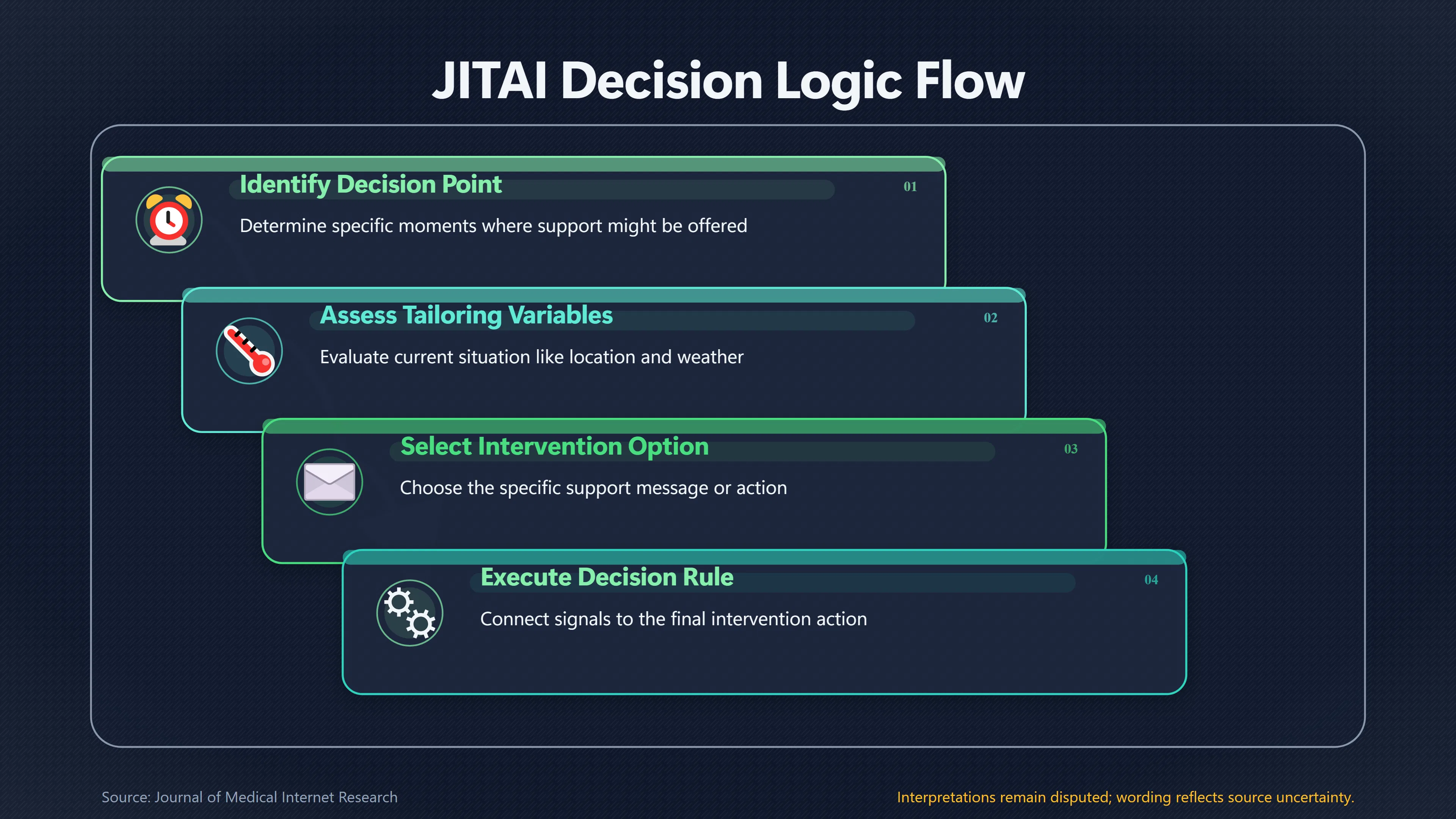
Just-in-time adaptive interventions, usually shortened to JITAIs, provide a concrete model of how this can work. Rather than selecting one intervention package at the beginning and leaving it unchanged, a JITAI makes repeated decisions. Researchers describe four central ingredients: decision points at which support might be offered, intervention options that could be selected, tailoring variables describing the person’s current situation, and decision rules connecting those signals to an action.[PubMed Central (PMC)]pmc.ncbi.nlm.nih.govPubMed Central (PMC)Just-in-Time Adaptive Interventions (JITAIs) in Mobile Health: Key Components and Design Principles for Ongoing Healt…
For a self-improvement system, the useful signals fall into a few practical categories:
- Recent behaviour: Has the intended behaviour already happened? Is performance improving, flat or deteriorating? Did the person act after the previous prompt?
- Current state: Relevant signals might include reported stress, mood, fatigue, craving, confidence or motivation, depending on the behaviour and whether measuring them is justified.
- Opportunity: Is there actually time and a suitable setting to act? A walking suggestion during a free lunch break has a different value from the same suggestion while somebody is driving.
- Context: Time of day, day of week, location, weather or the immediate social environment can sometimes change what is feasible.
- Receptivity: Can and will the person engage with support now? Recent ignored prompts or excessive intervention frequency may indicate that another notification would add burden rather than value.
- Response history: Which forms of support have previously been followed by useful action for this person, in circumstances resembling the present ones?
These signals need not all be collected, and collecting more data is not automatically better. A 2024 scoping review identified 62 JITAIs across behaviours including physical activity, diet, substance use and treatment adherence. More than half relied solely on self-reported information for tailoring, while 13 used passive monitoring alone; importantly, 44% of studies did not clearly specify their data-processing techniques. The field therefore demonstrates both the possibilities of dynamic personalisation and the distance still to travel before sophisticated sensing can automatically be equated with reliable personalisation.[PubMed Central (PMC)]pmc.ncbi.nlm.nih.govPubMed Central (PMC)Personalized interventions for behaviour change: A scoping review of just‐in‐time adaptive interventions - PMCNovembe…
The key design question is not “How much can we know about this person?” but “What changing information would alter a useful decision?” If knowing someone’s location cannot legitimately change the intervention, location data add privacy cost without necessarily adding behavioural value.
A walking prompt shows what dynamic fit means
HeartSteps, an experimental mobile physical-activity intervention, provides a useful concrete example. Its activity suggestions were tailored using factors including location, weather, time and day. Crucially, the system also considered whether someone was available for an intervention. Participants were treated as unavailable when, for example, they were already walking or running or were driving.[PubMed Central (PMC)]pmc.ncbi.nlm.nih.govOpen source on nih.gov.
That is a different philosophy from demographic or personality matching. The useful question is not “What sort of person are you?” but “Would this particular action make sense now?”
In a six-week micro-randomised trial involving 44 adults, HeartSteps repeatedly randomised whether activity suggestions were delivered, allowing researchers to examine their immediate effects. Walking suggestions increased subsequent 30-minute step counts on average, but their effect declined over the course of the study. The result is important precisely because it resists a magic formula: even an intervention that works initially may become less useful with repeated exposure.[PubMed Central (PMC)]pmc.ncbi.nlm.nih.govOpen source on nih.gov.
This is one reason adaptive systems need feedback loops. The relevant state includes not just today’s weather or calendar but the person’s history with the intervention itself. Repeated prompts can become familiar, irritating or easy to ignore. JITAI researchers consequently treat intervention burden, habituation and fatigue as design problems and explicitly include “provide nothing” as a legitimate intervention option. Sometimes the most personalised message is no message.[OUP Academic]academic.oup.comOpen source on oup.com.
Adaptation needs three tests: need, opportunity and receptivity
“Send the right message at the right time” sounds attractive but is too vague to design a system around. A more useful formulation separates at least three questions.
Is support needed? If someone has already completed today’s intended behaviour, another prompt may accomplish little. Need can change rapidly and can sometimes be inferred from recent behaviour rather than a permanent characteristic.
Is there an opportunity to act? A person may genuinely need support but be unable to use it. Exercise advice is poorly timed during a meeting; a planning prompt may be more useful when the person can actually make a decision about tomorrow.
Is the person receptive? Need and opportunity still do not guarantee that another intervention will help. Receptivity refers to the transient capacity or willingness to receive and use support. It can depend on mood, location, competing demands, previous prompts and the form in which the intervention arrives.[PubMed Central (PMC)]pmc.ncbi.nlm.nih.govPubMed Central (PMC)Building health behavior models to guide the development of just-in-time adaptive interventions: A pragmatic framewor…
Recent experimental work is trying to make these concepts testable rather than rhetorical. The JustWalk research programme, for example, operationalised receptivity partly from the number of messages recently received and whether previous walking notifications had been followed by walking. It distinguished a full just-in-time state — need, opportunity and receptivity together — from partial states in which only some conditions were present.[JMIR Research Protocols]researchprotocols.orgOpen source on researchprotocols.org.
For everyday self-improvement, the lesson is straightforward. A missed habit does not always call for more motivation. Sometimes the problem is opportunity. Sometimes the planned action is too difficult under current conditions. Sometimes the person already intends to act and another reminder merely interrupts them. Personalisation improves when the system is capable of distinguishing those states.
How adaptive personalisation avoids rigid user types
Dynamic personalisation is not simply “more personalised content”. It requires a system that can revise its working model of the user. An effective design therefore has several safeguards against turning yesterday’s data into tomorrow’s stereotype.
First, use stable characteristics as context rather than commands. A long-term preference can influence the initial choice, but current evidence should be allowed to override it. Someone who usually exercises in the evening may temporarily need morning sessions because their working hours have changed.
Second, learn from within-person comparisons. The question “Do reminders help people like you?” is useful, but “Under which circumstances have reminders helped you?” is closer to the decision the system ultimately needs to make. Ecological momentary assessment and related repeated-measurement methods are valuable because they capture feelings, behaviour and circumstances during ordinary life rather than reducing the individual to one retrospective average.[PubMed Central (PMC)]pmc.ncbi.nlm.nih.govOpen source on nih.gov.
Third, make non-intervention possible. A system optimised only to choose between message A and message B is forced to interfere even when neither is useful. Adaptive-intervention frameworks explicitly recognise doing nothing as an intervention option because unnecessary support can create burden, fatigue or unsafe interruptions.[PubMed Central (PMC)]pmc.ncbi.nlm.nih.govPubMed Central (PMC)Just-in-Time Adaptive Interventions (JITAIs) in Mobile Health: Key Components and Design Principles for Ongoing Healt…
Fourth, treat the model as corrigible. If someone repeatedly ignores an evening planning prompt but responds to one at lunchtime, the system should update. If a strategy that previously worked stops working, its priority should fall. Personalisation becomes stereotyping when evidence that contradicts the profile is ignored.
Finally, avoid assuming that finer segmentation automatically means greater fairness or accuracy. Research on data-driven personas has shown that the algorithm used to create user segments can itself alter the demographic representation of those segments. More broadly, the US National Institute of Standards and Technology warns that systems which quantify and categorise people’s behaviour can reproduce biases and harmful classifications.[PubMed]pubmed.ncbi.nlm.nih.govOpen source on nih.gov.
That makes an important distinction possible: personalisation should increase sensitivity to an individual’s circumstances, not merely increase the number of boxes into which people can be sorted.
What the evidence does — and does not — establish
There is evidence that repeated tailoring can outperform one-off personalisation. A meta-analysis of 88 computer-tailored health-behaviour interventions found an overall effect of about Hedges’ g = 0.17 compared with controls. More specifically for this question, dynamically tailored interventions using iterative assessment and feedback had larger mean effects than static tailoring based on an initial assessment (g = 0.19 versus 0.14).[PubMed Central (PMC)]pmc.ncbi.nlm.nih.govOpen source on nih.gov.
Research specifically on JITAIs is encouraging too, but should not be oversold. A 2020 meta-analysis reported substantial effects across the available studies and found that tailoring using both previous behavioural patterns and current need states was associated with greater efficacy. Yet the literature was relatively young and heterogeneous.[PubMed]pubmed.ncbi.nlm.nih.govOpen source on nih.gov. A later scoping review found that 71% of 62 included JITAI studies were evaluating feasibility, acceptability or usability, rather than providing mature evidence of long-term behavioural effectiveness.[PubMed Central (PMC)]pmc.ncbi.nlm.nih.govPubMed Central (PMC)Personalized interventions for behaviour change: A scoping review of just‐in‐time adaptive interventions - PMCNovembe… A systematic review of JITAIs targeting physiological outcomes likewise found substantial variation in designs and judged the overall quality of many included studies to be weak.[PubMed]pubmed.ncbi.nlm.nih.govOpen source on nih.gov.
A 2026 review of the field therefore describes rapidly changing needs as the rationale for JITAIs while still identifying major unresolved problems, including moments when people need assistance but cannot engage with it and generally suboptimal engagement with digital interventions.[PubMed Central (PMC)]pmc.ncbi.nlm.nih.govPubMed Central (PMC)Just-in-Time Adaptive Interventions: Where Are We Now and What Is Next? - PMCSeptember 12, 2025…
The defensible conclusion is consequently more modest — and more useful — than “AI can discover the perfect intervention for everyone”. Dynamic personalisation is a promising design principle because behaviour, circumstances and intervention effects themselves change. The evidence does not yet justify assuming that any sufficiently data-rich algorithm will automatically discover the correct adaptation rules.
Personalisation should remain a hypothesis
For self-improvement that works, the strongest interpretation of personalisation is provisional rather than essentialist. “You are this kind of person” is a closed conclusion. “This seems to work for you under these conditions; we will keep checking” is a testable hypothesis.
That approach preserves what is useful about individual differences without turning them into cages. Stable traits can inform a starting point. Recent behaviour can reveal whether the current approach is working. Context can show whether action is possible. Receptivity can prevent support becoming interruption. Repeated outcomes can tell the system when its assumptions have stopped being useful.[PubMed Central (PMC)]pmc.ncbi.nlm.nih.govPubMed Central (PMC)Just-in-Time Adaptive Interventions (JITAIs) in Mobile Health: Key Components and Design Principles for Ongoing Healt…
The resulting personalisation is less theatrical than assigning everyone a type, but it is better matched to how behaviour actually operates. People have tendencies, yet they also change across hours, situations, goals and stages of progress. A behaviour system should therefore remember enough to learn from the past without becoming so attached to its model of a person that it stops noticing the present.

Amazon book picks
Further Reading
Books and field guides related to Personalization Works Better When It Can Change. Use these as the next step if you want deeper reading beyond the article.
How to Change
Wall Street Journal bestseller “A welcome revelation.” --The Financial Times Award-winning Wharton Professor and Choiceology podcast host...
Atomic Habits
Rating: 3.5/5 from 7 Google Books ratings
The #1 New York Times bestseller. Over 25 million copies sold! Translated into 60+ languages! Tiny Changes, Remarkable Results No matter...
Thinking in Systems
Thinking in Systems is a concise and crucial book offering insight for problem-solving on scales ranging from the personal to the global....
Tiny Habits
Improving your life is much easier than you think. Whether it’s losing weight, sleeping more, or restoring your work/life balance – the s...
eBay marketplace picks
Marketplace Samples
Live-tested eBay searches with available results related to this page.
Selected frommotivational poster oneBay.co.uk.


Current eBay listing
Motivational Quotes Framed Wall Art Poster Canvas Print Picture


Current eBay listing
Gym Motivational Posters Work Out Insperational Quotes Wall Art
Endnotes
1.
Source: academic.oup.com
Link:https://academic.oup.com/abm/article/52/6/446/4733473
2.
Source: mhealth.jmir.org
Link:https://mhealth.jmir.org/2026/1/e81378
3.
Source: jmir.org
Title: Journal of Medical Internet Research
Link:https://www.jmir.org/2026/1/e84422
4.
Source: academic.oup.com
Link:https://academic.oup.com/abm/article/60/1/kaag018/8662083
5.
Source: academic.oup.com
Link:https://academic.oup.com/jamia/article/26/3/198/5260831
6.
Source: academic.oup.com
Link:https://academic.oup.com/abm/article/52/6/446/4733473?searchresult=1
7.
Source: pmc.ncbi.nlm.nih.gov
Link:https://pmc.ncbi.nlm.nih.gov/articles/PMC13217361/
Source snippet
PubMed Central (PMC)Just-in-Time Adaptive Interventions: Where Are We Now and What Is Next? - PMCSeptember 12, 2025...
Published: September 12, 2025
8.
Source: pmc.ncbi.nlm.nih.gov
Link:https://pmc.ncbi.nlm.nih.gov/articles/PMC5364076/
Source snippet
PubMed Central (PMC)Just-in-Time Adaptive Interventions (JITAIs) in Mobile Health: Key Components and Design Principles for Ongoing Healt...
9.
Source: pmc.ncbi.nlm.nih.gov
Link:https://pmc.ncbi.nlm.nih.gov/articles/PMC4673017/
Source snippet
PubMed Central (PMC)TraitEnactments as Density Distributions: The Role of Actors, Situations, and Observers in Explaining Stability and V...
10.
Source: pmc.ncbi.nlm.nih.gov
Link:https://pmc.ncbi.nlm.nih.gov/articles/PMC4726800/
Source snippet
PubMed Central (PMC)Understanding the P×S Aspect of Within-Person Variation: A Variance Partitioning Approach - PMC...
11.
Source: pmc.ncbi.nlm.nih.gov
Link:https://pmc.ncbi.nlm.nih.gov/articles/PMC4732268/
Source snippet
PubMed Central (PMC)Building health behavior models to guide the development of just-in-time adaptive interventions: A pragmatic framewor...
12.
Source: pmc.ncbi.nlm.nih.gov
Link:https://pmc.ncbi.nlm.nih.gov/articles/PMC2773515/
Source snippet
PubMed Central (PMC)Experience Sampling Methods: A Modern Idiographic Approach to Personality Research - PMC...
13.
Source: annualreviews.org
Title: Annual Reviews A Theory of States and Traits—Revised | Annual Reviews
Link:https://www.annualreviews.org/content/journals/10.1146/annurev-clinpsy-032813-153719
Source snippet
Annual ReviewsA Theory of States and Traits—Revised | Annual ReviewsMarch 28, 2015...
Published: March 28, 2015
14.
Source: nationalacademies.org
Link:https://www.nationalacademies.org/read/1580/chapter/8
15.
Source: pmc.ncbi.nlm.nih.gov
Link:https://pmc.ncbi.nlm.nih.gov/articles/PMC11583291/
Source snippet
PubMed Central (PMC)Personalized interventions for behaviour change: A scoping review of just‐in‐time adaptive interventions - PMCNovembe...
16.
Source: pubmed.ncbi.nlm.nih.gov
Link:https://pubmed.ncbi.nlm.nih.gov/39542743/
17.
Source: pmc.ncbi.nlm.nih.gov
Link:https://pmc.ncbi.nlm.nih.gov/articles/PMC6401341/
18.
Source: pmc.ncbi.nlm.nih.gov
Link:https://pmc.ncbi.nlm.nih.gov/articles/PMC4732571/
19.
Source: researchprotocols.org
Link:https://www.researchprotocols.org/2023/1/e52161/
20.
Source: pmc.ncbi.nlm.nih.gov
Link:https://pmc.ncbi.nlm.nih.gov/articles/PMC6754809/
21.
Source: pmc.ncbi.nlm.nih.gov
Link:https://pmc.ncbi.nlm.nih.gov/articles/PMC9276848/
22.
Source: pubmed.ncbi.nlm.nih.gov
Link:https://pubmed.ncbi.nlm.nih.gov/35969694/
23.
Source: pmc.ncbi.nlm.nih.gov
Link:https://pmc.ncbi.nlm.nih.gov/articles/PMC2939185/
24.
Source: ncbi.nlm.nih.gov
Link:https://www.ncbi.nlm.nih.gov/books/NBK79171/
25.
Source: pubmed.ncbi.nlm.nih.gov
Link:https://pubmed.ncbi.nlm.nih.gov/31488002/
26.
Source: pubmed.ncbi.nlm.nih.gov
Link:https://pubmed.ncbi.nlm.nih.gov/39331951/
27.
Source: annualreviews.org
Link:https://www.annualreviews.org/content/journals/10.1146/annurev-psych-121024-044244
28.
Source: pmc.ncbi.nlm.nih.gov
Link:https://pmc.ncbi.nlm.nih.gov/articles/PMC13236872/
29.
Source: pubmed.ncbi.nlm.nih.gov
Link:https://pubmed.ncbi.nlm.nih.gov/42166801/
30.
Source: pmc.ncbi.nlm.nih.gov
Link:https://pmc.ncbi.nlm.nih.gov/articles/PMC13143990/
31.
Source: pmc.ncbi.nlm.nih.gov
Link:https://pmc.ncbi.nlm.nih.gov/articles/PMC12978917/
32.
Source: pmc.ncbi.nlm.nih.gov
Link:https://pmc.ncbi.nlm.nih.gov/articles/PMC12989556/
33.
Source: pubmed.ncbi.nlm.nih.gov
Link:https://pubmed.ncbi.nlm.nih.gov/41701244/
34.
Source: pmc.ncbi.nlm.nih.gov
Link:https://pmc.ncbi.nlm.nih.gov/articles/PMC12262167/
35.
Source: pubmed.ncbi.nlm.nih.gov
Link:https://pubmed.ncbi.nlm.nih.gov/41447266/
36.
Source: GOV.UK
Title: www.gov.uk Data and AI Ethics Framework
Link:https://www.gov.uk/government/publications/data-ethics-framework/data-and-ai-ethics-framework
37.
Source: pmc.ncbi.nlm.nih.gov
Link:https://pmc.ncbi.nlm.nih.gov/articles/PMC12677381/
38.
Source: pmc.ncbi.nlm.nih.gov
Link:https://pmc.ncbi.nlm.nih.gov/articles/PMC12630729/
39.
Source: pubmed.ncbi.nlm.nih.gov
Link:https://pubmed.ncbi.nlm.nih.gov/41261160/
40.
Source: pubmed.ncbi.nlm.nih.gov
Link:https://pubmed.ncbi.nlm.nih.gov/41027677/
41.
Source: pubmed.ncbi.nlm.nih.gov
Link:https://pubmed.ncbi.nlm.nih.gov/40939059/
42.
Source: pmc.ncbi.nlm.nih.gov
Link:https://pmc.ncbi.nlm.nih.gov/articles/PMC12465124/
43.
Source: pubmed.ncbi.nlm.nih.gov
Link:https://pubmed.ncbi.nlm.nih.gov/40724199/
44.
Source: pubmed.ncbi.nlm.nih.gov
Link:https://pubmed.ncbi.nlm.nih.gov/40549656/
45.
Source: pmc.ncbi.nlm.nih.gov
Link:https://pmc.ncbi.nlm.nih.gov/articles/PMC11811111/
46.
Source: pmc.ncbi.nlm.nih.gov
Link:https://pmc.ncbi.nlm.nih.gov/articles/PMC11684587/
47.
Source: annualreviews.org
Link:https://www.annualreviews.org/content/journals/10.1146/annurev-publhealth-071723-103909
48.
Source: pmc.ncbi.nlm.nih.gov
Link:https://pmc.ncbi.nlm.nih.gov/articles/PMC11589493/
49.
Source: pmc.ncbi.nlm.nih.gov
Link:https://pmc.ncbi.nlm.nih.gov/articles/PMC11495417/
50.
Source: pubmed.ncbi.nlm.nih.gov
Link:https://pubmed.ncbi.nlm.nih.gov/39264703/
51.
Source: pmc.ncbi.nlm.nih.gov
Link:https://pmc.ncbi.nlm.nih.gov/articles/PMC11245659/
52.
Source: pmc.ncbi.nlm.nih.gov
Link:https://pmc.ncbi.nlm.nih.gov/articles/PMC11251861/
53.
Source: pubmed.ncbi.nlm.nih.gov
Link:https://pubmed.ncbi.nlm.nih.gov/38887953/
54.
Source: pmc.ncbi.nlm.nih.gov
Link:https://pmc.ncbi.nlm.nih.gov/articles/PMC10996729/
55.
Source: pubmed.ncbi.nlm.nih.gov
Link:https://pubmed.ncbi.nlm.nih.gov/38226507/
56.
Source: pmc.ncbi.nlm.nih.gov
Link:https://pmc.ncbi.nlm.nih.gov/articles/PMC10619650/
57.
Source: pubmed.ncbi.nlm.nih.gov
Link:https://pubmed.ncbi.nlm.nih.gov/37792469/
58.
Source: pmc.ncbi.nlm.nih.gov
Link:https://pmc.ncbi.nlm.nih.gov/articles/PMC10502072/
59.
Source: pmc.ncbi.nlm.nih.gov
Link:https://pmc.ncbi.nlm.nih.gov/articles/PMC11272684/
60.
Source: pubmed.ncbi.nlm.nih.gov
Link:https://pubmed.ncbi.nlm.nih.gov/37521518/
61.
Source: pubmed.ncbi.nlm.nih.gov
Link:https://pubmed.ncbi.nlm.nih.gov/37394024/
62.
Source: GOV.UK
Link:https://www.gov.uk/government/publications/enabling-responsible-access-to-demographic-data-to-make-ai-systems-fairer/report-enabling-responsible-access-to-demographic-data-to-make-ai-systems-fairer
63.
Source: pmc.ncbi.nlm.nih.gov
Link:https://pmc.ncbi.nlm.nih.gov/articles/PMC10302190/
64.
Source: annualreviews.org
Link:https://www.annualreviews.org/content/journals/10.1146/annurev-ecolsys-102220-011451
65.
Source: GOV.UK
Link:https://www.gov.uk/government/publications/findings-from-the-drcf-algorithmic-processing-workstream-spring-2022/the-benefits-and-harms-of-algorithms-a-shared-perspective-from-the-four-digital-regulators
66.
Source: pmc.ncbi.nlm.nih.gov
Link:https://pmc.ncbi.nlm.nih.gov/articles/PMC9704370/
67.
Source: doi.org
Title: JMI R Research Protocols
Link:https://doi.org/10.2196/38958
68.
Source: pmc.ncbi.nlm.nih.gov
Link:https://pmc.ncbi.nlm.nih.gov/articles/PMC9265719/
69.
Source: pmc.ncbi.nlm.nih.gov
Link:https://pmc.ncbi.nlm.nih.gov/articles/PMC8872509/
70.
Source: pmc.ncbi.nlm.nih.gov
Link:https://pmc.ncbi.nlm.nih.gov/articles/PMC8691411/
71.
Source: GOV.UK
Link:https://www.gov.uk/government/publications/unlocking-the-value-of-data-exploring-the-role-of-data-intermediaries/unlocking-the-value-of-data-exploring-the-role-of-data-intermediaries
72.
Source: pmc.ncbi.nlm.nih.gov
Link:https://pmc.ncbi.nlm.nih.gov/articles/PMC8350606/
73.
Source: annualreviews.org
Link:https://www.annualreviews.org/content/journals/10.1146/annurev-orgpsych-012420-062228
74.
Source: pmc.ncbi.nlm.nih.gov
Link:https://pmc.ncbi.nlm.nih.gov/articles/PMC7968352/
75.
Source: annualreviews.org
Link:https://www.annualreviews.org/content/journals/10.1146/annurev-orgpsych-012119-045350
76.
Source: annualreviews.org
Link:https://www.annualreviews.org/content/journals/10.1146/annurev-orgpsych-012119-045350?identity=5131&originator=useradmin&signature=861bbc7c699b081b8e54c67b0bc72242×tamp=20991231000000
77.
Source: GOV.UK
Title: www.gov.uk Interim report: Review into bias in algorithmic decision-making
Link:https://www.gov.uk/government/publications/interim-reports-from-the-centre-for-data-ethics-and-innovation/interim-report-review-into-bias-in-algorithmic-decision-making
78.
Source: pmc.ncbi.nlm.nih.gov
Link:https://pmc.ncbi.nlm.nih.gov/articles/PMC6468333/
79.
Source: pubmed.ncbi.nlm.nih.gov
Link:https://pubmed.ncbi.nlm.nih.gov/30943983/
80.
Source: pmc.ncbi.nlm.nih.gov
Link:https://pmc.ncbi.nlm.nih.gov/articles/PMC6713230/
81.
Source: annualreviews.org
Link:https://www.annualreviews.org/content/journals/10.1146/annurev-psych-010418-102917
82.
Source: annualreviews.org
Title: Personality Across the Life Span | Annual Reviews
Link:https://www.annualreviews.org/content/journals/10.1146/annurev-psych-010418-103244
83.
Source: pmc.ncbi.nlm.nih.gov
Link:https://pmc.ncbi.nlm.nih.gov/articles/PMC6493252/
84.
Source: pubmed.ncbi.nlm.nih.gov
Link:https://pubmed.ncbi.nlm.nih.gov/27663578/
85.
Source: dictionary.apa.org
Link:https://dictionary.apa.org/personality
86.
Source: pmc.ncbi.nlm.nih.gov
Link:https://pmc.ncbi.nlm.nih.gov/articles/PMC5832713/
87.
Source: pubmed.ncbi.nlm.nih.gov
Link:https://pubmed.ncbi.nlm.nih.gov/29224379/
88.
Source: pmc.ncbi.nlm.nih.gov
Link:https://pmc.ncbi.nlm.nih.gov/articles/PMC5596082/
89.
Source: pmc.ncbi.nlm.nih.gov
Link:https://pmc.ncbi.nlm.nih.gov/articles/PMC4925296/
90.
Source: pmc.ncbi.nlm.nih.gov
Link:https://pmc.ncbi.nlm.nih.gov/articles/PMC4848174/
91.
Source: pmc.ncbi.nlm.nih.gov
Link:https://pmc.ncbi.nlm.nih.gov/articles/PMC4472377/
92.
Source: pmc.ncbi.nlm.nih.gov
Link:https://pmc.ncbi.nlm.nih.gov/articles/PMC2908394/
93.
Source: pubmed.ncbi.nlm.nih.gov
Link:https://pubmed.ncbi.nlm.nih.gov/20558196/
94.
Source: pmc.ncbi.nlm.nih.gov
Link:https://pmc.ncbi.nlm.nih.gov/articles/PMC2791901/
95.
Source: pubmed.ncbi.nlm.nih.gov
Link:https://pubmed.ncbi.nlm.nih.gov/18947966/
96.
Source: annualreviews.org
Link:https://www.annualreviews.org/content/journals/10.1146/annurev.psych.56.091103.070133?crawler=true&mimetype=application%2Fpdf
97.
Source: annualreviews.org
Title: Toward an Integrative Science of the Person | Annual Reviews
Link:https://www.annualreviews.org/content/journals/10.1146/annurev.psych.55.042902.130709
98.
Source: annualreviews.org
Title: RECONCILIN G PROCESSING DYNAMICS AND PERSONALITY DISPOSITIONS | Annual Reviews
Link:https://www.annualreviews.org/content/journals/10.1146/annurev.psych.49.1.229
99.
Source: pubmed.ncbi.nlm.nih.gov
Link:https://pubmed.ncbi.nlm.nih.gov/2709300/
100.
Source: pubmed.ncbi.nlm.nih.gov
Link:https://pubmed.ncbi.nlm.nih.gov/28083725/
101.
Source: pubmed.ncbi.nlm.nih.gov
Link:https://pubmed.ncbi.nlm.nih.gov/11936208/
102.
Source: pmc.ncbi.nlm.nih.gov
Link:https://pmc.ncbi.nlm.nih.gov/articles/PMC12434840/
103.
Source: pubmed.ncbi.nlm.nih.gov
Link:https://pubmed.ncbi.nlm.nih.gov/16367202/
104.
Source: pubmed.ncbi.nlm.nih.gov
Link:https://pubmed.ncbi.nlm.nih.gov/34926979/
105.
Source: annualreviews.org
Link:https://www.annualreviews.org/content/journals/clinpsy/11/1
106.
Source: annualreviews.org
Title: Volume 55 | Annual Reviews ANNUAL REVIEW OF PSYCHOLOGY
Link:https://www.annualreviews.org/content/journals/psych/55/1
Additional References
107.
Source: youtube.com
Title: Video 2
Link:https://www.youtube.com/watch?v=6sPbR7qQOR8
Source snippet
Personality traits vs states behavior situation Trait Theory - History of Personality Psychology...
108.
Source: youtube.com
Title: Who are you, really? The puzzle of personality | Brian Little | TED
Link:https://www.youtube.com/watch?v=qYvXk_bqlBk
Source snippet
Walter Mischel’s Personality Theory Simplified - Marshmallow Experiment & CAPS Model...
109.
Source: youtube.com
Title: Walter Mischel’s Personality Theory Simplified
Link:https://www.youtube.com/watch?v=p0HX0M2y5XI
Source snippet
Video 1: Introduction to JITAI with Susan Murphy...
110.
Source: nature.com
Link:https://www.nature.com/articles/s41746
111.
Source: nature.com
Link:https://www.nature.com/articles/s41599-021-00787-w
112.
Source: youtube.com
Title: The Art and Science of Personality Development (with Dan Mc Adams)
Link:https://www.youtube.com/watch?v=l5O-ig5wfDc
Source snippet
Video 2: Introduction to Micro-Randomized Trials with Susan Murphy...
113.
Source: oecd.org
Title: algorithmic bias the state of the situation and policy recommendations a0b7cec1
Link:https://www.oecd.org/en/publications/oecd-digital-education-outlook-2023_c74f03de-en/full-report/algorithmic-bias-the-state-of-the-situation-and-policy-recommendations_a0b7cec1.html
114.
Source: nist.gov
Link:https://www.nist.gov/publications/towards-standard-identifying-and-managing-bias-artificial-intelligence
115.
Source: youtube.com
Title: Video 1
Link:https://www.youtube.com/watch?v=c2owFV6o7os
Source snippet
The Art and Science of Personality Development (with Dan McAdams)...
116.
Source: doi.org
Link:https://doi.org/10.1002/jcad.70006