Within Small Habits
What to Do After Missing a Habit
One missed opportunity need not derail habit formation, so the useful skill is resuming at the next available cue without overcompensating.
On this page
- What habit research says about a single missed opportunity
- Why perfect streaks are a fragile measure of consistency
- Resuming normally instead of compensating with extra effort
Page outline Jump by section
Introduction
Missing one day does not mean a habit has gone back to zero. The best direct evidence comes from a 12-week real-world habit-formation study: participants who missed a single opportunity did not materially disrupt the growth of automaticity, whereas broader inconsistency was more concerning. The practical response is therefore simple: resume the ordinary version of the habit at the next appropriate cue rather than trying to compensate for the miss.[Wiley Online Library]onlinelibrary.wiley.comWiley Online LibraryHow are habits formed: Modelling habit formation in the real world - Lally - 2010 - European Journal of Social Psycho…
This distinction matters because habit formation is built from repeated cue–behaviour associations, not from maintaining an aesthetically perfect calendar. A streak can motivate repetition, but research also shows that highlighting a broken streak can reduce subsequent engagement. Treating one missed day as a major failure may therefore create a second problem that the original miss did not: reluctance to restart.[OUP Academic]academic.oup.comOUP AcademicOn or Off Track: How (Broken) Streaks Affect Consumer Decisions | Journal of Consumer Research | Oxford AcademicJune 30, 2022…
What one missed opportunity actually does
The most useful dataset for this question is Phillippa Lally and colleagues’ study of 96 volunteers. Participants selected an eating, drinking or physical-activity behaviour and attempted to perform it once a day in the same context for 12 weeks. They recorded both whether they had performed the behaviour and how automatic it felt. The researchers then modelled changes in automaticity over the 84-day study.[Wiley Online Library]onlinelibrary.wiley.comWiley Online LibraryHow are habits formed: Modelling habit formation in the real world - Lally - 2010 - European Journal of Social Psycho…
The headline result is unusually reassuring: missing one opportunity to perform the behaviour did not materially affect the habit-formation process. A later account by researchers involved in this work describes automaticity gains as resuming after an occasional missed performance. In other words, the learning trajectory did not behave like a counter that reset to zero when somebody missed Tuesday.[Wiley Online Library]onlinelibrary.wiley.comWiley Online LibraryHow are habits formed: Modelling habit formation in the real world - Lally - 2010 - European Journal of Social Psycho…
That does not mean frequency is irrelevant. In the same dataset, greater consistency of performance was associated with better-fitting habit-development trajectories, and UCL’s account of the research explicitly distinguishes an isolated miss from being “very inconsistent”. The study did not establish a precise minimum percentage of opportunities that must be completed. Its narrower finding is stronger and more defensible: occasional misses appear compatible with habit formation; persistent inconsistency should not be assumed to be harmless.[Wiley Online Library]onlinelibrary.wiley.comWiley Online LibraryHow are habits formed: Modelling habit formation in the real world - Lally - 2010 - European Journal of Social Psycho…
This fits the underlying mechanism. Psychological habit research describes habits as cue–response associations acquired through context-dependent repetition. Repeatedly acting in a particular situation strengthens the association between that situation and the response, so that encountering the context increasingly prompts the behaviour with less deliberation. Experimental work has since provided further evidence that practice strengthens cue–response associations rather than merely strengthening people’s intentions to act.[PubMed Central (PMC)]pmc.ncbi.nlm.nih.govPubMed Central (PMC)A review and analysis of the use of ‘habit’ in understanding, predicting and influencing health-related behaviour - PMC…
A missed opportunity is therefore better understood as one repetition that did not occur, not as the destruction of all previous learning. Established habit associations are not generally thought to shift dramatically because of an infrequent counter-habitual response, and the Lally dataset provides direct real-world evidence that a single omission need not seriously alter the formation trajectory.[PubMed]pubmed.ncbi.nlm.nih.govPub Med A new look at habits and the habit-goal interfaceA new look at habits and the habit-goal interface - PubMed…
There is an important limit to how far this finding can be stretched. Lally and colleagues studied daily health-related behaviours in a relatively small sample, and only 62 participants produced automaticity trajectories that could be modelled. A 2024 systematic review likewise concluded that the habit-formation literature remains limited and that the degree of repetition consistency required is still unclear. “One miss is not disastrous” is evidence-based; “it does not matter how often you miss” is not.[Wiley Online Library]onlinelibrary.wiley.comWiley Online LibraryHow are habits formed: Modelling habit formation in the real world - Lally - 2010 - European Journal of Social Psycho…
Why a perfect streak is the wrong scorecard
A streak answers one narrow question: how many consecutive scheduled performances have occurred? Habit strength answers a different question: how automatically does a particular context evoke the behaviour? Those measures can overlap, but they are not interchangeable.
Research on logged streaks makes the difference particularly clear. Jackie Silverman and Alixandra Barasch studied streak tracking across seven experiments involving domains including exercise, language learning and games. They found that highlighting an intact streak increased subsequent engagement compared with highlighting a broken streak. Crucially, the effect could occur even when participants’ actual preceding behaviour was identical: changing how the behavioural history was represented changed what people did next.[OUP Academic]academic.oup.comOUP AcademicOn or Off Track: How (Broken) Streaks Affect Consumer Decisions | Journal of Consumer Research | Oxford AcademicJune 30, 2022…
That makes streaks potentially useful motivational devices, but also fragile ones. In one experiment described by the researchers, participants performed the same four strength exercises, yet some were shown a log in which the fourth exercise appeared not to have registered. When subsequently given a choice, 66.23% of those shown an intact streak selected another strength exercise, compared with 57.86% of those shown the apparently broken streak. The behavioural history was effectively the same; the displayed continuity differed.[INSEAD Knowledge]knowledge.insead.eduINSEAD KnowledgeConsumer Streaks Are Motivating – The Key Is Keeping Them Alive | INSEAD KnowledgeJune 22, 2022…
The broader experiments found that people came to treat preserving the logged streak as a goal in its own right. The disadvantage appeared after a break: highlighting a broken streak reduced engagement relative to highlighting an intact one, with the effect stronger when people attributed the break to themselves and weaker when they had an opportunity to “repair” it.[UD Space]udspace.udel.eduUD Space On or Off Track: How (Broken) Streaks Affect Consumer DecisionsUD Space On or Off Track: How (Broken) Streaks Affect Consumer Decisions
This does not establish that streak tracking is bad. An unbroken run of repetitions can encourage another repetition, which is useful during habit formation. The problem is making the streak the definition of success. If the display changes from “37” to “0”, the habit itself has not necessarily undergone an equivalent transformation. The habit-learning evidence and the streak research point to different processes: one missed opportunity need not materially derail automaticity, while perceiving a streak as broken can nevertheless weaken motivation to continue.[Wiley Online Library]onlinelibrary.wiley.comWiley Online LibraryHow are habits formed: Modelling habit formation in the real world - Lally - 2010 - European Journal of Social Psycho…
For habits designed to survive ordinary life, a more robust scorecard is therefore returnability: after travel, illness, an overloaded evening or a forgotten cue, does the behaviour resume when its normal opportunity returns? That measure better reflects the underlying task of repeatedly reconnecting a familiar context with a useful response.
The fastest route back is the normal route
After a miss, it is tempting to make the next performance unusually ambitious: double tomorrow’s exercise, read twice as long, complete two language lessons, or otherwise “pay back” the missing day. Habit research provides little reason to think such repayment is necessary for habit formation.
The mechanism instead points towards restoring the ordinary cue–behaviour pairing. Context stability has repeatedly been associated with stronger automaticity. In two datasets involving study habits and habits recorded through an app, greater context stability predicted greater automaticity and better attainment of repetition goals. More recently, a randomised study of 127 adults found that participants assigned to plan walking in consistent contexts developed and maintained more walking automaticity than those planning walks in varied contexts.[PubMed]pubmed.ncbi.nlm.nih.govOpen source on nih.gov.
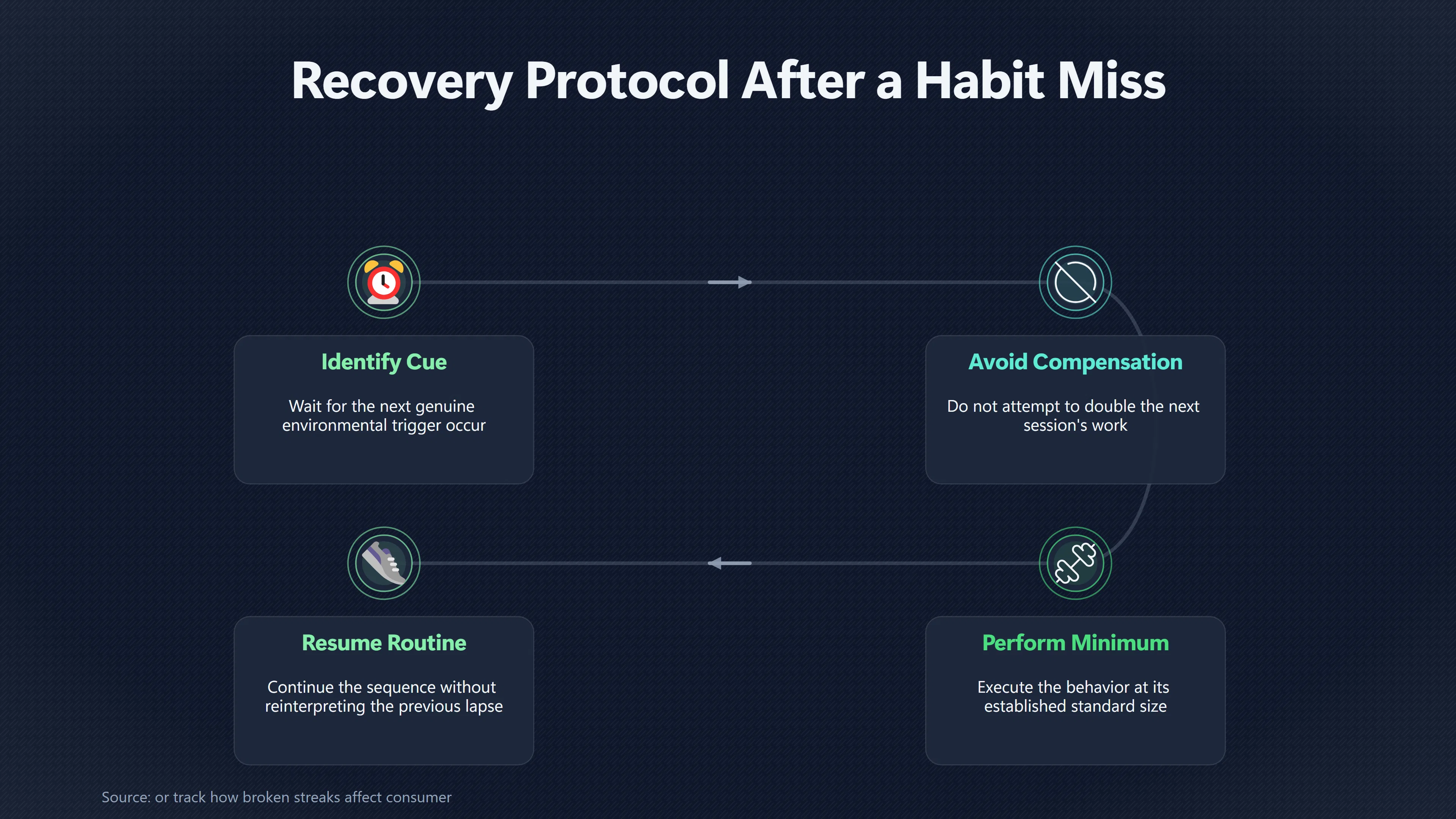
The practical sequence after a missed day is therefore short:
- Do not reinterpret the habit. A miss is evidence that one opportunity was missed, not that the entire routine has failed.
- Identify the next genuine cue. If the habit is “floss after brushing at night”, wait for the next normal brushing occasion rather than creating an emergency compensatory session at an unrelated time.
- Perform the usual minimum. Resume the behaviour at its established size rather than adding extra work as a penalty.
- Continue from there. The objective is another cue-linked repetition, followed by another, not restoration of a historical streak number.
This emphasis on the normal cue is supported by evidence beyond the original Lally dataset. An exploratory flossing study found that participants who flossed after brushing rather than before tended to develop stronger habits and, eight months later, reported both stronger habits and more frequent flossing. The researchers argued that placement within existing routines can matter for habit development.[PubMed]pubmed.ncbi.nlm.nih.govOpen source on nih.gov.
Qualitative research also offers a useful real-life illustration of interruption and return. In interviews with people undertaking a habit-based weight-loss intervention, weekends and holidays sometimes disrupted newly developing behaviours because the normal work-based cues disappeared. Yet the habits could be reinstated when participants returned to work and encountered those contexts again. The interruption was therefore partly a cue problem, not necessarily evidence that all previous habit learning had vanished.[PubMed]pubmed.ncbi.nlm.nih.govPub Med Experiences of habit formation: a qualitative studyPub Med Experiences of habit formation: a qualitative study
That is an important distinction when ordinary life causes a miss. If you normally walk after lunch at work but spend Wednesday travelling, forcing a compensatory late-night walk may preserve a numerical streak while doing little to reinforce the usual lunchtime cue. Returning to the normal post-lunch walk on Thursday directly resumes the context–behaviour relationship you were trying to establish.
When a miss becomes a pattern
The forgiving interpretation of a single miss should not become an excuse to ignore repeated failures. If the habit repeatedly disappears at the same point — every weekend, every busy evening or whenever work finishes late — the useful information is no longer “I happened to miss”. It is that the chosen cue, behaviour or minimum may not fit the conditions in which it is supposed to operate.
Contemporary evidence continues to emphasise frequency and context stability. A 2024 systematic review found context-dependent repetition and stable performance contexts associated with stronger habit formation, while noting that the exact consistency threshold remains unresolved. A 2026 preregistered longitudinal reanalysis likewise found habit trajectories differed with behavioural frequency, complexity and context stability, with frequency among the factors associated with habit strength.[PubMed Central (PMC)]pmc.ncbi.nlm.nih.govOpen source on nih.gov.
The response to repeated misses is therefore different from the response to an isolated one. One miss calls for a normal restart. Recurring misses call for diagnosis: perhaps the cue is unreliable, the minimum action is too demanding for that part of the day, or the context changes too much to support the association. That is a design problem rather than a debt to be repaid with a heroic catch-up session.
The central lesson is deliberately modest. Consistency matters, but consistency does not require perfection. The strongest direct dataset on isolated missed opportunities found no material derailment of habit formation, while separate research shows that framing a lapse as a broken streak can itself discourage continuation. The most useful move after missing a habit is consequently neither punishment nor compensation. It is to make the ordinary behaviour at the next ordinary cue and allow repetition to continue doing its work.[wiley.com]onlinelibrary.wiley.comWiley Online LibraryHow are habits formed: Modelling habit formation in the real world - Lally - 2010 - European Journal of Social Psycho…
Amazon book picks
Further Reading
Books and field guides related to What to Do After Missing a Habit. Use these as the next step if you want deeper reading beyond the article.
Atomic Habits
Rating: 3.5/5 from 7 Google Books ratings
The #1 New York Times bestseller. Over 25 million copies sold! Translated into 60+ languages! Tiny Changes, Remarkable Results No matter...
Tiny Habits
Improving your life is much easier than you think. Whether it’s losing weight, sleeping more, or restoring your work/life balance – the s...
Good Habits, Bad Habits
'The world's leading expert on habits' - Matthew Syed, bestselling author of Black Box Thinking and Rebel IdeasWhat if you could harness...
How to Change
Wall Street Journal bestseller “A welcome revelation.” --The Financial Times Award-winning Wharton Professor and Choiceology podcast host...
eBay marketplace picks
Marketplace Samples
Live-tested eBay searches with available results related to this page.
Selected frommotivational wall art oneBay.co.uk.



Endnotes
1.
Source: onlinelibrary.wiley.com
Link:https://onlinelibrary.wiley.com/doi/10.1002/ejsp.674
Source snippet
Wiley Online LibraryHow are habits formed: Modelling habit formation in the real world - Lally - 2010 - European Journal of Social Psycho...
2.
Source: academic.oup.com
Link:https://academic.oup.com/jcr/article-abstract/49/6/1095/6623414
Source snippet
OUP AcademicOn or Off Track: How (Broken) Streaks Affect Consumer Decisions | Journal of Consumer Research | Oxford AcademicJune 30, 2022...
Published: June 30, 2022
3.
Source: academic.oup.com
Link:https://academic.oup.com/jcr/article/49/6/1095/6623414?guestAccessKey=1bb91501-7f0d-4dcc-806d-8124e533be13
Source snippet
OUP AcademicOn or Off Track: How (Broken) Streaks Affect Consumer Decisions | Journal of Consumer Research | Oxford Academic...
4.
Source: knowledge.insead.edu
Link:https://knowledge.insead.edu/marketing/consumer-streaks-are-motivating-key-keeping-them-alive
Source snippet
INSEAD KnowledgeConsumer Streaks Are Motivating – The Key Is Keeping Them Alive | INSEAD KnowledgeJune 22, 2022...
Published: June 22, 2022
5.
Source: compass.onlinelibrary.wiley.com
Link:https://compass.onlinelibrary.wiley.com/doi/full/10.1111/spc3.12975
6.
Source: compass.onlinelibrary.wiley.com
Link:https://compass.onlinelibrary.wiley.com/doi/epdf/10.1111/spc3.12975
7.
Source: onlinelibrary.wiley.com
Link:https://onlinelibrary.wiley.com/doi/full/10.1002/jeab.893
8.
Source: insead.edu
Title: or track how [broken streaks]({{ ‘broken-streaks/’ | relative_url }}) affect consumer
Link:https://www.insead.edu/faculty-research/publications/journal-articles/or-track-how-broken-streaks-affect-consumer
9.
Source: academic.oup.com
Link:https://academic.oup.com/jcr/article-abstract/49/6/1095/6623414?login=false
10.
Source: academic.oup.com
Link:https://academic.oup.com/jcr/article/49/6/1095/6623414?guestAccessKey=1bb91501-7f0d-4dcc-806d-8124e533be13&login=false
11.
Source: onlinelibrary.wiley.com
Link:https://onlinelibrary.wiley.com/doi/abs/10.1002/ejsp.674
12.
Source: onlinelibrary.wiley.com
Link:https://onlinelibrary.wiley.com/doi/10.1002/ejsp.674?2d235898_page=2&538fcd4b_page=6&d2101103_page=8&d73ad837_page=2
13.
Source: onlinelibrary.wiley.com
Link:https://onlinelibrary.wiley.com/doi/abs/10.1002/ejsp.674?MixPanelId=15e3fe314440-0468d8411-64220f54-100000-15e3fe314460
14.
Source: onlinelibrary.wiley.com
Link:https://onlinelibrary.wiley.com/doi/abs/10.1002/ejsp.674?msockid=2489864bf52b6612230d95d6f48167ef
15.
Source: onlinelibrary.wiley.com
Link:https://onlinelibrary.wiley.com/doi/abs/10.1002/ejsp.674?538fcd4b_page=6&947f74f7_page=5
16.
Source: onlinelibrary.wiley.com
Link:https://onlinelibrary.wiley.com/doi/abs/10.1002/ejsp.674?cf_chl_jschl_tk=pmd_EwcJDaCFBR9OVEL1O_0qjioww0Gc86ZzpBvCBFhrDcE-1635261061-0-gqNtZGzNAjujcnBszQi9
17.
Source: onlinelibrary.wiley.com
Link:https://onlinelibrary.wiley.com/doi/abs/10.1002/ejsp.674?msockid=038ed114f43667dd0790c4bef5146634
18.
Source: onlinelibrary.wiley.com
Link:https://onlinelibrary.wiley.com/doi/abs/10.1002/ejsp.674?msockid=17570258034862e732eb114c02616368
19.
Source: ucl.ac.uk
Title: University College London How long does it take to form a habit? | UCL News
Link:https://www.ucl.ac.uk/news/2009/aug/how-long-does-it-take-form-habit%20
Source snippet
University College LondonHow long does it take to form a habit? | UCL News - UCL – University College London...
20.
Source: pmc.ncbi.nlm.nih.gov
Link:https://pmc.ncbi.nlm.nih.gov/articles/PMC4566897/
Source snippet
PubMed Central (PMC)A review and analysis of the use of ‘habit’ in understanding, predicting and influencing health-related behaviour - PMC...
21.
Source: pmc.ncbi.nlm.nih.gov
Link:https://pmc.ncbi.nlm.nih.gov/articles/3505409/
Source snippet
PubMed Central (PMC)Making health habitual: the psychology of ‘habit-formation’ and general practice - PMC...
22.
Source: pubmed.ncbi.nlm.nih.gov
Title: Pub Med Measuring context-response associations that drive habits
Link:https://pubmed.ncbi.nlm.nih.gov/38047612/
Source snippet
Measuring context-response associations that drive habits - PubMed...
23.
Source: pubmed.ncbi.nlm.nih.gov
Title: Pub Med A new look at habits and the habit-goal interface
Link:https://pubmed.ncbi.nlm.nih.gov/17907866/
Source snippet
A new look at habits and the habit-goal interface - PubMed...
24.
Source: pmc.ncbi.nlm.nih.gov
Link:https://pmc.ncbi.nlm.nih.gov/articles/PMC11641623/
25.
Source: udspace.udel.edu
Title: UD Space On or Off Track: How (Broken) Streaks Affect Consumer Decisions
Link:https://udspace.udel.edu/items/42ce576b-8e1f-429a-8541-e29e48dbcfbb
26.
Source: pubmed.ncbi.nlm.nih.gov
Link:https://pubmed.ncbi.nlm.nih.gov/35756236/
27.
Source: pubmed.ncbi.nlm.nih.gov
Link:https://pubmed.ncbi.nlm.nih.gov/39225981/
28.
Source: pubmed.ncbi.nlm.nih.gov
Link:https://pubmed.ncbi.nlm.nih.gov/22989272/
29.
Source: pubmed.ncbi.nlm.nih.gov
Title: Pub Med Experiences of habit formation: a qualitative study
Link:https://pubmed.ncbi.nlm.nih.gov/21749245/
30.
Source: pubmed.ncbi.nlm.nih.gov
Link:https://pubmed.ncbi.nlm.nih.gov/42053513/
31.
Source: pmc.ncbi.nlm.nih.gov
Link:https://pmc.ncbi.nlm.nih.gov/articles/PMC11920387/
32.
Source: pubmed.ncbi.nlm.nih.gov
Link:https://pubmed.ncbi.nlm.nih.gov/39685110/
33.
Source: pubmed.ncbi.nlm.nih.gov
Link:https://pubmed.ncbi.nlm.nih.gov/39439910/
34.
Source: pmc.ncbi.nlm.nih.gov
Link:https://pmc.ncbi.nlm.nih.gov/articles/PMC11494719/
35.
Source: pubmed.ncbi.nlm.nih.gov
Link:https://pubmed.ncbi.nlm.nih.gov/36749452/
36.
Source: pmc.ncbi.nlm.nih.gov
Link:https://pmc.ncbi.nlm.nih.gov/articles/PMC9372943/
37.
Source: doi.org
Link:https://doi.org/10.1093/jcr/ucac029
38.
Source: udspace.udel.edu
Link:https://udspace.udel.edu/items/42ce576b-8e1f-429a-8541-e29e48dbcfbb/full
39.
Source: pmc.ncbi.nlm.nih.gov
Link:https://pmc.ncbi.nlm.nih.gov/articles/PMC12318445/
40.
Source: pmc.ncbi.nlm.nih.gov
Link:https://pmc.ncbi.nlm.nih.gov/articles/PMC8602149/
41.
Source: pmc.ncbi.nlm.nih.gov
Link:https://pmc.ncbi.nlm.nih.gov/articles/PMC8231551/
42.
Source: pmc.ncbi.nlm.nih.gov
Link:https://pmc.ncbi.nlm.nih.gov/articles/PMC8137900/
43.
Source: pmc.ncbi.nlm.nih.gov
Link:https://pmc.ncbi.nlm.nih.gov/articles/PMC8774291/
44.
Source: pmc.ncbi.nlm.nih.gov
Link:https://pmc.ncbi.nlm.nih.gov/articles/PMC7645026/
45.
Source: pmc.ncbi.nlm.nih.gov
Link:https://pmc.ncbi.nlm.nih.gov/articles/4975085/
46.
Source: pmc.ncbi.nlm.nih.gov
Link:https://pmc.ncbi.nlm.nih.gov/articles/PMC4216661/
47.
Source: pmc.ncbi.nlm.nih.gov
Link:https://pmc.ncbi.nlm.nih.gov/articles/PMC3505409/
48.
Source: pubmed.ncbi.nlm.nih.gov
Link:https://pubmed.ncbi.nlm.nih.gov/22107605/
49.
Source: pubmed.ncbi.nlm.nih.gov
Link:https://pubmed.ncbi.nlm.nih.gov/22935297/
50.
Source: pmc.ncbi.nlm.nih.gov
Link:https://pmc.ncbi.nlm.nih.gov/articles/PMC3552971/
51.
Source: pubmed.ncbi.nlm.nih.gov
Link:https://pubmed.ncbi.nlm.nih.gov/22682656/
52.
Source: pmc.ncbi.nlm.nih.gov
Link:https://pmc.ncbi.nlm.nih.gov/articles/PMC3163829/
53.
Source: pmc.ncbi.nlm.nih.gov
Link:https://pmc.ncbi.nlm.nih.gov/articles/PMC2862890/
54.
Source: pubmed.ncbi.nlm.nih.gov
Link:https://pubmed.ncbi.nlm.nih.gov/23211256/
55.
Source: udspace.udel.edu
Link:https://udspace.udel.edu/collections/6f4d4898-de7a-4c5e-8bd9-9020a3b36a33
Additional References
56.
Source: youtube.com
Title: Get Back on Track With Habits using 3 Simple Tricks
Link:https://www.youtube.com/watch?v=FgoqwcRBIL4
Source snippet
"Never miss twice" habit consistency restart 🎧 Atomic Habits by James Clear — Chapter 16: How to Stick with Good Habits Every Day | Audio...
57.
Source: youtube.com
Title: Katy Milkman: What I’ve Learned from Applying The Fresh Start Effect
Link:https://www.youtube.com/watch?v=37yIGeBDo8M
Source snippet
Wharton Great Question: Prof. Katy Milkman – How to Foster Healthy Habits...
58.
Source: youtube.com
Title: How to Get Back on Track After Falling Off Your Diet or Workout Plan
Link:https://www.youtube.com/watch?v=-7n8b96ifiQ
Source snippet
Katy Milkman: What I've Learned from Applying The Fresh Start Effect...
59.
Source: youtube.com
Title: Wharton Great Question: Prof. Katy Milkman – How to Foster Healthy Habits
Link:https://www.youtube.com/watch?v=Cz_BP1yanLI
Source snippet
The Never Miss Twice Rule That Saves Failing Habits...
60.
Source: federalregister.gov
Link:https://www.federalregister.gov/citation/90-FR-33486
61.
Source: youtube.com
Title: The Never Miss Twice Rule That Saves Failing Habits
Link:https://www.youtube.com/watch?v=7GlqbhWK4mY
Source snippet
Get Back on Track With Habits using 3 Simple Tricks...
62.
Source: researchgate.net
Link:https://www.researchgate.net/publication/298791113_Learning_from_Entrepreneurial_Failure_Emotions_Cognitions_and_Actions
63.
Source: researchgate.net
Link:https://www.researchgate.net/publication/45364462_The_Automatic_Component_of_Habit_in_Health_Behavior_Habit_as_Cue-Contingent_Automaticity
64.
Source: researchgate.net
Link:https://www.researchgate.net/publication/405162141_The_dark_side_of_streaking_Examining_the_backfire_potential_of_run_streaking_in_recreational_runners_who_broke_a_long-term_streak
65.
Source: sciencedirect.com
Link:https://www.sciencedirect.com/science/article/pii/S0749597816308056