Within Fix the System
When Your Habit Is Simply Too Big
A smaller version of the behaviour can preserve repetition on difficult days without abandoning the larger performance goal.
On this page
- Telling low motivation from excessive task demand
- Defining a minimum version that preserves repetition
- When to expand the behaviour again
Page outline Jump by section
Introduction
When a habit repeatedly starts and then collapses because the planned action is too long, difficult or demanding for the conditions in which it occurs, shrinking the behaviour is a practical design change rather than an abandonment of the goal. The aim is to preserve a repeatable version on low-capacity days while keeping the larger performance target available when circumstances permit.
This distinction matters because habit formation depends on actually repeating behaviour in sufficiently stable contexts. Research also suggests that behavioural complexity and perceived difficulty can work against automaticity, while more complex established behaviours continue to require deliberate self-regulation.[wiley.com]onlinelibrary.wiley.comWiley Online LibraryHow are habits formed: Modelling habit formation in the real world - Lally - 2010 - European Journal of Social Psycho… The useful troubleshooting question is therefore not simply “How can I become more motivated?” but “What version of this behaviour reliably fits the capacity I have when the cue occurs?”
The strongest evidence supports the underlying principles—repeatability, manageable complexity and graded progression—rather than any universal formula such as “one push-up” or “two minutes”. A minimum habit should be small enough to survive difficult days, meaningful enough to count as the intended behaviour, and expandable without turning the minimum itself into an escalating obligation.
Is motivation low, or is the task simply too demanding?
Low motivation and excessive task demand can look identical from the outside: the planned behaviour does not get completed. The pattern of failure helps distinguish them. A 45-minute workout that is enthusiastically planned in the morning but repeatedly abandoned after ten minutes in the evening may not primarily be a commitment problem. The behaviour may simply exceed the time, energy or concentration normally available at its actual point of performance.
Recent longitudinal evidence strengthens this interpretation. A 2026 preregistered reanalysis following 254 people for six months found that habit trajectories differed with behavioural complexity, frequency and context stability. In its multilevel analyses, greater perceived difficulty was negatively associated with habit strength, while greater behaviour frequency and feeling energised were positively associated with it. The study is observational rather than proof that making any behaviour easier will necessarily create a habit, but it makes perceived difficulty a legitimate variable to troubleshoot rather than something automatically attributed to deficient motivation.[Sage Journals]journals.sagepub.comSage JournalsWhat Makes a Habit? Investigating Potential Determinants of Habit Formation - Sebastian Bürgler, Marina Milyavskaya, Gail Mc…
Complexity presents a related problem. In a study covering 25 behaviours among 459 participants, perceived behavioural complexity was negatively associated with automaticity. The researchers defined complexity partly in terms of behaviours involving more mental or physical steps, taking more time and requiring more planning.[Frontiers]frontiersin.orgFrontiersFrontiers | Habits, Quick and Easy: Perceived Complexity Moderates the Associations of Contextual Stability and Rewards With Beh… A conceptual review similarly argues that complex behaviours cannot always be treated like single, uniform responses: they may contain multiple separable components, each with different demands.[PubMed]pubmed.ncbi.nlm.nih.govRamifications of behavioural complexity for habit conceptualisation, promotion, and measurement - PubMedApril 6, 2022…
That gives repeated mid-task collapse diagnostic value. Consider three attempts:
- “Read after breakfast” is repeatedly forgotten. Shrinking the reading session will not necessarily fix the missing cue.
- “Read for 45 minutes after breakfast” is started almost every day but commonly abandoned after 10 minutes. Duration is now a plausible bottleneck.
- “Go to the gym after work” succeeds on quiet days but repeatedly fails when work finishes late. A smaller fallback session may fit the variable capacity better than insisting that every performance must be the full workout.
The distinction should not be overdrawn. Motivation, opportunity and task difficulty interact, and there is no simple diagnostic test that converts a few failures into a precise psychological cause. But repeated initiation followed by predictable collapse is a good reason to test a smaller specification of the behaviour before concluding that stronger motivation is the missing ingredient.

Define a minimum that preserves the repetition
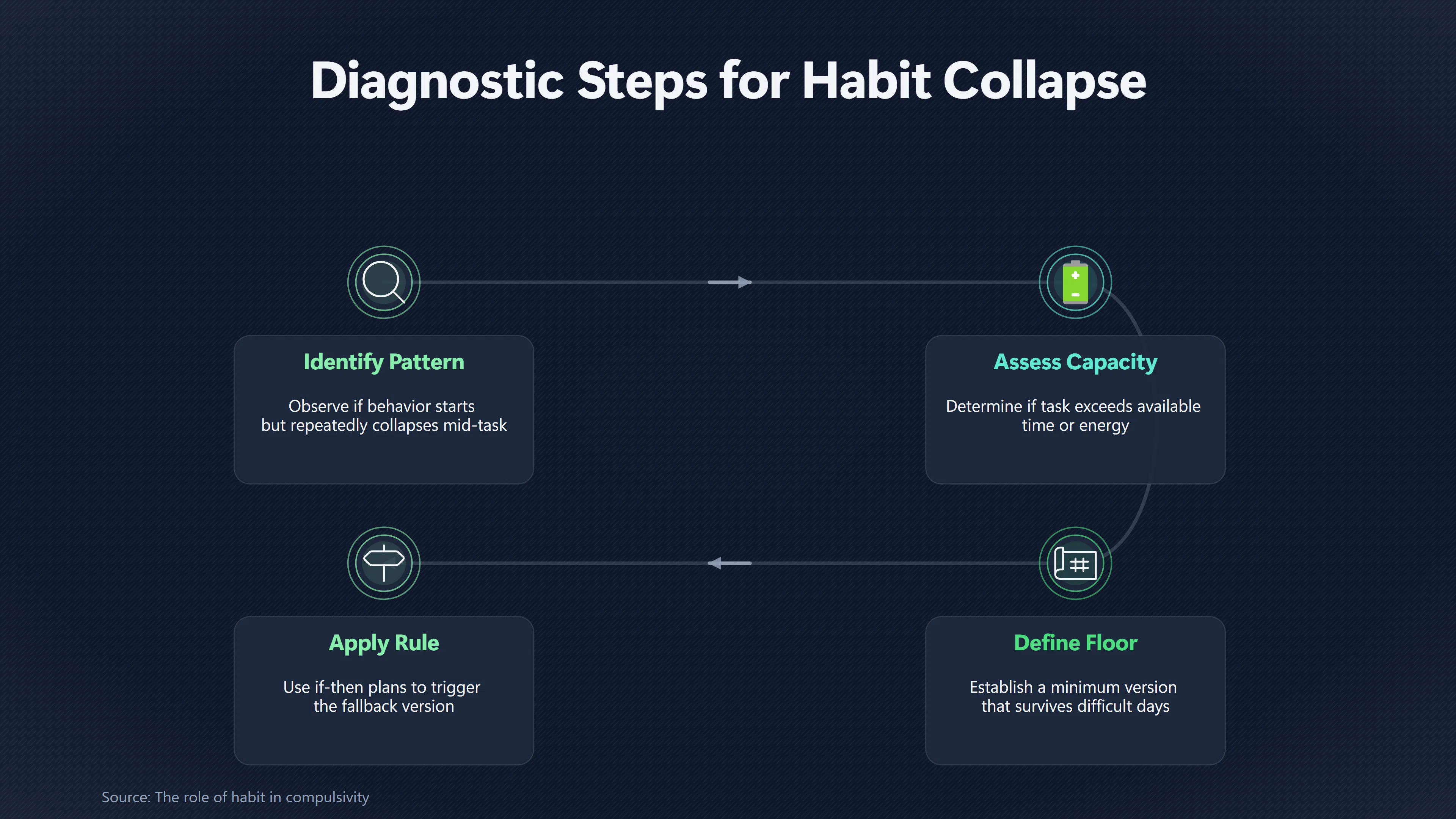
The minimum version is best understood as a floor, not a new ceiling. If the performance goal is to read for 30 minutes, for example, the minimum might be reading two pages after breakfast. On a normal day, reading continues towards 30 minutes. On a difficult day, two pages still constitutes a completed repetition.
That arrangement separates two jobs that are easily confused. The habit floor protects the recurring act of starting and performing the behaviour in its intended context. The performance goal determines how much work is desirable when sufficient capacity exists. The smaller version is therefore not a claim that two pages, five minutes of walking or one paragraph of writing is enough to achieve every larger outcome. It is a way of making repetition less brittle.
This distinction fits the habit literature particularly well. Habit researchers define habits in terms of cue-linked automatic responding learned through repetition, rather than simply as ambitious goals completed repeatedly. Reviews of applied habit formation consequently recommend selecting a simple action and repeating it in a consistent context.[PubMed Central (PMC)]pmc.ncbi.nlm.nih.govPubMed Central (PMC)Making health habitual: the psychology of ‘habit-formation’ and general practice - PMCDecember 1, 2012… In Lally and colleagues’ influential real-world study, participants selected an eating, drinking or activity behaviour and repeated it in the same daily context for 12 weeks. Automaticity generally increased with repetition, although the estimated time to reach 95% of each person’s plateau varied enormously—from 18 to 254 days among those whose data fitted the model.[Wiley Online Library]onlinelibrary.wiley.comWiley Online LibraryHow are habits formed: Modelling habit formation in the real world - Lally - 2010 - European Journal of Social Psycho… A 2024 systematic review likewise found substantial variation in health-habit formation and warned against treating a fixed number of days as a universal rule.[PubMed Central (PMC)]pmc.ncbi.nlm.nih.govOpen source on nih.gov.
A workable minimum therefore has four useful properties:
- It keeps the behaviour recognisable. “Open the textbook” may be an excellent cue or preparation step, but if the intended habit is studying, “answer one practice question” more clearly preserves the target behaviour.
- It fits the bad-but-normal day. A minimum designed only for ideal conditions does not solve the capacity problem. It should survive ordinary fatigue, time pressure or competing demands.
- Its completion rule is unambiguous. “Do a little exercise” invites renegotiation; “walk for five minutes after lunch” makes completion observable.
- It remains attached to the intended cue or context. Shrinking the amount while retaining “after breakfast”, “after lunch” or another stable event preserves the repeated context–behaviour pairing that habit theory regards as important. PubMed Central (PMC)
An if–then rule can make the fallback explicit rather than leaving it to an exhausted person to negotiate in the moment: If I reach the normal cue and cannot reasonably do the full session, then I do the minimum version. Implementation intentions—plans specifying the situation and corresponding response—have substantial evidence behind them as a general aid to goal attainment. A 2024 meta-analysis covering 642 independent tests found positive effects across cognitive, emotional and behavioural outcomes, with stronger effects for genuinely contingent if–then plans. DOI That evidence concerns planning broadly, not minimum habits specifically, so it supports making the fallback rule concrete rather than proving any particular minimum-size prescription.
The minimum should reduce demand, not disguise it
“Make it tiny” becomes bad advice when shrinking changes only the wording while leaving the real burden intact. “Write one sentence” is not a low-demand fallback if completing that sentence still requires finding a laptop, locating research, choosing a topic and overcoming a 20-minute set-up process. Capacity has several dimensions: duration, physical effort, cognitive complexity, preparation and the number of decisions involved.
This is especially important for behaviours that people casually describe as single habits but which are actually action sequences. Going to the gym can include changing clothes, packing equipment, travelling, choosing exercises, training and returning home. Research on behavioural complexity suggests that complex behaviours may retain a substantial need for conscious self-regulation even when their initiation becomes habitual. In one study, self-regulation strategy use rose with behavioural complexity even for strongly habitually instigated behaviours. PubMed Central (PMC) Separate research distinguishing habitual instigation from habitual execution found that automatic initiation predicted frequency across behaviours of different complexity, whereas automatic execution did not. ScienceDirect
A better reduction therefore targets the part that repeatedly exceeds capacity. If duration is the failure point, shorten duration. If preparation is the problem, create a version needing almost none. If cognitive load causes collapse, reduce the number of choices. A 30-minute language session might become five minutes of reviewing an already selected deck rather than five minutes spent deciding what to study.
There is also an important limit to the “small habits” idea: small is not automatically superior. In weight-management research, modest behavioural changes have sometimes produced useful results, but findings are mixed. A three-year randomised trial of 320 adults found that a small-change intervention did not significantly outperform monitoring alone on body weight at two or three years. PubMed Another trial in young adults found benefits from both small-change and large-change self-regulation strategies, with the large-change condition producing greater average weight reduction over roughly three years. PubMed These studies address weight management rather than habit floors directly, but they expose the crucial misconception: lowering behavioural demand can improve feasibility without guaranteeing that the smaller dose will produce the full desired outcome.
The minimum is therefore successful when it prevents an oversized specification from repeatedly destroying the routine. It is not successful merely because it is easy.
Do not turn the minimum into another performance contest
A common failure mode is immediate escalation. Someone chooses five minutes as the fallback, completes it easily for three days, decides that ten minutes would be “better”, then raises the requirement again until the supposedly minimum version once more exceeds capacity. The intervention has quietly recreated the original problem.
Behaviour-change research offers a more defensible model: graded tasks. In the Behaviour Change Technique Taxonomy, graded tasks involve starting with achievable tasks and increasing their difficulty while keeping them attainable. NCBI A 2026 systematic review and meta-analysis examined this technique in adult physical-activity interventions. Across 39 studies included in its meta-analysis, graded-task interventions were associated with a medium increase in physical activity, although graded tasks were always combined with goal setting and action planning, heterogeneity was high and the certainty of evidence was rated low. The authors therefore could not isolate graded tasks as the sole cause of the improvement. Taylor & Francis Online
That caution is useful for personal habit design. Progression should be treated as an experiment in sustainable capacity, not proof that a person ought continually to raise the floor. Earlier meta-analyses of physical-activity interventions have even produced unfavourable associations between graded-task techniques and self-efficacy in some populations, illustrating that “start easy and increase” is not a universally reliable ingredient when separated from the wider intervention. PubMed
A practical policy is to keep the minimum stable while expanding the normal performance above it. Suppose the target is a 30-minute evening study session and the minimum is one practice problem. After the routine becomes reliable, normal sessions can grow from ten to fifteen to twenty minutes while one problem remains the difficult-day floor. That prevents successful expansion from eliminating the safety margin that made the behaviour resilient in the first place.
When should the behaviour expand again?
Expansion makes sense when the current version is being completed reliably enough that the behaviour no longer repeatedly collides with normal conditions. There is no research-backed universal threshold such as “seven perfect days” or “90% completion”. Habit-formation times vary substantially between people and behaviours, and the evidence does not support a fixed calendar rule. PubMed Central (PMC)
Instead, look for a change in the failure pattern. If the minimum is routinely completed, starting has become less contentious, and additional capacity is commonly available afterwards, test a modest increase in the normal version. Change one dimension at a time: five minutes might become ten, one set might become two, or one practice question might become three. If the familiar pattern of repeated collapse returns, that is evidence that the new specification has crossed the workable boundary and should be reduced again.
Importantly, expansion need not mean making the entire sequence automatic. Research on complex behaviour suggests that habitual initiation can coexist with deliberately controlled execution. ScienceDirect A useful long-term design might therefore be “automatically begin writing after breakfast” rather than expecting an entire demanding writing session to unfold without conscious effort.
Nor does one missed opportunity mean that the minimum must be reduced further. In Lally and colleagues’ study, missing a single opportunity did not materially derail the habit-formation trajectory. Wiley Online Library The diagnostic signal is repeated mismatch: the same behaviour, under the same ordinary conditions, continually proving too demanding.
The resulting policy is deliberately conservative. Shrink when repeated performance shows that the specification exceeds available capacity; retain a meaningful minimum tied to the same cue; perform more whenever capacity permits; and expand the normal version only when the smaller design has become reliably sustainable. This preserves the distinction between building a dependable pattern of repetition and pursuing the larger performance outcome. A habit does not need to be permanently small. It needs to be small enough, for long enough, that ordinary difficult days stop destroying the system.
Amazon book picks
Further Reading
Books and field guides related to When Your Habit Is Simply Too Big. Use these as the next step if you want deeper reading beyond the article.
Tiny Habits
Improving your life is much easier than you think. Whether it’s losing weight, sleeping more, or restoring your work/life balance – the s...
Atomic Habits
Rating: 3.5/5 from 7 Google Books ratings
The #1 New York Times bestseller. Over 25 million copies sold! Translated into 60+ languages! Tiny Changes, Remarkable Results No matter...
Mini Habits
Discover the Life-Changing Strategy of This Worldwide Bestseller in 17 Languages! Lasting Change For Early Quitters, Burnouts, The Unmoti...
The Power of Habit
Rating: 4.0/5 from 145 Google Books ratings
Duhigg takes us to the edge of scientific discoveries that explain why habits exist and how they can be changed. Distilling information i...
eBay marketplace picks
Marketplace Samples
Live-tested eBay searches with available results related to this page.
Selected frommotivational wall art oneBay.co.uk.



Endnotes
1.
Source: onlinelibrary.wiley.com
Link:https://onlinelibrary.wiley.com/doi/10.1002/ejsp.674
Source snippet
Wiley Online LibraryHow are habits formed: Modelling habit formation in the real world - Lally - 2010 - European Journal of Social Psycho...
2.
Source: doi.org
Link:https://doi.org/10.1080/10463283.2024.2334563
3.
Source: sciencedirect.com
Link:https://www.sciencedirect.com/science/article/pii/S266651822200016X
4.
Source: ncbi.nlm.nih.gov
Link:https://www.ncbi.nlm.nih.gov/books/NBK501960/
5.
Source: iaap-journals.onlinelibrary.wiley.com
Link:https://iaap-journals.onlinelibrary.wiley.com/doi/10.1111/aphw.12642
6.
Source: compass.onlinelibrary.wiley.com
Link:https://compass.onlinelibrary.wiley.com/doi/full/10.1111/spc3.12975
7.
Source: onlinelibrary.wiley.com
Link:https://onlinelibrary.wiley.com/doi/abs/10.1111/jopy.12926
8.
Source: onlinelibrary.wiley.com
Link:https://onlinelibrary.wiley.com/doi/full/10.1111/jopy.12926
9.
Source: sciencedirect.com
Link:https://www.sciencedirect.com/science/article/pii/S0300571220302165
10.
Source: doi.org
Link:https://doi.org/10.1111/hsc.13090
11.
Source: sciencedirect.com
Link:https://www.sciencedirect.com/science/article/abs/pii/S0738399118307699
12.
Source: sciencedirect.com
Title: The role of habit in compulsivity
Link:https://www.sciencedirect.com/science/article/pii/S0924977X15004162
13.
Source: bpspsychub.onlinelibrary.wiley.com
Link:https://bpspsychub.onlinelibrary.wiley.com/doi/10.1111/bjc.12086
14.
Source: bpspsychub.onlinelibrary.wiley.com
Link:https://bpspsychub.onlinelibrary.wiley.com/doi/abs/10.1111/bjc.12086
15.
Source: sciencedirect.com
Link:https://www.sciencedirect.com/science/article/pii/S155171441500004X
16.
Source: bpspsychub.onlinelibrary.wiley.com
Title: j.2044 8287.2012.02086.x
Link:https://bpspsychub.onlinelibrary.wiley.com/doi/10.1111/j.2044-8287.2012.02086.x
17.
Source: doi.org
Link:https://doi.org/10.1080/17437199.2011.603640%C2%A0
18.
Source: sciencedirect.com
Link:https://www.sciencedirect.com/science/article/pii/S0271531711000674
19.
Source: bpspsychub.onlinelibrary.wiley.com
Link:https://bpspsychub.onlinelibrary.wiley.com/doi/abs/10.1348/014466607X248903
20.
Source: onlinelibrary.wiley.com
Link:https://onlinelibrary.wiley.com/doi/abs/10.1002/ejsp.674
21.
Source: onlinelibrary.wiley.com
Link:https://onlinelibrary.wiley.com/doi/abs/10.1002/ejsp.674?MixPanelId=15e3fe314440-0468d8411-64220f54-100000-15e3fe314460
22.
Source: onlinelibrary.wiley.com
Link:https://onlinelibrary.wiley.com/doi/abs/10.1002/ejsp.674?msockid=17570258034862e732eb114c02616368
23.
Source: onlinelibrary.wiley.com
Link:https://onlinelibrary.wiley.com/doi/full/10.1002/ejsp.674
24.
Source: onlinelibrary.wiley.com
Link:https://onlinelibrary.wiley.com/doi/pdf/10.1002/ejsp.674
25.
Source: onlinelibrary.wiley.com
Link:https://onlinelibrary.wiley.com/doi/abs/10.1002/ejsp.674?msockid=038ed114f43667dd0790c4bef5146634
26.
Source: onlinelibrary.wiley.com
Link:https://onlinelibrary.wiley.com/doi/abs/10.1002/ejsp.674?cf_chl_jschl_tk=pmd_EwcJDaCFBR9OVEL1O_0qjioww0Gc86ZzpBvCBFhrDcE-1635261061-0-gqNtZGzNAjujcnBszQi9
27.
Source: onlinelibrary.wiley.com
Link:https://onlinelibrary.wiley.com/doi/10.1002/ejsp.674?2d235898_page=2&538fcd4b_page=6&d2101103_page=8&d73ad837_page=2
28.
Source: onlinelibrary.wiley.com
Link:https://onlinelibrary.wiley.com/doi/10.1002/ejsp.674?538fcd4b_page=1&947f74f7page=3&=%2Fen-gt%2Four-commitment%23kI3HdLdDj7HLFW4BJlUYoy23RoHF9sl3JcIXrw%3D%3D
29.
Source: onlinelibrary.wiley.com
Link:https://onlinelibrary.wiley.com/doi/abs/10.1002/ejsp.674?source=content_type%3Areact%7Cfirst_level_url%3Aarticle%7Csection%3Amain_content%7Cbutton%3Abody_link
30.
Source: sciencedirect.com
Link:https://www.sciencedirect.com/science/article/pii/S0361476X07000276
31.
Source: bpspsychub.onlinelibrary.wiley.com
Link:https://bpspsychub.onlinelibrary.wiley.com/doi/10.1348/014466604X17533
32.
Source: sciencedirect.com
Title: Differential engagement of self-reactive influences in cognitive motivation
Link:https://www.sciencedirect.com/science/article/pii/0749597886900282
33.
Source: sciencedirect.com
Title: Self-efficacy and human motivation
Link:https://www.sciencedirect.com/science/article/pii/S2215091920300158
34.
Source: sciencedirect.com
Link:https://www.sciencedirect.com/science/article/pii/S0959475225001471
35.
Source: sciencedirect.com
Link:https://www.sciencedirect.com/science/article/abs/pii/S1469029214000922
36.
Source: sciencedirect.com
Link:https://www.sciencedirect.com/science/article/pii/S1469029214000922
37.
Source: sciencedirect.com
Link:https://www.sciencedirect.com/science/article/abs/pii/S0065260106380021
38.
Source: sciencedirect.com
Link:https://www.sciencedirect.com/science/chapter/bookseries/abs/pii/S0065260106380021
39.
Source: sciencedirect.com
Link:https://www.sciencedirect.com/science/article/pii/S1356689X15000673
40.
Source: pubmed.ncbi.nlm.nih.gov
Link:https://pubmed.ncbi.nlm.nih.gov/42053513/
Source snippet
What Makes a Habit? Investigating Potential Determinants of Habit Formation - PubMed...
41.
Source: pmc.ncbi.nlm.nih.gov
Link:https://pmc.ncbi.nlm.nih.gov/articles/PMC11891988/
42.
Source: journals.sagepub.com
Link:https://journals.sagepub.com/doi/full/10.1177/01461672261440446
Source snippet
Sage JournalsWhat Makes a Habit? Investigating Potential Determinants of Habit Formation - Sebastian Bürgler, Marina Milyavskaya, Gail Mc...
43.
Source: frontiersin.org
Link:https://www.frontiersin.org/journals/psychology/articles/10.3389/fpsyg.2019.01556/full
Source snippet
FrontiersFrontiers | Habits, Quick and Easy: Perceived Complexity Moderates the Associations of Contextual Stability and Rewards With Beh...
44.
Source: pmc.ncbi.nlm.nih.gov
Link:https://pmc.ncbi.nlm.nih.gov/articles/PMC6667662/
Source snippet
PubMed Central (PMC)Habits, Quick and Easy: Perceived Complexity Moderates the Associations of Contextual Stability and Rewards With Beha...
45.
Source: pubmed.ncbi.nlm.nih.gov
Link:https://pubmed.ncbi.nlm.nih.gov/35382707/
Source snippet
Ramifications of behavioural complexity for habit conceptualisation, promotion, and measurement - PubMedApril 6, 2022...
Published: April 6, 2022
46.
Source: pmc.ncbi.nlm.nih.gov
Link:https://pmc.ncbi.nlm.nih.gov/articles/PMC3505409/
Source snippet
PubMed Central (PMC)Making health habitual: the psychology of ‘habit-formation’ and general practice - PMCDecember 1, 2012...
Published: December 1, 2012
47.
Source: pmc.ncbi.nlm.nih.gov
Link:https://pmc.ncbi.nlm.nih.gov/articles/PMC11641623/
49.
Source: tandfonline.com
Link:https://www.tandfonline.com/doi/abs/10.1080/10463283.2024.2334563
50.
Source: pubmed.ncbi.nlm.nih.gov
Link:https://pubmed.ncbi.nlm.nih.gov/35256388/
51.
Source: pubmed.ncbi.nlm.nih.gov
Link:https://pubmed.ncbi.nlm.nih.gov/27136493/
52.
Source: tandfonline.com
Link:https://www.tandfonline.com/doi/full/10.1080/17437199.2026.2618195
53.
Source: pubmed.ncbi.nlm.nih.gov
Link:https://pubmed.ncbi.nlm.nih.gov/21321008/
54.
Source: pmc.ncbi.nlm.nih.gov
Link:https://pmc.ncbi.nlm.nih.gov/articles/PMC3639155/
55.
Source: journals.sagepub.com
Link:https://journals.sagepub.com/doi/10.1177/01461672261440446
56.
Source: journals.sagepub.com
Link:https://journals.sagepub.com/doi/abs/10.1177/01461672261440446
57.
Source: pubmed.ncbi.nlm.nih.gov
Link:https://pubmed.ncbi.nlm.nih.gov/41784001/
58.
Source: tandfonline.com
Link:https://www.tandfonline.com/doi/abs/10.1080/17437199.2026.2618195
59.
Source: pmc.ncbi.nlm.nih.gov
Link:https://pmc.ncbi.nlm.nih.gov/articles/PMC12770921/
60.
Source: pmc.ncbi.nlm.nih.gov
Link:https://pmc.ncbi.nlm.nih.gov/articles/PMC12596556/
61.
Source: pmc.ncbi.nlm.nih.gov
Link:https://pmc.ncbi.nlm.nih.gov/articles/PMC12649445/
62.
Source: pmc.ncbi.nlm.nih.gov
Link:https://pmc.ncbi.nlm.nih.gov/articles/PMC12499672/
63.
Source: pmc.ncbi.nlm.nih.gov
Link:https://pmc.ncbi.nlm.nih.gov/articles/PMC12059501/
64.
Source: pubmed.ncbi.nlm.nih.gov
Link:https://pubmed.ncbi.nlm.nih.gov/39685110/
65.
Source: pmc.ncbi.nlm.nih.gov
Link:https://pmc.ncbi.nlm.nih.gov/articles/PMC11351980/
66.
Source: pmc.ncbi.nlm.nih.gov
Link:https://pmc.ncbi.nlm.nih.gov/articles/PMC10427801/
67.
Source: pubmed.ncbi.nlm.nih.gov
Link:https://pubmed.ncbi.nlm.nih.gov/38560998/
68.
Source: pubmed.ncbi.nlm.nih.gov
Link:https://pubmed.ncbi.nlm.nih.gov/38078244/
69.
Source: pmc.ncbi.nlm.nih.gov
Link:https://pmc.ncbi.nlm.nih.gov/articles/PMC10698739/
70.
Source: frontiersin.org
Link:https://www.frontiersin.org/journals/psychology/articles/10.3389/fpsyg.2023.1260084/full
71.
Source: pmc.ncbi.nlm.nih.gov
Link:https://pmc.ncbi.nlm.nih.gov/articles/PMC10944418/
72.
Source: pmc.ncbi.nlm.nih.gov
Link:https://pmc.ncbi.nlm.nih.gov/articles/PMC10357511/
73.
Source: tandfonline.com
Link:https://www.tandfonline.com/doi/full/10.1080/07294360.2023.2197194
74.
Source: pubmed.ncbi.nlm.nih.gov
Link:https://pubmed.ncbi.nlm.nih.gov/35995541/
75.
Source: pmc.ncbi.nlm.nih.gov
Link:https://pmc.ncbi.nlm.nih.gov/articles/PMC10511844.1/
76.
Source: pmc.ncbi.nlm.nih.gov
Link:https://pmc.ncbi.nlm.nih.gov/articles/PMC9223740/
77.
Source: tandfonline.com
Link:https://www.tandfonline.com/doi/abs/10.1080/17437199.2022.2060849
78.
Source: pmc.ncbi.nlm.nih.gov
Link:https://pmc.ncbi.nlm.nih.gov/articles/PMC9053990/
79.
Source: tandfonline.com
Link:https://www.tandfonline.com/doi/full/10.1080/23311908.2022.2041277
80.
Source: pmc.ncbi.nlm.nih.gov
Link:https://pmc.ncbi.nlm.nih.gov/articles/PMC8388501/
81.
Source: pubmed.ncbi.nlm.nih.gov
Link:https://pubmed.ncbi.nlm.nih.gov/34207799/
82.
Source: pmc.ncbi.nlm.nih.gov
Link:https://pmc.ncbi.nlm.nih.gov/articles/PMC8149892/
83.
Source: pubmed.ncbi.nlm.nih.gov
Link:https://pubmed.ncbi.nlm.nih.gov/34054628/
84.
Source: frontiersin.org
Link:https://www.frontiersin.org/journals/psychology/articles/10.3389/fpsyg.2021.634223/full
85.
Source: pmc.ncbi.nlm.nih.gov
Link:https://pmc.ncbi.nlm.nih.gov/articles/PMC7429724/
86.
Source: pmc.ncbi.nlm.nih.gov
Link:https://pmc.ncbi.nlm.nih.gov/articles/PMC7321770/
87.
Source: pmc.ncbi.nlm.nih.gov
Link:https://pmc.ncbi.nlm.nih.gov/articles/PMC7429262/
88.
Source: pubmed.ncbi.nlm.nih.gov
Link:https://pubmed.ncbi.nlm.nih.gov/32059728/
89.
Source: pmc.ncbi.nlm.nih.gov
Link:https://pmc.ncbi.nlm.nih.gov/articles/PMC6690557/
90.
Source: pmc.ncbi.nlm.nih.gov
Link:https://pmc.ncbi.nlm.nih.gov/articles/PMC5641896/
91.
Source: pubmed.ncbi.nlm.nih.gov
Link:https://pubmed.ncbi.nlm.nih.gov/28382755/
92.
Source: pmc.ncbi.nlm.nih.gov
Link:https://pmc.ncbi.nlm.nih.gov/articles/PMC5113774/
93.
Source: pmc.ncbi.nlm.nih.gov
Link:https://pmc.ncbi.nlm.nih.gov/articles/PMC4977881/
94.
Source: pmc.ncbi.nlm.nih.gov
Link:https://pmc.ncbi.nlm.nih.gov/articles/PMC4894125/
95.
Source: pmc.ncbi.nlm.nih.gov
Link:https://pmc.ncbi.nlm.nih.gov/articles/PMC4842193/
96.
Source: pmc.ncbi.nlm.nih.gov
Link:https://pmc.ncbi.nlm.nih.gov/articles/PMC4975085/
97.
Source: pubmed.ncbi.nlm.nih.gov
Link:https://pubmed.ncbi.nlm.nih.gov/26479070/
98.
Source: pubmed.ncbi.nlm.nih.gov
Link:https://pubmed.ncbi.nlm.nih.gov/26361052/
99.
Source: pubmed.ncbi.nlm.nih.gov
Link:https://pubmed.ncbi.nlm.nih.gov/26361052/?dopt=Abstract
100.
Source: pmc.ncbi.nlm.nih.gov
Link:https://pmc.ncbi.nlm.nih.gov/articles/PMC4500900/
101.
Source: pubmed.ncbi.nlm.nih.gov
Link:https://pubmed.ncbi.nlm.nih.gov/25965276/
102.
Source: pubmed.ncbi.nlm.nih.gov
Link:https://pubmed.ncbi.nlm.nih.gov/25851609/
103.
Source: pubmed.ncbi.nlm.nih.gov
Link:https://pubmed.ncbi.nlm.nih.gov/25633208/
104.
Source: pubmed.ncbi.nlm.nih.gov
Link:https://pubmed.ncbi.nlm.nih.gov/23750603/
105.
Source: pmc.ncbi.nlm.nih.gov
Link:https://pmc.ncbi.nlm.nih.gov/articles/PMC4346081/
106.
Source: pmc.ncbi.nlm.nih.gov
Link:https://pmc.ncbi.nlm.nih.gov/articles/PMC4288988/
107.
Source: pmc.ncbi.nlm.nih.gov
Link:https://pmc.ncbi.nlm.nih.gov/articles/PMC3557456/
108.
Source: pmc.ncbi.nlm.nih.gov
Link:https://pmc.ncbi.nlm.nih.gov/articles/PMC3540350/
109.
Source: tandfonline.com
Title: Promoting habit formation: Health Psychology Review: Vol 7, No sup1
Link:https://www.tandfonline.com/doi/full/10.1080/17437199.2011.603640
110.
Source: pubmed.ncbi.nlm.nih.gov
Link:https://pubmed.ncbi.nlm.nih.gov/21749245/
111.
Source: pmc.ncbi.nlm.nih.gov
Link:https://pmc.ncbi.nlm.nih.gov/articles/PMC3521039/
112.
Source: pmc.ncbi.nlm.nih.gov
Link:https://pmc.ncbi.nlm.nih.gov/articles/PMC3278071/
113.
Source: pubmed.ncbi.nlm.nih.gov
Link:https://pubmed.ncbi.nlm.nih.gov/18568379/
114.
Source: pubmed.ncbi.nlm.nih.gov
Link:https://pubmed.ncbi.nlm.nih.gov/1429347/
115.
Source: ncbi.nlm.nih.gov
Link:https://www.ncbi.nlm.nih.gov/books/NBK576350/
116.
Source: pmc.ncbi.nlm.nih.gov
Link:https://pmc.ncbi.nlm.nih.gov/articles/PMC5404988/
117.
Source: pmc.ncbi.nlm.nih.gov
Link:https://pmc.ncbi.nlm.nih.gov/articles/PMC4444702/
118.
Source: ncbi.nlm.nih.gov
Link:https://www.ncbi.nlm.nih.gov/books/NBK327613/
119.
Source: ncbi.nlm.nih.gov
Link:https://www.ncbi.nlm.nih.gov/books/NBK327618/?report=printable
120.
Source: pubmed.ncbi.nlm.nih.gov
Link:https://pubmed.ncbi.nlm.nih.gov/17945040/
121.
Source: pubmed.ncbi.nlm.nih.gov
Link:https://pubmed.ncbi.nlm.nih.gov/12837010/
122.
Source: pubmed.ncbi.nlm.nih.gov
Link:https://pubmed.ncbi.nlm.nih.gov/16238850/
123.
Source: pubmed.ncbi.nlm.nih.gov
Link:https://pubmed.ncbi.nlm.nih.gov/17561217/
124.
Source: ncbi.nlm.nih.gov
Link:https://www.ncbi.nlm.nih.gov/books/NBK567039/
125.
Source: coventry.gov.uk
Link:https://www.coventry.gov.uk/healthdeterminantsresearchcollaboration/research-projects/behaviour-change-physical-activity
126.
Source: taylorfrancis.com
Title: The Role of Self-Efficacy in Goal-Based Motivation | 13 | New Developm
Link:https://www.taylorfrancis.com/chapters/edit/10.4324/9780203082744-13/role-self-efficacy-goal-based-motivation-albert-bandura
127.
Source: mind.help
Title: Habit Formation
Link:https://mind.help/topic/habit-formation/
Additional References
128.
Source: youtube.com
Title: How small habits and a two-minute rule can help your productivity
Link:https://www.youtube.com/watch?v=GECcjrYHH8w
Source snippet
BJ Fogg Tiny Habits ability motivation Fogg behavior model in 2 minutes and 30 seconds...
129.
Source: youtube.com
Title: Forget big change, start with a tiny habit: BJ Fogg at TEDx Fremont
Link:https://www.youtube.com/watch?v=AdKUJxjn-R8
Source snippet
The Surprising Power of Small Habits | James Clear...
130.
Source: youtube.com
Title: MINI HABITS by Stephen Guise | Core Message
Link:https://www.youtube.com/watch?v=rETOlen9G30
Source snippet
How small habits and a two-minute rule can help your productivity...
131.
Source: researchgate.net
Link:https://www.researchgate.net/publication/285542964_Behaviour_change_techniques_the_development_and_evaluation_of_a_taxonomic_method_for_reporting_and_describing_behaviour_change_interventions_a_suite_of_five_studies_involving_consensus_methods_randomi
132.
Source: researchgate.net
Link:https://www.researchgate.net/publication/365012800_Fostering_research_article_reading_habits_of_Thai_graduate_students_with_an_intervention_through_design_research
133.
Source: researchgate.net
Link:https://www.researchgate.net/publication/362509175_Habit_and_behavioural_complexity_habitual_instigation_and_execution_as_predictors_of_simple_and_complex_behaviours
134.
Source: researchgate.net
Link:https://www.researchgate.net/publication/37367696_Implementation_Intentions_and_Goal_Achievement_A_Meta-Analysis_of_Effects_and_Processes
135.
Source: researchgate.net
Link:https://www.researchgate.net/publication/263504602_The_Behaviour_Change_Technique_Taxonomy_BCTTv1_of_93_hierarchically-clustered_techniques_testing_reliability_of_the_taxonomy_in_specifying_the_content_of_behaviour_change_interventions
136.
Source: researchgate.net
Link:https://www.researchgate.net/figure/A-tool-for-patients-Make-a-new-healthy-habit-1-Decide-on-a-goal-that-you-would-like-to_fig1_313222925
137.
Source: academic.oup.com
Link:https://academic.oup.com/edited-volume/62246/chapter-abstract/550940636