Within Learning Goals
When Are You Ready for a Performance Goal?
Performance goals become more useful once effective strategies are reliable enough that attention can shift from discovery toward execution.
On this page
- Signs that strategy discovery is becoming reliable
- How performance targets change the task demand
- Using a gradual handoff from learning to results
Page outline Jump by section
Introduction
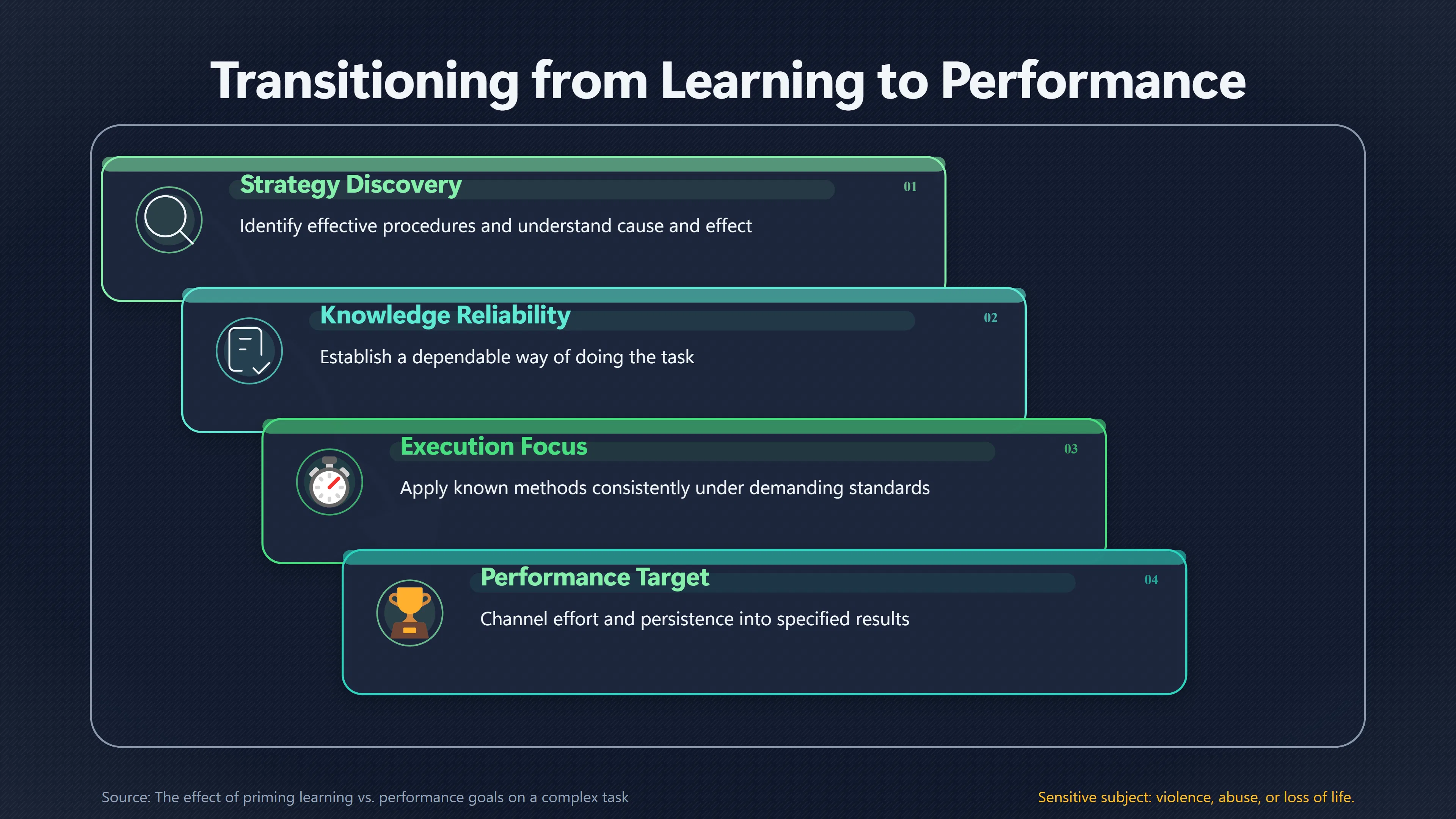
The right time to switch from a learning goal to a performance target is not simply “after enough practice”. The more useful threshold is when you have a dependable way of doing the task. Early on, the main problem is usually discovery: finding effective strategies, understanding cause and effect, and learning which procedures work. Later, once that knowledge is sufficiently reliable, the problem increasingly becomes execution: applying the method consistently, efficiently and under demanding standards.
That distinction matters because performance goals work best when effort and persistence can be channelled through relevant task knowledge. Goal-setting research has long found benefits from specific, challenging targets, but research on complex tasks qualifies that finding: when people do not yet know how to achieve the result, an ambitious outcome target can compete with the learning needed to develop the method. Once useful knowledge and skills exist, that constraint weakens and performance targets become more appropriate.[Academy of Management Journals]journals.aom.orgAcademy of Management JournalsLearning versus performance goals: When should each be used? | Academy of Management PerspectivesFebruary 1…
The practical implication is a handoff rather than a fixed date. Do not ask only, “How long have I been practising?” Ask, “Am I still searching for a workable strategy, or am I now mainly trying to execute a strategy I understand?”
When strategy discovery is becoming reliable
A useful way to recognise the transition is to look at what is causing your remaining errors. If failures still routinely reveal that you misunderstood the task, chose the wrong method or cannot explain why one approach works better than another, learning remains the bottleneck. If failures increasingly come from inconsistent execution, insufficient effort, lapses of attention, pacing or failure to apply an already-known procedure, a performance target has more to work with.
This follows from an important distinction in the goal-setting literature between motivation and task knowledge. Edwin Locke’s analysis of studies linking goals, strategies and performance argued that direct benefits from performance goals arise when people already possess relevant task knowledge. In effect, a demanding target can tell an experienced person to mobilise and apply strategies that are already available; it cannot substitute for strategies that have not yet been acquired.[IAAP Journals]iaap-journals.onlinelibrary.wiley.comIAAP JournalsMotivation, Cognition, and Action: An Analysis of Studies of Task Goals and Knowledge - Locke - 2000 - Applied Psychology…
Experience matters for the same reason. A field study involving 347 employees found that experience moderated relationships between goal setting, strategy quality and performance on jobs with substantial component complexity. This does not produce a universal number of hours after which somebody becomes “ready”, but it reinforces the underlying principle: the same objective can impose different cognitive demands on a novice and an experienced performer.[Wiley Online Library]onlinelibrary.wiley.comWiley Online LibraryJoint moderating effects of job experience and task component complexity: Relations among goal setting, task strategi…
For self-improvement, several practical signs therefore point towards readiness for a stronger performance focus:
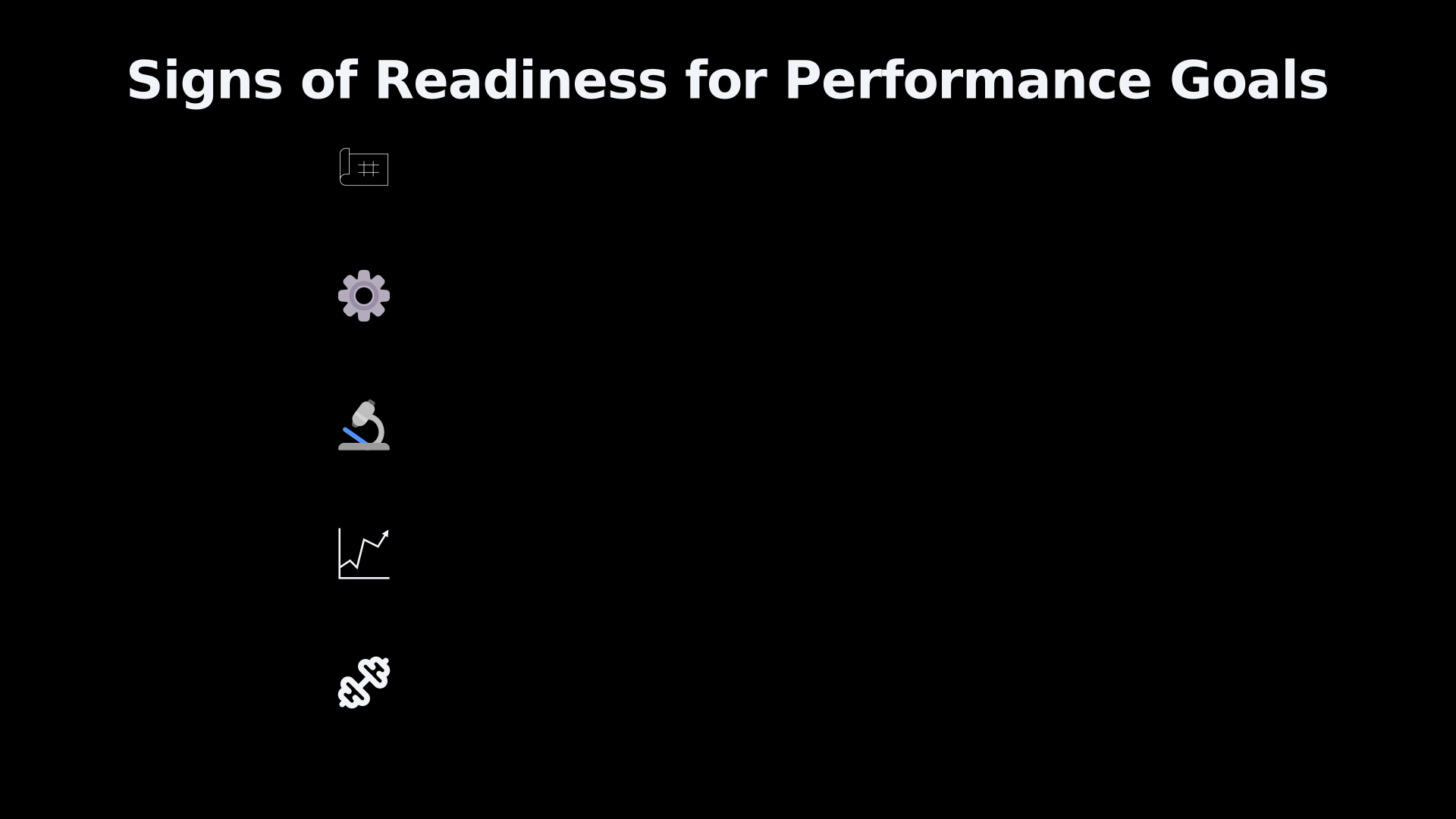
- You can describe the method, not merely the desired result. You know the main steps, decisions or techniques that generate good performance.
- The strategy survives repetition. A successful attempt no longer feels like a lucky exception; similar decisions produce reasonably similar results across several attempts.
- Feedback mostly refines execution. Corrections concern speed, precision, consistency or application rather than repeatedly exposing a missing mental model.
- You can diagnose mistakes. When performance drops, you can usually identify what went wrong and what to change on the next attempt.
- Extra effort has somewhere useful to go. Working faster, harder or for longer now means applying known behaviours more consistently rather than simply intensifying an uncertain approach.
These are diagnostic indicators, not a validated five-part test. Research gives much stronger support to the underlying principle — use learning goals when relevant knowledge and skill still need to be acquired — than to any universal numerical switching threshold. A recent expert statement on goal setting in exercise and physical activity makes the same distinction explicitly: specific, challenging performance goals are appropriate when the necessary ability is present, whereas people should avoid such targets while they still lack the knowledge or skill needed to perform the task.[PubMed Central (PMC)]pmc.ncbi.nlm.nih.govPubMed Central (PMC)Goal Setting in Exercise and Physical Activity: An Expert Statement on Behalf of Exercise and Sports Science Australi…
Confidence can be informative too, but it should be treated as supporting evidence rather than proof. In a complex business simulation, a specific learning goal improved performance relative to a performance goal or vague goal, with information search and self-efficacy helping to explain the effect. Someone who feels confident because they have discovered and successfully applied effective strategies is in a different position from someone who merely feels confident before those strategies have been tested.[Academy of Management Journals]journals.aom.orgAcademy of Management JournalsGoal Setting and Goal Orientation: An Integration of Two Different Yet Related Literatures | Academy of Man…
What changes when you adopt a performance target?
Switching goals changes what deserves your limited attention. A learning goal might be: identify three ways of structuring this analysis and determine which produces the fewest errors. A performance goal might become: complete the analysis accurately within 90 minutes. The second target makes sense once the first problem has largely been solved.
This is why performance goals should not be understood as the “advanced” version of learning goals in a simple hierarchy. They perform a different job. Learning goals direct attention towards discovering strategies, procedures and task knowledge. Performance goals can then direct established capability towards a specified result through greater focus, effort and persistence. Seijts and Latham summarised the distinction by arguing that learning goals are particularly useful when acquiring knowledge and skills is more important than simply increasing effort.[Academy of Management Journals]journals.aom.orgAcademy of Management JournalsLearning versus performance goals: When should each be used? | Academy of Management PerspectivesFebruary 1…
Historically, this qualification emerged against a large body of goal-setting research showing that specific, difficult goals often outperform vague “do your best” instructions. A major meta-analysis of studies conducted from 1966 to 1984 found strong support for difficult and specific goals, while also identifying moderators of their effects. Later work on complex tasks helped clarify why the familiar prescription cannot simply be transferred unchanged to a novice who is still learning what to do.[ScienceDirect]sciencedirect.comA meta-analytic study of the effects of goal setting on task performance: 1966–1984 - ScienceDirectFebruary 1, 1987…
The difference is especially visible when knowledge acquisition is experimentally important. In research using a complex business simulation, participants assigned a specific learning goal performed better than those assigned a specific performance goal or a vague goal; information search helped mediate the learning-goal advantage. Another experiment on a complex knowledge-acquisition task found a significant performance effect for a primed learning goal but not for a primed performance goal.[Academy of Management Journals]journals.aom.orgAcademy of Management JournalsGoal Setting and Goal Orientation: An Integration of Two Different Yet Related Literatures | Academy of Man…
Once task knowledge is available, however, a performance target becomes capable of doing what it does well. Instead of consuming attention that should have been spent discovering a method, the target can concentrate effort on applying that method. A runner who has learnt sustainable pacing can now pursue a time; an analyst with a reliable checking procedure can pursue turnaround time; a speaker who can structure and deliver a coherent presentation can begin targeting tighter timing or fewer verbal fillers.
The crucial change is therefore not from learning to no more learning. It is from learning as the principal constraint on results to execution as the principal constraint. Even experts continue to learn.

Use a gradual handoff rather than an abrupt switch
In real life, the boundary is rarely clean enough to justify declaring one day the end of learning and the next day the beginning of performance. Complex skills contain components that mature at different rates, and new circumstances can make an apparently familiar task unfamiliar again. A more robust approach is to change the weight placed on each type of goal.
During early practice, the dominant question might be, “What strategies work?” Performance can still be recorded, but primarily as feedback. During the transition, the question becomes, “Can I apply what I have learnt reliably while beginning to meet an output standard?” Later, the dominant question becomes, “Can I consistently reach this result?” Learning then remains in reserve for diagnosing plateaux, failures and changing conditions.
There is some direct experimental evidence supporting this sequential logic, although the evidence base is considerably smaller than the broader literature on learning versus performance goals. A University of Waterloo doctoral experiment in a high-complexity accounting task found that learning goals increased learning relative to performance goals alone. It also found that introducing performance goals after learning goals had induced learning produced better performance than learning goals alone. Simultaneously combining learning and performance goals also improved performance in that experiment without the predicted impairment to learning.[UWSpace]uwspace.uwaterloo.caWorking Smarter and Working Harder: Combining Learning and Performance Goals to Improve Performance in a High-Complexity Task Envi…
That result argues against treating the handoff as an absolute either-or choice. It may be perfectly reasonable to retain a learning objective while adding a performance target. For example:
Early stage: “Test three ways of planning the work and record which one reduces rework.”
Transition stage: “Use the best method on five comparable attempts, while aiming to finish within two hours.”
Performance stage: “Finish within 90 minutes while maintaining the agreed quality standard.”
The transition stage is especially useful because it tests whether newly acquired knowledge is genuinely dependable. One successful attempt does not establish mastery. Requiring the strategy to produce acceptable results repeatedly makes the performance target a test of execution rather than a desperate attempt to force an immature method to work.
Process feedback remains valuable during this handoff. Research using a stock-investment simulation found that both process and outcome feedback could interact with goal setting to improve performance, but process feedback was more strongly associated with information-search and strategy quality, whereas outcome feedback was more strongly associated with effort and self-confidence. That distinction suggests a sensible transition: keep enough process feedback to detect weaknesses in the method while increasingly using outcome feedback to judge execution.[Academy of Management Journals]journals.aom.orgOpen source on aom.org.
Do not mistake an improving score for readiness
A rising performance measure is encouraging, but by itself it does not prove that the learning phase is finished. Results can improve because the particular examples became familiar, conditions were unusually favourable or a partially effective strategy happened to work. The more important question is whether the knowledge behind the result transfers across repeated or varied attempts.
Likewise, failing to hit a newly introduced performance target does not automatically mean the target is too ambitious. The diagnosis depends on why you missed it. If you know what to do but cannot yet do it quickly or consistently enough, a calibrated performance goal may be exactly the useful pressure you need. If failure sends you back into uncontrolled strategy switching because you still do not know what works, the goal may have been introduced too early.
Feedback can help distinguish these situations. Research has found that process feedback is particularly connected with strategy quality and information search, while work on learning goals and reflection indicates that structured reflection can strengthen the performance benefits of learning goals on complex decision-making tasks.[Academy of Management Journals]journals.aom.orgOpen source on aom.org. A practical review after an attempt can therefore ask two different questions: Did my method fail, or did my execution of a sound method fail? The answer tells you which kind of goal deserves priority next.
Negative feedback can also justify temporarily moving in the opposite direction. Research on achievement goals and feedback found that people given learning-goal instructions improved more after negative feedback in the experimental setting studied. More broadly, reviews of goal-setting theory recommend returning attention to learning when negative feedback arrives on a task experienced as highly complex.[Taylor & Francis Online]tandfonline.comOpen source on tandfonline.com.
That makes the transition reversible. A person can be ready for performance goals in familiar conditions yet need learning goals again after moving to a harder level, adopting new technology, encountering unfamiliar opponents or taking on a substantially different version of the task. Expertise is specific enough that “experienced” should never automatically be translated into “no longer needs learning goals”.
The switch is about the bottleneck
The most useful rule is simple: set the goal around what is currently limiting improvement.
When the bottleneck is discovering what to do, make learning explicit. When you possess a sufficiently reliable strategy and the bottleneck has shifted towards applying it with greater effort, speed, accuracy or consistency, introduce a performance target. If the situation is intermediate, combine the two carefully or let performance targets enter progressively rather than replacing learning overnight. This interpretation fits the broader evidence that task knowledge and motivation work together: goals become most useful when the person possesses knowledge that can be mobilised towards the desired result.[IAAP Journals]iaap-journals.onlinelibrary.wiley.comIAAP JournalsMotivation, Cognition, and Action: An Analysis of Studies of Task Goals and Knowledge - Locke - 2000 - Applied Psychology…
There are important limits to how mechanically this principle should be applied. Individual findings do not always favour learning goals. For example, research on highly interdependent teams found specific learning goals performed worse than specific performance goals in its command-and-control simulation, with team coordination helping to explain the result.[ScienceDirect]sciencedirect.comOpen source on sciencedirect.com. That is a useful warning against turning evidence about individual skill acquisition into an inflexible rule for every group or setting.
For an individual learning an unfamiliar, complex task, however, the central decision remains practical rather than philosophical. A performance target is most useful when it asks you to execute knowledge you have, rather than compensating for knowledge you do not. The aim of the learning phase is therefore not endless preparation. It is to build a method dependable enough that a demanding result can finally become the right thing to pursue.
Amazon book picks
Further Reading
Books and field guides related to When Are You Ready for a Performance Goal?. Use these as the next step if you want deeper reading beyond the article.
Make It Stick: The Science of Successful Learning
To most of us, learning something "the hard way" implies wasted time and effort. Good teaching, we believe, should be creatively tailored...
Peak: Secrets from the New Science of Expertise
El mayor experto mundial en rendimiento y desarrollo de habilidades, Anders Ericsson, nos enseña los secretos para conseguir ser el mejor...
Mindset: The New Psychology of Success
From the renowned psychologist who introduced the world to “growth mindset” comes this updated edition of the million-copy bestseller—fea...
The Art of Learning: An Inner Journey to Optimal Performance
In his riveting new book, The Art of Learning, Waitzkin tells his remarkable story of personal achievement and shares the principles of l...
eBay marketplace picks
Marketplace Samples
Live-tested eBay searches with available results related to this page.
Selected frommotivational wall art oneBay.co.uk.




Endnotes
1.
Source: iaap-journals.onlinelibrary.wiley.com
Link:https://iaap-journals.onlinelibrary.wiley.com/doi/abs/10.1111/1464-0597.00023
Source snippet
IAAP JournalsMotivation, Cognition, and Action: An Analysis of Studies of Task Goals and Knowledge - Locke - 2000 - Applied Psychology...
2.
Source: onlinelibrary.wiley.com
Link:https://onlinelibrary.wiley.com/doi/10.1002/job.4030110104
Source snippet
Wiley Online LibraryJoint moderating effects of job experience and task component complexity: Relations among goal setting, task strategi...
3.
Source: sciencedirect.com
Link:https://www.sciencedirect.com/science/article/abs/pii/0749597887900458
Source snippet
A meta-analytic study of the effects of goal setting on task performance: 1966–1984 - ScienceDirectFebruary 1, 1987...
Published: February 1, 1987
4.
Source: sciencedirect.com
Link:https://www.sciencedirect.com/science/article/pii/S0749597896900023
Source snippet
Goal Setting Effects on Implicit and Explicit Learning of Complex Tasks - ScienceDirect...
5.
Source: sciencedirect.com
Link:https://www.sciencedirect.com/science/article/pii/S0749597813000423
6.
Source: sciencedirect.com
Link:https://www.sciencedirect.com/science/article/pii/S1469029225002055
7.
Source: sciencedirect.com
Link:https://www.sciencedirect.com/science/article/pii/S0361476X17302527
8.
Source: sciencedirect.com
Title: The effect of priming learning vs. performance goals on a complex task
Link:https://www.sciencedirect.com/science/article/abs/pii/S0749597814000508
9.
Source: sciencedirect.com
Link:https://www.sciencedirect.com/science/article/pii/S0959475212000382
10.
Source: sciencedirect.com
Title: Knowing when to set learning versus performance goals
Link:https://www.sciencedirect.com/science/article/abs/pii/S0090261611000751
11.
Source: onlinelibrary.wiley.com
Title: j.1750 4716.2009.00050.x
Link:https://onlinelibrary.wiley.com/doi/full/10.1111/j.1750-4716.2009.00050.x
12.
Source: iaap-journals.onlinelibrary.wiley.com
Title: j.1464 0597.2006.00246.x
Link:https://iaap-journals.onlinelibrary.wiley.com/doi/10.1111/j.1464-0597.2006.00246.x
13.
Source: sciencedirect.com
Link:https://www.sciencedirect.com/science/article/pii/S0361476X03000328
14.
Source: sciencedirect.com
Title: Challenge versus threat effects on the goal–performance relationship
Link:https://www.sciencedirect.com/science/article/pii/S0749597802000043
15.
Source: sciencedirect.com
Title: Goal Attainment
Link:https://www.sciencedirect.com/topics/social-sciences/goal-attainment
16.
Source: sciencedirect.com
Link:https://www.sciencedirect.com/science/article/pii/0749597887900458
17.
Source: sciencedirect.com
Title: Task-goal attributes, n achievement, and supervisory performance
Link:https://www.sciencedirect.com/science/article/pii/0030507375900586
18.
Source: sciencedirect.com
Link:https://www.sciencedirect.com/science/article/abs/pii/S1747938X25000466
19.
Source: sciencedirect.com
Link:https://www.sciencedirect.com/science/article/pii/S0005789405803417
20.
Source: journals.aom.org
Link:https://journals.aom.org/doi/10.5465/ame.2005.15841964
Source snippet
Academy of Management JournalsLearning versus performance goals: When should each be used? | Academy of Management PerspectivesFebruary 1...
21.
Source: pmc.ncbi.nlm.nih.gov
Link:https://pmc.ncbi.nlm.nih.gov/articles/PMC13018065/
Source snippet
PubMed Central (PMC)Goal Setting in Exercise and Physical Activity: An Expert Statement on Behalf of Exercise and Sports Science Australi...
22.
Source: journals.aom.org
Link:https://journals.aom.org/doi/pdf/10.5465/20159574
Source snippet
Academy of Management JournalsGoal Setting and Goal Orientation: An Integration of Two Different Yet Related Literatures | Academy of Man...
23.
Source: uwspace.uwaterloo.ca
Link:https://uwspace.uwaterloo.ca/items/776665d9-fbb6-4f7f-afae-a884e788b49e
Source snippet
Working Smarter and Working Harder: Combining Learning and Performance Goals to Improve Performance in a High-Complexity Task Envi...
24.
Source: uwaterloo.ca
Link:https://uwaterloo.ca/ctr-sustainability-performance-management/working-smarter-and-working-harder-combining-learning-and
25.
Source: journals.aom.org
Link:https://journals.aom.org/doi/epdf/10.5465/256353
26.
Source: journals.aom.org
Link:https://journals.aom.org/doi/10.5465/256353
27.
Source: tandfonline.com
Link:https://www.tandfonline.com/doi/abs/10.1080/08959281003621687
28.
Source: tandfonline.com
Link:https://www.tandfonline.com/doi/full/10.1080/17437199.2019.1706616
29.
Source: doi.org
Link:https://doi.org/10.1007/s40279-025-02373-5
30.
Source: tandfonline.com
Title: Full article: Goal-Setting Strategies: A Primer for Sport Coaches
Link:https://www.tandfonline.com/doi/full/10.1080/08924562.2025.2523247
31.
Source: pmc.ncbi.nlm.nih.gov
Link:https://pmc.ncbi.nlm.nih.gov/articles/PMC12423735/
32.
Source: tandfonline.com
Link:https://www.tandfonline.com/doi/full/10.1080/1359432X.2024.2384665
33.
Source: doi.org
Link:https://doi.org/10.1007/s12186-021-09265-5
34.
Source: tandfonline.com
Link:https://www.tandfonline.com/doi/abs/10.1080/17437199.2019.1706616
35.
Source: doi.org
Link:https://doi.org/10.1146%2Fannurev-orgpsych-041015-062547
36.
Source: uwspace.uwaterloo.ca
Link:https://uwspace.uwaterloo.ca/items/776665d9-fbb6-4f7f-afae-a884e788b49e/full
37.
Source: journals.aom.org
Link:https://journals.aom.org/doi/10.5465/ambpp.2016.11095abstract
38.
Source: doi.org
Link:https://doi.org/10.5465/20159574
39.
Source: doi.org
Link:https://doi.org/10.2307/20159574
40.
Source: pmc.ncbi.nlm.nih.gov
Link:https://pmc.ncbi.nlm.nih.gov/articles/PMC4861881/
41.
Source: pmc.ncbi.nlm.nih.gov
Link:https://pmc.ncbi.nlm.nih.gov/articles/PMC3668796/
42.
Source: pubmed.ncbi.nlm.nih.gov
Link:https://pubmed.ncbi.nlm.nih.gov/21848715/
43.
Source: journals.aom.org
Link:https://journals.aom.org/doi/abs/10.5465/ame.2005.15841964
44.
Source: journals.aom.org
Link:https://journals.aom.org/doi/10.5465/amr.1983.4284597
45.
Source: journals.aom.org
Link:https://journals.aom.org/doi/abs/10.5465/amr.1983.4284597
46.
Source: pubmed.ncbi.nlm.nih.gov
Link:https://pubmed.ncbi.nlm.nih.gov/10262609/
47.
Source: pubmed.ncbi.nlm.nih.gov
Link:https://pubmed.ncbi.nlm.nih.gov/15647124/
48.
Source: scilove.app
Link:https://www.scilove.app/article/10.5465/ame.2005.15841964
49.
Source: periodicos.capes.gov.br
Link:https://www.periodicos.capes.gov.br/index.php/acervo/buscador.html?id=W2037374094&task=detalhes
Additional References
50.
Source: nature.com
Link:https://www.nature.com/articles/s41598-026-46305-3
51.
Source: youtube.com
Title: Mastery vs Performance goals
Link:https://www.youtube.com/watch?v=z0RWxtN6lN8
Source snippet
Learning goals vs performance goals Gary Latham Edwin Locke Edwin Locke: Goal-Setting Theory of Motivation...
52.
Source: researchgate.net
Link:https://www.researchgate.net/publication/308361481_Can_motto-goals_outperform_learning_and_performance_goals_Influence_of_goal_setting_on_performance_and_affect_in_a_complex_problem_solving_task
53.
Source: researchgate.net
Link:https://www.researchgate.net/publication/299646596_Distinguished_Scholar_Invited_Essay_Similarities_and_Differences_Among_Performance_Behavioral_and_Learning_Goals
54.
Source: researchgate.net
Link:https://www.researchgate.net/publication/321653803_Effects_of_Goal_Orientation_Self-Efficacy_and_Task_Complexity_on_the_Audit_Judgment_Performance_of_Malaysian_Auditors
55.
Source: researchgate.net
Link:https://www.researchgate.net/publication/320609499_Goal_Setting_and_Goal_Orientation_An_Integration_of_Two_Different_yet_Related_Literatures
56.
Source: researchgate.net
Link:https://www.researchgate.net/publication/232566831_Goal_Setting_Conditions_of_Practice_and_Task_Performance_A_Resource_Allocation_Perspective
57.
Source: researchgate.net
Link:https://www.researchgate.net/publication/284013835_How_to_motivate_yourself_and_others_Intended_and_unintended_consequences
58.
Source: researchgate.net
Link:https://www.researchgate.net/publication/284621413_Learning_versus_performance_goals_When_should_each_be_used
59.
Source: researchgate.net
Link:https://www.researchgate.net/publication/232524393_Motivation_and_Cognitive_Abilities_An_IntegrativeAptitude-Treatment_Interaction_Approach_to_Skill_Acquisition