Within Design Around Temptation
Does Making Your Phone Boring Reduce Screen Time?
Making a phone screen less visually vivid can reduce measured screen time, although that alone does not guarantee better wellbeing or performance.
On this page
- How greyscale changes the phone's visual environment
- What the preregistered screen time experiment found
- Why lower screen time is not the same as better wellbeing
Page outline Jump by section
Introduction
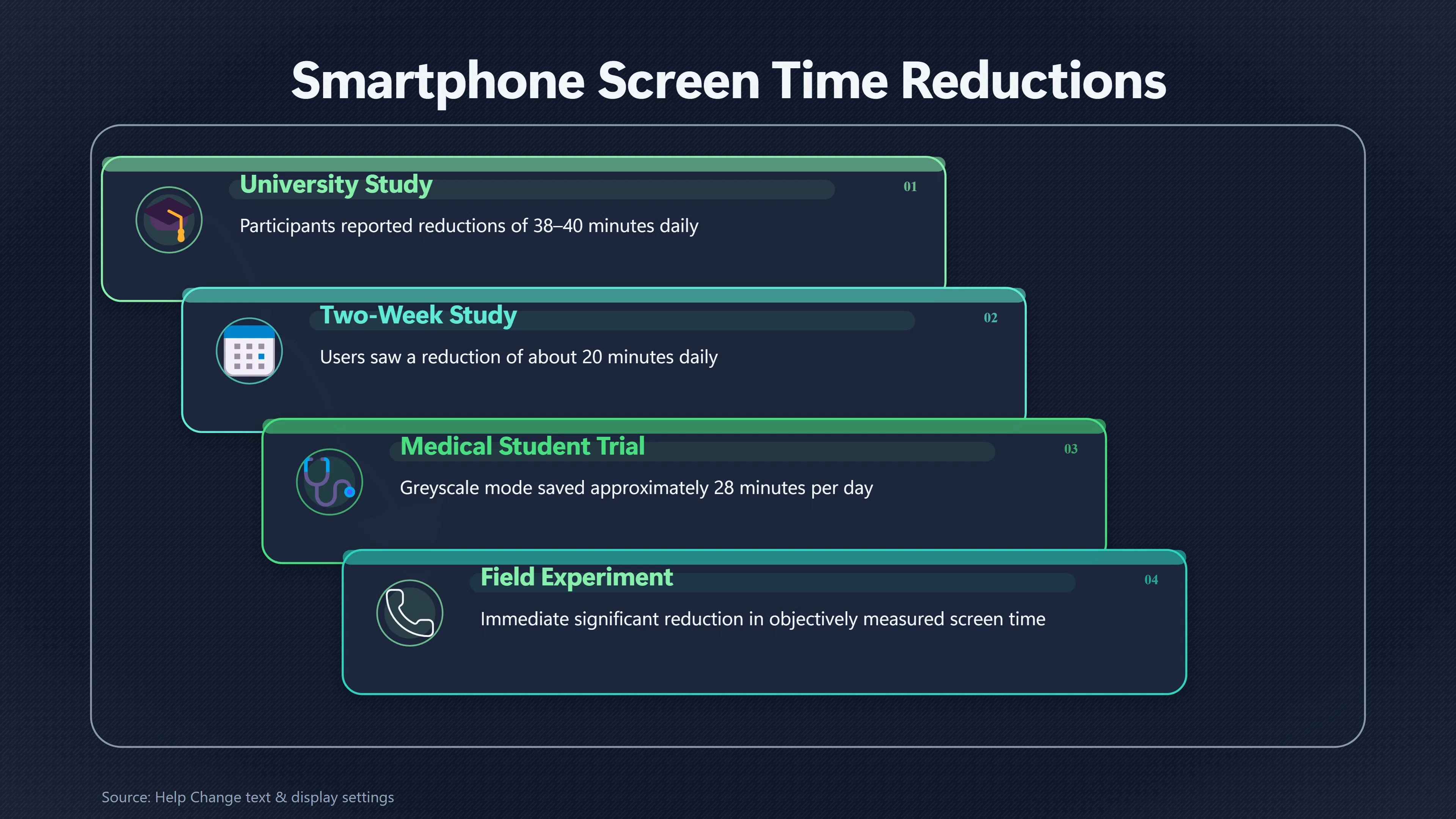
Making a smartphone screen greyscale can reduce how long people use it. The strongest evidence comes from field experiments in which participants actually changed their phones rather than merely reporting what they thought they would do. A preregistered randomised experiment with 112 participants found that greyscale produced an immediate, significant reduction in objectively measured screen time, while a separate two-week study found a reduction of about 20 minutes a day. Earlier research with university students reported reductions of roughly 38–40 minutes a day.[nih.gov]pubmed.ncbi.nlm.nih.govDigital Strategies for Screen Time Reduction: A Randomized Field Experiment - PubMedDecember 26, 2022…
The attraction is that greyscale changes the environment rather than demanding a fresh act of self-control every time the phone comes out. Apps still work and nothing is blocked; the screen is simply less visually vivid. That makes greyscale a useful example of environmental design for self-improvement: alter the cue or reward before the habitual behaviour unfolds. But the evidence also gives an important warning. Less screen time is an outcome in itself, not proof of better productivity, sleep or wellbeing.
How greyscale changes the phone’s visual environment
Greyscale removes colour saturation while preserving the phone’s basic functionality. Photographs, notification badges, games, social-media feeds and app icons remain visible, but their colour differences disappear. Research on visual attention has long established that colour can affect where people direct their gaze; experiments comparing colour and greyscale versions of the same scenes have found substantial differences in fixation patterns.[PubMed]pubmed.ncbi.nlm.nih.govWhat's color got to do with it? The influence of color on visual attention in different categories - PubMedOctober 23, 2008…
That provides a plausible mechanism for greyscale, but it should not be overstated. Researchers studying smartphone interventions generally describe greyscale as reducing visual salience or gratification, rather than demonstrating that a particular colour causes compulsive checking. In a 2026 crossover feasibility trial involving medical students, the researchers framed the intervention as reducing the visual salience of non-essential stimuli while leaving useful smartphone functions available. Greyscale was associated with about 28 fewer minutes of screen time per day.[Frontiers]frontiersin.orgFrontiersFrontiers | A cross-over feasibility trial of smartphone grayscale mode in medical studentsJuly 6, 2026…
This distinction matters. Greyscale is not an app blocker and does not impose a hard limit. A person can still spend an hour scrolling through a feed in black and white. Instead, it changes the small incentive surrounding the behaviour. The phone becomes a little less stimulating to look at, potentially making it easier to notice that an intended 30-second check has turned into aimless browsing.
The pattern within earlier research is consistent with that interpretation. In a study of 161 undergraduates, 73 participants used greyscale for eight to ten days. Their total daily screen time fell substantially, with reductions particularly evident in social-media and internet-browsing use, while video screen time did not show the same effect.[Taylor & Francis Online]tandfonline.comOpen source on tandfonline.com. In other words, removing colour did not make every form of phone use disappear equally. It appears better suited to weakening some forms of visually driven, discretionary engagement than to preventing activities people have a specific reason to continue.
What the preregistered experiment found
The particularly useful test is Laura Zimmermann and Michael Sobolev’s preregistered randomised field experiment. It involved 112 participants and compared three approaches over several weeks: greyscale as a design-friction intervention, self-imposed time limits as a goal-setting intervention, and self-monitoring as the control. The groups were broadly similar at baseline, including in estimated daily screen time.[Sage Journals]journals.sagepub.comSage JournalsRAPID COMMUNICATIONSApril 21, 2026…
The contrast between the interventions is important. Greyscale produced an immediate, significant reduction in objectively measured screen time relative to the control group. Setting time limits also reduced use, but its effect was smaller and developed more gradually.[Sage Journals]journals.sagepub.comSage JournalsDigital Strategies for Screen Time Reduction: A Randomized Field Experiment - Laura Zimmermann, Michael Sobolev, 2023…
That makes the experiment unusually relevant to environment design. A time limit asks the user to formulate and follow a goal: I intend not to spend more than this much time on my phone. Greyscale changes the experience of using the device itself. Once enabled, it continues operating whether or not the user is consciously thinking about a screen-time goal.
Other studies point in the same broad direction, although their designs differ. Holte and Ferraro’s university-student study found a daily reduction of roughly 38–40 minutes among greyscale users.[Taylor & Francis Online]tandfonline.comOpen source on tandfonline.com. A German experimental study subsequently asked participants to use greyscale for at least 24 hours and also found substantially lower reported smartphone-use duration, although only 92 of the initial 240 participants completed the second questionnaire, making it weaker evidence than the randomised field experiment.[DOI]doi.orgSuffering from problematic smartphone use? Why not use grayscale setting as an intervention! – An experimental study - ScienceDirectMa…
More recently, a 2026 two-period crossover study of 51 medical students compared each participant’s experience under normal colour and greyscale conditions. Mean daily screen time was about 347 minutes in colour versus 319 minutes in greyscale, a difference of approximately 28 minutes. Because this was a small feasibility study with self-reported adherence and retrospective reporting of phone-recorded screen-time figures, it is better treated as supportive evidence than as a definitive estimate of the effect.[Frontiers]frontiersin.orgFrontiersFrontiers | A cross-over feasibility trial of smartphone grayscale mode in medical studentsJuly 6, 2026…
Taken together, these studies make a reasonably consistent case for a modest behavioural effect. They do not establish that everyone will save a predictable number of minutes. Samples have generally been fairly small and often student-heavy, interventions have been short, and study designs and screen-time measurements differ. The defensible conclusion is narrower: making the screen greyscale can reduce smartphone use, at least over the short periods studied.
Checking can survive even when screen time falls
One result is especially revealing for habitual phone use. Cynthia Dekker and Susanne Baumgartner tracked 84 participants for two weeks, using the first week as baseline and the second as a greyscale intervention. Average daily screen time fell from about 287 minutes to 268 minutes — roughly 20 minutes — but the number of daily phone unlocks barely changed: approximately 80 before and 80 during greyscale.[Sage Journals]journals.sagepub.comOpen source on sagepub.com.
That separates two behaviours that are easily conflated. Greyscale may shorten what happens after someone unlocks the phone without necessarily stopping the initial checking impulse. A person can still reflexively reach for the device, unlock it and look; the diminished visual environment may simply make continued browsing less rewarding.
For self-improvement, this is a useful limitation rather than a reason to dismiss the technique. If the problem is unexpectedly losing 20 minutes after opening an app, reducing the attractiveness of continued use could be valuable. If the problem is constantly reaching for the phone whenever there is a spare moment, greyscale alone may leave much of that cue-driven routine intact. The unchanged unlock count in the Dekker and Baumgartner study is unusually concrete evidence for that distinction.[Sage Journals]journals.sagepub.comOpen source on sagepub.com.
There is also an adherence problem. In the same study, participants reported high compliance, at about 90%, but described greyscale as more annoying than helpful on average. Around half said afterwards that they would never or rarely use it again.[Sage Journals]journals.sagepub.comOpen source on sagepub.com. An environmental intervention only works while it remains part of the environment; a theoretically effective setting that people continually disable has limited practical value.
Why lower screen time is not the same as better wellbeing
The tempting inference is that if greyscale cuts screen time, the recovered minutes must produce better concentration, grades, sleep or happiness. The experiments do not justify that leap.
Zimmermann and Sobolev explicitly tested the broader assumption and found no immediate causal effect of reduced smartphone use on subjective wellbeing or academic performance in their experiment.[Sage Journals]journals.sagepub.comSage JournalsDigital Strategies for Screen Time Reduction: A Randomized Field Experiment - Laura Zimmermann, Michael Sobolev, 2023… Holte and Ferraro similarly found that although greyscale reduced phone use, changes in anxiety and depression symptoms could not be attributed to the greyscale intervention because both experimental and control groups improved.[Taylor & Francis Online]tandfonline.comOpen source on tandfonline.com.
The Dekker and Baumgartner study produced a more mixed picture. During the greyscale week, participants reported greater perceived control over their smartphone use and lower perceived overuse, online vigilance and stress. Yet there was no significant improvement in productivity or sleep quality. Participants themselves generally did not report feeling that greyscale had made them feel better, sleep better or focus more effectively.[Sage Journals]journals.sagepub.comOpen source on sagepub.com. The 2026 medical-student crossover study likewise found no consistent statistically significant differences in exploratory measures of productivity or sleep quality.[Frontiers]frontiersin.orgFrontiersFrontiers | A cross-over feasibility trial of smartphone grayscale mode in medical studentsJuly 6, 2026…
There is a straightforward reason to keep these outcomes separate. Screen time measures duration, not what replaces it. Saving half an hour on a phone might mean reading, exercising, working or talking to someone. It might equally mean spending another half-hour on a laptop. One participant in the 2026 crossover trial explicitly reported shifting some entertainment from the greyscale phone to another device.[Frontiers]frontiersin.orgFrontiersFrontiers | A cross-over feasibility trial of smartphone grayscale mode in medical studentsJuly 6, 2026…
So the useful question is not merely whether the screen-time counter goes down. It is whether greyscale removes time from the kind of phone use the person actually wanted to reduce and whether the released time goes somewhere worthwhile.

How to use greyscale as a practical self-nudge
The intervention is unusually easy to test because current smartphones already contain the required display controls. On an iPhone, Apple’s current instructions place Greyscale under Settings → Accessibility → Display & Text Size → Colour Filters; Colour Filters can also be assigned to an Accessibility Shortcut for quick switching.[Apple Support]support.apple.comOpen source on apple.com. On Android, Google’s accessibility settings include greyscale under colour correction, while Pixel phones can also activate it automatically through Bedtime mode.[Google Help]support.google.comHelp Change text & display settingsHelp Change text & display settings
A useful personal experiment is therefore simple: record the phone’s built-in screen-time figure for several ordinary days, enable greyscale for a week, and compare like with like. More informative than total minutes alone is what happened to the particular behaviour being targeted — for example, social-media browsing, repeated news checking or unplanned evening scrolling.
Full-time greyscale is not necessarily the best implementation for everyone. Colour carries useful information in maps, photographs, graphs, design work and some interfaces. Apple’s own documentation warns that colour filters change the appearance of pictures and films, while participants in the medical-student trial reported difficulties with some colour-dependent applications.[Apple Support]support.apple.comOpen source on apple.com. Scheduling greyscale for the period in which unwanted use is concentrated — or keeping a shortcut available for tasks that genuinely require colour — can preserve the environmental nudge without needlessly degrading useful functions.
The strongest reason to try it is therefore also the most modest one. Greyscale is cheap, reversible and does not require surrendering access to the phone. Several studies now indicate that it can make people spend somewhat less time on their devices. But it is better understood as a small piece of environmental friction than as a digital-wellbeing cure. It changes how tempting the screen looks; what someone does with the resulting attention and time remains a separate part of self-improvement.[nih.gov]pubmed.ncbi.nlm.nih.govDigital Strategies for Screen Time Reduction: A Randomized Field Experiment - PubMedDecember 26, 2022…
Amazon book picks
Further Reading
Books and field guides related to Does Making Your Phone Boring Reduce Screen Time?. Use these as the next step if you want deeper reading beyond the article.
Digital Minimalism
A New York Times, Wall Street Journal, Publishers Weekly, and USA Today bestseller "Newport is making a bid to be the Marie Kondo of tech...
Indistractable
*As heard on Steven Bartlett's Diary of a CEO* 'A must-read' Mark Manson We are living through a crisis of distraction. Plans get sidetra...
Atomic Habits
Rating: 3.5/5 from 7 Google Books ratings
The #1 New York Times bestseller. Over 25 million copies sold! Translated into 60+ languages! Tiny Changes, Remarkable Results No matter...
Nudge
Rating: 3.5/5 from 29 Google Books ratings
Thaler and Sunstein offer a groundbreaking discussion of how to apply the science of choice to nudge people toward decisions that can imp...
eBay marketplace picks
Marketplace Samples
Live-tested eBay searches with available results related to this page.
Selected fromminimal phone case oneBay.co.uk.


Endnotes
1.
Source: doi.org
Link:https://doi.org/10.1016/j.chbr.2023.100294
Source snippet
Suffering from problematic smartphone use? Why not use grayscale setting as an intervention! – An experimental study - ScienceDirectMa...
2.
Source: support.apple.com
Link:https://support.apple.com/en-gb/111773
3.
Source: support.google.com
Title: Help Change text & display settings
Link:https://support.google.com/accessibility/android/answer/11183305?hl=en
4.
Source: support.google.com
Title: Help Change your screen colour at night on a Pixel phone
Link:https://support.google.com/pixelphone/answer/7169926?hl=en-GB
5.
Source: support.apple.com
Link:https://support.apple.com/en-au/111773
6.
Source: support.apple.com
Link:https://support.apple.com/lt-lt/111773
7.
Source: support.apple.com
Link:https://support.apple.com/en-gb/109351
8.
Source: support.apple.com
Link:https://support.apple.com/en-ca/111773
9.
Source: support.apple.com
Link:https://support.apple.com/en-ae/111773
10.
Source: support.apple.com
Link:https://support.apple.com/en-us/109351
11.
Source: support.apple.com
Title: en mide
Link:https://support.apple.com/en-mide/109351
12.
Source: doi.org
Title: Prediction and Prioritisation: How Reward Learning Shapes Attentional Capture
Link:https://doi.org/10.1177/17470218261449808
13.
Source: support.apple.com
Link:https://support.apple.com/en-kz/121825
14.
Source: doi.org
Link:https://doi.org/10.1186/s12889-025-23700-5
15.
Source: support.apple.com
Link:https://support.apple.com/en-gu/102052
16.
Source: support.apple.com
Link:https://support.apple.com/en-mk/102052
17.
Source: support.google.com
Title: lost colour on phone every thing black and white
Link:https://support.google.com/pixelphone/thread/328069499/lost-colour-on-phone-every-thing-black-and-white?hl=en
18.
Source: support.google.com
Title: is it still possible to use grayscale on android without enabling bedtime mode
Link:https://support.google.com/pixelphone/thread/313156938/is-it-still-possible-to-use-grayscale-on-android-without-enabling-bedtime-mode?hl=en
19.
Source: support.google.com
Title: phone display is in black and white
Link:https://support.google.com/pixelphone/thread/308242173/phone-display-is-in-black-and-white?hl=en
20.
Source: support.apple.com
Link:https://support.apple.com/en-us/111779
21.
Source: support.google.com
Title: android 14 how to turn off grayscale
Link:https://support.google.com/pixelphone/thread/245479778/android-14-how-to-turn-off-grayscale?hl=en
22.
Source: doi.org
Title: Journal of Medical Internet Research
Link:https://doi.org/10.2196/42541
23.
Source: support.google.com
Title: gray scale
Link:https://support.google.com/pixelphone/thread/191578824/gray-scale?hl=en
24.
Source: sites.google.com
Title: about study
Link:https://sites.google.com/student.uw.edu.pl/grayscale/english/about-study
25.
Source: sites.google.com
Title: o badaniu
Link:https://sites.google.com/student.uw.edu.pl/grayscale/polski/o-badaniu
26.
Source: support.google.com
Link:https://support.google.com/accessibility/android/answer/16323943?hl=en
27.
Source: support.google.com
Link:https://support.google.com/pixelphone/answer/7169926?hl=en
28.
Source: support.google.com
Link:https://support.google.com/accessibility/android/answer/16323943?hl=en-uk
29.
Source: support.google.com
Link:https://support.google.com/accessibility/android/answer/6151800?hl=en
30.
Source: support.google.com
Link:https://support.google.com/accessibility/android/answer/6151800?hl=en-GB
31.
Source: support.apple.com
Link:https://support.apple.com/en-gb/guide/watch/apd766b7bd85/26/watchos/26
32.
Source: support.apple.com
Link:https://support.apple.com/en-nz/guide/iphone/iph3e2e1fb0/ios
33.
Source: support.apple.com
Link:https://support.apple.com/en-gb/guide/iphone/iph3e2e4367/ios
34.
Source: support.apple.com
Link:https://support.apple.com/en-ae/guide/iphone/iph53475523f/ios
35.
Source: support.apple.com
Link:https://support.apple.com/en-nz/guide/iphone/iph3e2e367e/ios
36.
Source: support.apple.com
Link:https://support.apple.com/es-es/guide/iphone/iph3e2e1fb0/ios
37.
Source: support.apple.com
Link:https://support.apple.com/en-mide/guide/ipad/ipad674f91c0/ipados
38.
Source: support.apple.com
Link:https://support.apple.com/en-gw/guide/iphone/iph53475523f/ios
39.
Source: support.apple.com
Link:https://support.apple.com/en-za/guide/iphone/iph3e2e1fb0/ios
40.
Source: support.apple.com
Link:https://support.apple.com/en-mide/guide/iphone/iph3e2e1fb0/ios
41.
Source: support.apple.com
Link:https://support.apple.com/en-lamr/guide/iphone/iph406a46ab8/ios
42.
Source: support.apple.com
Link:https://support.apple.com/en-ae/guide/iphone/iph3c076905a/ios
43.
Source: support.apple.com
Link:https://support.apple.com/en-mo/guide/ipad/ipad674f91c0/ipados
44.
Source: support.apple.com
Title: comi Phoneの画面の色を変更して画面上にあるものを見やすくする
Link:https://support.apple.com/ja-jp/guide/iphone/iph3e2e1fb0/ios
45.
Source: support.apple.com
Link:https://support.apple.com/sr-rs/guide/watch/apd766b7bd85/watchos
46.
Source: support.apple.com
Link:https://support.apple.com/bg-bg/guide/mac-help/unac089/26/mac/26
47.
Source: support.apple.com
Link:https://support.apple.com/sq-al/guide/mac-help/mchl11ddd4b3/mac
48.
Source: support.apple.com
Link:https://support.apple.com/nl-be/guide/motion/motnfcb11850/mac
49.
Source: pubmed.ncbi.nlm.nih.gov
Link:https://pubmed.ncbi.nlm.nih.gov/36577008/
Source snippet
Digital Strategies for Screen Time Reduction: A Randomized Field Experiment - PubMedDecember 26, 2022...
Published: December 26, 2022
50.
Source: journals.sagepub.com
Link:https://journals.sagepub.com/doi/10.1177/20501579231212062
51.
Source: tandfonline.com
Link:https://www.tandfonline.com/doi/full/10.1080/03623319.2020.1737461
52.
Source: pubmed.ncbi.nlm.nih.gov
Link:https://pubmed.ncbi.nlm.nih.gov/19146307/
Source snippet
What's color got to do with it? The influence of color on visual attention in different categories - PubMedOctober 23, 2008...
Published: October 23, 2008
53.
Source: frontiersin.org
Link:https://www.frontiersin.org/journals/digital-health/articles/10.3389/fdgth.2026.1816095/full
Source snippet
FrontiersFrontiers | A cross-over feasibility trial of smartphone grayscale mode in medical studentsJuly 6, 2026...
Published: July 6, 2026
54.
Source: journals.sagepub.com
Link:https://journals.sagepub.com/doi/pdf/10.1089/cyber.2022.0027?download=true
Source snippet
Sage JournalsRAPID COMMUNICATIONSApril 21, 2026...
Published: April 21, 2026
55.
Source: journals.sagepub.com
Link:https://journals.sagepub.com/doi/full/10.1089/cyber.2022.0027
Source snippet
Sage JournalsDigital Strategies for Screen Time Reduction: A Randomized Field Experiment - Laura Zimmermann, Michael Sobolev, 2023...
56.
Source: journals.sagepub.com
Link:https://journals.sagepub.com/doi/abs/10.1177/20501579231212062
57.
Source: pubmed.ncbi.nlm.nih.gov
Link:https://pubmed.ncbi.nlm.nih.gov/42426888/
58.
Source: pmc.ncbi.nlm.nih.gov
Link:https://pmc.ncbi.nlm.nih.gov/articles/PMC13284009/
59.
Source: pubmed.ncbi.nlm.nih.gov
Link:https://pubmed.ncbi.nlm.nih.gov/42223863/
60.
Source: pubmed.ncbi.nlm.nih.gov
Link:https://pubmed.ncbi.nlm.nih.gov/40921591/
61.
Source: pmc.ncbi.nlm.nih.gov
Link:https://pmc.ncbi.nlm.nih.gov/articles/PMC12310694/
62.
Source: frontiersin.org
Link:https://www.frontiersin.org/journals/psychiatry/articles/10.3389/fpsyt.2025.1602997/full
63.
Source: frontiersin.org
Link:https://www.frontiersin.org/journals/plant-science/articles/10.3389/fpsyt.2025.1602997
64.
Source: pubmed.ncbi.nlm.nih.gov
Link:https://pubmed.ncbi.nlm.nih.gov/40660635/
65.
Source: pmc.ncbi.nlm.nih.gov
Link:https://pmc.ncbi.nlm.nih.gov/articles/PMC12351200/
66.
Source: pmc.ncbi.nlm.nih.gov
Link:https://pmc.ncbi.nlm.nih.gov/articles/PMC12231446/
67.
Source: pubmed.ncbi.nlm.nih.gov
Link:https://pubmed.ncbi.nlm.nih.gov/40549948/
68.
Source: pubmed.ncbi.nlm.nih.gov
Link:https://pubmed.ncbi.nlm.nih.gov/40406611/
69.
Source: pmc.ncbi.nlm.nih.gov
Link:https://pmc.ncbi.nlm.nih.gov/articles/PMC11834938/
70.
Source: pubmed.ncbi.nlm.nih.gov
Link:https://pubmed.ncbi.nlm.nih.gov/39392706/
71.
Source: pmc.ncbi.nlm.nih.gov
Link:https://pmc.ncbi.nlm.nih.gov/articles/PMC11303118/
72.
Source: pmc.ncbi.nlm.nih.gov
Link:https://pmc.ncbi.nlm.nih.gov/articles/PMC10498313/
73.
Source: journals.sagepub.com
Link:https://journals.sagepub.com/doi/pdf/10.1089/cyber.2022.0027?cf-mal-redirected=true
74.
Source: journals.sagepub.com
Link:https://journals.sagepub.com/doi/10.1089/cyber.2022.0027?icid=int.sj-full-text.similar-articles.2
75.
Source: repositorio.ie.edu
Link:https://repositorio.ie.edu/entities/publication/78b87732-5c0d-494a-9769-bdfd4a501297/full
76.
Source: journals.sagepub.com
Link:https://journals.sagepub.com/doi/abs/10.1089/cyber.2022.0027?download=true
77.
Source: journals.sagepub.com
Link:https://journals.sagepub.com/doi/10.1089/cyber.2022.0027
78.
Source: journals.sagepub.com
Link:https://journals.sagepub.com/doi/abs/10.1089/cyber.2022.0027
79.
Source: journals.sagepub.com
Link:https://journals.sagepub.com/doi/abs/10.1089/cyber.2022.0027?cf-mal-redirected=true
80.
Source: pmc.ncbi.nlm.nih.gov
Link:https://pmc.ncbi.nlm.nih.gov/articles/PMC9112639/
81.
Source: pmc.ncbi.nlm.nih.gov
Link:https://pmc.ncbi.nlm.nih.gov/articles/PMC10159421/
82.
Source: tandfonline.com
Link:https://www.tandfonline.com/doi/full/10.1080/0144929X.2021.2007284
83.
Source: pmc.ncbi.nlm.nih.gov
Link:https://pmc.ncbi.nlm.nih.gov/articles/PMC8578406/
84.
Source: pubmed.ncbi.nlm.nih.gov
Link:https://pubmed.ncbi.nlm.nih.gov/34548824/
85.
Source: pubmed.ncbi.nlm.nih.gov
Link:https://pubmed.ncbi.nlm.nih.gov/34507959/
86.
Source: pmc.ncbi.nlm.nih.gov
Link:https://pmc.ncbi.nlm.nih.gov/articles/PMC7804494/
87.
Source: pubmed.ncbi.nlm.nih.gov
Link:https://pubmed.ncbi.nlm.nih.gov/33433602/
88.
Source: pubmed.ncbi.nlm.nih.gov
Link:https://pubmed.ncbi.nlm.nih.gov/35087630/
89.
Source: tandfonline.com
Link:https://www.tandfonline.com/doi/abs/10.1080/03623319.2020.1737461
90.
Source: tandfonline.com
Link:https://www.tandfonline.com/doi/abs/10.1080/03623319.2020.1737461?pubDate=20251130
91.
Source: pubmed.ncbi.nlm.nih.gov
Link:https://pubmed.ncbi.nlm.nih.gov/30455163/
92.
Source: pubmed.ncbi.nlm.nih.gov
Link:https://pubmed.ncbi.nlm.nih.gov/27829040/
93.
Source: pubmed.ncbi.nlm.nih.gov
Link:https://pubmed.ncbi.nlm.nih.gov/26146477/
94.
Source: sage.cnpereading.com
Link:https://sage.cnpereading.com/doi/10.1089/cyber.2022.0027
95.
Source: pubmed.ncbi.nlm.nih.gov
Link:https://pubmed.ncbi.nlm.nih.gov/40225264/
Additional References
96.
Source: sciencedirect.com
Link:https://www.sciencedirect.com/science/article/pii/S1386505624003885
Source snippet
Persuasive strategies in digital interventions to combat internet addiction: A systematic review - ScienceDirect...
97.
Source: youtube.com
Title: The Grey Protocol: How to Stop Your Phone From Hijacking Your Brain
Link:https://www.youtube.com/watch?v=lMn0IMR3TQ0
Source snippet
Grayscale phone screen time Forget Apple's 'Screen Time' Controls-Go Grayscale...
98.
Source: youtube.com
Title: Forget Apple’s ‘Screen Time’ Controls-Go Grayscale
Link:https://www.youtube.com/watch?v=FtqhKmotIxI
Source snippet
To Break a Phone Addiction, Turn Your Screen Gray...
99.
Source: youtube.com
Title: This 1 change cured my phone addiction
Link:https://www.youtube.com/watch?v=HZFaMLgo5tg
Source snippet
The Grey Protocol: How to Stop Your Phone From Hijacking Your Brain...
100.
Source: researchgate.net
Link:https://www.researchgate.net/publication/359735566_A_Nudge-Based_Intervention_to_Reduce_Problematic_Smartphone_Use_Randomised_Controlled_Trial
101.
Source: researchgate.net
Link:https://www.researchgate.net/publication/348235406_A_ten-step_behavioural_intervention_to_reduce_screen_time_and_problematic_smartphone_use
102.
Source: researchgate.net
Link:https://www.researchgate.net/publication/394129021_Active_nudging_towards_digital_well-being_reducing_excessive_screen_time_on_mobile_phones_and_potential_improvement_for_sleep_quality
103.
Source: researchgate.net
Link:https://www.researchgate.net/publication/392653380_From_Digital_Self-control_Apps_to_iOS_Shortcuts_Enabling_Privacy-Centric_Wellbeing_Research_Without_Code
104.
Source: researchgate.net
Link:https://www.researchgate.net/publication/399492145_Insights_Trends_Gaps_and_Future_Direction_in_Problematic_Smartphone_Use_Interventions_A_Systematic_Review
105.
Source: researchgate.net
Link:https://www.researchgate.net/publication/387793116_Technology-Based_interventions_to_address_internet_addictive_behaviors_systematic_review