Within Fix the System
Why Starting the Habit Feels Harder Than It Should
When you notice the cue but still postpone action, small preparation steps may be making the desired behaviour harder to start than the alternative.
On this page
- Mapping every step before the first real action
- Moving preparation outside the vulnerable moment
- Making the first action obvious and immediate
Page outline Jump by section
Introduction
When you notice the cue for a habit but still postpone starting, the problem may be neither memory nor commitment. The habit may simply have too much start-up friction: equipment has to be found, a space cleared, an app opened, a decision made, clothes changed, materials gathered or several small steps completed before the intended behaviour actually begins. Each step is modest, but together they make the alternative — often doing nothing or continuing an existing habit — easier.
This matters because effort influences choice, and habits become stronger through repeated behaviour in recurring contexts. Research on habit change therefore increasingly emphasises changing the environment and the ease of competing actions, rather than relying solely on stronger intentions.[Sage Journals]journals.sagepub.comSage Journals Habits, Goals, and Effective Behavior ChangeSage JournalsHabits, Goals, and Effective Behavior Change - Wendy Wood, 2024June 3, 2024…
The practical repair is specific: move as much preparation as possible out of the moment when the habit is supposed to start, then make the first real action immediately available. The aim is not to eliminate all effort from the activity. It is to stop unnecessary effort from deciding whether the activity begins.
Map Everything Before the First Real Action
Start-up friction is easy to underestimate because people tend to describe habits at too high a level. “Go for a run”, “practise guitar” and “study after dinner” sound like single behaviours. At the moment of action, however, each may actually be a chain.
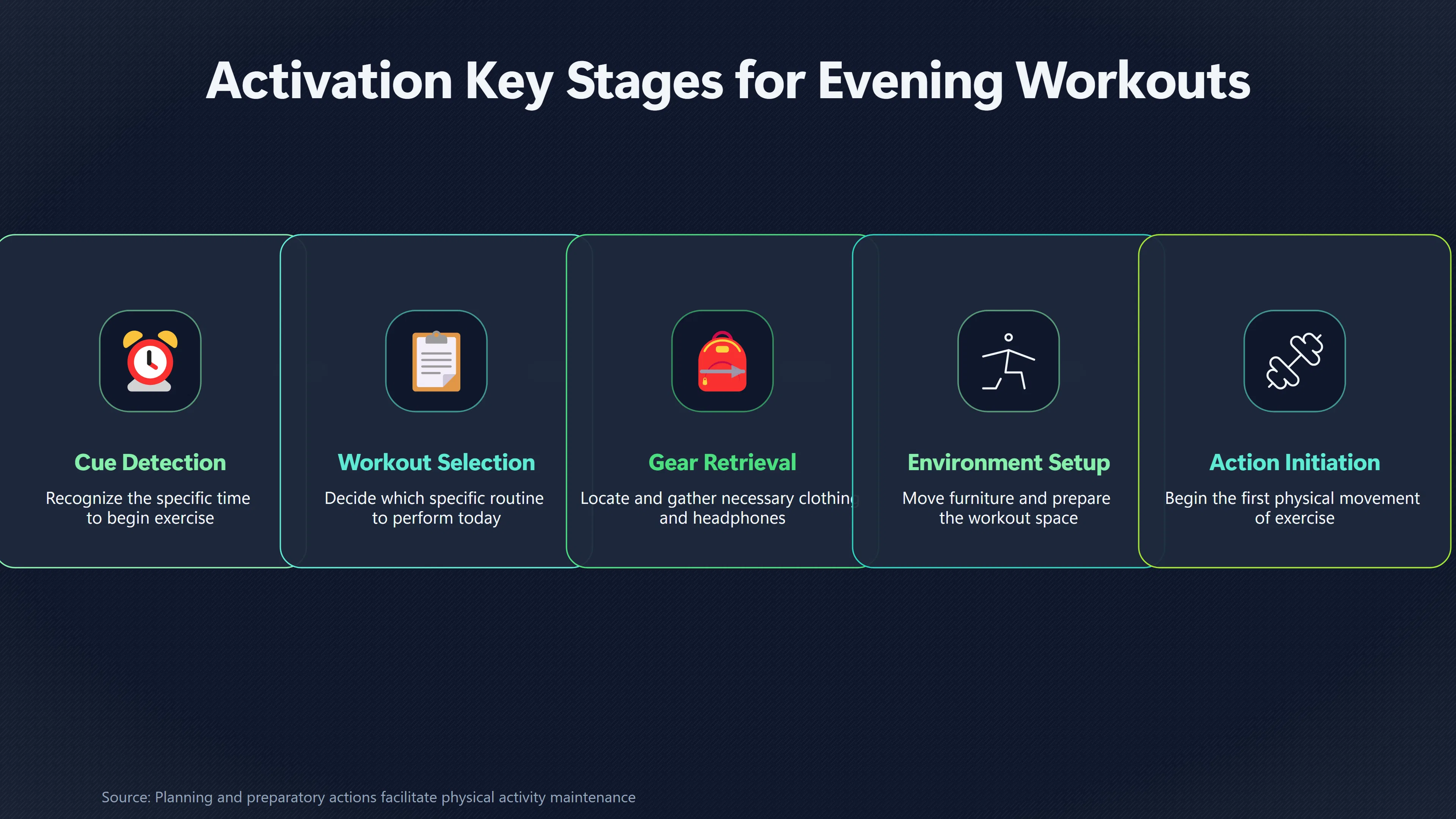
Consider an intended evening workout:
- Notice that it is workout time.
- Decide which workout to do.
- Find suitable clothes.
- Change clothes.
- Find headphones.
- Fill a water bottle.
- Move furniture or prepare equipment.
- Open an exercise programme.
- Choose the session.
- Start exercising.
Only the final step is the behaviour the person believes they are postponing. The preceding nine are an activation sequence that has to succeed first. If the competing option is “sit down and open my phone”, the two behaviours have radically different start costs.
That asymmetry is behaviourally important. Laboratory research consistently finds that greater anticipated physical or cognitive effort reduces the subjective attractiveness of rewards and affects which actions people choose. The exact mathematics of effort discounting varies by task, so it would be an overstatement to translate those experiments directly into a rule such as “every extra habit step reduces adherence by X per cent”. The defensible conclusion is simpler: effort is a genuine cost in action selection, even when the eventual outcome is desirable.[PubMed Central (PMC)]pmc.ncbi.nlm.nih.govPubMed Central (PMC)Physical and cognitive effort discounting across different reward magnitudes: Tests of discounting models - PMCJuly 3…
Small procedural burdens can also have surprisingly large effects outside the laboratory. A field experiment involving small and medium-sized businesses found that adding minor effort to the process for obtaining free environmental-management items substantially reduced programme effectiveness. That setting is very different from personal habit formation, but it demonstrates the broader mechanism: seemingly trivial hassles can alter whether an intended action gets completed.[DOI]doi.orgHow sludge impairs the effectiveness of policy programs: a field experiment with SMEs | Behavioural Public Policy | Cambridge CoreNove…
Audit the activation sequence, not the habit
When a habit repeatedly stalls after its cue, write down what actually happens between “now is the moment” and “I am doing it”. Include steps that seem too trivial to matter.
For a reading habit, the sequence might be: finish dinner → remember the plan → decide where to read → locate the book → find the page → move the laptop → put the phone somewhere else → sit down → begin the first paragraph. For morning exercise, it might include locating clothing, choosing a route, checking the weather and deciding what counts as today’s workout.
Then mark each pre-start step according to what it demands:
- Physical friction: fetching, carrying, changing clothes, unlocking, plugging in, travelling or setting up.
- Decision friction: choosing the workout, book, lesson, route, duration or starting point.
- Search friction: finding equipment, files, passwords, notes or instructions.
- Digital friction: logging in, navigating menus, dismissing notifications or locating the correct document.
- Transition friction: stopping one comfortable activity, moving elsewhere or switching from leisure to focused work.
The useful diagnostic question is not “Is any one of these difficult?” It is “Which of these steps still has to happen after the cue?” Five easy preparatory actions can collectively create a poor starting system.
This distinction also prevents the wrong repair. If you reliably notice “I should practise now” and then spend ten minutes avoiding getting the instrument out, adding another reminder targets a problem you do not have. The cue is already working. The bottleneck lies between cue detection and behavioural initiation.
Move Preparation Outside the Vulnerable Moment
The highest-value fix is often pre-positioning: perform preparatory actions earlier, when they are not competing with the immediate temptation to postpone.
Research on physical activity offers a useful illustration. In a longitudinal study of 338 participants, planning predicted preparatory behaviours, and those preparatory behaviours in turn predicted subsequent physical activity. The study was observational rather than an experiment proving that laying out clothes directly causes exercise, but it supports an important distinction: preparation is part of the pathway through which an intention becomes behaviour, not merely administrative detail surrounding it.[ScienceDirect]sciencedirect.comPlanning and preparatory actions facilitate physical activity maintenance - ScienceDirect…
For a repeatedly failing habit, that suggests changing when preparation occurs:
HabitPreparation left until start timePreparation moved earlierMorning runFind kit, choose route, locate headphonesKit and shoes laid out; default route already chosenGuitar practiceRetrieve guitar and music, choose exerciseGuitar accessible; music open at next exerciseEvening studyClear desk, find notes, decide subjectDesk ready; correct document already openHealthy lunchDecide what to eat and prepare ingredientsLunch prepared or ingredients portioned beforehandBedtime readingFind book, charge reading light, move phoneBook on pillow or bedside table; light ready
The point is not ritual for its own sake. A preparation routine is useful only when it removes work from the later initiation point.
This is also why organisation can occasionally become disguised friction. Elaborate productivity systems may add categories, tracking, app navigation and choices before meaningful work begins. If “write for 20 minutes” requires opening a task manager, reviewing priorities, selecting a project, starting a timer, choosing music and configuring a distraction blocker, the system intended to support the habit has acquired its own start-up sequence.
Remove decisions before removing effort
Physical setup is only part of the problem. A person can have running shoes beside the door and still stall over whether to run 3 km or 5 km, which route to take and what pace to aim for.
Implementation-intention research is relevant here. An implementation intention specifies a situation and a response in an if–then form — in effect, deciding in advance what will happen when a particular cue appears. Experimental work has found that these plans can make action initiation faster and more efficient once the specified situation occurs, including under cognitive load.[PubMed]pubmed.ncbi.nlm.nih.govPub Med Implementation intentions and efficient action initiationImplementation intentions and efficient action initiation - PubMed… A 2024 meta-analysis covering 642 independent tests found beneficial effects of implementation intentions across behavioural and other outcomes, with stronger effects for contingent if–then plans and when plans were rehearsed.[DOI]doi.orgThe when and how of planning: Meta-analysis of the scope and components of implementation intentions in 642 tests: European Review of…
For start-up friction, the important implication is to pre-decide the opening move. Instead of:
After dinner, I will decide whether to study.
use a predetermined response such as:
After I put my dinner plate down, I open the document already waiting on my desk and work on the next marked paragraph.
The first version leaves negotiation at the vulnerable moment. The second removes several decisions before that moment arrives.
Make the First Action Obvious and Immediate
A low-friction start has three useful properties: the required object is available, the opening action is already decided, and the cue can lead directly into that action.
This fits what habit researchers know about context-dependent behaviour. Habits develop as responses are repeatedly performed in recurring contexts, eventually allowing contextual cues to activate behavioural responses with less deliberation.[PubMed]pubmed.ncbi.nlm.nih.govPub Med Psychology of HabitPsychology of Habit - PubMed… Lally and Gardner’s review of habit formation therefore emphasises both initiating the new behaviour and supporting context-dependent repetition; restructuring the environment is also relevant when replacing unwanted habitual responses.[Taylor & Francis Online]tandfonline.comOpen source on tandfonline.com.
The practical target is consequently not simply to make a habit “easy”. It is to shorten the path from cue to first meaningful action.
If the intended habit is writing, opening the relevant document and leaving a clear next sentence or question can be more useful than merely keeping a tidy desk. If it is practising piano, having the music open at the required page removes more start friction than keeping the room generally organised. If it is walking after lunch, shoes beside the exit and a predetermined route remove two specific barriers.
This is a useful test:
When the cue occurs, can you perform the first meaningful action without searching, setting up or making another decision?
If not, there is probably still removable start-up friction.
The word meaningful matters. “Open my productivity app” is not necessarily the first action of studying. “Answer the first question” is. “Put on exercise clothes” may be necessary preparation, but “begin the warm-up” is closer to the target behaviour. Troubleshooting improves when preparation and performance are distinguished clearly.
Make the Desired Start Easier Than the Default
Start-up friction becomes especially consequential when the desired behaviour competes with an established response. Habit research describes habits as responses associated with recurring contextual cues; established habitual responses can therefore be activated quickly when the familiar context returns.[PubMed Central (PMC)]pmc.ncbi.nlm.nih.govOpen source on nih.gov.
Suppose sitting on the sofa after dinner already cues phone use. A planned reading habit must compete with an alternative that requires almost no preparation: the phone is nearby, familiar and immediately rewarding. Keeping the book on a shelf upstairs means reading begins the contest at a structural disadvantage.
Reducing friction on the desired action can be paired with modestly increasing friction on the competing one: put the book where you sit and the phone somewhere that requires getting up. Psychologist Wendy Wood describes this general strategy as making desired behaviours easier while introducing friction to unwanted habitual responses. Her recent review similarly argues that changing friction can make established responses more difficult and alternatives easier.[American Psychological Association]apa.orgOpen source on apa.org.
That does not mean engineering an elaborate obstacle course around every distraction. The useful comparison is local and concrete: at the moment of choice, which response has the shorter path to execution?
A good redesign often changes that answer without requiring dramatic lifestyle changes.
Do Not Confuse Low Start Friction With a Tiny Habit
Reducing start-up friction is related to making a behaviour smaller, but the two repairs solve different problems.
If you begin a planned 30-minute workout reliably but repeatedly stop after five minutes, reducing setup will probably not fix the main failure. The difficulty lies after initiation. Conversely, if a manageable workout repeatedly fails because you never get changed and start, shrinking the workout to two minutes may leave the actual bottleneck untouched: you still have to find the clothes, move the equipment and choose what to do.
That distinction is important because friction interventions should target incidental costs, not necessarily remove the productive difficulty of the behaviour itself. Studying may need concentration. Strength training should involve physical effort. Learning an instrument requires challenging practice. The aim is not to make those activities effortless; it is to stop irrelevant preliminaries from consuming the willingness available for them.
Evidence from effort research reinforces the need for this nuance. Effort affects valuation and choice, but effort is not inherently undesirable or something that should always be eliminated.[PubMed Central (PMC)]pmc.ncbi.nlm.nih.govOpen source on nih.gov. For habit troubleshooting, the useful distinction is between task effort, which may be essential to the goal, and activation effort, which often is not.
Test the Repair Against the Same Failure Point
After redesigning the start, evaluate the next several occurrences of the same cue. Do not judge the intervention primarily by whether the environment looks more organised or the plan feels more motivating. Ask whether the original bottleneck changed.
A useful troubleshooting cycle is:
- Observe the exact stall. “I notice the cue at 7 pm but remain on the sofa.”
- Trace the pre-start chain. “Starting requires choosing a workout, finding clothes and setting up the mat.”
- Remove or relocate preparation. Choose a default session earlier; lay out clothing and equipment beforehand.
- Specify the opening response. “When the 7 pm cue occurs, I put on the prepared clothes and start the saved warm-up.”
- Watch what happens next. If starting becomes reliable, friction was probably an important part of the failure. If postponement remains unchanged, look for a different bottleneck rather than endlessly optimising the setup.
This experimental mindset matters because behavioural systems are individual and contextual. Evidence supports the general importance of effort, planning, environmental structure and cue-linked responses, but it does not establish a universal number of acceptable preparation steps or prove that every failure to start is caused by friction. Habit researchers themselves caution against oversimplifying real-world behaviour or treating “habit” as a complete explanation for action.[Compass]compass.onlinelibrary.wiley.comOpen source on wiley.com.
The strongest sign that a friction repair has worked is therefore behavioural: the same cue now leads into action with less negotiation and fewer opportunities to divert.
The Practical Standard: Ready Before the Cue
When a habit repeatedly fails after you have already noticed its cue, inspect what sits between noticing and doing. Equipment retrieval, setup, navigation and last-minute decisions are not neutral details. They are part of the behavioural system.
The most useful redesign is usually concrete rather than motivational: prepare materials earlier, pre-position what you need, pre-decide routine choices and make the cue lead to one unmistakable opening action. Planning research suggests that specifying cue-linked responses can improve initiation, while habit research explains why repeatedly making the desired response easy to perform in a stable context matters for eventually making that response more automatic.[nih.gov]pubmed.ncbi.nlm.nih.govPub Med Implementation intentions and efficient action initiationImplementation intentions and efficient action initiation - PubMed…
A failing habit therefore deserves one final diagnostic question before you conclude that you lack discipline: when the moment to act arrives, have you made the behaviour itself ready to begin — or have you merely scheduled the moment when preparation starts?
Amazon book picks
Further Reading
Books and field guides related to Why Starting the Habit Feels Harder Than It Should. Use these as the next step if you want deeper reading beyond the article.
Atomic Habits
Rating: 3.5/5 from 7 Google Books ratings
The #1 New York Times bestseller. Over 25 million copies sold! Translated into 60+ languages! Tiny Changes, Remarkable Results No matter...
Tiny Habits
Improving your life is much easier than you think. Whether it’s losing weight, sleeping more, or restoring your work/life balance – the s...
The Power of Habit
Rating: 4.0/5 from 145 Google Books ratings
Duhigg takes us to the edge of scientific discoveries that explain why habits exist and how they can be changed. Distilling information i...
Good Habits, Bad Habits
'The world's leading expert on habits' - Matthew Syed, bestselling author of Black Box Thinking and Rebel IdeasWhat if you could harness...
eBay marketplace picks
Marketplace Samples
Live-tested eBay searches with available results related to this page.
Selected fromstorage organizer oneBay.co.uk.

Endnotes
1.
Source: doi.org
Link:https://doi.org/10.1017/bpp.2024.44
Source snippet
How sludge impairs the effectiveness of policy programs: a field experiment with SMEs | Behavioural Public Policy | Cambridge CoreNove...
2.
Source: sciencedirect.com
Link:https://www.sciencedirect.com/science/article/pii/S1469029214000612
Source snippet
Planning and preparatory actions facilitate physical activity maintenance - ScienceDirect...
3.
Source: doi.org
Link:https://doi.org/10.1080/10463283.2024.2334563
Source snippet
The when and how of planning: Meta-analysis of the scope and components of implementation intentions in 642 tests: European Review of...
4.
Source: doi.org
Link:https://doi.org/10.1002/bdm.2404
5.
Source: sciencedirect.com
Title: Planning and preparatory actions facilitate physical activity maintenance
Link:https://www.sciencedirect.com/science/article/abs/pii/S1469029214000612
6.
Source: doi.org
Link:https://doi.org/10.1080/17437199.2011.603640%C2%A0
7.
Source: doi.org
Link:https://doi.org/10.1111/j.1559-1816.2009.00485.x
8.
Source: doi.org
Link:https://doi.org/10.1521/SOCO.2007.25.2.248
9.
Source: sciencedirect.com
Link:https://www.sciencedirect.com/science/article/pii/S0301421525004033
10.
Source: sciencedirect.com
Link:https://www.sciencedirect.com/science/article/abs/pii/S0065260106380021
11.
Source: sciencedirect.com
Link:https://www.sciencedirect.com/science/chapter/bookseries/abs/pii/S0065260106380021
12.
Source: sciencedirect.com
Link:https://www.sciencedirect.com/science/article/abs/pii/S2352550925000260
13.
Source: sciencedirect.com
Link:https://www.sciencedirect.com/science/article/pii/S1469029218305867
14.
Source: sciencedirect.com
Title: Predicting habit: The case of physical exercise
Link:https://www.sciencedirect.com/science/article/pii/S1469029207000039
15.
Source: sciencedirect.com
Link:https://www.sciencedirect.com/science/article/pii/S0167487018305063
16.
Source: sciencedirect.com
Link:https://www.sciencedirect.com/science/article/pii/S0001879104001149
17.
Source: sciencedirect.com
Link:https://www.sciencedirect.com/science/article/abs/pii/S0091743520303650
18.
Source: journals.sagepub.com
Title: Sage Journals Habits, Goals, and Effective Behavior Change
Link:https://journals.sagepub.com/doi/pdf/10.1177/09637214241246480
Source snippet
Sage JournalsHabits, Goals, and Effective Behavior Change - Wendy Wood, 2024June 3, 2024...
Published: June 3, 2024
19.
Source: pubmed.ncbi.nlm.nih.gov
Title: Pub Med Psychology of Habit
Link:https://pubmed.ncbi.nlm.nih.gov/26361052/
Source snippet
Psychology of Habit - PubMed...
20.
Source: pmc.ncbi.nlm.nih.gov
Link:https://pmc.ncbi.nlm.nih.gov/articles/PMC5536267/
Source snippet
PubMed Central (PMC)Physical and cognitive effort discounting across different reward magnitudes: Tests of discounting models - PMCJuly 3...
21.
Source: pmc.ncbi.nlm.nih.gov
Link:https://pmc.ncbi.nlm.nih.gov/articles/PMC5460791/
Source snippet
PubMed Central (PMC)What makes a reach movement effortful? Physical effort discounting supports common minimization principles in decisio...
22.
Source: pmc.ncbi.nlm.nih.gov
Link:https://pmc.ncbi.nlm.nih.gov/articles/PMC2904211/
Source snippet
PubMed Central (PMC)Choosing to Make an Effort: The Role of Striatum in Signaling Physical Effort of a Chosen Action - PMC...
23.
Source: pubmed.ncbi.nlm.nih.gov
Title: Pub Med Implementation intentions and efficient action initiation
Link:https://pubmed.ncbi.nlm.nih.gov/11708569/
Source snippet
Implementation intentions and efficient action initiation - PubMed...
24.
Source: pmc.ncbi.nlm.nih.gov
Link:https://pmc.ncbi.nlm.nih.gov/articles/PMC4500900/
Source snippet
PubMed Central (PMC)Promoting the translation of intentions into action by implementation intentions: behavioral effects and physiologica...
25.
Source: compass.onlinelibrary.wiley.com
Link:https://compass.onlinelibrary.wiley.com/doi/full/10.1111/spc3.12975
26.
Source: tandfonline.com
Link:https://www.tandfonline.com/doi/full/10.1080/17437199.2011.603640
27.
Source: pmc.ncbi.nlm.nih.gov
Link:https://pmc.ncbi.nlm.nih.gov/articles/PMC4566897/
28.
Source: journals.sagepub.com
Title: Sage Journals Habits, Goals, and Effective Behavior Change
Link:https://journals.sagepub.com/doi/abs/10.1177/09637214241246480
29.
Source: apa.org
Link:https://www.apa.org/news/podcasts/speaking-of-psychology/behavioral-habits
30.
Source: pmc.ncbi.nlm.nih.gov
Link:https://pmc.ncbi.nlm.nih.gov/articles/PMC6007391/
31.
Source: pmc.ncbi.nlm.nih.gov
Link:https://pmc.ncbi.nlm.nih.gov/articles/PMC7989786/
32.
Source: pmc.ncbi.nlm.nih.gov
Link:https://pmc.ncbi.nlm.nih.gov/articles/PMC13372327/
33.
Source: pmc.ncbi.nlm.nih.gov
Link:https://pmc.ncbi.nlm.nih.gov/articles/PMC13114073/
34.
Source: pubmed.ncbi.nlm.nih.gov
Link:https://pubmed.ncbi.nlm.nih.gov/41799381/
35.
Source: pubmed.ncbi.nlm.nih.gov
Link:https://pubmed.ncbi.nlm.nih.gov/40383155/
36.
Source: pmc.ncbi.nlm.nih.gov
Link:https://pmc.ncbi.nlm.nih.gov/articles/PMC11962463/
37.
Source: pmc.ncbi.nlm.nih.gov
Link:https://pmc.ncbi.nlm.nih.gov/articles/PMC11573280/
38.
Source: pmc.ncbi.nlm.nih.gov
Link:https://pmc.ncbi.nlm.nih.gov/articles/PMC11451290/
39.
Source: tandfonline.com
Link:https://www.tandfonline.com/doi/full/10.1080/17482631.2024.2409832
40.
Source: pmc.ncbi.nlm.nih.gov
Link:https://pmc.ncbi.nlm.nih.gov/articles/PMC11652125/
41.
Source: iaap-journals.onlinelibrary.wiley.com
Link:https://iaap-journals.onlinelibrary.wiley.com/doi/10.1111/aphw.12597
42.
Source: pmc.ncbi.nlm.nih.gov
Link:https://pmc.ncbi.nlm.nih.gov/articles/PMC11884755/
43.
Source: pubmed.ncbi.nlm.nih.gov
Link:https://pubmed.ncbi.nlm.nih.gov/38849183/
44.
Source: tandfonline.com
Link:https://www.tandfonline.com/doi/abs/10.1080/10463283.2024.2334563
45.
Source: pmc.ncbi.nlm.nih.gov
Link:https://pmc.ncbi.nlm.nih.gov/articles/PMC10636210/
46.
Source: pmc.ncbi.nlm.nih.gov
Link:https://pmc.ncbi.nlm.nih.gov/articles/PMC10403928/
47.
Source: pubmed.ncbi.nlm.nih.gov
Link:https://pubmed.ncbi.nlm.nih.gov/37099193/
48.
Source: pubmed.ncbi.nlm.nih.gov
Link:https://pubmed.ncbi.nlm.nih.gov/37033032/
49.
Source: pmc.ncbi.nlm.nih.gov
Link:https://pmc.ncbi.nlm.nih.gov/articles/PMC10585941/
50.
Source: pmc.ncbi.nlm.nih.gov
Link:https://pmc.ncbi.nlm.nih.gov/articles/PMC9663561/
51.
Source: pmc.ncbi.nlm.nih.gov
Link:https://pmc.ncbi.nlm.nih.gov/articles/PMC9682275/
52.
Source: pmc.ncbi.nlm.nih.gov
Link:https://pmc.ncbi.nlm.nih.gov/articles/PMC9641919/
53.
Source: pubmed.ncbi.nlm.nih.gov
Link:https://pubmed.ncbi.nlm.nih.gov/36344975/
54.
Source: pubmed.ncbi.nlm.nih.gov
Link:https://pubmed.ncbi.nlm.nih.gov/35742582/
55.
Source: GOV.UK
Link:https://www.gov.uk/government/publications/online-choice-architecture-how-digital-design-can-harm-competition-and-consumers/evidence-review-of-online-choice-architecture-and-consumer-and-competition-harm
56.
Source: pmc.ncbi.nlm.nih.gov
Link:https://pmc.ncbi.nlm.nih.gov/articles/PMC8869571/
57.
Source: pmc.ncbi.nlm.nih.gov
Link:https://pmc.ncbi.nlm.nih.gov/articles/PMC8593117/
58.
Source: journals.sagepub.com
Link:https://journals.sagepub.com/doi/10.1177/237946152100700207
59.
Source: pmc.ncbi.nlm.nih.gov
Link:https://pmc.ncbi.nlm.nih.gov/articles/PMC8149892/
60.
Source: pubmed.ncbi.nlm.nih.gov
Link:https://pubmed.ncbi.nlm.nih.gov/32938432/
61.
Source: pmc.ncbi.nlm.nih.gov
Link:https://pmc.ncbi.nlm.nih.gov/articles/PMC8185453/
62.
Source: pubmed.ncbi.nlm.nih.gov
Link:https://pubmed.ncbi.nlm.nih.gov/30843703/
63.
Source: pubmed.ncbi.nlm.nih.gov
Link:https://pubmed.ncbi.nlm.nih.gov/31650034/
64.
Source: pubmed.ncbi.nlm.nih.gov
Link:https://pubmed.ncbi.nlm.nih.gov/30567532/
65.
Source: pmc.ncbi.nlm.nih.gov
Link:https://pmc.ncbi.nlm.nih.gov/articles/PMC6300013/
66.
Source: pmc.ncbi.nlm.nih.gov
Link:https://pmc.ncbi.nlm.nih.gov/articles/PMC6235272/
67.
Source: pubmed.ncbi.nlm.nih.gov
Link:https://pubmed.ncbi.nlm.nih.gov/29163265/
68.
Source: pmc.ncbi.nlm.nih.gov
Link:https://pmc.ncbi.nlm.nih.gov/articles/PMC5681532/
69.
Source: pmc.ncbi.nlm.nih.gov
Link:https://pmc.ncbi.nlm.nih.gov/articles/PMC6129222/
70.
Source: pubmed.ncbi.nlm.nih.gov
Link:https://pubmed.ncbi.nlm.nih.gov/28374463/
71.
Source: pmc.ncbi.nlm.nih.gov
Link:https://pmc.ncbi.nlm.nih.gov/articles/PMC5513026/
72.
Source: pmc.ncbi.nlm.nih.gov
Link:https://pmc.ncbi.nlm.nih.gov/articles/PMC5340749/
73.
Source: pubmed.ncbi.nlm.nih.gov
Link:https://pubmed.ncbi.nlm.nih.gov/28183809/
74.
Source: pubmed.ncbi.nlm.nih.gov
Link:https://pubmed.ncbi.nlm.nih.gov/26315814/
75.
Source: pubmed.ncbi.nlm.nih.gov
Link:https://pubmed.ncbi.nlm.nih.gov/26361052/?dopt=Abstract
76.
Source: pmc.ncbi.nlm.nih.gov
Link:https://pmc.ncbi.nlm.nih.gov/articles/PMC4435068/
77.
Source: pubmed.ncbi.nlm.nih.gov
Link:https://pubmed.ncbi.nlm.nih.gov/25965276/
78.
Source: pmc.ncbi.nlm.nih.gov
Link:https://pmc.ncbi.nlm.nih.gov/articles/PMC4376637/
79.
Source: pmc.ncbi.nlm.nih.gov
Link:https://pmc.ncbi.nlm.nih.gov/articles/PMC4370584/
80.
Source: pubmed.ncbi.nlm.nih.gov
Link:https://pubmed.ncbi.nlm.nih.gov/23493307/
81.
Source: pubmed.ncbi.nlm.nih.gov
Link:https://pubmed.ncbi.nlm.nih.gov/24929276/
82.
Source: tandfonline.com
Link:https://www.tandfonline.com/doi/full/10.1080/17437199.2013.876238
83.
Source: iaap-journals.onlinelibrary.wiley.com
Link:https://iaap-journals.onlinelibrary.wiley.com/doi/10.1111/aphw.12017
84.
Source: iaap-journals.onlinelibrary.wiley.com
Link:https://iaap-journals.onlinelibrary.wiley.com/doi/abs/10.1111/aphw.12017
85.
Source: pmc.ncbi.nlm.nih.gov
Link:https://pmc.ncbi.nlm.nih.gov/articles/PMC3684100/
86.
Source: pmc.ncbi.nlm.nih.gov
Link:https://pmc.ncbi.nlm.nih.gov/articles/PMC3644281/
87.
Source: pubmed.ncbi.nlm.nih.gov
Link:https://pubmed.ncbi.nlm.nih.gov/23332020/
88.
Source: bpspsychub.onlinelibrary.wiley.com
Link:https://bpspsychub.onlinelibrary.wiley.com/doi/10.1348/135910709X436723
89.
Source: myscp.onlinelibrary.wiley.com
Link:https://myscp.onlinelibrary.wiley.com/doi/10.1016/j.jcps.2009.08.003
90.
Source: pmc.ncbi.nlm.nih.gov
Link:https://pmc.ncbi.nlm.nih.gov/articles/PMC2691905/
91.
Source: pubmed.ncbi.nlm.nih.gov
Link:https://pubmed.ncbi.nlm.nih.gov/19454143/
92.
Source: pubmed.ncbi.nlm.nih.gov
Link:https://pubmed.ncbi.nlm.nih.gov/30177007/
93.
Source: pubmed.ncbi.nlm.nih.gov
Link:https://pubmed.ncbi.nlm.nih.gov/18000123/
94.
Source: pubmed.ncbi.nlm.nih.gov
Link:https://pubmed.ncbi.nlm.nih.gov/27860169/
95.
Source: pubmed.ncbi.nlm.nih.gov
Link:https://pubmed.ncbi.nlm.nih.gov/17295981/
96.
Source: pubmed.ncbi.nlm.nih.gov
Link:https://pubmed.ncbi.nlm.nih.gov/15647140/
97.
Source: pubmed.ncbi.nlm.nih.gov
Link:https://pubmed.ncbi.nlm.nih.gov/11760131/
98.
Source: pubmed.ncbi.nlm.nih.gov
Link:https://pubmed.ncbi.nlm.nih.gov/18272806/
99.
Source: pubmed.ncbi.nlm.nih.gov
Link:https://pubmed.ncbi.nlm.nih.gov/2108465/
100.
Source: journals.sagepub.com
Link:https://journals.sagepub.com/doi/10.1177/014544558044003
101.
Source: openurl.ebsco.com
Link:https://openurl.ebsco.com/contentitem/doi%3A10.1017/bpp.2024.44?id=ebsco%3Adoi%3A10.1017%2Fbpp.2024.44&sid=ebsco%3Aplink%3Acrawler
Additional References
102.
Source: youtube.com
Title: How to Build Habits That Actually Stick
Link:https://www.youtube.com/watch?v=gRUvZ61Z7WI
Source snippet
To dive deeper into the behavioral science of environmental design and reducing friction, check out The Secret Habits That Control Your L...
103.
Source: youtube.com
Title: 20-Second Rule: 3 Tricks to Build a Good Habit or Break a Bad Habit
Link:https://www.youtube.com/watch?v=kae09kPaR2M
Source snippet
How to Break Bad Habits | James Clear & Dr. Andrew Huberman...
104.
Source: youtube.com
Title: The 20 Second Rule | A Simple Way to Change Your Habits
Link:https://www.youtube.com/watch?v=QjsywuURRDA
Source snippet
20-Second Rule: 3 Tricks to Build a Good Habit or Break a Bad Habit...
105.
Source: youtube.com
Title: The Secret Habits That Control Your Life | Wendy Wood
Link:https://www.youtube.com/watch?v=FoAODalKhv8
Source snippet
The 20 Second Rule | A Simple Way to Change Your Habits...
106.
Source: researchgate.net
Link:https://www.researchgate.net/publication/378870694_The_When_and_How_of_Planning_Meta-Analysis_of_the_Scope_and_Components_of_Implementation_Intentions_in_642_Tests
107.
Source: schwab.co.uk
Link:https://www.schwab.co.uk/story/sticky-situation-with-guests-richard-thaler-wendy-wood-susan-budowski
108.
Source: schwab.co.uk
Link:https://www.schwab.co.uk/story/creatures-habit-with-guests-wendy-wood-angela-duckworth-stephan-kesting
109.
Source: cambridge.org
Link:https://www.cambridge.org/core/journals/behavioural-public-policy/article/defaults-are-not-a-panacea-distinguishing-between-default-effects-on-choices-and-on-outcomes/A9CDEBE021D23C750E14F58C03D2DD83
110.
Source: mdpi.com
Link:https://www.mdpi.com/2075-4663/14/7/304
111.
Source: frontiersin.org
Link:https://www.frontiersin.org/journals/psychology/articles/10.3389/fpsyg.2017.01874/full