Within Learning Goals
Can You Explain Why Your Method Works?
Explaining why a method works, where it fails and what to change next can reveal whether practice has produced usable understanding.
On this page
- Why explanation exposes shallow understanding
- Questions that turn experience into usable knowledge
- Using explanations to choose the next practice step
Page outline Jump by section
Introduction
Practice can make a procedure familiar without making it understandable. You may learn to reproduce the steps that worked last time yet still be unable to say why they worked, recognise when they no longer apply, or adapt them when the task changes. An explanation goal addresses that gap: after practising a method, aim to explain its mechanism, its conditions of use, its likely failure modes and the evidence that would make you change it.

Research on self-explanation suggests that this is more than a test of whether learning happened. Generating an explanation can itself improve learning by forcing connections between actions, principles and prior knowledge. A 2018 meta-analysis covering 64 research reports found a moderate overall benefit from prompting self-explanation, although effects vary with the task, learner and prompt.[ERIC]eric.ed.govEJ1186664 - Inducing Self-Explanation: A Meta-Analysis, Educational Psychology Review, 2018-Sep… The practical aim is therefore not to become eloquent about what you did. It is to turn repeated experience into knowledge that can guide the next unfamiliar case.
Why explanation exposes shallow understanding
Successful repetition provides weak evidence about what has been learnt. Suppose you follow a particular sequence for analysing a spreadsheet, diagnosing a technical fault or solving an equation. After several successful attempts, at least three different things could be true: you understand the underlying relationships; you have memorised a useful sequence; or the practice problems have been similar enough that the same sequence keeps working. Performance alone may not distinguish them.
Self-explanation research provides a useful model of the difference. In a landmark study of students learning mechanics from worked examples, Michelene Chi and colleagues found that stronger learners did more than recount the displayed solution. They explained how solution steps related to underlying principles and elaborated the conditions under which actions were appropriate. Their knowledge subsequently depended less on the examples themselves. Weaker learners generated fewer such explanations and relied more heavily on examples during later problem solving.[ScienceDirect]sciencedirect.comSelf-explanations: How students study and use examples in learning to solve problems - ScienceDirectApril 1, 1989…
That distinction matters for unfamiliar and complex tasks because usable understanding contains conditions, not merely actions. “When I see X, do Y” is useful only while the new problem resembles the old one. A stronger representation is closer to: “Y works here because X implies Z; if Z is absent, I need a different method.” Explanation pushes the learner towards that second form.
There is evidence that deliberately prompting this process helps. Bisra and colleagues’ 2018 meta-analysis identified 69 effect sizes from 64 research reports and estimated an overall weighted effect of g = 0.55 for induced self-explanation. The studies covered activities including problem solving, studying worked problems and learning from text, suggesting that the mechanism is not confined to a single school subject.[ERIC]eric.ed.govEJ1186664 - Inducing Self-Explanation: A Meta-Analysis, Educational Psychology Review, 2018-Sep… In classroom experiments using a computer-based Cognitive Tutor, students required to explain their problem-solving steps subsequently showed better understanding and greater success on transfer problems than students who practised without explaining their steps.[Wiley Online Library]onlinelibrary.wiley.comWiley Online LibraryAn effective metacognitive strategy: learning by doing and explaining with a computer‐based Cognitive Tutor - Aleven…
The feeling of understanding is not enough
Explanation is particularly valuable because subjective familiarity can be misleading. Rozenblit and Keil demonstrated what they called the illusion of explanatory depth: people often believe that they understand causal systems in substantially greater detail than they can actually explain. The illusion was especially pronounced for knowledge involving mechanisms and causal relationships.[PubMed Central (PMC)]pmc.ncbi.nlm.nih.govPubMed Central (PMC)The misunderstood limits of folk science: an illusion of explanatory depth - PMCSeptember 1, 2002…
That produces a simple diagnostic for practice. Do not ask only, “Does this method feel clear now?” Try to produce the mechanism without leaning on the worked example, notes or interface that normally supplies cues. A smooth procedure can conceal missing reasoning; an attempted explanation makes some of those gaps observable.
The important signal is not whether the explanation sounds polished. It is where it breaks. If you can describe steps one through four but cannot explain why step three is necessary, you have located a learning target. If you can explain why the method works in the practice case but cannot state what would make it inappropriate, you have identified a boundary that needs testing.
Questions that turn experience into usable knowledge
A useful explanation goal should demand more than “explain what you did”. That prompt can produce little more than a verbal replay of the procedure. Research on mathematics learning makes the distinction especially clear: explanations can help learners develop conceptual and procedural knowledge and transfer, but their quality and focus matter. A 2024 review reports strong evidence for immediate benefits in these areas while noting that evidence for delayed procedural transfer is more limited. It also concludes that carefully structured prompts and support for higher-quality explanations can increase their usefulness.[ScienceDirect]sciencedirect.comEncouraging students to explain their ideas when learning mathematics: A psychological perspective - ScienceDirectDecember 1…
After practising a method, four questions provide a more demanding test:
- Why did this work? Identify the principle, causal relationship or constraint that made the important steps effective. “Because those are the instructions” is not yet a mechanism.
- When should I use it? State the cues or features of a new problem that justify choosing this method rather than another one.
- Where would it fail? Change an assumption, input or constraint. Predict whether the method still works and explain why.
- What would I change next? Use the explanation to specify the next variation, correction or experiment needed to strengthen the method.
These questions probe different weaknesses. “Why?” looks beneath the sequence. “When?” tests whether you know the method’s conditions of application. “Where would it fail?” searches for boundaries rather than merely accumulating successes. “What next?” converts the resulting uncertainty into deliberate practice.
Consider someone learning a data-analysis procedure. Ten successful repetitions of “remove unusual values, calculate the average, compare the groups” may create procedural fluency. An explanation goal asks something harder: Why are those observations being removed? What evidence makes them errors rather than genuine extreme cases? Why is the mean appropriate for these data? What happens if the distribution is strongly skewed? The moment those questions become difficult, practice has revealed what it has not yet taught.
Comparison can sharpen the same process. When two examples look different but share an underlying structure, explaining what remains invariant can help the learner abstract beyond surface details. Research on contrasting cases and self-explanation suggests that learners can use comparison to extract common relational structures and connect procedures to their conceptual basis.[ScienceDirect]sciencedirect.comOpen source on sciencedirect.com. Instead of merely asking, “Can I solve another one?”, ask, “What is the same about these two cases that makes the same method appropriate?”
Explanation should predict, not merely justify
There is a trap in explaining successful practice: hindsight makes almost any successful sequence easy to rationalise. An explanation becomes much stronger evidence of understanding when it generates a prediction that can be checked.
Suppose a method worked under conditions A, B and C. Your explanation says B is the crucial feature. That claim now gives you something to test: preserve A and C but alter B. If performance changes as predicted, the explanation gains support. If nothing changes, the explanation needs revision. In this way, explanation connects practice to experimentation rather than becoming a story told after the result is known.
This is also why transfer matters. A learner who genuinely understands why a procedure works should have some capacity to recognise its structure beneath changed surface details. Research in mathematics broadly supports this expectation. A 2017 meta-analysis found that self-explanation prompts produced small-to-moderate improvements in immediate procedural knowledge, conceptual knowledge and procedural transfer. The authors nevertheless cautioned that evidence for classroom effectiveness and durable benefits over delays was considerably more limited.[ERIC]eric.ed.govOpen source on ed.gov.
That qualification is important. Being able to explain something once is not proof of mastery, and self-explanation is not a universal substitute for other forms of practice. A major review of learning techniques rated self-explanation as having moderate, rather than high, utility because the evidence base was promising but less extensive and generalisable than that for techniques such as practice testing and distributed practice.[PubMed]pubmed.ncbi.nlm.nih.govOpen source on nih.gov. Explanation is best treated as evidence about the structure of your understanding, then checked against performance on new cases.
When self-explanation goes wrong
An explanation is generated from the knowledge you currently possess, which creates an obvious limitation: existing knowledge can be incomplete or incorrect. A learner can produce a coherent explanation that rests on a misconception.
Research therefore points towards fit between the prompt and the learner’s knowledge state. Work on self-explanation distinguishes prompts that encourage learners to fill missing reasoning from prompts intended to make them notice and revise an existing mental model. Evidence from contrasting-case research suggests these approaches need not work equally well for every learner or topic.[ScienceDirect]sciencedirect.comOpen source on sciencedirect.com.
Nor does simply adding the words “explain your answer” guarantee useful reasoning. In a 2024 study of learning from problem-solving errors, standard self-explanation prompts did not significantly outperform the no-prompt control. More explicitly scaffolded prompts, however, produced higher-quality explanations, more successful error correction and better near-transfer performance, although not better far transfer.[ScienceDirect]sciencedirect.comOpen source on sciencedirect.com.
This suggests a useful rule: when your knowledge is weak, constrain the explanation with reliable evidence. Explain a verified worked example, compare your reasoning with trustworthy feedback, or identify exactly where your account conflicts with an established principle. Worked-example research likewise indicates that self-explanation can be supported by instructional explanations rather than assuming that novices can generate every missing connection themselves.[ScienceDirect]sciencedirect.comOpen source on sciencedirect.com.
Errors can become useful material once there is enough knowledge to analyse them safely. A 2025 meta-analysis of 42 papers found only a small overall advantage for learning from erroneous examples, but the design of error-explanation activities mattered: self-explanation prompts or instructional explanations improved learning from erroneous examples relative to providing no error explanation.[Sage Journals]journals.sagepub.comOpen source on sagepub.com. The lesson is not “study mistakes”. It is “explain the mechanism of the mistake”: which assumption failed, which cue was misread, and why the correction fixes it.
Using explanations to choose the next practice step
The greatest value of an explanation goal appears after the explanation is attempted. Instead of rating the session simply as a success or failure, use the gaps in your account to decide what kind of practice comes next.
If you cannot explain why a step works, return to the underlying principle rather than performing another identical repetition. If you understand the principle but cannot tell when to use the method, practise discrimination: mix cases where the method applies with similar cases where it does not. If you know when it applies but cannot predict its limits, deliberately vary assumptions and constraints. If your explanation is coherent but fails on a new case, inspect the mismatch and revise the explanation rather than merely memorising the exception.
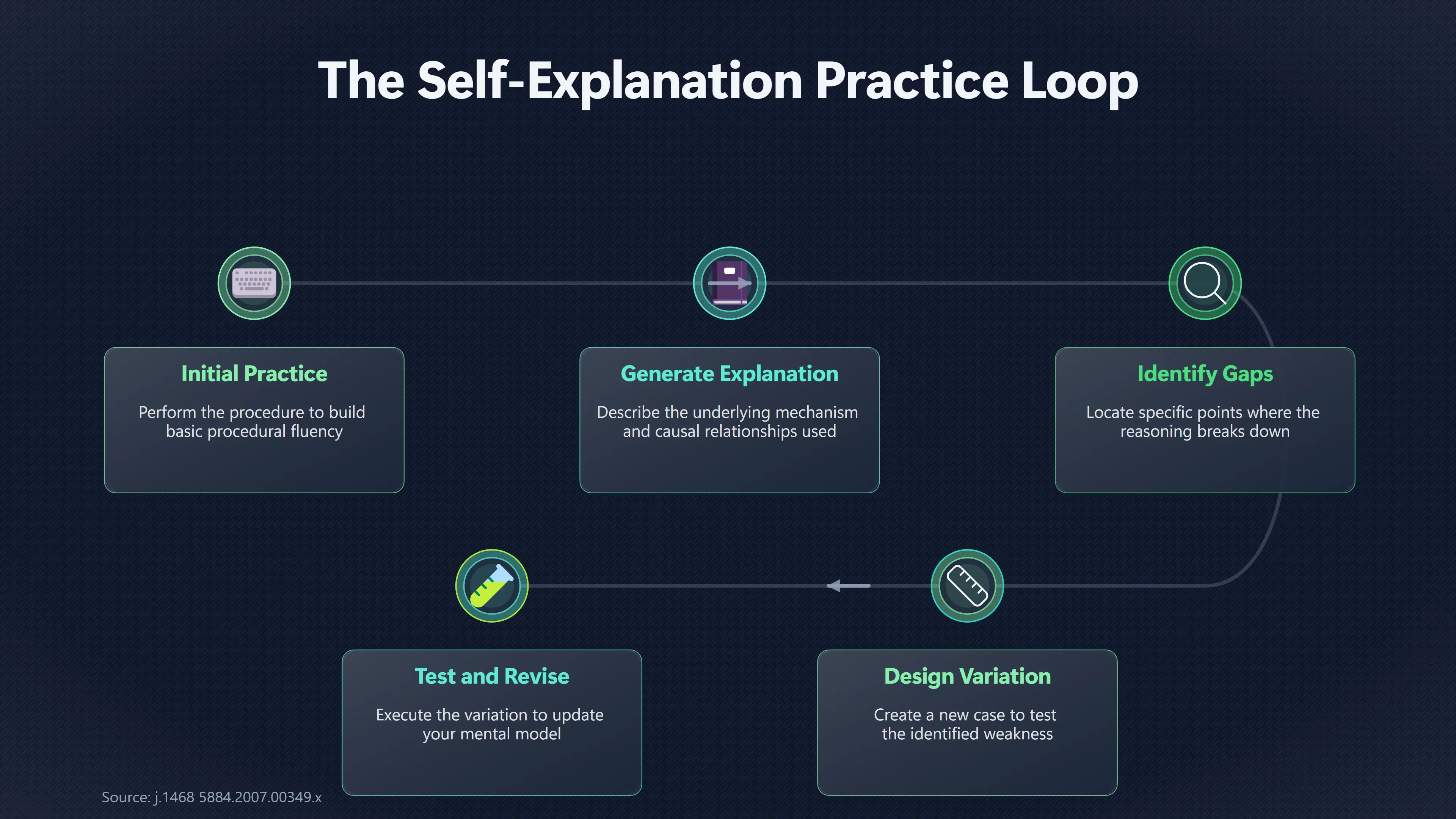
This creates a productive loop:
practise → explain → expose a gap → design a variation → test → revise the explanation
That loop changes the purpose of repetition. Each attempt is no longer merely another opportunity to execute the procedure; it becomes evidence about your current model of the task.
For example, after learning a troubleshooting routine, “complete it correctly five times” is a performance target. An explanation goal might be: “After five cases, explain which symptom justifies each diagnostic step, identify one condition under which the usual sequence should change, and predict what you would do in a case with conflicting symptoms.” The second target produces information that the first does not. It reveals whether repeated success has become a rule that can be selected and adapted.
This also provides a sensible bridge from learning goals towards stronger performance goals. Early in an unfamiliar complex task, explanation helps determine whether you have acquired a workable model rather than a fragile routine. Once you can explain the method, state its conditions, anticipate important failures and use those explanations to handle meaningful variations, faster or more demanding performance targets become better tests of progress.
The goal, then, is not to be able to talk about everything you practise. It is to make your practice answerable to an explanation. A method that you can justify, bound, test and revise is far more useful for self-improvement than one that merely worked several times in a row.

Amazon book picks
Further Reading
Books and field guides related to Can You Explain Why Your Method Works?. Use these as the next step if you want deeper reading beyond the article.
Make It Stick: The Science of Successful Learning
To most of us, learning something "the hard way" implies wasted time and effort. Good teaching, we believe, should be creatively tailored...
Ultralearning: Master Hard Skills, Outsmart the Competition,...
Now a Wall Street Journal bestseller. Learn a new talent, stay relevant, reinvent yourself, and adapt to whatever the workplace throws yo...
Peak: Secrets from the New Science of Expertise
El mayor experto mundial en rendimiento y desarrollo de habilidades, Anders Ericsson, nos enseña los secretos para conseguir ser el mejor...

How We Learn: The Surprising Truth About When, Where, and Why...
Rating: 3.1/5 from 7 Google Books ratings
First published 2014. Subjects: Psychology of Learning, Learning.
eBay marketplace picks
Marketplace Samples
Live-tested eBay searches with available results related to this page.
Selected fromlearning poster oneBay.co.uk.
Endnotes
1.
Source: sciencedirect.com
Link:https://www.sciencedirect.com/science/article/abs/pii/0364021389900025
Source snippet
Self-explanations: How students study and use examples in learning to solve problems - ScienceDirectApril 1, 1989...
Published: April 1, 1989
2.
Source: onlinelibrary.wiley.com
Link:https://onlinelibrary.wiley.com/doi/10.1207/s15516709cog2602_1
Source snippet
Wiley Online LibraryAn effective metacognitive strategy: learning by doing and explaining with a computer‐based Cognitive Tutor - Aleven...
3.
Source: sciencedirect.com
Link:https://www.sciencedirect.com/science/article/abs/pii/S0364021302000617
Source snippet
An effective metacognitive strategy: learning by doing and explaining with a computer-based Cognitive Tutor - ScienceDirect...
4.
Source: onlinelibrary.wiley.com
Link:https://onlinelibrary.wiley.com/doi/10.1207/s15516709cog2605_1
Source snippet
Wiley Online LibraryThe misunderstood limits of folk science: an illusion of explanatory depth - Rozenblit - 2002 - Cognitive Science - W...
5.
Source: sciencedirect.com
Link:https://www.sciencedirect.com/science/article/pii/S0732312324000695
Source snippet
Encouraging students to explain their ideas when learning mathematics: A psychological perspective - ScienceDirectDecember 1...
6.
Source: sciencedirect.com
Link:https://www.sciencedirect.com/science/article/pii/S0959475215300207
7.
Source: sciencedirect.com
Link:https://www.sciencedirect.com/science/article/pii/S0361476X24000717
8.
Source: sciencedirect.com
Link:https://www.sciencedirect.com/science/article/abs/pii/S0959475201000305
9.
Source: sciencedirect.com
Link:https://www.sciencedirect.com/science/article/pii/S0361476X26000238
10.
Source: onlinelibrary.wiley.com
Link:https://onlinelibrary.wiley.com/doi/full/10.1002/acp.70174
11.
Source: sciencedirect.com
Link:https://www.sciencedirect.com/science/article/pii/S0022096508001215
12.
Source: onlinelibrary.wiley.com
Title: j.1468 5884.2007.00349.x
Link:https://onlinelibrary.wiley.com/doi/10.1111/j.1468-5884.2007.00349.x
13.
Source: onlinelibrary.wiley.com
Title: j.1468 5884.2007.00349.x
Link:https://onlinelibrary.wiley.com/doi/full/10.1111/j.1468-5884.2007.00349.x
14.
Source: sciencedirect.com
Title: The effects of self-explaining when learning with text or diagrams
Link:https://www.sciencedirect.com/science/article/pii/S0364021303000338
15.
Source: sciencedirect.com
Title: The misunderstood limits of folk science: an illusion of explanatory depth
Link:https://www.sciencedirect.com/science/article/pii/S0364021302000782
16.
Source: onlinelibrary.wiley.com
Title: s15516709cog2605 1
Link:https://onlinelibrary.wiley.com/doi/abs/10.1207/s15516709cog2605_1
17.
Source: onlinelibrary.wiley.com
Title: s15516709cog2605 1
Link:https://onlinelibrary.wiley.com/doi/abs/10.1207/s15516709cog2605_1?source=post_page—————————
18.
Source: onlinelibrary.wiley.com
Title: s15516709cog2602 1
Link:https://onlinelibrary.wiley.com/doi/abs/10.1207/s15516709cog2602_1
19.
Source: sciencedirect.com
Title: A Comparison of Self-Explanation and Elaborative Interrogation
Link:https://www.sciencedirect.com/science/article/abs/pii/S0361476X97909772
20.
Source: sciencedirect.com
Title: A Comparison of Self-Explanation and Elaborative Interrogation
Link:https://www.sciencedirect.com/science/article/pii/S0361476X97909772/pdf?md5=47e2e8434461162a8e8ccee2bc3cfe30&pid=1-s2.0-S0361476X97909772-main.pdf
21.
Source: sciencedirect.com
Link:https://www.sciencedirect.com/science/article/pii/S0361476X97909590
22.
Source: sciencedirect.com
Link:https://www.sciencedirect.com/science/article/pii/S0747563214001757
23.
Source: sciencedirect.com
Title: Do worked examples boost the spacing effect on lasting learning?
Link:https://www.sciencedirect.com/science/article/pii/S0959475225000271
24.
Source: sciencedirect.com
Link:https://www.sciencedirect.com/science/article/pii/S0959475220307337
25.
Source: sciencedirect.com
Link:https://www.sciencedirect.com/science/article/abs/pii/S0022096503001590
26.
Source: sciencedirect.com
Link:https://www.sciencedirect.com/science/article/abs/pii/S036013150900298X
27.
Source: sciencedirect.com
Title: Explanation and prior knowledge interact to guide learning
Link:https://www.sciencedirect.com/science/article/pii/S0010028512000771
28.
Source: onlinelibrary.wiley.com
Title: s15516709cog1302 1
Link:https://onlinelibrary.wiley.com/doi/10.1207/s15516709cog1302_1
29.
Source: onlinelibrary.wiley.com
Title: s15516709cog1302 1
Link:https://onlinelibrary.wiley.com/doi/abs/10.1207/s15516709cog1302_1
30.
Source: eric.ed.gov
Link:https://eric.ed.gov/?id=EJ1186664
Source snippet
EJ1186664 - Inducing Self-Explanation: A Meta-Analysis, Educational Psychology Review, 2018-Sep...
31.
Source: doi.org
Link:https://doi.org/10.1007/s10648-018-9434-x?urlappend=%3Futm_source%3Dresearchgate.net%26utm_medium%3Darticle
Source snippet
Inducing Self-Explanation: a Meta-Analysis | Educational Psychology Review | Springer Nature Link...
32.
Source: doi.org
Link:https://doi.org/10.1207/s15516709cog1302_1
Source snippet
Self‐Explanations: How Students Study and Use Examples in Learning to Solve Problems - Chi - 1989 - Cognitive Science - Wiley Online L...
33.
Source: pmc.ncbi.nlm.nih.gov
Link:https://pmc.ncbi.nlm.nih.gov/articles/PMC3062901/
Source snippet
PubMed Central (PMC)The misunderstood limits of folk science: an illusion of explanatory depth - PMCSeptember 1, 2002...
Published: September 1, 2002
34.
Source: eric.ed.gov
Link:https://eric.ed.gov/?id=EJ1149060
35.
Source: pubmed.ncbi.nlm.nih.gov
Link:https://pubmed.ncbi.nlm.nih.gov/26173288/
36.
Source: doi.org
Title: Improving Students’ Learning With Effective Learning Techniques
Link:https://doi.org/10.1177/1529100612453266
37.
Source: journals.sagepub.com
Link:https://journals.sagepub.com/doi/pdf/10.3102/00346543251390901?download=true
38.
Source: doi.org
Link:https://doi.org/10.1007/s10648-025-10076-6
39.
Source: journals.sagepub.com
Link:https://journals.sagepub.com/doi/10.1177/14697874251356245
40.
Source: pmc.ncbi.nlm.nih.gov
Link:https://pmc.ncbi.nlm.nih.gov/articles/PMC9130926/
41.
Source: doi.org
Title: Is self‐explanation worth the time? A comparison to additional practice
Link:https://doi.org/10.1111/j.2044-8279.2012.02083.x
42.
Source: pubmed.ncbi.nlm.nih.gov
Link:https://pubmed.ncbi.nlm.nih.gov/21442007/
43.
Source: doi.org
Link:https://doi.org/10.1207/s15516709cog2602_1
44.
Source: eric.ed.gov
Link:https://eric.ed.gov/?ff1=pubInformation+Analyses&id=EJ1492680&pg=4&q=source%3A%22Educational+Psychology+Review%22
45.
Source: eric.ed.gov
Link:https://eric.ed.gov/?id=EJ658398
46.
Source: eric.ed.gov
Link:https://eric.ed.gov/?id=EJ1044161
47.
Source: pubmed.ncbi.nlm.nih.gov
Link:https://pubmed.ncbi.nlm.nih.gov/9769186/
48.
Source: periodicos.capes.gov.br
Link:https://www.periodicos.capes.gov.br/index.php/acervo/buscador.html?id=W2124868162&task=detalhes
Additional References
49.
Source: nature.com
Link:https://www.nature.com/articles/s44159-022-00089-1.pdf
50.
Source: youtube.com
Title: This Really Makes a Difference (The Self-Explanation Effect)
Link:https://www.youtube.com/watch?v=bxabk7o6NgY
Source snippet
What is Elaborative Interrogation? and how to use it to Optimize Learning...
51.
Source: youtube.com
Title: How to Learn Faster with the Feynman Technique (Example Included)
Link:https://www.youtube.com/watch?v=_f-qkGJBPts
Source snippet
Feynman Technique explain to understand The Feynman Technique...
52.
Source: youtube.com
Title: What is Elaborative Interrogation? and how to use it to Optimize Learning
Link:https://www.youtube.com/watch?v=I1I7e-m0pmo
Source snippet
The protégé effect: Learning by teaching...
53.
Source: ies.ed.gov
Link:https://ies.ed.gov/use-work/awards/geometry-example-developing-effective-intervention-varied-geometry-content-and-learner
54.
Source: ies.ed.gov
Link:https://ies.ed.gov/use-work/awards/improving-students-skill-solving-equations-through-better-encoding-algebraic-concepts
55.
Source: youtube.com
Title: The protégé effect: Learning by teaching!
Link:https://www.youtube.com/watch?v=VBM87YqTUdE
Source snippet
How to Learn Faster with the Feynman Technique (Example Included)...
56.
Source: researchgate.net
Link:https://www.researchgate.net/publication/313794629_Promoting_self-explanation_to_improve_mathematics_learning_A_meta-analysis_and_instructional_design_principles
57.
Source: researchgate.net
Link:https://www.researchgate.net/publication/226236884_Testing_the_instructional_fit_hypothesis_The_case_of_self-explanation_prompts
58.
Source: researchgate.net
Link:https://www.researchgate.net/publication/200772684_Transitioning_From_Studying_Examples_to_Solving_Problems_Effects_of_Self-Explanation_Prompts_and_Fading_Worked-Out_Steps