Within Exercise
What Should Happen When Your Normal Workout Falls Apart?
A prepared backup session can keep an exercise routine intact when travel, overtime, or other predictable barriers block the default plan.
On this page
- Choosing barriers that deserve a backup plan
- Designing a short home session that is ready in advance
- Using fallbacks without quietly replacing the main routine
Page outline Jump by section
Introduction
A fallback workout is a pre-decided session for the days when the normal exercise plan becomes impractical: a late finish at work, travel, bad weather, childcare trouble or another predictable disruption. Its job is not to reproduce the full gym session at home. It is to prevent an ordinary obstacle from turning “not today” into the default response.
The idea has a useful basis in behavioural research. “Coping planning” means identifying likely barriers and deciding in advance what to do when they occur. Across randomised trials, planning interventions produce modest improvements in physical activity, although effects vary considerably between studies.[PubMed Central (PMC)]pmc.ncbi.nlm.nih.govPubMed Central (PMC)The Effectiveness of Planning Interventions for Improving Physical Activity in the General Population: A Systematic R… Meanwhile, recent habit research specifically warns that changing circumstances and competing responsibilities can disrupt the cues that normally start physical activity.[PubMed]pubmed.ncbi.nlm.nih.govMaintaining habitual physical activity by overcoming disruptive competing actions: mechanisms and interventions - PubMedDecember 19…
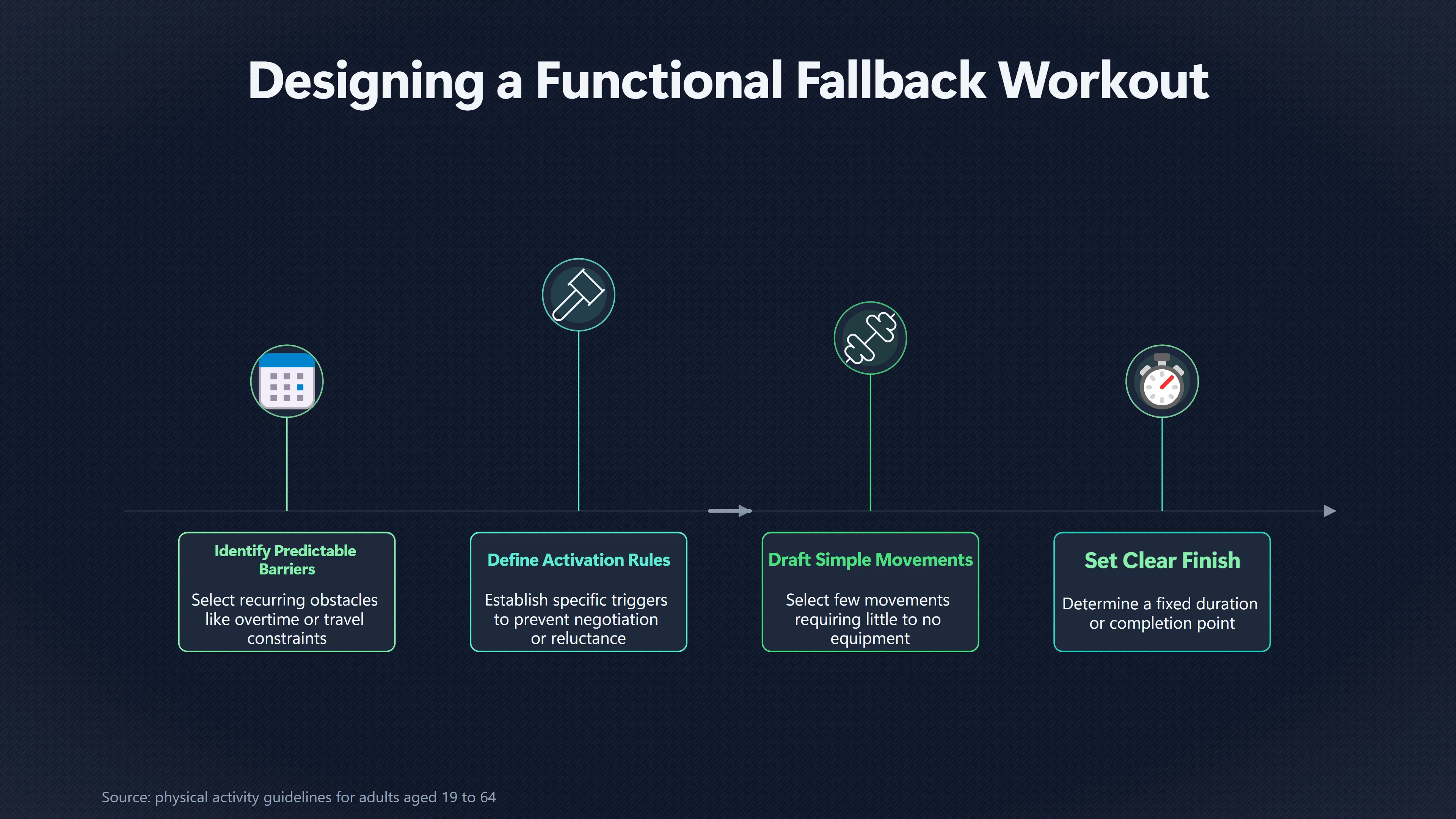
The practical policy is therefore simple: keep the preferred workout as Plan A, but give the most predictable failures a small, specific Plan B that can start immediately at home.
Which barriers deserve a backup plan?
A fallback is most useful for a barrier that is both predictable and capable of cancelling the normal session. The point is not to construct contingencies for every imaginable inconvenience. It is to notice the handful of situations that repeatedly defeat an otherwise workable routine.
This distinction mirrors the difference between action planning and coping planning in exercise research. Action planning specifies when, where and how exercise will happen. Coping planning goes a step further by anticipating difficulties and specifying how they will be handled. In a longitudinal study of 354 people, coping planning appeared particularly relevant to maintaining physical activity among people who were already active.[PubMed]pubmed.ncbi.nlm.nih.govBeyond behavioural intentions: planning mediates between intentions and physical activity - PubMedJune 2, 2007… In an earlier randomised study involving 211 cardiac-rehabilitation patients, participants given both action and coping planning subsequently reported more exercise than those given action planning alone or standard care. That clinical population should not be generalised directly to every exerciser, but it illustrates the underlying intervention clearly: planning for obstacles can add something that merely scheduling the intended behaviour does not.[PubMed]pubmed.ncbi.nlm.nih.govAction plans and coping plans for physical exercise: A longitudinal intervention study in cardiac rehabilitation - PubMed…
For an ordinary exercise routine, useful triggers might therefore look like this:
- If overtime makes the gym impractical, do the prepared home session after closing the laptop.
- If travelling removes access to normal equipment, use the equipment-free version in the hotel room or accommodation.
- If childcare or another responsibility prevents leaving home, switch to the home session rather than postponing the decision until later.
- If severe weather blocks an outdoor session, use the indoor alternative at the normal workout time.
Notice what is absent: “If I do not feel motivated, do something easier.” That is a much looser rule. A fallback works best as a response to an identifiable constraint, not as an unrestricted permission slip to downgrade any demanding session.
There is also little value in building elaborate alternatives for rare events. If a barrier has cancelled the routine several times, it deserves attention. If it has never occurred, preparing for it may simply make the exercise system more complicated.
Make the home session ready before it is needed
The worst time to invent a backup workout is the evening when the original plan has already fallen apart. At that point the person has to recognise the disruption, decide whether exercise is still worthwhile, search for exercises, choose repetitions, find equipment and determine how long the substitute should last. The fallback is supposed to remove those decisions, not relocate them.
A useful home session can therefore be surprisingly plain. For an adult who is already familiar with the movements and for whom they are appropriate, a pre-written example might be:
- Two minutes: brisk marching, stair walking or another simple warm-up.
- Six to twelve minutes: two or three rounds of familiar movements such as squats or sit-to-stands, press-ups against a suitable surface, lunges or another leg exercise, and a familiar trunk exercise.
- Two to five minutes: brisk stair climbing, marching or another aerobic movement if space and circumstances permit.
- Stop when the predetermined session is complete.
That is an illustration, not a universal prescription. Exercise selection and intensity need to suit the person’s ability, health and experience. The important design features are more general: few movements, little or no equipment, a fixed sequence and a clear finish point.
Home exercise does not have to mean “exercise that does not count”. The NHS lists resistance bands and body-weight movements such as press-ups among ways to strengthen muscles at home.[nhs.uk]nhs.ukphysical activity guidelines for adults aged 19 to 64May 22, 2024… Home-based resistance training has also been studied as a genuine training method rather than merely an emergency substitute; systematic reviews in older adults, for example, have found improvements in strength, although supervised or facility-based programmes may have advantages and those findings cannot automatically be extended to every population.[PubMed]pubmed.ncbi.nlm.nih.govUnsupervised home-based resistance training for community-dwelling older adults: A systematic review and meta-analysis of randomize…
Short is a feature, not a loophole
A common mistake is to make the fallback nearly as demanding logistically as Plan A. A 50-minute gym workout replaced by a complicated 45-minute home programme has preserved most of the original barrier.
A deliberately short fallback has a different objective. It creates a response that remains feasible after the day has already gone wrong. Current UK guidance also removes an old reason for dismissing short activity: moderate-to-vigorous activity does not have to occur in bouts of at least ten minutes to contribute towards physical-activity totals. Small bouts accumulated across the day and week can provide benefits.[GOV.UK]GOV.UKU K Chief Medical Officers' physical activity guidelinesUK Chief Medical Officers' physical activity guidelines - GOV.UKJuly 10, 2026… The World Health Organization similarly states that physical activity of any duration is associated with health benefits and that some activity is better than none.[NCBI]ncbi.nlm.nih.govOpen source on nih.gov.
That does not mean five or ten minutes is nutritionally equivalent, so to speak, to the workout it replaced. Volume, intensity and exercise type still matter. UK guidance recommends that adults accumulate at least 150 minutes of moderate-intensity activity, 75 minutes of vigorous activity, or an equivalent combination each week, alongside muscle-strengthening work on at least two days.[GOV.UK]GOV.UKU K Chief Medical Officers' physical activity guidelinesUK Chief Medical Officers' physical activity guidelines - GOV.UKJuly 10, 2026… A ten-minute fallback should therefore be understood as ten useful minutes, not as a magical substitute for every longer session.
Its behavioural value may be larger than its duration suggests, however, because it supplies an executable response at exactly the point where the normal routine has become unavailable.

Preserve the cue even when the workout changes
Fallback workouts become particularly relevant when exercise depends on stable cues. If the normal sequence is “finish work → change clothes → go to the gym”, overtime or travel does more than remove a location. It can dismantle the chain of circumstances that normally initiates exercise.
Research on habit disruption makes this vulnerability explicit. A 2025 paper on maintaining habitual physical activity argues that increased work demands, personal responsibilities and other competing actions can disrupt the preparation and initiation of exercise habits; the authors identify planning and self-monitoring among the strategies that could help limit that disruption.[PubMed]pubmed.ncbi.nlm.nih.govMaintaining habitual physical activity by overcoming disruptive competing actions: mechanisms and interventions - PubMedDecember 19…
Other habit research helps explain why this matters. In a randomised study of insufficiently active working adults, participants who planned walking in consistent contexts developed and maintained greater automaticity than those planning it in varied contexts, although consistent-context planning did not by itself produce the expected maintenance of walking behaviour.[PubMed]pubmed.ncbi.nlm.nih.govOpen source on nih.gov. An observational study of older adults likewise found that more stable physical contexts were associated with more moderate-to-vigorous physical activity, while not finding the expected relationship between context stability and measured habit strength.[PubMed]pubmed.ncbi.nlm.nih.govOpen source on nih.gov. The evidence is therefore more nuanced than “same cue guarantees a habit”.
For fallback design, the useful inference is narrower. Preserve as much of the initiation sequence as the disruption allows. If the normal cue is finishing work, the backup might still begin immediately after work. If the normal first action is changing into exercise clothes, keep it. Only the part made impossible by the barrier needs to change.
Instead of:
Gym unavailable → exercise at some point tonight.
the rule becomes:
Gym unavailable → at the usual workout cue, change clothes and start the saved home session.
The workout changes; the response to the cue changes as little as possible.
Do not let Plan B quietly become Plan A
The main risk of a convenient fallback is obvious once it starts working: the easier alternative can become attractive even when the original barrier is absent.
This is why the fallback needs an activation rule, not merely a menu of easier workouts. “Do the short home session whenever the planned session is inconvenient” creates room for negotiation. “Use it when work runs past 19:00 and the gym session is no longer feasible” is more constrained.
That distinction matters because the evidence for planning is positive but not unlimited. A 2022 systematic review identified 41 randomised trials of physical-activity planning interventions; 35 entered its meta-analysis, producing a small-to-medium pooled effect, but with substantial variation between studies. Interestingly, the review did not find that combining action and coping planning was superior to action planning alone in its subgroup analysis.[PubMed Central (PMC)]pmc.ncbi.nlm.nih.govPubMed Central (PMC)The Effectiveness of Planning Interventions for Improving Physical Activity in the General Population: A Systematic R… Earlier meta-analytic work likewise found benefits from action and coping planning while emphasising considerable heterogeneity in how planning was measured and implemented.[ScienceDirect]sciencedirect.comSpontaneous and experimentally induced action planning and coping planning for physical activity: A meta-analysis - ScienceD… There is no strong evidence that simply accumulating ever more contingency rules produces an ever more resilient routine.
A sensible fallback policy therefore separates legitimate disruption from ordinary reluctance. Three rules keep that boundary visible:
- Name the trigger in advance. “Unexpected overtime” is clearer than “busy day”.
- Keep the fallback deliberately bounded. It should solve the disruption without becoming a sprawling second programme.
- Track Plan A and Plan B separately. If the fallback begins appearing frequently, investigate why rather than congratulating the system for maintaining a nominal streak.
That last point is important. Frequent fallback use is information. Perhaps the gym is too far from work, the chosen workout time routinely collides with family responsibilities, or the programme requires more uninterrupted time than the person’s week actually contains. In that case the problem is no longer an occasional disruption. The supposed backup may be revealing that the main routine itself needs redesign.
Judge the fallback by continuity, not perfection
The wrong test is: Was this home workout as good as the session I missed? Often it will not be. A brief body-weight session cannot necessarily reproduce heavy resistance training, a long run, a swimming session or sport-specific practice. Pretending otherwise obscures the trade-off that makes fallback workouts useful.
A better question is: When the predictable barrier appeared, did the exercise system still produce an appropriate bout of activity instead of an unplanned zero?
That framing fits public-health guidance unusually well. Both UK and WHO recommendations emphasise that some physical activity is better than none while still retaining higher weekly targets for substantial health benefits.[NCBI]ncbi.nlm.nih.govOpen source on nih.gov. A fallback workout occupies exactly that middle ground: it does not erase the difference between a short substitute and the intended programme, but it refuses the false choice between completing Plan A perfectly and doing nothing.
The strongest version is therefore almost boring. One or two recurring barriers are identified in advance. Each has a specific trigger. One short, familiar home session is already written down and requires little equipment. The usual exercise cue is preserved where possible. The substitute is recorded as a fallback rather than quietly counted as an identical workout. And when the disruption disappears, the normal routine resumes.
That is what makes a fallback useful for self-improvement that lasts: it is not a second ideal routine. It is a small piece of infrastructure for the days when the ideal routine cannot happen.
Amazon book picks
Further Reading
Books and field guides related to What Should Happen When Your Normal Workout Falls Apart?. Use these as the next step if you want deeper reading beyond the article.
You Are Your Own Gym
Providing the only exercise equipment anyone will ever need again, this guide presents to the public, for the first time, the most elite...
The One Minute Workout
We all know we should exercise more – but many of us just don’t have time. The current NHS guidelines advise 150 minutes of moderate exer...
Built to Move
INSTANT NEW YORK TIMES BEST SELLER • Simple but powerful physical practices to dramatically improve the way your body feels and prolong y...
Atomic Habits
Rating: 3.5/5 from 7 Google Books ratings
The #1 New York Times bestseller. Over 25 million copies sold! Translated into 60+ languages! Tiny Changes, Remarkable Results No matter...
eBay marketplace picks
Marketplace Samples
Live-tested eBay searches with available results related to this page.
Selected fromfitness poster oneBay.co.uk.
Endnotes
1.
Source: sciencedirect.com
Link:https://www.sciencedirect.com/science/article/pii/S1469029212001148
Source snippet
Spontaneous and experimentally induced action planning and coping planning for physical activity: A meta-analysis - ScienceD...
2.
Source: nhs.uk
Title: physical activity guidelines for adults aged 19 to 64
Link:https://www.nhs.uk/live-well/exercise/physical-activity-guidelines-for-adults-aged-19-to-64/
Source snippet
May 22, 2024...
Published: May 22, 2024
3.
Source: sciencedirect.com
Link:https://www.sciencedirect.com/science/article/pii/S0167494319301529
Source snippet
Minimally supervised home-based resistance training and muscle function in older adults: A meta-analysis - ScienceDirect...
4.
Source: GOV.UK
Title: U K Chief Medical Officers’ physical activity guidelines
Link:https://www.gov.uk/government/publications/physical-activity-guidelines-uk-chief-medical-officers-report/uk-chief-medical-officers-physical-activity-guidelines
Source snippet
UK Chief Medical Officers' physical activity guidelines - GOV.UKJuly 10, 2026...
Published: July 10, 2026
5.
Source: sciencedirect.com
Link:https://www.sciencedirect.com/org/science/article/pii/S2291522224001074
6.
Source: who.int
Title: Physical activity
Link:https://www.who.int/news-room/fact-sheets/detail/physical-activity%E2%80%AF%E2%80%AF
7.
Source: sciencedirect.com
Title: A framework of routine transitions in daily travel
Link:https://www.sciencedirect.com/science/article/pii/S0965856423003117
8.
Source: who.int
Title: Physical activity
Link:https://www.who.int/europe/news-room/fact-sheets/item/physical-activity
9.
Source: who.int
Title: WH O guidelines on physical activity and sedentary behaviour: at a glance
Link:https://www.who.int/publications/i/item/9789240014886
10.
Source: GOV.UK
Title: www.gov.uk Physical activity guidelines
Link:https://www.gov.uk/government/collections/physical-activity-guidelines
11.
Source: sciencedirect.com
Title: Habit discontinuity and student travel mode choice
Link:https://www.sciencedirect.com/science/article/pii/S1369847818305874
12.
Source: sciencedirect.com
Link:https://www.sciencedirect.com/science/article/pii/S0272494407000898
13.
Source: who.int
Link:https://www.who.int/initiatives/behealthy/physical-activity
14.
Source: emro.who.int
Title: int WH O EMRO
Link:https://www.emro.who.int/health-education/physical-activity/recommended-levels-of-physical-activity-for-health.html
15.
Source: emro.who.int
Title: int WH O EMRO
Link:https://www.emro.who.int/health-education/physical-activity/promoting-physical-activity/What-is-the-recommended-amount-of-exerci.html
16.
Source: who.int
Link:https://www.who.int/health-topics/noncommunicable-diseases/physical-activity
17.
Source: sciencedirect.com
Link:https://www.sciencedirect.com/science/article/pii/S156816372100115X
18.
Source: sciencedirect.com
Link:https://www.sciencedirect.com/science/article/pii/S156816372100012X
19.
Source: sciencedirect.com
Title: Coping Planning
Link:https://www.sciencedirect.com/topics/psychology/coping-planning
20.
Source: sciencedirect.com
Link:https://www.sciencedirect.com/science/article/pii/S1469029225000214
21.
Source: sciencedirect.com
Link:https://www.sciencedirect.com/science/article/abs/pii/S0749597816302096
22.
Source: sciencedirect.com
Link:https://www.sciencedirect.com/science/article/pii/S000169182400372X
23.
Source: pmc.ncbi.nlm.nih.gov
Link:https://pmc.ncbi.nlm.nih.gov/articles/PMC9223740/
Source snippet
PubMed Central (PMC)The Effectiveness of Planning Interventions for Improving Physical Activity in the General Population: A Systematic R...
24.
Source: pubmed.ncbi.nlm.nih.gov
Link:https://pubmed.ncbi.nlm.nih.gov/39702740/
Source snippet
Maintaining habitual physical activity by overcoming disruptive competing actions: mechanisms and interventions - PubMedDecember 19...
25.
Source: pubmed.ncbi.nlm.nih.gov
Link:https://pubmed.ncbi.nlm.nih.gov/17553212/
Source snippet
Beyond behavioural intentions: planning mediates between intentions and physical activity - PubMedJune 2, 2007...
Published: June 2, 2007
26.
Source: pubmed.ncbi.nlm.nih.gov
Link:https://pubmed.ncbi.nlm.nih.gov/16480553/
Source snippet
Action plans and [coping plans]({{ 'coping-plans/' | relative_url }}) for physical exercise: A longitudinal intervention study in cardiac rehabilitation - PubMed...
27.
Source: pubmed.ncbi.nlm.nih.gov
Link:https://pubmed.ncbi.nlm.nih.gov/34022464/
Source snippet
Unsupervised home-based resistance training for community-dwelling older adults: A systematic review and meta-analysis of randomize...
28.
Source: ncbi.nlm.nih.gov
Link:https://www.ncbi.nlm.nih.gov/books/NBK566046/
29.
Source: pubmed.ncbi.nlm.nih.gov
Link:https://pubmed.ncbi.nlm.nih.gov/39225981/
30.
Source: pubmed.ncbi.nlm.nih.gov
Link:https://pubmed.ncbi.nlm.nih.gov/33502088/
31.
Source: pubmed.ncbi.nlm.nih.gov
Link:https://pubmed.ncbi.nlm.nih.gov/41664442/
32.
Source: pmc.ncbi.nlm.nih.gov
Link:https://pmc.ncbi.nlm.nih.gov/articles/PMC12831378/
33.
Source: pmc.ncbi.nlm.nih.gov
Link:https://pmc.ncbi.nlm.nih.gov/articles/PMC12860660/
34.
Source: pubmed.ncbi.nlm.nih.gov
Link:https://pubmed.ncbi.nlm.nih.gov/40972791/
35.
Source: pubmed.ncbi.nlm.nih.gov
Link:https://pubmed.ncbi.nlm.nih.gov/39952422/
36.
Source: pubmed.ncbi.nlm.nih.gov
Link:https://pubmed.ncbi.nlm.nih.gov/39276445/
37.
Source: pubmed.ncbi.nlm.nih.gov
Link:https://pubmed.ncbi.nlm.nih.gov/38436969/
38.
Source: pmc.ncbi.nlm.nih.gov
Link:https://pmc.ncbi.nlm.nih.gov/articles/PMC10579494/
39.
Source: pmc.ncbi.nlm.nih.gov
Link:https://pmc.ncbi.nlm.nih.gov/articles/pmid/37414459/
40.
Source: pubmed.ncbi.nlm.nih.gov
Link:https://pubmed.ncbi.nlm.nih.gov/36623512/
41.
Source: pmc.ncbi.nlm.nih.gov
Link:https://pmc.ncbi.nlm.nih.gov/articles/PMC10087560/
42.
Source: pubmed.ncbi.nlm.nih.gov
Link:https://pubmed.ncbi.nlm.nih.gov/35742582/
43.
Source: pmc.ncbi.nlm.nih.gov
Link:https://pmc.ncbi.nlm.nih.gov/articles/PMC9226889/
44.
Source: pubmed.ncbi.nlm.nih.gov
Link:https://pubmed.ncbi.nlm.nih.gov/35756236/
45.
Source: pubmed.ncbi.nlm.nih.gov
Link:https://pubmed.ncbi.nlm.nih.gov/35522200/
46.
Source: pmc.ncbi.nlm.nih.gov
Link:https://pmc.ncbi.nlm.nih.gov/articles/PMC9052022/
47.
Source: pubmed.ncbi.nlm.nih.gov
Link:https://pubmed.ncbi.nlm.nih.gov/35436232/
48.
Source: pmc.ncbi.nlm.nih.gov
Link:https://pmc.ncbi.nlm.nih.gov/articles/PMC8997544/
49.
Source: pubmed.ncbi.nlm.nih.gov
Link:https://pubmed.ncbi.nlm.nih.gov/35409564/
50.
Source: pmc.ncbi.nlm.nih.gov
Link:https://pmc.ncbi.nlm.nih.gov/articles/PMC8613944/
51.
Source: pmc.ncbi.nlm.nih.gov
Link:https://pmc.ncbi.nlm.nih.gov/articles/PMC9219310/
52.
Source: pmc.ncbi.nlm.nih.gov
Link:https://pmc.ncbi.nlm.nih.gov/articles/PMC8250330/
53.
Source: pubmed.ncbi.nlm.nih.gov
Link:https://pubmed.ncbi.nlm.nih.gov/33571702/
54.
Source: pmc.ncbi.nlm.nih.gov
Link:https://pmc.ncbi.nlm.nih.gov/articles/PMC7719906/
55.
Source: pubmed.ncbi.nlm.nih.gov
Link:https://pubmed.ncbi.nlm.nih.gov/31396122/
56.
Source: pmc.ncbi.nlm.nih.gov
Link:https://pmc.ncbi.nlm.nih.gov/articles/PMC6440859/
57.
Source: pmc.ncbi.nlm.nih.gov
Link:https://pmc.ncbi.nlm.nih.gov/articles/PMC6500467/
58.
Source: pmc.ncbi.nlm.nih.gov
Link:https://pmc.ncbi.nlm.nih.gov/articles/PMC6796229/
59.
Source: pmc.ncbi.nlm.nih.gov
Link:https://pmc.ncbi.nlm.nih.gov/articles/PMC4847906/
60.
Source: pubmed.ncbi.nlm.nih.gov
Link:https://pubmed.ncbi.nlm.nih.gov/27120333/
61.
Source: pubmed.ncbi.nlm.nih.gov
Link:https://pubmed.ncbi.nlm.nih.gov/25109883/
62.
Source: nice.org.uk
Link:https://www.nice.org.uk/guidance/ph44/chapter/recommendations
63.
Source: pmc.ncbi.nlm.nih.gov
Link:https://pmc.ncbi.nlm.nih.gov/articles/PMC2533665/
64.
Source: ncbi.nlm.nih.gov
Link:https://www.ncbi.nlm.nih.gov/books/NBK566048/
65.
Source: pubmed.ncbi.nlm.nih.gov
Link:https://pubmed.ncbi.nlm.nih.gov/27193530/
66.
Source: pubmed.ncbi.nlm.nih.gov
Link:https://pubmed.ncbi.nlm.nih.gov/33337982/
67.
Source: ncbi.nlm.nih.gov
Link:https://www.ncbi.nlm.nih.gov/books/NBK566046/?report=printable
68.
Source: ncbi.nlm.nih.gov
Link:https://www.ncbi.nlm.nih.gov/books/NBK305058/
69.
Source: pubmed.ncbi.nlm.nih.gov
Link:https://pubmed.ncbi.nlm.nih.gov/21985115/
70.
Source: pubmed.ncbi.nlm.nih.gov
Link:https://pubmed.ncbi.nlm.nih.gov/16262543/
Additional References
71.
Source: youtube.com
Title: 15 MIN FULL BODY WORKOUT
Link:https://www.youtube.com/watch?v=9PCGvkXV-Bo
Source snippet
10 MIN FULL BODY BEGINNER WORKOUT | No Equipment | Rowan Row...
72.
Source: youtube.com
Title: Hotel Room Workout
Link:https://www.youtube.com/watch?v=4_rje2jKRWY
Source snippet
Quick home workout no equipment busy schedule 10 MIN FULL BODY BEGINNER WORKOUT | No Equipment | Rowan Row...
73.
Source: cdc.gov
Link:https://www.cdc.gov/pcd/issues/2020/19_0321.htm
74.
Source: youtube.com
Title: 10 MIN FULL BODY BEGINNER WORKOUT | No Equipment | Rowan Row
Link:https://www.youtube.com/watch?v=kj6F7H68PW4
Source snippet
20 Min Hotel Room Workout (No Equipment Needed)...
75.
Source: researchgate.net
Link:https://www.researchgate.net/publication/361369569_The_Effectiveness_of_Planning_Interventions_for_Improving_Physical_Activity_in_the_General_Population_A_Systematic_Review_and_Meta-Analysis_of_Randomized_Controlled_Trials
76.
Source: doi.org
Link:https://doi.org/10.1348/135910705X43804
77.
Source: tandfonline.com
Link:https://www.tandfonline.com/doi/full/10.1080/1476832050018891
78.
Source: doi.org
Link:https://doi.org/10.1093/abm/kaae045
79.
Source: tandfonline.com
Link:https://www.tandfonline.com/doi/abs/10.1080/08870446.2025.2528925
80.
Source: frontiersin.org
Link:https://www.frontiersin.org/journals/psychology/articles/10.3389/fpsyg.2022.883795/full