Within If Then Plans
How Specific Should an If Then Plan Be?
Plans work best when they are specific enough to guide action without becoming overloaded with unnecessary detail.
On this page
- What useful specificity looks like
- Why vague plans leave decisions unresolved
- Why maximum detail is not always better
Page outline Jump by section
Introduction
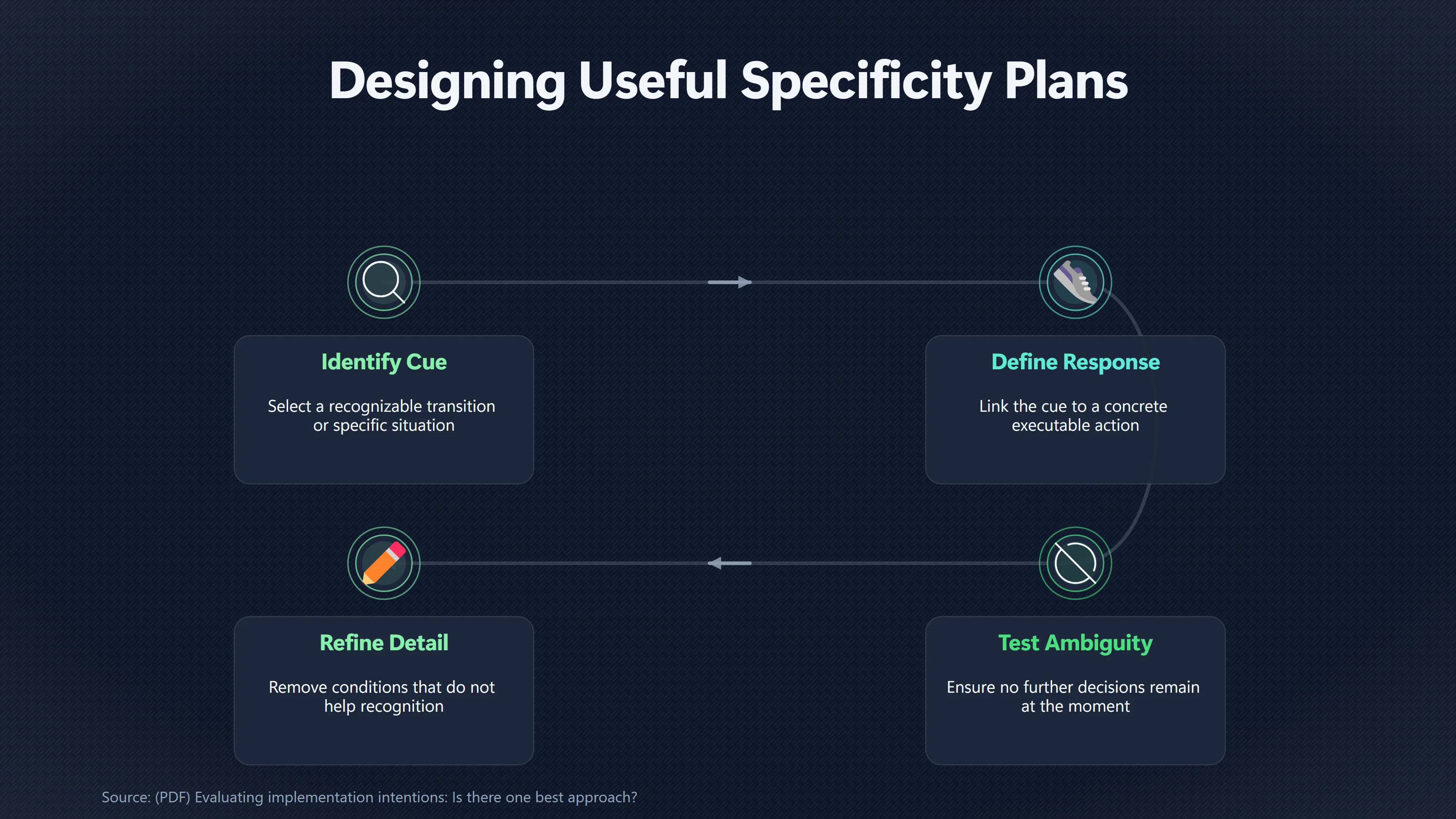
An if-then plan should be specific enough to remove the decision you would otherwise have to make in the moment, but not detailed merely for the sake of detail. A useful plan identifies a recognisable cue and an executable response: “If I finish lunch, then I will walk for ten minutes” gives the mind much more to work with than “If I have time, I will exercise”.
Research broadly supports that distinction. Studies of physical activity, smoking cessation and studying have found that better-specified plans tend to predict better follow-through. Yet the evidence does not establish a universal rule that every extra detail improves a plan. In one smoking-cessation study, medium and highly specific plans performed similarly, while experimental work has found that a generic situation can sometimes work as well as a collection of narrowly specified ones.[PubMed]pubmed.ncbi.nlm.nih.govFrom theory to practice: An explorative study into the instrumentality and specificity of implementation intentions - PubMed…
The practical target is therefore useful specificity: enough precision that you can recognise when to act and know what to do, without loading the plan with conditions that do not help either job.
What useful specificity looks like
The National Cancer Institute’s summary of implementation-intention research captures the central problem with vagueness. A plan such as “tomorrow I will exercise more” fails to identify an unambiguous opportunity or a particular action; some of the deciding still has to happen later.[Cancer Control]cancercontrol.cancer.govCancer ControlImplementation Intentions | Division of Cancer Control and Population Sciences (DCCPS)…
Consider three versions of the same intention:
- Too vague: “If I get a chance tomorrow, then I will study.”
- Useful specificity: “If I sit down on the bus home, then I will review my vocabulary.”
- Possibly unnecessary detail: “If I sit in the left-hand window seat on the 4.12 bus home and have at least 18 minutes before my stop, then I will review exactly 25 vocabulary cards.”
The middle version specifies a concrete transition and a concrete response. The first leaves unresolved what counts as a “chance”. The third adds conditions that may make the plan apply less often without obviously making the desired action easier to recognise or perform.
This distinction matters because an if-then plan is supposed to establish a link between a cue and a response. Research on implementation intentions proposes that specifying the cue makes it more mentally accessible and that linking it to the response strengthens the cue-response association. In other words, precision has a functional purpose: it should make the relevant moment easier to detect and the next action less ambiguous.[Cancer Control]cancercontrol.cancer.govCancer ControlImplementation Intentions | Division of Cancer Control and Population Sciences (DCCPS)…
A 2011 study provides a particularly useful real-world illustration. Emely de Vet and colleagues analysed plans made by 342 adults seeking to increase their physical activity. Participants could specify the activity, day, time of day, place and duration. They produced an average of 2.18 plans, yet more than 30% failed to make even one plan judged specific. Better-specified plans, rather than simply a greater number of plans, were associated with greater physical activity two weeks later. The researchers particularly highlighted specifying when to act.[ScienceDirect]sciencedirect.comMore or better: Do the number and specificity of implementation intentions matter in increasing physical activity? - Science…
The lesson is not that every plan must contain five pieces of information. It is that details should close genuine decision gaps. “If I exercise tomorrow, I will run” still leaves when unresolved. “If I finish work, I will run” may already settle the relevant question. Adding the exact pavement, playlist and colour of running top probably does not.
Why vague plans leave decisions unresolved
Vagueness weakens an if-then plan in two places. The if-part can fail to tell you when the rule applies, while the then-part can fail to tell you what to do.
“If I have some free time, then I will work on my project” illustrates both problems. How much free time counts? Does ten minutes qualify? And what does “work on” mean: research, write, organise files or answer email? Encountering free time can therefore reopen the same choice the plan was meant to settle.
That is important because the distinctive value of an implementation intention lies in contingency: a specified situation is linked to a specified response. A 2024 meta-analysis covering 642 independent tests found positive effects across cognitive, emotional and behavioural outcomes, with larger effects when plans actually used a contingent if-then format. The review also classified a wide range of workable cues, including times and places, task transitions and other situations, rather than implying that one particular type of microscopic detail is required.[DOI]doi.orgThe when and how of planning: Meta-analysis of the scope and components of implementation intentions in 642 tests: European Review of…
Recent field evidence makes the distinction even clearer. In a 42-day study published in 2025, 357 fifth- and sixth-year pupils were prompted on randomly selected evenings to create if-then plans for using a vocabulary-learning app the following day. Simply receiving a planning prompt was not enough: effectiveness depended strongly on the quality of the plan the pupil actually produced. Higher-quality cues were specific, noticeable and appropriate for studying.[ScienceDirect]sciencedirect.comPlanning promotes studying – The higher the plan quality the better: A micro-randomized trial - ScienceDirectDecember 1, 2025…
The researchers’ examples show why “specific” should not be confused with “long”. A cue tied to finishing a familiar activity, such as brushing one’s teeth in the morning, could provide a clear moment for action. By contrast, “when I am at home” describes a potentially lengthy period rather than a particular transition, while “when I have time” supplies no definite situation at all. The study also treated contextual suitability as part of plan quality: an otherwise identifiable cue is not especially useful if it occurs when the intended action is impractical.[ScienceDirect]sciencedirect.comPlanning promotes studying – The higher the plan quality the better: A micro-randomized trial - ScienceDirectDecember 1, 2025…
This suggests a simple test for specificity: when the if-part becomes true, should you still have to decide whether “now” really counts? And after it becomes true, should you still have to decide what action to begin? If either answer is yes, the plan probably needs clarification.
Why maximum detail is not always better
It is tempting to turn “specific plans work better” into “the most detailed possible plan works best”. The research does not justify that simple escalation.
A study of 764 participants in a smoking-cessation contest is especially relevant. Participants created three plans for dealing with difficult situations, and researchers independently classified their specificity as non-specific, medium or high. Specificity predicted point-prevalence smoking abstinence seven months later: medium-to-high specificity was associated with better outcomes than low specificity. Crucially, however, abstinence did not differ between the medium- and highly-specific groups.[PubMed]pubmed.ncbi.nlm.nih.govFrom theory to practice: An explorative study into the instrumentality and specificity of implementation intentions - PubMed…
The authors themselves raised the possibility of over-specification. A cue described through too many conditions may occur rarely or may be harder to match to a real situation that differs slightly from the imagined one. Similarly, an action burdened with numerous prerequisites may become impossible when one component is unavailable. They therefore framed the issue as finding an effective level of specificity rather than assuming an unlimited “more is better” relationship.[ResearchGate]researchgate.netResearchGate(PDF) From theory to practice: An explorative study into the instrumentality and specificity of implementation intentionsJanu…
There is another reason for caution. A 2017 physical-activity experiment directly compared implementation-intention interventions using different levels of situation specificity. A brief intervention based on a generic single situation was as effective at increasing vigorous physical activity as an intervention allowing participants to choose among ten more specific situations; both outperformed the control condition on that outcome. That does not show that specificity is irrelevant, but it does show that narrowing the situation further does not invariably produce a larger effect.[ScienceDirect]sciencedirect.comDoes Situation-Specificity Affect the Operation of Implementation Intentions? - ScienceDirect…
The evidence therefore points towards a more discriminating principle:
Make the cue as specific as necessary to be recognisable, and the response as specific as necessary to be executable. Stop adding detail when it no longer resolves meaningful uncertainty.
Specificity is not the same as plan quality
One of the most useful developments in recent research is the recognition that specificity alone cannot determine whether a plan is good. The 2025 vocabulary-learning study rated cues on three related dimensions: specificity, salience and contextual appropriateness. A cue could be precise but still poor if the pupil was unlikely to notice it or if it occurred in circumstances unsuitable for studying.[ScienceDirect]sciencedirect.comPlanning promotes studying – The higher the plan quality the better: A micro-randomized trial - ScienceDirectDecember 1, 2025…
That distinction prevents a common mistake in self-improvement advice. Compare:
“If it is exactly 18:07, then I will read.”
with:
“If I put my dinner plate in the dishwasher, then I will read for ten minutes.”
The first statement is numerically more precise, but the second may provide the better behavioural cue. Dinner creates a naturally noticeable transition; 18:07 helps only if the person reliably notices the clock at that moment. This example is an inference from the research rather than a direct experimental comparison, but it captures the distinction between mere precision and a cue that is actually salient in everyday life.[ScienceDirect]sciencedirect.comPlanning promotes studying – The higher the plan quality the better: A micro-randomized trial - ScienceDirectDecember 1, 2025…
Specificity should therefore serve recognition and action, not become an exercise in describing the future. A strong if-then plan normally answers two practical questions with little room for reinterpretation:
- What event will tell me that this is the moment?
- What concrete response will I start when it occurs?
Details about time, place, preceding activity, duration or method belong in the plan when they make one of those answers clearer. They need not be included automatically.

A practical specificity test
For everyday use, the research supports a short progression rather than a demand for maximal detail. Start with the smallest plan that genuinely pre-decides the moment and response, then sharpen it only where ambiguity remains.
“If I have time tonight, then I will exercise” is weak because both halves remain open. “If I finish dinner, then I will walk outside for ten minutes” identifies a recognisable transition and an immediately executable behaviour. Unless a recurring problem demands further clarification, that may already be specific enough.
If the plan repeatedly fails, diagnose the ambiguity rather than simply making the sentence longer. If you keep missing the cue, make the if-part more distinctive. If you notice the cue but hesitate over what to do, make the then-part more concrete. If the exact planned situation seldom occurs, loosen unnecessary conditions rather than adding new ones.
That interpretation fits the evidence better than either extreme. Vague plans can leave the crucial decision until the difficult moment, and several field studies associate higher-quality, more specific plans with better behaviour.[sciencedirect.com]sciencedirect.comMore or better: Do the number and specificity of implementation intentions matter in increasing physical activity? - Science… But medium specificity has sometimes performed as well as high specificity, and greater situation-specificity has not invariably improved outcomes.[PubMed]pubmed.ncbi.nlm.nih.govFrom theory to practice: An explorative study into the instrumentality and specificity of implementation intentions - PubMed…
For an if-then plan, then, the goal is not maximum description. It is minimum remaining ambiguity: a cue clear enough to recognise, paired with an action clear enough to begin.
Amazon book picks
Further Reading
Books and field guides related to How Specific Should an If Then Plan Be?. Use these as the next step if you want deeper reading beyond the article.

TINY HABITS: The Small Changes That Change Everything
Rating: 3.6/5 from 8 Google Books ratings
First published 2019. Subjects: Habit, Change (psychology), SELF-HELP / Motivational & Inspirational, SELF-HELP / Personal Growth / Happi...
Atomic Habits
Rating: 3.5/5 from 7 Google Books ratings
The #1 New York Times bestseller. Over 25 million copies sold! Translated into 60+ languages! Tiny Changes, Remarkable Results No matter...
The Power of Habit
Rating: 4.0/5 from 145 Google Books ratings
In The Power of Habit, award-winning business reporter Charles Duhigg takes us to the thrilling edge of scientific discoveries that expla...
Switch: How to Change Things When Change Is Hard
'A fantastic book.' WIRED 'Witty and instructive.' WALL STREET JOURNAL 'Invaluable for anyone wanting to make long-lasting change a reali...
eBay marketplace picks
Marketplace Samples
Live-tested eBay searches with available results related to this page.
Selected fromself improvement wall art oneBay.co.uk.



Endnotes
1.
Source: sciencedirect.com
Link:https://www.sciencedirect.com/science/article/abs/pii/S0005789417300904
Source snippet
Does Situation-Specificity Affect the Operation of Implementation Intentions? - ScienceDirect...
2.
Source: cancercontrol.cancer.gov
Link:https://cancercontrol.cancer.gov/brp/research/constructs/implementation-intentions
Source snippet
Cancer ControlImplementation Intentions | Division of Cancer Control and Population Sciences (DCCPS)...
3.
Source: doi.org
Link:https://doi.org/10.1080/10463283.2024.2334563
Source snippet
The when and how of planning: Meta-analysis of the scope and components of implementation intentions in 642 tests: European Review of...
4.
Source: sciencedirect.com
Link:https://www.sciencedirect.com/science/article/pii/S1469029211000264
Source snippet
More or better: Do the number and specificity of implementation intentions matter in increasing physical activity? - Science...
5.
Source: sciencedirect.com
Link:https://www.sciencedirect.com/science/article/pii/S0361476X25000876
Source snippet
Planning promotes studying – The higher the plan quality the better: A micro-randomized trial - ScienceDirectDecember 1, 2025...
Published: December 1, 2025
6.
Source: researchgate.net
Link:https://www.researchgate.net/publication/41762425_From_theory_to_practice_An_explorative_study_into_the_instrumentality_and_specificity_of_implementation_intentions
Source snippet
ResearchGate(PDF) From theory to practice: An explorative study into the instrumentality and specificity of implementation intentionsJanu...
7.
Source: sciencedirect.com
Link:https://www.sciencedirect.com/science/article/pii/S0361476X25000876?dgcid=rss_sd_all
8.
Source: researchgate.net
Link:https://www.researchgate.net/publication/396891759Planning_promotes_studying-_The_higher_the_plan_quality_the_better_A_micro-randomized_trial
9.
Source: researchgate.net
Title: (PDF) Evaluating implementation intentions: Is there one best approach?
Link:https://www.researchgate.net/publication/381621677_Evaluating_implementation_intentions_Is_there_one_best_approach
10.
Source: doi.org
Link:https://doi.org/10.1080/08870446.2023.2241777
11.
Source: doi.org
Link:https://doi.org/10.1007%2Fs12529-020-09864-x
12.
Source: sciencedirect.com
Link:https://www.sciencedirect.com/science/article/pii/S0195666318314363
13.
Source: sciencedirect.com
Link:https://www.sciencedirect.com/science/article/abs/pii/S136984781830086X
14.
Source: researchgate.net
Link:https://www.researchgate.net/publication/237095513_Situational_and_Affective_Risk_Situations_of_Relapse_and_the_Quality_of_Implementation_Intentions_in_an_E-Health_Smoking_Relapse_Prevention_Programme
15.
Source: researchgate.net
Link:https://www.researchgate.net/publication/236664591_Effects_of_a_One_Hour_Intervention_on_Condom_Implementation_Intentions_among_Drug_Users_in_Southern_California
16.
Source: researchgate.net
Link:https://www.researchgate.net/publication/50419782_Implementation_intentions_for_buying_carrying_discussing_and_using_condoms_The_role_of_the_quality_of_plans
17.
Source: sciencedirect.com
Link:https://www.sciencedirect.com/science/article/pii/S0277953620307097
18.
Source: sciencedirect.com
Link:https://www.sciencedirect.com/science/article/abs/pii/S002210310600028X
19.
Source: sciencedirect.com
Title: Coping Planning
Link:https://www.sciencedirect.com/topics/psychology/coping-planning
20.
Source: sciencedirect.com
Link:https://www.sciencedirect.com/science/article/abs/pii/S0277953617304598
21.
Source: sciencedirect.com
Link:https://www.sciencedirect.com/journal/contemporary-educational-psychology/vol/83/suppl/C
22.
Source: sciencedirect.com
Link:https://www.sciencedirect.com/author/25925791200/tracy-epton
23.
Source: sciencedirect.com
Link:https://www.sciencedirect.com/science/article/pii/S0010027724000040?dgcid=rss_sd_all
24.
Source: researchgate.net
Link:https://www.researchgate.net/publication/229109088_More_or_better_Do_the_number_and_specificity_of_implementation_intentions_matter_in_increasing_physical_activity
25.
Source: researchgate.net
Link:https://www.researchgate.net/publication/290193001_Implementation_Intentions
26.
Source: researchgate.net
Link:https://www.researchgate.net/publication/391896182Planning_promotes_studying-_the_higher_the_plan_quality_the_better_a_micro-randomized_trial
27.
Source: researchgate.net
Link:https://www.researchgate.net/publication/386002261Planning_promotes_studying-_the_higher_the_plan_quality_the_better_a_micro-randomized_trial
28.
Source: researchgate.net
Link:https://www.researchgate.net/publication/319015064_Does_Situation-Specificity_Affect_the_Operation_of_Implementation_Intentions
29.
Source: researchgate.net
Link:https://www.researchgate.net/publication/268694122_Evidence_that_implementation_intentions_reduce_drivers%27_speeding_behavior_Testing_a_new_intervention_to_change_driver_behavior
30.
Source: pubmed.ncbi.nlm.nih.gov
Link:https://pubmed.ncbi.nlm.nih.gov/20204939/
Source snippet
From theory to practice: An explorative study into the instrumentality and specificity of implementation intentions - PubMed...
31.
Source: pmc.ncbi.nlm.nih.gov
Link:https://pmc.ncbi.nlm.nih.gov/articles/PMC10758936/
32.
Source: pubmed.ncbi.nlm.nih.gov
Link:https://pubmed.ncbi.nlm.nih.gov/34233718/
33.
Source: pmc.ncbi.nlm.nih.gov
Link:https://pmc.ncbi.nlm.nih.gov/articles/PMC8009798/
34.
Source: pmc.ncbi.nlm.nih.gov
Link:https://pmc.ncbi.nlm.nih.gov/articles/PMC7366587/
35.
Source: pmc.ncbi.nlm.nih.gov
Link:https://pmc.ncbi.nlm.nih.gov/articles/PMC7092395/
36.
Source: pubmed.ncbi.nlm.nih.gov
Link:https://pubmed.ncbi.nlm.nih.gov/26892502/
37.
Source: pmc.ncbi.nlm.nih.gov
Link:https://pmc.ncbi.nlm.nih.gov/articles/PMC4370584/
38.
Source: pmc.ncbi.nlm.nih.gov
Link:https://pmc.ncbi.nlm.nih.gov/articles/PMC4299546/
39.
Source: pmc.ncbi.nlm.nih.gov
Link:https://pmc.ncbi.nlm.nih.gov/articles/PMC4129126/
40.
Source: pubmed.ncbi.nlm.nih.gov
Link:https://pubmed.ncbi.nlm.nih.gov/23750773/
41.
Source: pmc.ncbi.nlm.nih.gov
Link:https://pmc.ncbi.nlm.nih.gov/articles/PMC3644281/
42.
Source: pubmed.ncbi.nlm.nih.gov
Link:https://pubmed.ncbi.nlm.nih.gov/8216183/
Additional References
43.
Source: research.wur.nl
Link:https://research.wur.nl/en/publications/more-or-better-do-the-number-and-specificity-of-implementation-in/
Source snippet
Wageningen Research PortalMore or better: Do the number and specificity of implementation intentions matter in increasing physical activi...
44.
Source: cris.maastrichtuniversity.nl
Link:https://cris.maastrichtuniversity.nl/en/publications/from-theory-to-practice-an-explorative-study-into-the-instrumenta/
45.
Source: dipf.de
Link:https://www.dipf.de/en/research/publications/publications-data-base/show?b_start%3Aint=20&feldinhalt5=Brod%2C+Garvin&feldname5=Personen&mtz=200&set_language=en
Source snippet
Search results in the DIPF database of publications — DIPF | Leibniz Institute for Research and Information in Education...
46.
Source: youtube.com
Title: How to Achieve Any Goal with Science | The WOOP technique
Link:https://www.youtube.com/watch?v=65GCZV1WkfQ
Source snippet
Implementation intentions how to make if-then plans How To Actually Get Things Done (implementation intentions)...
47.
Source: tandfonline.com
Link:https://www.tandfonline.com/doi/abs/10.1080/08870440802642155
48.
Source: tandfonline.com
Link:https://www.tandfonline.com/doi/full/10.1080/17437199.2021.1876572
49.
Source: ehm-tech.com
Link:https://www.ehm-tech.com/habit/tools/if-then-habit-planner/
50.
Source: nervewindow.com
Link:https://nervewindow.com/blog/implementation-intentions-if-then-gollwitzer/
51.
Source: tandfonline.com
Link:https://www.tandfonline.com/doi/full/10.1080/08870446.2016.1146719
52.
Source: sciety.org
Link:https://sciety.org/articles/activity/10.31234/osf.io/jsmq4_v2