Within Adapt the Plan
Test Your New Routine Where the Old One Failed
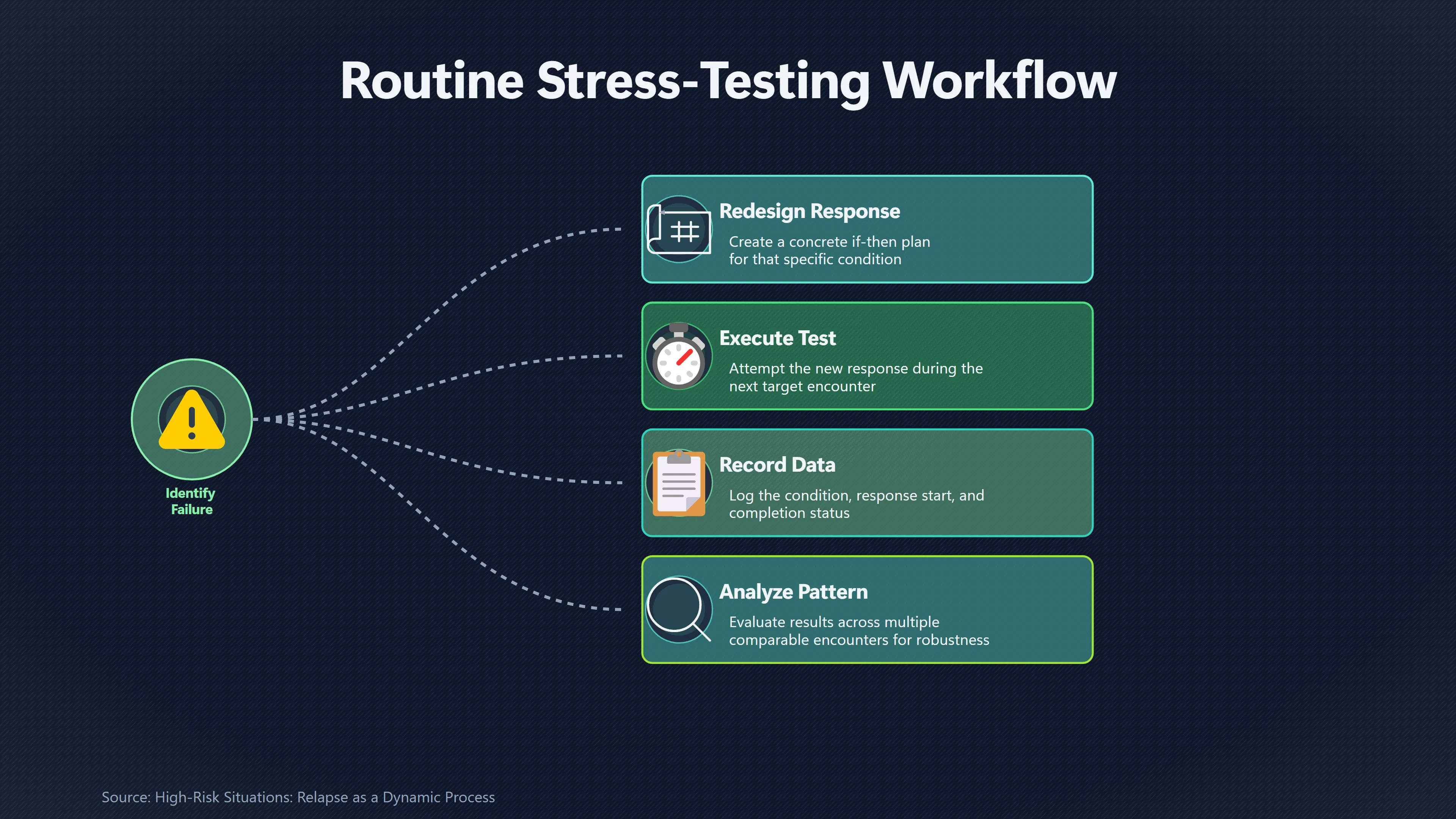
A routine change is only convincing when it survives repeated encounters with the same condition that defeated the old plan.
On this page
- Why the original failure condition is the right test environment
- How many repeated encounters can reveal a useful pattern
- What to change next when the redesign still fails
Page outline Jump by section
Introduction
A redesigned routine has not really passed its test because it worked on an easy Tuesday. The convincing test is whether it works when the condition that defeated the old routine returns: the late meeting, the tired evening, the disrupted commute, the distracting phone, the crowded house or another recurring obstacle. Re-testing in that same failure condition turns self-improvement from hopeful redesign into a small, practical experiment.
The important word is repeated. One successful encounter may be luck; one failure may be an unusually difficult day. What matters is the pattern across several comparable encounters. Research on habits, implementation intentions, progress monitoring and relapse prevention all points towards the importance of context: behaviour depends partly on the situations and cues in which it is attempted, and plans become more informative when evaluated against those situations rather than against an undifferentiated success rate.[nih.gov]pmc.ncbi.nlm.nih.govPubMed Central (PMC)Context Stability in Habit Building Increases Automaticity and Goal Attainment - PMCJune 10, 2022…
Why test where the old routine failed?
Suppose an evening exercise routine repeatedly disappeared whenever work ran late. You redesign it so that on late-work days the target becomes a 20-minute home session rather than a trip to the gym. Completing that session on a quiet weekend proves very little about the redesign. The relevant question is what happens on the next several late-work days.
This is essentially a matched test: keep the troublesome situation recognisable while changing the response to it. The reasoning has strong parallels with relapse-prevention research, where identifying a person’s particular high-risk situations and developing effective responses to those situations is central to the intervention. In that literature, the outcome of a high-risk encounter depends substantially on whether an effective coping response can actually be enacted when the risk is present.[PubMed Central (PMC)]pmc.ncbi.nlm.nih.govPubMed Central (PMC)Relapse Prevention: An Overview of Marlatt’s Cognitive-Behavioral Model - PMC…
The analogy should not be pushed too far. Evidence from treatment for addictive behaviours cannot establish that an ordinary study, exercise or productivity routine works in exactly the same way. But it provides a useful design principle: a response intended to solve a situational failure should eventually be evaluated in that situation.
Habit research gives another reason to care about this distinction. In a six-week study of 95 university students, involving 2,482 habit repetitions, participants assigned to build study habits in more stable contexts developed greater automaticity than those instructed to vary times and locations. A second dataset covering 308 habits and 2,368 repetitions showed the same general association between context stability, automaticity and goal attainment. The authors caution against broad generalisation, but the studies demonstrate something important for routine testing: context is not merely background scenery. Changing it can change how readily behaviour is performed.[PubMed Central (PMC)]pmc.ncbi.nlm.nih.govPubMed Central (PMC)Context Stability in Habit Building Increases Automaticity and Goal Attainment - PMCJune 10, 2022…
That means an overall completion figure can conceal the information that matters most. Imagine a redesigned study routine succeeds on 16 of 20 days. An 80% success rate sounds encouraging. But if all four failures occur on the four days when the person arrives home after 8 pm — precisely the condition the redesign was supposed to handle — the redesign has not solved its target problem.
A better record distinguishes ordinary opportunities from target-condition encounters:
EncounterOld failure condition present?Redesigned response attempted?ResultUseful observationMondayNoYesCompletedRoutine worked normallyWednesdayYesYesCompletedShort version fitted available timeFridayYesYesFailedStarted too late after arriving homeTuesdayYesYesCompletedImmediate start workedThursdayYesNoFailedCue was missed
The purpose is not to manufacture a scientific trial out of everyday life. It is to stop easy situations from masking the precise weakness the redesign was meant to repair.
How many repeated encounters reveal a useful pattern?
There is no well-supported universal rule saying that an ordinary personal routine must survive exactly three, five or ten difficult encounters before it can be declared robust. Behaviour-change research does not provide such a general threshold, and presenting one would create false precision. NICE guidance instead recommends reviewing behavioural goals in light of experience, monitoring outcomes and tailoring subsequent plans to progress. It also explicitly combines action planning with coping plans intended to manage relapse.[Nice]nice.org.ukRecommendations | Behaviour change: individual approaches | Guidance | NICEJanuary 2, 2014…
For personal self-improvement, the practical answer is therefore to collect enough comparable encounters to distinguish a recurring result from an isolated event, without waiting indefinitely. This is better treated as an evidence-quality question than as a magic-number question.
Three distinctions help.
Count opportunities, not merely days. If the routine fails specifically when work runs late, seven calendar days containing only one late finish provide one meaningful stress test, not seven. Conversely, a month containing six late finishes provides six observations of the condition that matters.
Record the severity of the condition. “Tired” can mean mildly fatigued after an ordinary day or exhausted after four hours’ sleep. “Busy” can cover a normal workload and an exceptional crisis. Without this distinction, apparently repeated tests may not really be comparable.
Look for direction, not perfection. A redesign can be useful without eliminating every lapse. If the old routine almost always collapsed under a particular condition and the new version now succeeds in most comparable encounters, that is meaningful evidence of improvement. If outcomes remain erratic, more observations or another adjustment may be warranted.
Progress monitoring itself has a substantial evidence base. A meta-analysis of 138 studies involving 19,951 participants found that interventions designed to increase monitoring increased goal attainment, with stronger effects where progress was physically recorded or reported. That does not tell an individual exactly how many retests to perform, but it supports making the results visible rather than relying on retrospective impressions such as “I think the new routine is going better”.[PubMed]pubmed.ncbi.nlm.nih.govDoes monitoring goal progress promote goal attainment? A meta-analysis of the experimental evidence - PubMed…
The resulting dataset can remain very small. For each encounter, record the condition, the planned response, whether the response started, whether it was completed sufficiently to count, and one brief explanation if it failed. Recording ten additional variables can create enough burden to become another reason the routine collapses.

Test the response, not your character
Repeated stress-testing is most useful when the unit being judged is the routine design. “The shortened workout failed on three of four late-work nights” is actionable information. “I am bad at consistency” is not.
Relapse-prevention research makes this distinction unusually explicit. Its cognitive-behavioural model contrasts interpreting a lapse as evidence of a stable personal deficiency with identifying an ineffective coping response to a particular high-risk situation. The latter interpretation creates a route towards changing the response when that situation appears again.[PubMed Central (PMC)]pmc.ncbi.nlm.nih.govPubMed Central (PMC)Relapse Prevention: An Overview of Marlatt’s Cognitive-Behavioral Model - PMC…
For ordinary routines, this translates into a simple governance rule: define failure operationally before the next test. If a study redesign says, “When I get home after 8 pm, I will do 15 minutes of review rather than the normal 45-minute session”, success is whether the 15-minute version happens. Do not retroactively decide that it “didn’t really count” because it was shorter than the ideal routine.
Specific contingency plans have good evidence behind them. A 2006 meta-analysis covering 94 independent tests found a medium-to-large overall effect of implementation intentions — plans specifying when, where and how to act — on goal attainment. A much larger 2024 meta-analysis covering 642 independent tests found beneficial effects across cognitive, emotional and behavioural outcomes, with stronger effects when plans used a contingent if–then structure and were rehearsed.[ScienceDirect]sciencedirect.comImplementation Intentions and Goal Achievement: A Meta‐analysis of Effects and Processes - ScienceDirect…
That makes a redesigned routine easier to test when its rule is concrete:
If the recurring failure condition happens, then I will use the redesigned response.
The test then has two observable parts. Did the situation occur? Did the planned response follow?
What if the redesign still fails?
Repeated failure under the target condition is useful information because it narrows the diagnosis. The next adjustment should follow what happened during the retest rather than trigger an indiscriminate overhaul.
If the redesigned response never starts, revisit the trigger. “When I have time” may still be too vague; a visible event such as closing the work laptop may be more dependable.
If it starts but repeatedly cannot be completed, the response may still be too large for the difficult situation. The next experiment might reduce its duration or complexity while preserving the core behaviour.
If the same obstacle intervenes after the trigger, redesign around that obstacle. For example, if a planned home workout repeatedly disappears once the person sits down and starts scrolling, changing the sequence or immediate environment may be more relevant than increasing motivation.
If the response works under one version of the situation but fails under another, split the condition. “Late workday” may actually contain two different cases: finishing at 7.30 pm still permits a shortened workout; finishing at 10 pm may require a recovery-day rule instead. The data have revealed that the original category was too broad.
This is where coping planning becomes particularly relevant. A systematic review found that plans addressing anticipated barriers appeared useful when people received support in forming them, and that combining action plans with coping plans appeared more effective than action plans alone, although results varied across studies.[Taylor & Francis Online]tandfonline.comOpen source on tandfonline.com. NICE likewise recommends coping plans, regular review and tailoring interventions according to progress and the person’s physical, economic and social context.[Nice]nice.org.ukRecommendations | Behaviour change: individual approaches | Guidance | NICEJanuary 2, 2014…
There is also a reason not to make the redesigned response excessively rigid. Laboratory research shows that implementation intentions can sometimes facilitate a planned response in sufficiently similar situations even when that response is no longer appropriate. Other experimental work has raised the possibility that the efficiency created by such plans can come at a cost to behavioural flexibility. These findings do not negate the wider evidence supporting if–then planning; they show why repeated testing should check whether the rule still fits the situation rather than treating automation as the goal in itself.[sciencedirect.com]sciencedirect.comOpen source on sciencedirect.com.
When has the routine earned confidence?
The strongest practical evidence is not “I followed the new routine for two weeks”. It is closer to: “The old routine repeatedly failed under condition X; I changed response Y; and across subsequent encounters with condition X, the new response usually held.”
That is a much narrower claim, but it is more useful. It identifies what was tested, what changed and where confidence is justified.
It also avoids confusing stability with robustness. Repeating a behaviour under favourable, stable conditions can help build automaticity; the context-stability research supports that approach. But if a person’s life predictably contains a troublesome condition — late shifts every Thursday, travel twice a month, childcare interruptions each morning — a routine designed to accommodate that reality eventually needs evidence from those encounters too.[PubMed Central (PMC)]pmc.ncbi.nlm.nih.govPubMed Central (PMC)Context Stability in Habit Building Increases Automaticity and Goal Attainment - PMCJune 10, 2022…
There is no need to deliberately manufacture unsafe, harmful or unusually severe stress tests. The useful tests are the naturally recurring situations that previously broke the routine. As those situations return, the redesigned system gets another observation.
Over time, the evidence can justify one of three decisions: keep the redesign when it repeatedly handles its target condition; modify it when failures expose a specific remaining weakness; or replace it when repeated comparable encounters show that its underlying assumption was wrong. That decision rule is the heart of adaptive self-improvement: changes are not rewarded merely for sounding clever. They earn their place by surviving contact with the problem they were designed to solve.
Amazon book picks
Further Reading
Books and field guides related to Test Your New Routine Where the Old One Failed. Use these as the next step if you want deeper reading beyond the article.
Tiny Habits
Improving your life is much easier than you think. Whether it’s losing weight, sleeping more, or restoring your work/life balance – the s...
How to Change
Wall Street Journal bestseller “A welcome revelation.” --The Financial Times Award-winning Wharton Professor and Choiceology podcast host...
Atomic Habits
Rating: 3.5/5 from 7 Google Books ratings
The #1 New York Times bestseller. Over 25 million copies sold! Translated into 60+ languages! Tiny Changes, Remarkable Results No matter...
Good Habits, Bad Habits
'The world's leading expert on habits' - Matthew Syed, bestselling author of Black Box Thinking and Rebel IdeasWhat if you could harness...
eBay marketplace picks
Marketplace Samples
Live-tested eBay searches with available results related to this page.
Selected frommotivational poster oneBay.co.uk.



Current eBay listing
Gym Motivational Posters Work Out Insperational Quotes Wall Art

Current eBay listing
Motivational Quotes Framed Wall Art Poster Canvas Print Picture
Endnotes
1.
Source: sciencedirect.com
Link:https://www.sciencedirect.com/science/article/abs/pii/S0065260106380021
Source snippet
Implementation Intentions and Goal Achievement: A Meta‐analysis of Effects and Processes - ScienceDirect...
2.
Source: sciencedirect.com
Link:https://www.sciencedirect.com/science/article/pii/S0001691816304048
3.
Source: sciencedirect.com
Link:https://www.sciencedirect.com/science/article/pii/S0001691816303626
4.
Source: sciencedirect.com
Link:https://www.sciencedirect.com/science/chapter/bookseries/abs/pii/S0065260106380021
5.
Source: sciencedirect.com
Title: High-Risk Situations: Relapse as a Dynamic Process
Link:https://www.sciencedirect.com/science/article/abs/pii/B978012369429450032X
6.
Source: sciencedirect.com
Title: High-Risk Situations: Relapse as a Dynamic Process
Link:https://www.sciencedirect.com/science/article/pii/B978012369429450032X
7.
Source: sciencedirect.com
Link:https://www.sciencedirect.com/science/article/abs/pii/S002210310600028X
8.
Source: sciencedirect.com
Link:https://www.sciencedirect.com/science/article/pii/S016882272100098X
9.
Source: sciencedirect.com
Title: Context-dependent repetition effects on recognition memory
Link:https://www.sciencedirect.com/science/article/pii/S0278262610000485
10.
Source: sciencedirect.com
Link:https://www.sciencedirect.com/science/article/abs/pii/S1469029225000214
11.
Source: sciencedirect.com
Link:https://www.sciencedirect.com/science/article/pii/S1469029212001148
12.
Source: pmc.ncbi.nlm.nih.gov
Link:https://pmc.ncbi.nlm.nih.gov/articles/PMC9226889/
Source snippet
PubMed Central (PMC)Context Stability in Habit Building Increases Automaticity and Goal Attainment - PMCJune 10, 2022...
Published: June 10, 2022
13.
Source: pubmed.ncbi.nlm.nih.gov
Link:https://pubmed.ncbi.nlm.nih.gov/26479070/
Source snippet
Does monitoring goal progress promote goal attainment? A meta-analysis of the experimental evidence - PubMed...
14.
Source: doi.org
Link:https://doi.org/10.1080/10463283.2024.2334563
Source snippet
The when and how of planning: Meta-analysis of the scope and components of implementation intentions in 642 tests: European Review of...
15.
Source: pmc.ncbi.nlm.nih.gov
Link:https://pmc.ncbi.nlm.nih.gov/articles/PMC6760427/
Source snippet
PubMed Central (PMC)Relapse Prevention: An Overview of Marlatt’s Cognitive-Behavioral Model - PMC...
16.
Source: pmc.ncbi.nlm.nih.gov
Title: Pub Med Central (PMC)Relapse prevention for addictive behaviors
Link:https://pmc.ncbi.nlm.nih.gov/articles/PMC3163190/
Source snippet
PubMed Central (PMC)Relapse prevention for addictive behaviors - PMC...
17.
Source: pubmed.ncbi.nlm.nih.gov
Link:https://pubmed.ncbi.nlm.nih.gov/35756236/
Source snippet
Context Stability in Habit Building Increases Automaticity and Goal Attainment - PubMed...
18.
Source: nice.org.uk
Link:https://www.nice.org.uk/Guidance/PH49/chapter/recommendations
Source snippet
Recommendations | Behaviour change: individual approaches | Guidance | NICEJanuary 2, 2014...
Published: January 2, 2014
19.
Source: pubmed.ncbi.nlm.nih.gov
Title: Pub Med Relapse prevention. An overview of Marlatt’s cognitive-behavioral model
Link:https://pubmed.ncbi.nlm.nih.gov/10890810/
Source snippet
Relapse prevention. An overview of Marlatt's cognitive-behavioral model - PubMed...
20.
Source: tandfonline.com
Link:https://www.tandfonline.com/doi/full/10.1080/17437199.2013.766832
21.
Source: pubmed.ncbi.nlm.nih.gov
Link:https://pubmed.ncbi.nlm.nih.gov/28666568/
22.
Source: pmc.ncbi.nlm.nih.gov
Link:https://pmc.ncbi.nlm.nih.gov/articles/PMC10585941/
23.
Source: pubmed.ncbi.nlm.nih.gov
Link:https://pubmed.ncbi.nlm.nih.gov/41664442/
24.
Source: pubmed.ncbi.nlm.nih.gov
Link:https://pubmed.ncbi.nlm.nih.gov/39702740/
25.
Source: pubmed.ncbi.nlm.nih.gov
Link:https://pubmed.ncbi.nlm.nih.gov/39225981/
26.
Source: tandfonline.com
Link:https://www.tandfonline.com/doi/abs/10.1080/10463283.2024.2334563
27.
Source: pubmed.ncbi.nlm.nih.gov
Link:https://pubmed.ncbi.nlm.nih.gov/38178230/
28.
Source: pmc.ncbi.nlm.nih.gov
Link:https://pmc.ncbi.nlm.nih.gov/articles/PMC10765525/
29.
Source: doi.org
Link:https://doi.org/10.1186/s12966-023-01555-6
30.
Source: pubmed.ncbi.nlm.nih.gov
Link:https://pubmed.ncbi.nlm.nih.gov/36976901/
31.
Source: pubmed.ncbi.nlm.nih.gov
Link:https://pubmed.ncbi.nlm.nih.gov/36476147/
32.
Source: pmc.ncbi.nlm.nih.gov
Link:https://pmc.ncbi.nlm.nih.gov/articles/PMC9704370/
33.
Source: pubmed.ncbi.nlm.nih.gov
Link:https://pubmed.ncbi.nlm.nih.gov/35975950/
34.
Source: tandfonline.com
Link:https://www.tandfonline.com/doi/full/10.1080/17437199.2022.2112258
35.
Source: pmc.ncbi.nlm.nih.gov
Link:https://pmc.ncbi.nlm.nih.gov/articles/PMC9372943/
36.
Source: pubmed.ncbi.nlm.nih.gov
Link:https://pubmed.ncbi.nlm.nih.gov/35962435/
37.
Source: pmc.ncbi.nlm.nih.gov
Link:https://pmc.ncbi.nlm.nih.gov/articles/PMC9223740/
38.
Source: pubmed.ncbi.nlm.nih.gov
Link:https://pubmed.ncbi.nlm.nih.gov/35742582/
39.
Source: pubmed.ncbi.nlm.nih.gov
Link:https://pubmed.ncbi.nlm.nih.gov/35719870/
40.
Source: pmc.ncbi.nlm.nih.gov
Link:https://pmc.ncbi.nlm.nih.gov/articles/PMC9163273/
41.
Source: pmc.ncbi.nlm.nih.gov
Link:https://pmc.ncbi.nlm.nih.gov/articles/PMC8149892/
42.
Source: pubmed.ncbi.nlm.nih.gov
Link:https://pubmed.ncbi.nlm.nih.gov/33502088/
43.
Source: pubmed.ncbi.nlm.nih.gov
Link:https://pubmed.ncbi.nlm.nih.gov/33405284/
44.
Source: pmc.ncbi.nlm.nih.gov
Link:https://pmc.ncbi.nlm.nih.gov/articles/PMC7106637/
45.
Source: pubmed.ncbi.nlm.nih.gov
Link:https://pubmed.ncbi.nlm.nih.gov/32228721/
46.
Source: pmc.ncbi.nlm.nih.gov
Link:https://pmc.ncbi.nlm.nih.gov/articles/PMC7571594/
47.
Source: pubmed.ncbi.nlm.nih.gov
Link:https://pubmed.ncbi.nlm.nih.gov/31662031/?dopt=Abstract
48.
Source: tandfonline.com
Link:https://www.tandfonline.com/doi/full/10.1080/17437199.2019.1679654
49.
Source: pubmed.ncbi.nlm.nih.gov
Link:https://pubmed.ncbi.nlm.nih.gov/30973747/
50.
Source: pubmed.ncbi.nlm.nih.gov
Link:https://pubmed.ncbi.nlm.nih.gov/29740980/
51.
Source: pmc.ncbi.nlm.nih.gov
Link:https://pmc.ncbi.nlm.nih.gov/articles/PMC4847906/
52.
Source: pubmed.ncbi.nlm.nih.gov
Link:https://pubmed.ncbi.nlm.nih.gov/27120333/
53.
Source: pubmed.ncbi.nlm.nih.gov
Link:https://pubmed.ncbi.nlm.nih.gov/25965276/
54.
Source: pmc.ncbi.nlm.nih.gov
Link:https://pmc.ncbi.nlm.nih.gov/articles/PMC4566897/
55.
Source: nice.org.uk
Link:https://www.nice.org.uk/guidance/ph49/evidence
56.
Source: nice.org.uk
Link:https://www.nice.org.uk/guidance/ph49/chapter/context
57.
Source: nice.org.uk
Link:https://www.nice.org.uk/Guidance/ph49?print=true
58.
Source: nice.org.uk
Title: behaviour change call for evidence
Link:https://www.nice.org.uk/guidance/ph49/resources/behaviour-change-call-for-evidence
59.
Source: nice.org.uk
Title: gaps in the evidence
Link:https://www.nice.org.uk/guidance/ph49/chapter/gaps-in-the-evidence
60.
Source: nice.org.uk
Title: the evidence
Link:https://www.nice.org.uk/guidance/ph49/chapter/the-evidence
61.
Source: nice.org.uk
Title: who should take action
Link:https://www.nice.org.uk/guidance/ph49/chapter/who-should-take-action
62.
Source: pmc.ncbi.nlm.nih.gov
Link:https://pmc.ncbi.nlm.nih.gov/articles/PMC3505409/
63.
Source: pmc.ncbi.nlm.nih.gov
Link:https://pmc.ncbi.nlm.nih.gov/articles/3505409/
64.
Source: tandfonline.com
Title: Promoting habit formation: Health Psychology Review: Vol 7, No sup1
Link:https://www.tandfonline.com/doi/full/10.1080/17437199.2011.603640
65.
Source: pubmed.ncbi.nlm.nih.gov
Link:https://pubmed.ncbi.nlm.nih.gov/20493623/
66.
Source: pubmed.ncbi.nlm.nih.gov
Link:https://pubmed.ncbi.nlm.nih.gov/18096108/
67.
Source: pubmed.ncbi.nlm.nih.gov
Link:https://pubmed.ncbi.nlm.nih.gov/17553212/
68.
Source: pubmed.ncbi.nlm.nih.gov
Link:https://pubmed.ncbi.nlm.nih.gov/8997780/
69.
Source: pmc.ncbi.nlm.nih.gov
Link:https://pmc.ncbi.nlm.nih.gov/articles/PMC6876446/
70.
Source: pubmed.ncbi.nlm.nih.gov
Link:https://pubmed.ncbi.nlm.nih.gov/31662031/
71.
Source: pubmed.ncbi.nlm.nih.gov
Link:https://pubmed.ncbi.nlm.nih.gov/17678574/
72.
Source: pubmed.ncbi.nlm.nih.gov
Link:https://pubmed.ncbi.nlm.nih.gov/21985115/
73.
Source: nice.org.uk
Link:https://www.nice.org.uk/about/what-we-do/research-and-development/research-recommendations/ph49/3
74.
Source: nice.org.uk
Link:https://www.nice.org.uk/about/what-we-do/research-and-development/research-recommendations/ph49/7
75.
Source: doi.org
Link:https://doi.org/10.1007/978
76.
Source: doi.org
Link:https://doi.org/10.1093/ajcn/nqx048
77.
Source: taylorfrancis.com
Title: Relapse Prevention | 1 | An Overview of Marlatt’s Cognitive-Behavioral
Link:https://www.taylorfrancis.com/chapters/edit/10.4324/9780203503508-1/relapse-prevention-mary-larimer-rebekka-palmer-alan-marlatt
78.
Source: spring.org.uk
Link:https://www.spring.org.uk/habits
Additional References
79.
Source: youtube.com
Title: Habits: How to be successful every day | Big Think
Link:https://www.youtube.com/watch?v=Ogc8JUn-F5I
Source snippet
For a clear breakdown of mapping high-risk contexts and building structured contingency plans, watch Relapse Prevention Plan: A Step-by-S...
80.
Source: youtube.com
Title: Relapse Prevention Plan: A Step-by-Step Guide for Recovery
Link:https://www.youtube.com/watch?v=gIAO-Jw03po
Source snippet
Drug Relapse: Why 60% Go Back (It's Not Willpower)...
81.
Source: youtube.com
Title: 4-Phases for Achieving Goals: A Mindset Theory
Link:https://www.youtube.com/watch?v=DByYjTtFX-0
Source snippet
Relapse Prevention Plan: A Step-by-Step Guide for Recovery...
82.
Source: youtube.com
Title: The 5-Step Formula for Building Habits | Wendy Wood
Link:https://www.youtube.com/watch?v=ba1ClolAJRU
Source snippet
Habits: How to be successful every day | Big Think...
83.
Source: youtube.com
Title: Drug Relapse: Why 60% Go Back (It’s Not Willpower)
Link:https://www.youtube.com/watch?v=vgD_gH5jNA0
Source snippet
The 5-Step Formula for Building Habits | Wendy Wood...
84.
Source: researchgate.net
Link:https://www.researchgate.net/publication/37367696_Implementation_Intentions_and_Goal_Achievement_A_Meta-Analysis_of_Effects_and_Processes
85.
Source: ucl.ac.uk
Link:https://www.ucl.ac.uk/brain-sciences/behaviour-change/resources/advancing-behavioural-science
86.
Source: ucl.ac.uk
Link:https://www.ucl.ac.uk/brain-sciences/archived-bcttv1-publications
87.
Source: ucl.ac.uk
Link:https://www.ucl.ac.uk/brain-sciences/events/2026/oct/behaviour-change-interventions-introductory-principles-and-practice
88.
Source: ehps.net
Link:https://ehps.net/ehp/index.php/contents/article/view/2882