Within Reduce Friction
Is Your Gym Too Far Away to Stick With?
Travel distance can become meaningful exercise friction, with research linking longer journeys to lower programme adherence.
On this page
- What exercise adherence studies found about distance
- Why detours raise the threshold for starting
- Choosing exercise that fits an existing route
Page outline Jump by section
Introduction
A gym can be excellent on paper and still be a poor choice for consistency if getting there requires a separate, inconvenient journey. Exercise research does not support a universal cut-off at which a facility becomes “too far away”, but it does show a recurring pattern: greater travel distance is associated with lower attendance or adherence, particularly when exercise depends on repeatedly reaching a fixed facility. A systematic review of prescribed exercise in older adults judged greater distance from the exercise facility to be a negative predictor of adherence with moderate-quality evidence.[PubMed Central (PMC)]pmc.ncbi.nlm.nih.govPubMed Central (PMC)Predictors of adherence to prescribed exercise programs for older adults with medical or surgical indications for exe…
One study makes the size of that friction unusually concrete. Among older adults enrolled in a community exercise programme, each additional kilometre between home and the gym was associated with an 8% lower probability of adherence after other measured predictors were considered.[PubMed Central (PMC)]pmc.ncbi.nlm.nih.govPubMed Central (PMC)Adherence to a Community-Based Exercise Program is a Strong Predictor of Improved Back Pain Status in Older Adults: A… That does not mean everyone’s adherence falls by exactly 8% per kilometre. It does mean that location can be part of the behaviour itself, rather than a trivial detail surrounding it.
What exercise adherence studies found about distance
The clearest single-dataset example comes from an observational study of a community-based adaptive physical activity programme for older adults with chronic lower-back pain. Researchers examined factors associated with adherence and found that distance from home to the gym remained significant in their multivariable model. The odds ratio was 0.92 for each additional kilometre: in the authors’ interpretation, every extra kilometre was associated with an 8% decrease in the probability of adhering to the programme.[PubMed Central (PMC)]pmc.ncbi.nlm.nih.govPubMed Central (PMC)Adherence to a Community-Based Exercise Program is a Strong Predictor of Improved Back Pain Status in Older Adults: A…
That result is especially useful because it concerns follow-through, not merely people’s stated attitudes towards exercise. Participants already had access to an organised programme; the question was who actually adhered. Distance was one of five variables that remained statistically significant after adjustment, alongside physical function, self-rated health, duration of back pain and ratings of the trainer.[PubMed Central (PMC)]pmc.ncbi.nlm.nih.govPubMed Central (PMC)Adherence to a Community-Based Exercise Program is a Strong Predictor of Improved Back Pain Status in Older Adults: A… In other words, the journey still mattered even though it was plainly not the only thing that mattered.
A much larger English dataset points in the same direction. The Leeds Let’s Get Active programme offered free access to specified sessions at 15 council leisure centres. Researchers analysed a year of attendance data covering 25,745 registered people and 185,245 visits before exclusions and cleaning. When predicting whether someone returned to the same leisure centre after an initial visit, distance from home was the most influential variable in the study’s random-forest analysis. For the estimated number of return visits, the difference between living 300 metres and 15 kilometres from a centre amounted to roughly seven to ten visits over a year.[ScienceDirect]sciencedirect.comInvestigating the environmental, behavioural, and sociodemographic determinants of attendance at a city-wide public health p…
The relationship was not simply “near equals attendance, far equals none”. Age became more important when predicting the total number of return visits, and calendar month was most important for predicting attendance on a particular day.[ScienceDirect]sciencedirect.comInvestigating the environmental, behavioural, and sociodemographic determinants of attendance at a city-wide public health p… That distinction matters. Distance appears to be one ingredient in follow-through, rather than a master variable capable of explaining exercise behaviour by itself.
Evidence from prescribed exercise programmes strengthens that interpretation. A 2022 systematic review included 23 studies and 5,785 older adults prescribed exercise for cardiac, pulmonary, surgical, medical or neurological indications. After grading the available evidence, the reviewers concluded that greater distance from an exercise facility predicted poorer adherence with moderate-quality evidence. They described distance as the only clear programme-level factor predicting adherence in their review, while also noting that the relevant distance evidence came specifically from cardiac and pulmonary rehabilitation studies.[Springer Nature]link.springer.comSpringer NaturePredictors of adherence to prescribed exercise programs for older adults with medical or surgical indications for exercise…
There are also smaller examples in other populations. In a community exercise and support programme for African-American breast-cancer survivors, participants attending at least 70% of sessions lived an average of 6.6 miles from the facility, compared with 10.8 miles among the less-adherent group; the difference was statistically significant. The sample was small enough that this should be treated as supporting rather than definitive evidence.[DOI]doi.orgClinMed International Library | A Community-Based Exercise and Support Group Program Improves Quality of Life in African-American Brea…
Distance matters, but there is no universal “too far”
It would be easy to turn these findings into an attractive rule such as “never join a gym more than five kilometres away”. The research does not justify such precision.
First, much of the evidence is observational. People living nearer and farther from facilities can differ in income, transport access, health, neighbourhood design and other characteristics. The chronic-back-pain study, for example, adjusted for multiple measured factors and still detected an association with distance, but adjustment cannot prove that distance itself caused the difference.[PubMed Central (PMC)]pmc.ncbi.nlm.nih.govPubMed Central (PMC)Adherence to a Community-Based Exercise Program is a Strong Predictor of Improved Back Pain Status in Older Adults: A… The systematic review likewise found useful but still limited evidence and explicitly called for more research across different exercise populations.[Springer Nature]link.springer.comSpringer NaturePredictors of adherence to prescribed exercise programs for older adults with medical or surgical indications for exercise…
Second, proximity does not behave identically across every activity or population. A German study of 1,768 adolescents found that girls in rural areas living farther from the nearest gym were less likely to participate in indoor sports, but proximity to tennis courts and indoor pools did not show equivalent associations with their corresponding activities.[PubMed Central (PMC)]pmc.ncbi.nlm.nih.govPubMed Central (PMC)Proximity to Sports Facilities and Sports Participation for Adolescents in Germany - PMCMarch 27, 2014… Research on children has similarly found that the distance-participation relationship varies according to the type of sports facility; participation did not simply decline at the same rate with every additional kilometre.[Springer Nature]link.springer.comSpringer NatureThe closer the sportier? Children’s sports activity and their distance to sports facilities | European Review of Aging and…
A Swedish study of 7,358 working adults adds another useful qualification. Greater distance from home to paid indoor and outdoor physical-activity facilities was associated with exercising less frequently, whereas associations involving free outdoor facilities were not robust. Distance from the workplace also mattered for some facility categories. The authors stressed that the study was cross-sectional and that longitudinal research was needed.[PubMed Central (PMC)]pmc.ncbi.nlm.nih.govOpen source on nih.gov.
So the useful question is not “How many kilometres is too far?” It is how much extra journey does this particular exercise option add to this particular person’s normal day?
Why detours raise the threshold for starting
Distance is usually more than a measurement on a map. Travelling farther can mean extra minutes, another bus, parking, fuel costs, waiting, carrying equipment or having to leave home again after returning from work. Qualitative evidence from community exercise programmes makes this practical burden visible. Participants with chronic obstructive pulmonary disease described travel distance and journey time as barriers to regular gym attendance; reliance on public transport could add cost, unreliability and still more travel time.[Wiley Online Library]onlinelibrary.wiley.comOpen source on wiley.com.
A systematic review of barriers and facilitators in exercise-referral schemes found the same pattern across multiple studies. Location and travel distance repeatedly appeared as barriers to adherence, alongside difficulties with public transport.[PubMed Central (PMC)]pmc.ncbi.nlm.nih.govOpen source on nih.gov. These findings help explain why straight-line distance alone is an imperfect measure of exercise friction. Three kilometres along a direct train or cycling route can be easier than one kilometre requiring an awkward connection or a difficult walk.
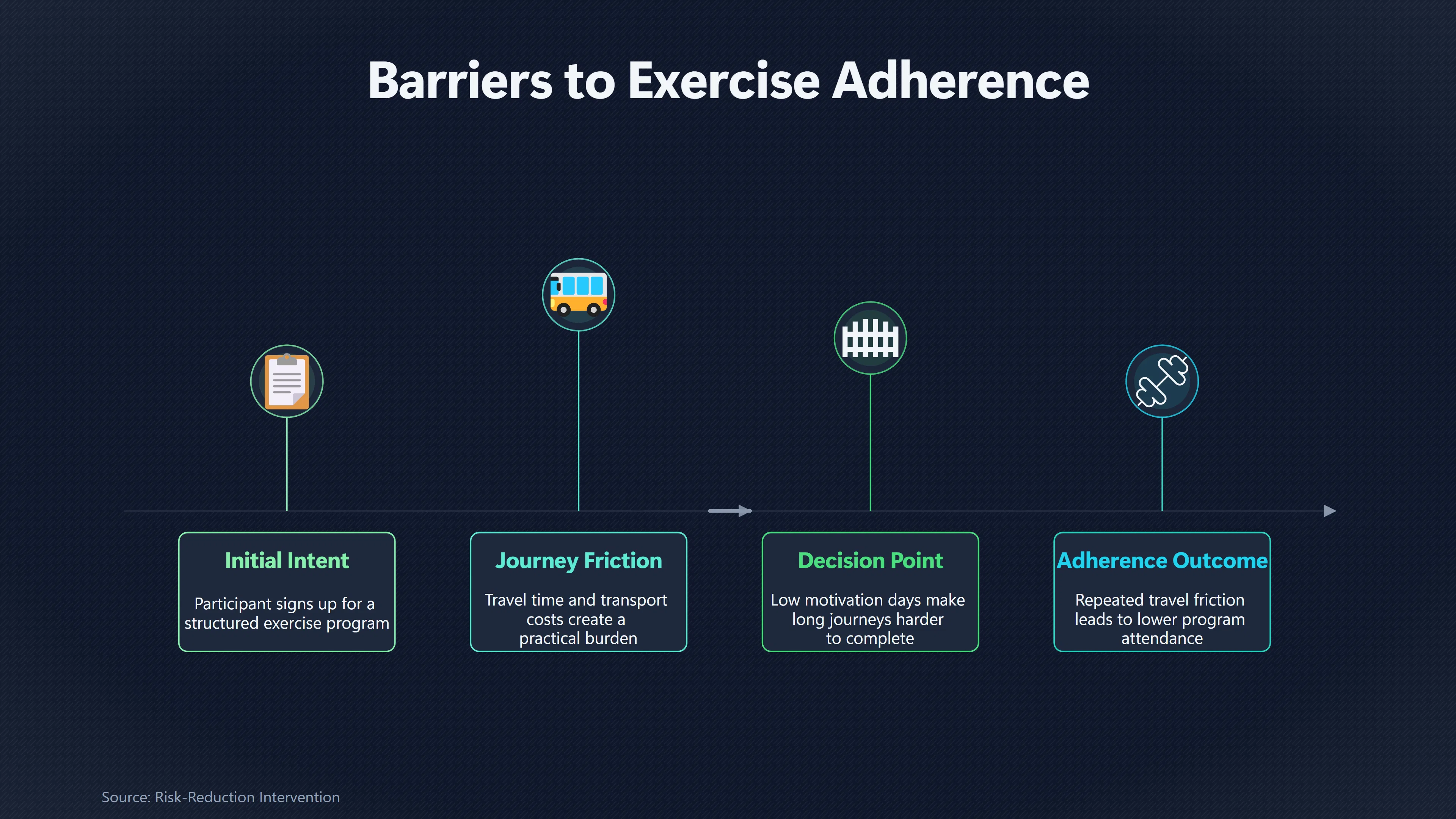
The friction also repeats. A ten-minute inconvenience attached to an activity performed three times a week is not experienced once; it is faced roughly 150 times a year. On days when enthusiasm is high, the additional journey may hardly register. On a cold evening, during a busy week or when someone is already tired, the same journey creates another decision point at which the intended workout can be abandoned.
That interpretation fits the Leeds attendance data particularly well. Distance was most influential when predicting whether a participant came back to the same centre after the first visit.[ScienceDirect]sciencedirect.comInvestigating the environmental, behavioural, and sociodemographic determinants of attendance at a city-wide public health p… Signing up or trying a facility once therefore should not be mistaken for evidence that its location will work comfortably as part of an ordinary week. The better test is whether the journey remains acceptable after novelty has disappeared.
Choosing exercise that fits an existing route
For self-improvement, the evidence points towards a simple design principle: optimise an exercise plan for repeatable access, not merely for the ideal facility. The gym with better equipment, a cheaper monthly fee or a more impressive class schedule may be the worse behavioural choice if every workout requires a substantial detour.
That makes route fit a useful criterion when comparing exercise options. A facility beside home, the workplace or a station already used every day removes some of the journey as a separate task. A lunchtime gym next to work may therefore be functionally “closer” than a geographically nearer gym that requires leaving home again in the evening. The Swedish findings are relevant here because the researchers examined proximity from both home and work rather than assuming that home was the only meaningful starting point.[PubMed Central (PMC)]pmc.ncbi.nlm.nih.govOpen source on nih.gov.
There is also a reasonable case for removing the facility journey entirely when it is the recurring obstacle. The systematic review of prescribed exercise explicitly identified home-based programmes as one way of eliminating distance as a barrier.[Springer Nature]link.springer.comSpringer NaturePredictors of adherence to prescribed exercise programs for older adults with medical or surgical indications for exercise… That does not establish that home exercise is universally superior: travelling to a group programme can provide equipment, instruction and social contact that are difficult to reproduce at home. Indeed, long-term research with older adults has found advantages to group exercise in some settings.[ScienceDirect]sciencedirect.comOpen source on sciencedirect.com. The relevant trade-off is whether those benefits are large enough to justify the access cost repeatedly.
A practical way to choose is therefore to compare door-to-exercise effort, rather than kilometres alone. Consider the total journey from wherever you will normally be immediately before the workout; whether the facility lies naturally on that route; the number of transport or preparation steps required; and whether the journey would still seem reasonable on a low-motivation day. That is not a scientifically established scoring system, but it follows directly from what the adherence evidence says distance represents in real life.
The central lesson is narrower than “always use the nearest gym”. Distance effects vary between populations and activities, and the research is not strong enough to specify one optimal radius. What the evidence does support is treating access effort as a genuine component of an exercise plan. A workout that begins only after a substantial detour has a recurring obstacle built into it. When two exercise options are otherwise good enough, the one that fits most naturally into an existing route gives follow-through one less reason to fail.
Amazon book picks
Further Reading
Books and field guides related to Is Your Gym Too Far Away to Stick With?. Use these as the next step if you want deeper reading beyond the article.
Tiny Habits: The Small Changes That Change Everything
Improving your life is much easier than you think. Whether it’s losing weight, sleeping more, or restoring your work/life balance – the s...
Nudge
Rating: 3.5/5 from 29 Google Books ratings
Thaler and Sunstein offer a groundbreaking discussion of how to apply the science of choice to nudge people toward decisions that can imp...

No Sweat: How the Simple Science of Motivation Can Bring You...
First published 2015. Subjects: Motivation (Psychology), Self-care, Health, Physical fitness, Lifestyles, Motivation (psychology).

Exercised: Why Something We Never Evolved to Do Is Healthy an...
Rating: 3.8/5 from 5 Google Books ratings
First published 2020. Subjects: Physiology, New York Times reviewed, Exercise, Physical fitness, Physical education and training, history.
eBay marketplace picks
Marketplace Samples
Live-tested eBay searches with available results related to this page.
Selected fromfitness motivation poster oneBay.co.uk.


Current eBay listing
Fitness Motivation Framed Wall Art Poster Canvas Print Picture
Current eBay listing
Fitness Motivation Framed Wall Art Poster Canvas Print Picture

Current eBay listing
Gym Fitness Motivation Framed Wall Art Poster Canvas Print Picture
Endnotes
1.
Source: link.springer.com
Link:https://link.springer.com/article/10.1186/s13643-022-01966-9
Source snippet
Springer NaturePredictors of adherence to prescribed exercise programs for older adults with medical or surgical indications for exercise...
2.
Source: sciencedirect.com
Link:https://www.sciencedirect.com/science/article/abs/pii/S0091743520303650
Source snippet
Investigating the environmental, behavioural, and sociodemographic determinants of attendance at a city-wide public health p...
3.
Source: doi.org
Link:https://doi.org/10.23937/2469-5718/1510020
Source snippet
ClinMed International Library | A Community-Based Exercise and Support Group Program Improves Quality of Life in African-American Brea...
4.
Source: link.springer.com
Link:https://link.springer.com/article/10.1007/s11556
Source snippet
Springer NatureThe closer the sportier? Children’s sports activity and their distance to sports facilities | European Review of Aging and...
5.
Source: onlinelibrary.wiley.com
Link:https://onlinelibrary.wiley.com/doi/full/10.1111/hsc.12929
6.
Source: link.springer.com
Link:https://link.springer.com/article/10.1186/s12889
7.
Source: sciencedirect.com
Link:https://www.sciencedirect.com/science/article/abs/pii/S1440244006001502
8.
Source: link.springer.com
Link:https://link.springer.com/article/10.1186/s11556-026-00421-1
9.
Source: doi.org
Link:https://doi.org/10.1186/s12889-026-26204-y
10.
Source: doi.org
Link:https://doi.org/10.1017/s0714980823000211
11.
Source: link.springer.com
Link:https://link.springer.com/article/10.1186/s13102-022-00472-8
12.
Source: link.springer.com
Link:https://link.springer.com/article/10.1186/s12966-021-01213-9
13.
Source: link.springer.com
Link:https://link.springer.com/article/10.1186/s13690
14.
Source: link.springer.com
Link:https://link.springer.com/article/10.1186/s12889
15.
Source: dom-pubs.onlinelibrary.wiley.com
Link:https://dom-pubs.onlinelibrary.wiley.com/doi/full/10.1111/dom.12874
16.
Source: dom-pubs.onlinelibrary.wiley.com
Link:https://dom-pubs.onlinelibrary.wiley.com/doi/abs/10.1111/dom.12874
17.
Source: onlinelibrary.wiley.com
Link:https://onlinelibrary.wiley.com/doi/full/10.1111/eip.12329
18.
Source: sciencedirect.com
Link:https://www.sciencedirect.com/science/article/pii/S1836955314000800
19.
Source: sciencedirect.com
Link:https://www.sciencedirect.com/science/article/pii/S1279770723017876
20.
Source: sciencedirect.com
Link:https://www.sciencedirect.com/journal/preventive-medicine/vol/143/suppl/C
21.
Source: sciencedirect.com
Link:https://www.sciencedirect.com/science/article/pii/S0091743514003582
22.
Source: sciencedirect.com
Title: Risk-Reduction Intervention
Link:https://www.sciencedirect.com/topics/nursing-and-health-professions/risk-reduction-intervention
23.
Source: pmc.ncbi.nlm.nih.gov
Link:https://pmc.ncbi.nlm.nih.gov/articles/PMC9052492/
Source snippet
PubMed Central (PMC)Predictors of adherence to prescribed exercise programs for older adults with medical or surgical indications for exe...
24.
Source: pmc.ncbi.nlm.nih.gov
Link:https://pmc.ncbi.nlm.nih.gov/articles/PMC3274640/
Source snippet
PubMed Central (PMC)Adherence to a Community-Based Exercise Program is a Strong Predictor of Improved Back Pain Status in Older Adults: A...
25.
Source: pmc.ncbi.nlm.nih.gov
Link:https://pmc.ncbi.nlm.nih.gov/articles/PMC3968093/
Source snippet
PubMed Central (PMC)Proximity to Sports Facilities and Sports Participation for Adolescents in Germany - PMCMarch 27, 2014...
Published: March 27, 2014
26.
Source: pmc.ncbi.nlm.nih.gov
Link:https://pmc.ncbi.nlm.nih.gov/articles/PMC9641919/
27.
Source: pmc.ncbi.nlm.nih.gov
Link:https://pmc.ncbi.nlm.nih.gov/articles/PMC4779205/
28.
Source: pmc.ncbi.nlm.nih.gov
Link:https://pmc.ncbi.nlm.nih.gov/articles/PMC12431197/
29.
Source: pmc.ncbi.nlm.nih.gov
Link:https://pmc.ncbi.nlm.nih.gov/articles/PMC12302583/
30.
Source: pmc.ncbi.nlm.nih.gov
Link:https://pmc.ncbi.nlm.nih.gov/articles/PMC11255765/
31.
Source: pubmed.ncbi.nlm.nih.gov
Link:https://pubmed.ncbi.nlm.nih.gov/38813401/
32.
Source: pmc.ncbi.nlm.nih.gov
Link:https://pmc.ncbi.nlm.nih.gov/articles/PMC12392820/
33.
Source: pmc.ncbi.nlm.nih.gov
Link:https://pmc.ncbi.nlm.nih.gov/articles/PMC10514993/
34.
Source: pmc.ncbi.nlm.nih.gov
Link:https://pmc.ncbi.nlm.nih.gov/articles/PMC9853241/
35.
Source: pubmed.ncbi.nlm.nih.gov
Link:https://pubmed.ncbi.nlm.nih.gov/36344975/
36.
Source: pubmed.ncbi.nlm.nih.gov
Link:https://pubmed.ncbi.nlm.nih.gov/36339183/
37.
Source: pubmed.ncbi.nlm.nih.gov
Link:https://pubmed.ncbi.nlm.nih.gov/35488307/
38.
Source: pubmed.ncbi.nlm.nih.gov
Link:https://pubmed.ncbi.nlm.nih.gov/35325627/
39.
Source: pubmed.ncbi.nlm.nih.gov
Link:https://pubmed.ncbi.nlm.nih.gov/33345056/
40.
Source: pmc.ncbi.nlm.nih.gov
Link:https://pmc.ncbi.nlm.nih.gov/articles/PMC6555722/
41.
Source: pmc.ncbi.nlm.nih.gov
Link:https://pmc.ncbi.nlm.nih.gov/articles/PMC6677841/
42.
Source: pubmed.ncbi.nlm.nih.gov
Link:https://pubmed.ncbi.nlm.nih.gov/28760148/
43.
Source: pmc.ncbi.nlm.nih.gov
Link:https://pmc.ncbi.nlm.nih.gov/articles/PMC5264485/
44.
Source: pubmed.ncbi.nlm.nih.gov
Link:https://pubmed.ncbi.nlm.nih.gov/28122532/
45.
Source: pubmed.ncbi.nlm.nih.gov
Link:https://pubmed.ncbi.nlm.nih.gov/26303505/
46.
Source: pmc.ncbi.nlm.nih.gov
Link:https://pmc.ncbi.nlm.nih.gov/articles/PMC4615691/
47.
Source: pmc.ncbi.nlm.nih.gov
Link:https://pmc.ncbi.nlm.nih.gov/articles/PMC4151955/
48.
Source: pubmed.ncbi.nlm.nih.gov
Link:https://pubmed.ncbi.nlm.nih.gov/25033133/
49.
Source: pubmed.ncbi.nlm.nih.gov
Link:https://pubmed.ncbi.nlm.nih.gov/24745369/
50.
Source: pmc.ncbi.nlm.nih.gov
Link:https://pmc.ncbi.nlm.nih.gov/articles/PMC4021412/
51.
Source: pubmed.ncbi.nlm.nih.gov
Link:https://pubmed.ncbi.nlm.nih.gov/23922717/
52.
Source: pmc.ncbi.nlm.nih.gov
Link:https://pmc.ncbi.nlm.nih.gov/articles/PMC3423408/
53.
Source: pmc.ncbi.nlm.nih.gov
Link:https://pmc.ncbi.nlm.nih.gov/articles/PMC3508808/
54.
Source: pubmed.ncbi.nlm.nih.gov
Link:https://pubmed.ncbi.nlm.nih.gov/20501583/
55.
Source: pubmed.ncbi.nlm.nih.gov
Link:https://pubmed.ncbi.nlm.nih.gov/18096216/
56.
Source: pubmed.ncbi.nlm.nih.gov
Link:https://pubmed.ncbi.nlm.nih.gov/17173712/
57.
Source: pmc.ncbi.nlm.nih.gov
Link:https://pmc.ncbi.nlm.nih.gov/articles/PMC1832127/
58.
Source: pmc.ncbi.nlm.nih.gov
Link:https://pmc.ncbi.nlm.nih.gov/articles/PMC1557534/
59.
Source: pmc.ncbi.nlm.nih.gov
Link:https://pmc.ncbi.nlm.nih.gov/articles/PMC6464851/
60.
Source: pubmed.ncbi.nlm.nih.gov
Link:https://pubmed.ncbi.nlm.nih.gov/18579917/
61.
Source: pubmed.ncbi.nlm.nih.gov
Link:https://pubmed.ncbi.nlm.nih.gov/27362526/
62.
Source: pubmed.ncbi.nlm.nih.gov
Link:https://pubmed.ncbi.nlm.nih.gov/21297190/
63.
Source: pubmed.ncbi.nlm.nih.gov
Link:https://pubmed.ncbi.nlm.nih.gov/29698019/
64.
Source: ncbi.nlm.nih.gov
Link:https://www.ncbi.nlm.nih.gov/books/NBK566046/
65.
Source: ncbi.nlm.nih.gov
Link:https://www.ncbi.nlm.nih.gov/books/NBK261681/?report=reader
66.
Source: pmc.ncbi.nlm.nih.gov
Link:https://pmc.ncbi.nlm.nih.gov/articles/PMC12018717/
67.
Source: ouci.dntb.gov.ua
Link:https://ouci.dntb.gov.ua/en/works/452daV3l/
68.
Source: science.gov
Link:https://www.science.gov/topicpages/b/background%2Bphysical%2Bexercise
Additional References
69.
Source: youtube.com
Link:https://www.youtube.com/watch?v=TgAENdtihNM
Source snippet
For an in-depth breakdown of how environmental design and reducing physical resistance directly influence workout adherence, check out 5...
70.
Source: youtube.com
Title: Why Consistency Beats Motivation (And How to Build the Habit)
Link:https://www.youtube.com/watch?v=Ipx6KNohSPs
Source snippet
Motivational Monday | Purposeful Friction – How to Design Your Environment for Success...
71.
Source: youtube.com
Title: The mental game of physical fitness | Mayo Clinic On Human Optimization
Link:https://www.youtube.com/watch?v=qVNUYpHIhXA
Source snippet
Why Consistency Beats Motivation (And How to Build the Habit)...
72.
Source: youtube.com
Title: Best Ways to Build Better Habits & Break Bad Ones | James Clear
Link:https://www.youtube.com/watch?v=bdsc3Spm6Sw
Source snippet
The mental game of physical fitness | Mayo Clinic On Human Optimization...
73.
Source: youtube.com
Title: 5 Science-Backed Cheat Codes to Stay Consistent With Your Workouts
Link:https://www.youtube.com/watch?v=q5k1XUzg7yo
Source snippet
Best Ways to Build Better Habits & Break Bad Ones | James Clear...
74.
Source: researchgate.net
Link:https://www.researchgate.net/publication/286220182_A_Community-Based_Exercise_and_Support_Group_Program_Improves_Quality_of_Life_in_African-American_Breast_Cancer_Survivors_A_Quantitative_and_Qualitative_Analysis
75.
Source: researchgate.net
Link:https://www.researchgate.net/publication/302982746_Physical_Activity_and_Sedentary_Behavior_Clustering_Segmentation_to_Optimize_Active_Lifestyles
76.
Source: researchgate.net
Link:https://www.researchgate.net/publication/255695202_Physical_Activity_in_Deprived_Communities_in_London_Examining_Individual_and_Neighbourhood-Level_Factors
77.
Source: researchgate.net
Link:https://www.researchgate.net/publication/347805820_Predictors_of_Adherence_to_Prescribed_Exercise_Programs_for_Older_Adults_With_Medical_or_Surgical_Indications_for_Exercise_a_Systematic_Review
78.
Source: researchgate.net
Link:https://www.researchgate.net/publication/343147068_Predictors_of_adherence_to_prescribed_exercise_programs_for_older_adults_with_non-musculoskeletal_indications_for_exercise_a_systematic_review