Within Goals vs Actions
When Outcome Numbers Give You the Wrong Signal
Weight, investment balances and race times can move for reasons unrelated to whether today's planned behaviour was good.
On this page
- Why outcomes contain factors outside personal control
- How short term noise can mislead daily decisions
- Using outcome trends without abandoning behaviour feedback
Page outline Jump by section
Introduction
Outcome measures are useful because they tell you whether your efforts are ultimately producing the result you want. The problem is that many outcomes are noisy: today’s number reflects not only your underlying progress, but also temporary influences that have little to do with whether today’s planned behaviour was sensible.

Body weight can rise because of water, glycogen or digestive contents even while fat loss is progressing. An investment balance can fall despite disciplined saving because markets moved. A race time can deteriorate despite improved fitness because the day was hotter, windier or preceded by poor sleep. Research confirms meaningful short-term variation in all three cases.[nih.gov]pmc.ncbi.nlm.nih.govPub Med Central (PMC)Day-to-day variability in euvolemic body massPubMed Central (PMC)Day-to-day variability in euvolemic body mass - PMCNovember 13, 2023…
The practical consequence is not to abandon outcome measures. It is to use them at the timescale at which they become informative. Daily behaviour answers “Did I do what I intended?”; an outcome trend answers “Does this approach appear to be working?” Confusing those two feedback loops can make good behaviour look unsuccessful and random favourable fluctuations look like progress.
Why outcomes contain factors outside personal control
An outcome number is rarely a pure measurement of personal effort. A useful way to think about it is:
observed outcome = underlying progress + temporary conditions + measurement variation
The proportions differ between domains. With body weight, much of the short-term disturbance is physiological. With investments, external market movements can dominate. With race performance, environmental and day-specific physical conditions affect what a given level of fitness produces.
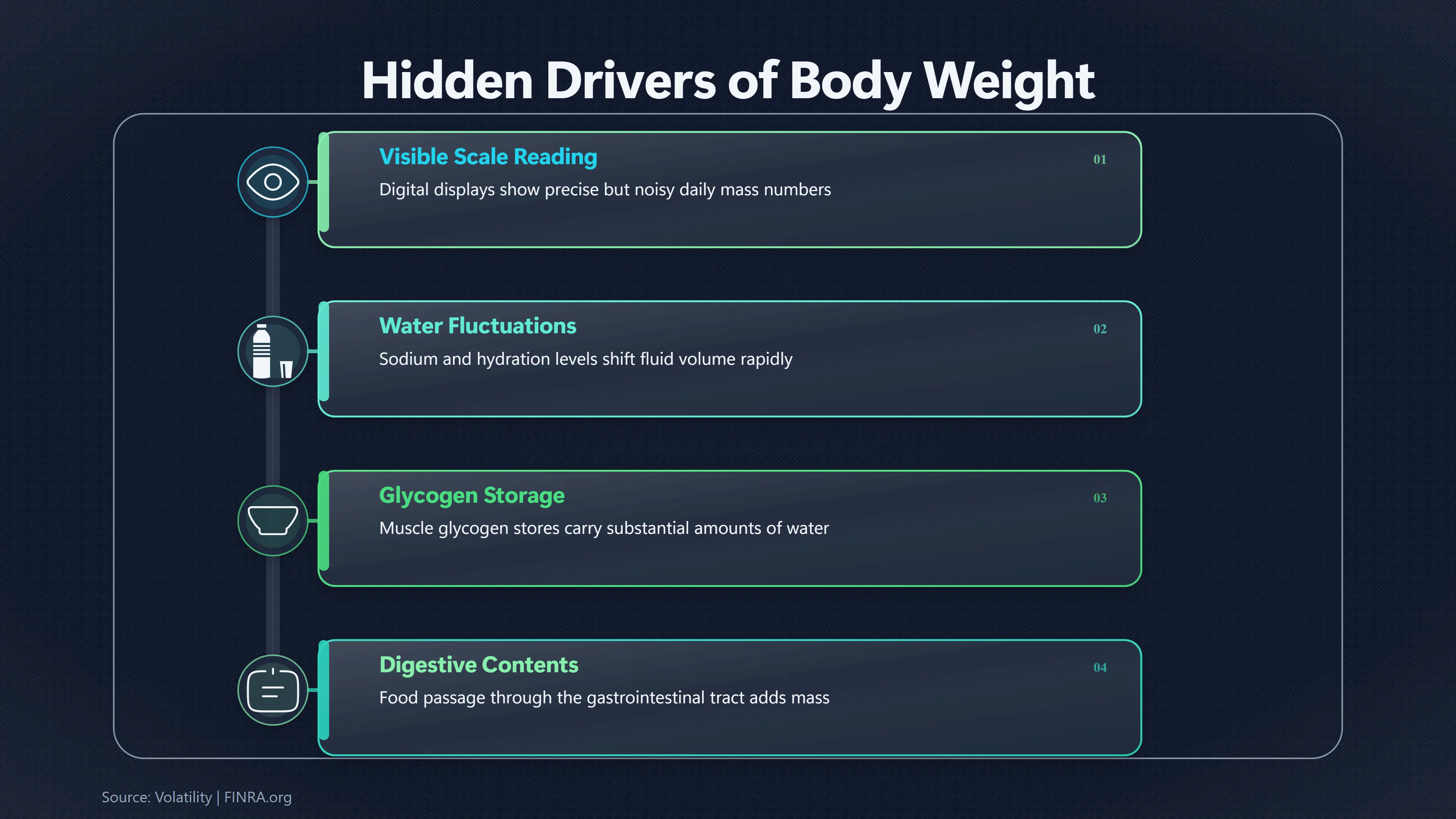
Body weight can move faster than body tissue
Scale weight is particularly good at demonstrating the problem because it looks precise. A digital scale might report 78.4 kg rather than 78 kg, encouraging the impression that a change to 78.8 kg represents equally precise information about fat gain. It does not.
Research on normal day-to-day body-mass variability found fluctuations of roughly 0.4 kg attributable largely to changes in water associated with factors including sodium and glycogen. The researchers noted that a tissue-composition change of that magnitude within one day would be physiologically implausible.[PubMed Central (PMC)]pmc.ncbi.nlm.nih.govPub Med Central (PMC)Day-to-day variability in euvolemic body massPubMed Central (PMC)Day-to-day variability in euvolemic body mass - PMCNovember 13, 2023… Glycogen adds another mechanism: glycogen stored in muscle is accompanied by substantial water, while changing intestinal contents also contributes to short-term changes in measured mass.[PubMed Central (PMC)]pmc.ncbi.nlm.nih.govPubMed Central (PMC)Composition of two‐week change in body weight under unrestricted free‐living conditions - PMC…
For people who menstruate, there can be another systematic source of variation. A 2023 study following 42 women found body weight was about 0.45 kg higher during menstruation than during the first week of the cycle, with the difference largely attributable to increased extracellular water rather than a detected change in other body-composition measures.[PubMed]pubmed.ncbi.nlm.nih.govPub Med Changes in body weight and body composition during the menstrual cycleChanges in body weight and body composition during the menstrual cycle - PubMedJuly 3, 2023…
This produces a common false signal. Someone can follow their intended eating and activity behaviours on Monday and Tuesday, then see a higher weight on Wednesday. If Wednesday’s measurement is interpreted as a verdict on those behaviours, water movement can masquerade as failure.
Repeated measurements solve a different problem from single measurements. A review of daily self-weighing notes that although body water, glycogen and gastrointestinal contents create substantial daily variation, graphing measurements over time can reveal the underlying pattern in body tissue.[PubMed Central (PMC)]pmc.ncbi.nlm.nih.govPubMed Central (PMC)Daily Self-Weighing to Control Body Weight in Adults: A Critical Review of the Literature - PMCDecember 14, 2014… The individual measurement is not useless; it becomes more useful when treated as one observation in a series.
Investment balances mix your decisions with the market’s decisions
An investment account makes the separation between behaviour and outcome even clearer. You control whether you make the planned contribution, how much you contribute and — within practical limits — your asset allocation. You do not control what other investors collectively decide those assets are worth tomorrow.
FINRA describes volatility simply as the movement of market indexes and security prices up and down, noting that long-term buy-and-hold investors may appropriately treat much of this movement as background noise.[FINRA]finra.orgVolatility | FINRA.orgVolatility | FINRA.org… The US Securities and Exchange Commission similarly advises investors considering changes during volatile periods to relate decisions to their financial goals, time horizon and tolerance for risk rather than treating market movements in isolation.[SEC]sec.govThings to Consider Before You Make Investing DecisionsThings to Consider Before You Make Investing Decisions…
Suppose somebody contributes £500 to a diversified long-term portfolio exactly as planned and the portfolio nevertheless finishes the month £300 below where it started. “My balance fell” and “I failed at my savings behaviour” are not equivalent statements. The first can be true while the second is false.
That distinction matters because reacting to the noisy outcome can create a second-order problem: changing a sound long-term strategy because of a short-term price movement. FINRA warns that market timing involves predicting such movements and carries the risk of exiting during a decline only to miss a subsequent recovery.[FINRA]finra.orgWhat Is Market Timing? | FINRA.orgWhat Is Market Timing? | FINRA.orgJune 10, 2025… Frequent observation can make this temptation stronger; Vanguard notes that repeatedly checking a portfolio during volatile periods can magnify the perceived significance of short-term movements and encourage reactive decisions.[Vanguard UK Investor]ukd-ics.ecs.itlp.c1.vanguard.comUK Investor How often should I check my portfolio?UK Investor How often should I check my portfolio?
The important qualification is that volatility is not always irrelevant. A person who needs the money soon faces a genuinely different risk from somebody investing over decades. The SEC explicitly treats time horizon as an important determinant of appropriate investment risk.[SEC]sec.govBeginners' Guide to Asset Allocation, Diversification, and RebalancingBeginners' Guide to Asset Allocation, Diversification, and Rebalancing “Ignore every fluctuation” is therefore too crude. The narrower lesson is that a short-term balance movement should not automatically be interpreted as evidence about the quality of today’s controllable behaviour.
Race times measure fitness under particular conditions
A finishing time also appears beautifully objective: 42:17 is unquestionably faster than 43:05. Yet the stopwatch measures performance under the conditions of that particular attempt, not fitness in isolation.
A large study covering 1,258 endurance races in 42 countries found temperature to be the most important weather variable examined. Peak performance was more likely within favourable temperature ranges, while performance declined as wet-bulb globe temperature moved away from the optimum range.[PubMed]pubmed.ncbi.nlm.nih.govEffects of Weather Parameters on Endurance Running Performance: Discipline-specific Analysis of 1258 Races - PubMed… Analysis of hundreds of thousands of Boston Marathon performances likewise found slower times as temperatures increased, alongside effects associated with precipitation, wind and other conditions.[PubMed]pubmed.ncbi.nlm.nih.govOpen source on nih.gov.
Even under competition conditions, repeated performances by the same runner vary. Research examining competitive distance runners found typical race-to-race variation among the fastest male runners of roughly 1.2–1.9% for cross-country and shorter road races and greater variation for half marathons and marathons.[PubMed]pubmed.ncbi.nlm.nih.govPub Med Variability of competitive performance of distance runnersPub Med Variability of competitive performance of distance runners That means a small personal-best improvement or deterioration can sit within the ordinary variability of performance rather than proving that training suddenly became much better or worse.
Fitness is not the only internal variable either. A systematic review and meta-analysis of 31 studies found sleep deprivation had a moderate negative effect on endurance performance, with longer efforts particularly affected.[PubMed]pubmed.ncbi.nlm.nih.govHow much does sleep deprivation impair endurance performance? A systematic review and meta-analysis - PubMed… A disappointing race after poor sleep and unfavourable weather therefore contains several signals at once: training adaptation, temporary physical state, environmental conditions, pacing and random variation.

How short-term noise can mislead daily decisions
Noise becomes harmful when a person responds to every observation as though it were a reliable estimate of the underlying trend. The problem is less “outcomes fluctuate” than “fluctuations invite action”.
Experimental decision-making research provides a useful parallel. In four inventory-management experiments involving random noise, more frequent feedback actually reduced performance. Participants focused excessively on recent information and did not adequately integrate evidence across longer periods.[ScienceDirect]sciencedirect.comOpen source on sciencedirect.com. Other experimental work on learning in variable environments has likewise shown that noise can interfere with identifying an effective strategy when people treat uncertain cues as useful information.[PubMed]pubmed.ncbi.nlm.nih.govPub Med Learning in Noise: Dynamic Decision-Making in a Variable EnvironmentPub Med Learning in Noise: Dynamic Decision-Making in a Variable Environment
In self-improvement, this creates several predictable errors:
- A bad number can provoke an unnecessary correction. A one-day weight increase leads to an abrupt diet restriction, or a disappointing run leads to an unplanned increase in training.
- A good number can reward the wrong behaviour. A sudden weight drop caused partly by water loss can make an ineffective routine appear successful.
- Recent observations can outweigh the longer pattern. A falling portfolio balance feels like evidence that the investment plan is failing even though the movement may chiefly reflect market volatility.
- The person keeps changing the experiment. When the plan is altered after every noisy observation, it becomes difficult to discover whether the original behaviour would have worked consistently.
The last problem is especially important. Imagine a runner completes a sensible training week but produces a slow time trial on an unusually hot day. If that one result triggers a major increase in training load, the athlete is not merely misreading the test; the misleading feedback has now changed subsequent behaviour. The outcome’s noise has entered the control system.
This is why the timescale of feedback matters. Immediate feedback is valuable when it measures something immediate and controllable — whether the planned session was completed, for example. It becomes much more ambiguous when an immediate observation is expected to reveal a slow-moving adaptation.
Using outcome trends without abandoning behaviour feedback
The solution is not to replace outcomes with a permanent streak of completed habits. Behaviour can be perfectly consistent and still fail to produce the intended result. Outcome information is what eventually reveals that the strategy itself needs revision.
The more useful approach is to separate fast feedback from slow feedback.
Fast feedback asks whether the controllable behaviour occurred. Did you make the planned savings contribution? Complete the scheduled training session? Follow the eating plan you had decided on? That information is normally available quickly and is comparatively easy to attribute to your own actions.
Slow feedback asks whether repeated behaviours are producing the intended result. Is body weight trending in the desired direction across repeated comparable measurements? Is the portfolio progressing towards the amount needed on the relevant multi-year horizon? Are comparable running performances improving across a block of training?
This does not require pretending that every outcome should be averaged mechanically. The appropriate comparison depends on the mechanism producing the noise. For body weight, repeated measurements under reasonably consistent conditions can make the trend more interpretable; the literature on self-weighing specifically highlights graphs as a way of distinguishing daily fluctuations from underlying change.[PubMed Central (PMC)]pmc.ncbi.nlm.nih.govPubMed Central (PMC)Daily Self-Weighing to Control Body Weight in Adults: A Critical Review of the Literature - PMCDecember 14, 2014… For endurance performance, comparing several efforts and recording relevant conditions is more informative than assuming two race times were generated under equivalent circumstances. Weather research demonstrates why temperature and other environmental variables can materially change the observed result.[PubMed]pubmed.ncbi.nlm.nih.govEffects of Weather Parameters on Endurance Running Performance: Discipline-specific Analysis of 1258 Races - PubMed…
For investing, the horizon should follow the financial goal rather than the emotional intensity of today’s price movement. FINRA distinguishes long-term investors, for whom volatility may be background noise, from people who require money in the near term, for whom that volatility can pose a real problem.[FINRA]finra.orgVolatility | FINRA.orgVolatility | FINRA.org… This is an important safeguard against turning “focus on trends” into the indiscriminate claim that short-term outcomes never matter.
A practical interpretation rule is therefore to ask what would have to be true before an outcome justified changing the behaviour underneath it. One unexpectedly high weigh-in probably should not overturn an eating plan. Several weeks of a clearly unfavourable trend might. One slow race in difficult weather offers weak evidence that training has failed. Repeated underperformance under reasonably comparable conditions deserves more attention. One market decline does not tell a long-term investor whether making the planned contribution was a mistake, although a change in time horizon or financial circumstances could legitimately require a portfolio reassessment.
The signal becomes clearer when the timescale matches the goal
Noisy outcomes create a subtle self-improvement trap because the numbers themselves are usually real. The scale really did rise. The portfolio really is worth less today. The race really was slower. The error occurs one step later, when a real measurement is given an unjustified explanation.
Short-term outcome variation can reflect water balance, glycogen and digestive contents; market repricing; weather; sleep; and ordinary performance variability, among other influences.[nih.gov]pmc.ncbi.nlm.nih.govPub Med Central (PMC)Day-to-day variability in euvolemic body massPubMed Central (PMC)Day-to-day variability in euvolemic body mass - PMCNovember 13, 2023… None of this makes outcomes unimportant. It means the measurement interval and the decision interval should not automatically be the same.
For self-improvement that works, the useful division of labour is precise: judge today’s execution mainly from the behaviours that were actually under your control, and judge the strategy from sufficiently persistent outcome patterns. That preserves the motivational and diagnostic value of an outcome goal without allowing every temporary fluctuation to rewrite tomorrow’s plan.
Amazon book picks
Further Reading
Books and field guides related to When Outcome Numbers Give You the Wrong Signal. Use these as the next step if you want deeper reading beyond the article.
Thinking in Bets
Wall Street Journal bestseller! Poker champion turned business consultant Annie Duke teaches you how to get comfortable with uncertainty...
The Signal and the Noise
This work explores the history, art and science of prediction.
Thinking in Systems
Thinking in Systems is a concise and crucial book offering insight for problem-solving on scales ranging from the personal to the global....
Atomic Habits
Rating: 3.5/5 from 7 Google Books ratings
The #1 New York Times bestseller. Over 25 million copies sold! Translated into 60+ languages! Tiny Changes, Remarkable Results No matter...
eBay marketplace picks
Marketplace Samples
Live-tested eBay searches with available results related to this page.
Selected fromself improvement wall art oneBay.co.uk.




Endnotes
1.
Source: finra.org
Title: Volatility | FINRA.org
Link:https://www.finra.org/investors/investing/investing-basics/volatility
Source snippet
Volatility | FINRA.org...
2.
Source: sec.gov
Title: Things to Consider Before You Make Investing Decisions
Link:https://www.sec.gov/investor/pubs/financialnavigating.htm
Source snippet
Things to Consider Before You Make Investing Decisions...
3.
Source: sec.gov
Title: Beginners’ Guide to Asset Allocation, Diversification, and Rebalancing
Link:https://www.sec.gov/about/reports-publications/investorpubsassetallocationhtm
4.
Source: finra.org
Title: What Is Market Timing? | FINRA.org
Link:https://www.finra.org/investors/insights/market-timing
Source snippet
What Is Market Timing? | FINRA.orgJune 10, 2025...
Published: June 10, 2025
5.
Source: ukd-ics.ecs.itlp.c1.vanguard.com
Title: UK Investor How often should I check my portfolio?
Link:https://ukd-ics.ecs.itlp.c1.vanguard.com/articles/latest-thoughts/investing-success/how-often-should-i-check-my-portfolio
6.
Source: sciencedirect.com
Link:https://www.sciencedirect.com/science/article/pii/S0749597808000745
7.
Source: ukd-ics.ecs.itlp.c1.vanguard.com
Title: how to navigate market turbulence
Link:https://ukd-ics.ecs.itlp.c1.vanguard.com/articles/latest-thoughts/markets-economy/how-to-navigate-market-turbulence
8.
Source: syndication.finra.org
Title: benefits and limitations dollar cost averaging
Link:https://syndication.finra.org/content/benefits-and-limitations-dollar-cost-averaging
9.
Source: corporate.vanguard.com
Title: discipline prevails during geopolitical shocks
Link:https://corporate.vanguard.com/content/corporatesite/us/en/corp/articles/discipline-prevails-during-geopolitical-shocks.html
10.
Source: sec.gov
Link:https://www.sec.gov/Archives/edgar/data/1174610/000119312526014245/f43796d1.htm
11.
Source: sec.gov
Link:https://www.sec.gov/Archives/edgar/data/1174610/000119312525220526/f42961d1.htm
12.
Source: ukd-ics.ecs.itlp.c1.vanguard.com
Title: why you shouldnt try to predict stock market movements
Link:https://ukd-ics.ecs.itlp.c1.vanguard.com/articles/latest-thoughts/investing-success/why-you-shouldnt-try-to-predict-stock-market-movements
13.
Source: advisors.vanguard.com
Title: staying the course wins again
Link:https://advisors.vanguard.com/insights/article/staying-the-course-wins-again
14.
Source: investor.vanguard.com
Title: top market volatility questions answered
Link:https://investor.vanguard.com/investor-resources-education/article/top-market-volatility-questions-answered
15.
Source: investor.vanguard.com
Title: persist when others quit
Link:https://investor.vanguard.com/investor-resources-education/article/persist-when-others-quit
16.
Source: advisors.vanguard.com
Title: market volatility is inevitable advisors alpha is enduring
Link:https://advisors.vanguard.com/insights/article/market-volatility-is-inevitable-advisors-alpha-is-enduring
17.
Source: corporate.vanguard.com
Title: not all market volatility created equal
Link:https://corporate.vanguard.com/content/corporatesite/us/en/corp/articles/not-all-market-volatility-created-equal.html
18.
Source: workplace.vanguard.com
Title: politics and investing
Link:https://workplace.vanguard.com/insights-and-research/perspective/politics-and-investing.html
19.
Source: workplace.vanguard.com
Title: adding value through a strategic approach
Link:https://workplace.vanguard.com/insights-and-research/perspective/adding-value-through-a-strategic-approach.html
20.
Source: sec.gov
Link:https://www.sec.gov/Archives/edgar/data/35315/000003531524000102/filing7241.htm
21.
Source: investor.gov
Link:https://www.investor.gov/introduction-investing/general-resources/news-alerts/alerts-bulletins/investor-alerts/investor-alert-thinking-about-investing-latest-hot-stock-understand-significant-risks-short-term
22.
Source: sciencedirect.com
Title: Should Long-Term Investors Time Volatility?
Link:https://www.sciencedirect.com/science/article/pii/S0304405X18302745
23.
Source: sec.gov
Link:https://www.sec.gov/Archives/edgar/data/1004655/000093247118008571/whitehallfundsfinal.htm
24.
Source: sec.gov
Link:https://www.sec.gov/Archives/edgar/data/1097519/000119312516782407/d290498dncsrs.htm
25.
Source: investor.gov
Title: Bulletin: Behavioral Patterns of U.S. Investors | Investor.gov
Link:https://www.investor.gov/introduction-investing/general-resources/news-alerts/alerts-bulletins/investor-bulletins-72?chain_id=Name1K9-3FXPhg.1kvd400&global_content=%7B%22promote_id%22%3A13764%2C%22sub_promote_id%22%3A39%2C%22f%22%3A%22www.moomoo.com%2Fus%2Flearn%2Fdetail-technical-vs-fundamental-analysis-117040-240244020%22%7D
26.
Source: sec.gov
Title: Library of Congress Report: Behavioral Patterns of U.S. Investors
Link:https://www.sec.gov/investor/tools/behaviorialpatterns.htm
27.
Source: sec.gov
Link:https://www.sec.gov/Archives/edgar/data/1424958/000095012310021653/c55935b2e485bpos.htm
28.
Source: sec.gov
Title: SE C.gov | Taking Stock
Link:https://www.sec.gov/about/reports-publications/investorpubstakingstockhtm
29.
Source: sciencedirect.com
Title: Learning in noise: Dynamic decision-making in a variable environment
Link:https://www.sciencedirect.com/science/article/pii/S0022249609000224
30.
Source: sec.gov
Title: SE C.gov | Mutual Fund Investing: Look at More Than a Fund’s Past Performance
Link:https://www.sec.gov/about/reports-publications/investorpubsmfperformhtm
31.
Source: sec.gov
Title: SE C Roadmap: Risk
Link:https://www.sec.gov/investor/pubs/roadmap/risk.htm
32.
Source: sciencedirect.com
Link:https://www.sciencedirect.com/science/article/pii/S0002916523313005
33.
Source: sciencedirect.com
Link:https://www.sciencedirect.com/science/article/abs/pii/S0002916523313005
34.
Source: investor.vanguard.com
Title: trading during volatile markets
Link:https://investor.vanguard.com/investor-resources-education/online-trading/trading-during-volatile-markets
35.
Source: finra.org
Link:https://www.finra.org/investors/investing/investing-basics/risk
36.
Source: finra.org
Link:https://www.finra.org/investors/learn-to-invest/key-investing-concepts
37.
Source: sciencedirect.com
Link:https://www.sciencedirect.com/science/article/pii/S0959475225000325
38.
Source: sciencedirect.com
Title: Mechanism of feedback affecting task performance
Link:https://www.sciencedirect.com/science/article/pii/0030507383901150
39.
Source: sec.gov
Link:https://www.sec.gov/investor/pubs/tenthingstoconsider.htm?sf202165470=1
40.
Source: pmc.ncbi.nlm.nih.gov
Title: Pub Med Central (PMC)Day-to-day variability in euvolemic body mass
Link:https://pmc.ncbi.nlm.nih.gov/articles/PMC10653631/
Source snippet
PubMed Central (PMC)Day-to-day variability in euvolemic body mass - PMCNovember 13, 2023...
Published: November 13, 2023
41.
Source: pmc.ncbi.nlm.nih.gov
Link:https://pmc.ncbi.nlm.nih.gov/articles/PMC5506524/
Source snippet
PubMed Central (PMC)Composition of two‐week change in body weight under unrestricted free‐living conditions - PMC...
42.
Source: pubmed.ncbi.nlm.nih.gov
Link:https://pubmed.ncbi.nlm.nih.gov/34652333/
Source snippet
Effects of Weather Parameters on Endurance Running Performance: Discipline-specific Analysis of 1258 Races - PubMed...
43.
Source: pubmed.ncbi.nlm.nih.gov
Link:https://pubmed.ncbi.nlm.nih.gov/36472094/
Source snippet
How much does sleep deprivation impair endurance performance? A systematic review and meta-analysis - PubMed...
44.
Source: pubmed.ncbi.nlm.nih.gov
Title: Pub Med Changes in body weight and body composition during the menstrual cycle
Link:https://pubmed.ncbi.nlm.nih.gov/37395124/
Source snippet
Changes in body weight and body composition during the menstrual cycle - PubMedJuly 3, 2023...
Published: July 3, 2023
45.
Source: pmc.ncbi.nlm.nih.gov
Link:https://pmc.ncbi.nlm.nih.gov/articles/PMC4846305/
Source snippet
PubMed Central (PMC)Daily Self-Weighing to Control Body Weight in Adults: A Critical Review of the Literature - PMCDecember 14, 2014...
Published: December 14, 2014
46.
Source: pmc.ncbi.nlm.nih.gov
Link:https://pmc.ncbi.nlm.nih.gov/articles/PMC8677617/
47.
Source: pubmed.ncbi.nlm.nih.gov
Link:https://pubmed.ncbi.nlm.nih.gov/30791523/
48.
Source: pubmed.ncbi.nlm.nih.gov
Link:https://pubmed.ncbi.nlm.nih.gov/30849085/
49.
Source: pubmed.ncbi.nlm.nih.gov
Title: Pub Med Variability of competitive performance of distance runners
Link:https://pubmed.ncbi.nlm.nih.gov/11528349/
50.
Source: pubmed.ncbi.nlm.nih.gov
Title: Pub Med Learning in Noise: Dynamic Decision-Making in a Variable Environment
Link:https://pubmed.ncbi.nlm.nih.gov/20161328/
51.
Source: pmc.ncbi.nlm.nih.gov
Link:https://pmc.ncbi.nlm.nih.gov/articles/PMC2678746/
52.
Source: pmc.ncbi.nlm.nih.gov
Link:https://pmc.ncbi.nlm.nih.gov/articles/PMC3359364/
53.
Source: pubmed.ncbi.nlm.nih.gov
Link:https://pubmed.ncbi.nlm.nih.gov/42225881/
54.
Source: pmc.ncbi.nlm.nih.gov
Link:https://pmc.ncbi.nlm.nih.gov/articles/PMC13247178/
55.
Source: pubmed.ncbi.nlm.nih.gov
Link:https://pubmed.ncbi.nlm.nih.gov/41637496/
56.
Source: pmc.ncbi.nlm.nih.gov
Link:https://pmc.ncbi.nlm.nih.gov/articles/PMC12871445/
57.
Source: pmc.ncbi.nlm.nih.gov
Link:https://pmc.ncbi.nlm.nih.gov/articles/PMC12107507/
58.
Source: pubmed.ncbi.nlm.nih.gov
Link:https://pubmed.ncbi.nlm.nih.gov/40236824/
59.
Source: pmc.ncbi.nlm.nih.gov
Link:https://pmc.ncbi.nlm.nih.gov/articles/PMC11996801/
60.
Source: pubmed.ncbi.nlm.nih.gov
Link:https://pubmed.ncbi.nlm.nih.gov/39413062/
61.
Source: pubmed.ncbi.nlm.nih.gov
Link:https://pubmed.ncbi.nlm.nih.gov/39006249/
62.
Source: pmc.ncbi.nlm.nih.gov
Link:https://pmc.ncbi.nlm.nih.gov/articles/PMC9408651/
63.
Source: pubmed.ncbi.nlm.nih.gov
Link:https://pubmed.ncbi.nlm.nih.gov/35708888/
64.
Source: pmc.ncbi.nlm.nih.gov
Link:https://pmc.ncbi.nlm.nih.gov/articles/PMC9584849/
65.
Source: pmc.ncbi.nlm.nih.gov
Link:https://pmc.ncbi.nlm.nih.gov/articles/PMC9158426/
66.
Source: pubmed.ncbi.nlm.nih.gov
Link:https://pubmed.ncbi.nlm.nih.gov/34296342/
67.
Source: pmc.ncbi.nlm.nih.gov
Link:https://pmc.ncbi.nlm.nih.gov/articles/PMC8277333/
68.
Source: pubmed.ncbi.nlm.nih.gov
Link:https://pubmed.ncbi.nlm.nih.gov/34079472/
69.
Source: pmc.ncbi.nlm.nih.gov
Link:https://pmc.ncbi.nlm.nih.gov/articles/PMC7192384/
70.
Source: pmc.ncbi.nlm.nih.gov
Link:https://pmc.ncbi.nlm.nih.gov/articles/PMC6635083/
71.
Source: pmc.ncbi.nlm.nih.gov
Link:https://pmc.ncbi.nlm.nih.gov/articles/PMC6407773/
72.
Source: pmc.ncbi.nlm.nih.gov
Link:https://pmc.ncbi.nlm.nih.gov/articles/PMC6406844/
73.
Source: pubmed.ncbi.nlm.nih.gov
Link:https://pubmed.ncbi.nlm.nih.gov/30649648/
74.
Source: pubmed.ncbi.nlm.nih.gov
Link:https://pubmed.ncbi.nlm.nih.gov/28713466/
75.
Source: pmc.ncbi.nlm.nih.gov
Link:https://pmc.ncbi.nlm.nih.gov/articles/PMC5504586/
76.
Source: pubmed.ncbi.nlm.nih.gov
Link:https://pubmed.ncbi.nlm.nih.gov/28685514/
77.
Source: pubmed.ncbi.nlm.nih.gov
Link:https://pubmed.ncbi.nlm.nih.gov/28392775/
78.
Source: pubmed.ncbi.nlm.nih.gov
Link:https://pubmed.ncbi.nlm.nih.gov/26669250/
79.
Source: pubmed.ncbi.nlm.nih.gov
Link:https://pubmed.ncbi.nlm.nih.gov/25801853/
80.
Source: pubmed.ncbi.nlm.nih.gov
Link:https://pubmed.ncbi.nlm.nih.gov/25683820/
81.
Source: pubmed.ncbi.nlm.nih.gov
Link:https://pubmed.ncbi.nlm.nih.gov/27127719/
82.
Source: pubmed.ncbi.nlm.nih.gov
Link:https://pubmed.ncbi.nlm.nih.gov/25397613/
83.
Source: pmc.ncbi.nlm.nih.gov
Link:https://pmc.ncbi.nlm.nih.gov/articles/PMC4232563/
84.
Source: pmc.ncbi.nlm.nih.gov
Link:https://pmc.ncbi.nlm.nih.gov/articles/PMC4159987/
85.
Source: pmc.ncbi.nlm.nih.gov
Link:https://pmc.ncbi.nlm.nih.gov/articles/PMC4127345/
86.
Source: pubmed.ncbi.nlm.nih.gov
Link:https://pubmed.ncbi.nlm.nih.gov/23521346/
87.
Source: pubmed.ncbi.nlm.nih.gov
Link:https://pubmed.ncbi.nlm.nih.gov/21845193/
88.
Source: pubmed.ncbi.nlm.nih.gov
Link:https://pubmed.ncbi.nlm.nih.gov/19543909/
89.
Source: pubmed.ncbi.nlm.nih.gov
Link:https://pubmed.ncbi.nlm.nih.gov/18663122/
90.
Source: pubmed.ncbi.nlm.nih.gov
Link:https://pubmed.ncbi.nlm.nih.gov/8776790/
91.
Source: pubmed.ncbi.nlm.nih.gov
Link:https://pubmed.ncbi.nlm.nih.gov/8776790/?dopt=Abstract
92.
Source: pubmed.ncbi.nlm.nih.gov
Link:https://pubmed.ncbi.nlm.nih.gov/35776017/
93.
Source: pubmed.ncbi.nlm.nih.gov
Link:https://pubmed.ncbi.nlm.nih.gov/15673099/
94.
Source: pubmed.ncbi.nlm.nih.gov
Link:https://pubmed.ncbi.nlm.nih.gov/2927308/
95.
Source: pubmed.ncbi.nlm.nih.gov
Link:https://pubmed.ncbi.nlm.nih.gov/2371185/
96.
Source: pmc.ncbi.nlm.nih.gov
Link:https://pmc.ncbi.nlm.nih.gov/articles/PMC5644907/
97.
Source: pubmed.ncbi.nlm.nih.gov
Link:https://pubmed.ncbi.nlm.nih.gov/8470872/
98.
Source: pubmed.ncbi.nlm.nih.gov
Link:https://pubmed.ncbi.nlm.nih.gov/40254779/
99.
Source: pubmed.ncbi.nlm.nih.gov
Link:https://pubmed.ncbi.nlm.nih.gov/3578405/
100.
Source: pubmed.ncbi.nlm.nih.gov
Link:https://pubmed.ncbi.nlm.nih.gov/12685336/
101.
Source: pubmed.ncbi.nlm.nih.gov
Link:https://pubmed.ncbi.nlm.nih.gov/1534995/
102.
Source: pubmed.ncbi.nlm.nih.gov
Link:https://pubmed.ncbi.nlm.nih.gov/1533178/
103.
Source: pubmed.ncbi.nlm.nih.gov
Link:https://pubmed.ncbi.nlm.nih.gov/15514515/
104.
Source: pubmed.ncbi.nlm.nih.gov
Link:https://pubmed.ncbi.nlm.nih.gov/1194868/
105.
Source: pubmed.ncbi.nlm.nih.gov
Link:https://pubmed.ncbi.nlm.nih.gov/15677259/
106.
Source: pubmed.ncbi.nlm.nih.gov
Link:https://pubmed.ncbi.nlm.nih.gov/18567246/
107.
Source: pubmed.ncbi.nlm.nih.gov
Link:https://pubmed.ncbi.nlm.nih.gov/17685700/
Additional References
108.
Source: youtube.com
Title: What is the difference between leading and lagging indicators?
Link:https://www.youtube.com/watch?v=RwBrLCGluW4
Source snippet
Why scale weight fluctuates daily water weight Why My Weight Fluctuates When I'm Dieting...
109.
Source: youtube.com
Title: Why should we focus on lead measures vs lag measures?
Link:https://www.youtube.com/watch?v=09FvToFbG_g
Source snippet
What is the difference between leading and lagging indicators?...
110.
Source: youtube.com
Title: Why Weight Fluctuation Is Normal | Nutritionist Explains
Link:https://www.youtube.com/watch?v=zXIZGQG3ffY
Source snippet
Why My Weight Fluctuates When I'm Dieting...
111.
Source: frontiersin.org
Link:https://www.frontiersin.org/journals/psychology/articles/10.3389/fpsyg.2017.00152/full
112.
Source: tandfonline.com
Link:https://www.tandfonline.com/doi/full/10.1080/07420528.2025.2459668
113.
Source: annualreviews.org
Link:https://www.annualreviews.org/content/journals/10.1146/annurev-orgpsych-120920-050708
114.
Source: ssga.com
Link:https://www.ssga.com/uk/en_gb/institutional/insights/time-not-timing-the-case-for-long-term-investing
115.
Source: eprints.whiterose.ac.uk
Link:https://eprints.whiterose.ac.uk/id/eprint/87431/
116.
Source: eprints.whiterose.ac.uk
Link:https://eprints.whiterose.ac.uk/id/eprint/91437/
117.
Source: youtube.com
Title: Weight Fluctuations On The Scale
Link:https://www.youtube.com/watch?v=kS5ZzxQewtk
Source snippet
Why should we focus on lead measures vs lag measures?...