Within Scale Up
How Big Should Your Next Habit Increase Be?
Small progressive increases often protect repetition better than abrupt leaps, although research does not support one universal progression formula.
On this page
- What graded tasks mean in practice
- Why there is no universal percentage increase
- Choosing a step large enough to matter but small enough to test
Page outline Jump by section
Introduction
Once a habit is reliably established, the next increase should usually be large enough to create a meaningful new challenge but small enough that repetition remains realistic. Behaviour-change research supports the general idea of graded tasks: start from what a person can already do and increase the demand through achievable steps. A 2026 systematic review of physical-activity interventions found that programmes containing graded tasks produced meaningful increases in activity, although the evidence was heterogeneous and graded tasks were always combined with other techniques such as goal-setting and action planning.[PubMed]pubmed.ncbi.nlm.nih.govThe effects of graded tasks on physical activity: a systematic review and meta-analysis - PubMedFebruary 5, 2026…

What research does not establish is a universal progression rule such as “increase every habit by 10% each week”. The appropriate jump depends on what is being increased, the person’s present capacity and what happens to consistency after the change. The useful principle is therefore not always make tiny increases. It is increase experimentally rather than assuming that a large leap will be sustainable.
What graded tasks mean in practice
“Graded tasks” has a more precise meaning in behavioural science than simply taking things slowly. In the Behaviour Change Technique Taxonomy, the technique involves setting tasks that begin easy enough to perform and then become progressively more difficult while remaining achievable.[PubMed Central (PMC)]pmc.ncbi.nlm.nih.govPubMed Central (PMC)Linking behaviour change techniques to mechanisms of action: Using the Theory and Techniques Tool alongside the Behav… This resembles the older behavioural principle of shaping, in which a target behaviour is approached through successive approximations rather than demanding the finished performance immediately. The American Psychological Association describes shaping as progressively reinforcing responses that come closer to the desired behaviour.[APA Dictionary]dictionary.apa.orgDictionary APA Dictionary of PsychologyAPA DictionaryAPA Dictionary of PsychologyApril 19, 2018…
Applied to an established personal habit, grading means changing the criterion in stages. Someone who already reads reliably for ten minutes after breakfast might try fifteen minutes before considering thirty. A regular 15-minute walk could become 20 minutes, rather than immediately becoming an hour-long outing. A person consistently completing one focused study session might extend its duration or add a second session on selected days rather than simultaneously doubling both frequency and length.
The important feature is not that each numerical increase must be small. It is that the next demand is chosen in relation to demonstrated performance. Work on shaping in rehabilitation illustrates this adaptive logic particularly clearly: tasks are progressively made harder as capability improves, with difficulty adjusted through variables such as time, repetitions or task demands. One influential constraint-induced movement therapy protocol describes the appropriate task as slightly beyond what the patient can already accomplish easily, while stressing that progression must be individualised.[PubMed Central (PMC)]pmc.ncbi.nlm.nih.govPubMed Central (PMC)The Behavior-Analytic Origins of Constraint-Induced Movement Therapy: An Example of Behavioral Neurorehabilitation - PMC…
Behavioural activation provides another practical precedent. Graded task assignment breaks activities that feel difficult into manageable steps so that people can practise rather than repeatedly fail or avoid the activity. In a UK behavioural-activation trial for people with post-stroke depression, for example, a difficult shopping goal could begin with visiting a familiar local shop before progressing to a larger, more distant one.[PubMed Central (PMC)]pmc.ncbi.nlm.nih.govPubMed Central (PMC)Behavioural Activation Therapy for Depression after Stroke (BEADS): a study protocol for a feasibility randomised con… Although that clinical setting is not the same as everyday habit scaling, the progression principle transfers cleanly: the next step should stretch current behaviour without making successful repetition implausible.
Why gradual progression has an advantage over a sudden leap
The case for grading is strongest when the objective is not a one-off peak performance but continued repetition at a higher level. A dramatic target can produce a dramatic day; it does not necessarily produce a durable new baseline.
The strongest recent evidence comes from physical activity. A 2026 systematic review identified 53 randomised controlled trials involving 10,060 adults in which graded tasks were used to increase physical activity. Thirty-nine studies entered the meta-analysis, which found a medium overall effect, with a standardised effect size of g = 0.61. Intriguingly, the number of graded-task increments explained substantial variation in outcomes. However, certainty of evidence was rated low, heterogeneity was high, and every graded-task intervention also used behavioural goal-setting and action planning. The review therefore supports graded progression as a useful component of intervention, not as an independently proven formula for every habit.[PubMed]pubmed.ncbi.nlm.nih.govThe effects of graded tasks on physical activity: a systematic review and meta-analysis - PubMedFebruary 5, 2026…
Smaller-change interventions also show why plausibility matters. In the ASPIRE randomised trial, researchers deliberately tested modest, cumulative, participant-chosen changes in eating and physical activity rather than relying on large initial behavioural changes. The small-change group lost more weight than comparison groups over the short study and maintained that initial loss at three-month follow-up.[PubMed]pubmed.ncbi.nlm.nih.govSmall changes in nutrition and physical activity promote weight loss and maintenance: 3-month evidence from the ASPIRE randomized t… But longer studies provide an important corrective: a two-year trial in sedentary adults found that a small-change intervention involving roughly 2,000 extra daily steps and a 100-kcal dietary reduction did not produce a significant weight advantage over monitoring alone at two or three years.[PubMed]pubmed.ncbi.nlm.nih.govOpen source on nih.gov.
That mixed record matters. “Small” is not automatically superior. A change can be so modest that its cumulative benefit is limited, or it can still prove difficult to maintain. In a more recent remote small-change trial, 62% of participants described the approach as helpful for weight management, yet adherence failed the researchers’ predefined feasibility criterion.[PubMed Central (PMC)]pmc.ncbi.nlm.nih.govOpen source on nih.gov.
The more defensible conclusion is narrower: graded progression gives you repeated opportunities to discover a sustainable level before committing to a much larger demand. It is a method for calibrating difficulty, not evidence that tiny actions inevitably compound into large outcomes.
There is no universal percentage increase
Habit advice often becomes more precise than its evidence. A rule such as “add 10% each week” sounds attractive because it converts a judgement call into arithmetic. But different behaviours impose very different constraints, and even exercise science does not provide a universal percentage that can simply be exported to reading, writing, meditation, studying or household routines.
Running is a useful warning. The familiar “10% rule” recommends limiting increases in training volume, yet reviews have questioned the evidence for that particular threshold. A systematic review of transitions to minimalist running footwear, for example, noted that the 10% training-volume rule had not been validated as a reliable injury-prevention boundary and concluded that an optimal progression rate was unclear.[PubMed Central (PMC)]pmc.ncbi.nlm.nih.govOpen source on nih.gov. More broadly, proposed workload thresholds in sport have themselves attracted methodological criticism, making it unwise to treat one numerical limit as a law of safe progression.[Taylor & Francis Online]tandfonline.comOpen source on tandfonline.com.
Even within resistance exercise, where progression can be measured much more precisely than most habits, recommendations are conditional. The American College of Sports Medicine has recommended increasing resistance by roughly 2–10% when a person can exceed the target repetitions at the existing load; the percentage varies with the exercise and training situation.[PubMed]pubmed.ncbi.nlm.nih.govOpen source on nih.gov. That is a performance-triggered rule, not a claim that everyone should automatically increase by the same amount every week.
Everyday habits make universal percentages still less meaningful. Moving from ten to eleven minutes of reading is mathematically a 10% increase but may be behaviourally trivial. Going from one weekly language class to two is a 100% increase, yet could be perfectly manageable. Adding one minute to a demanding exercise might matter more than adding five minutes to an easy walk. Percentage change alone cannot capture effort, scheduling friction, recovery requirements, attention or competing obligations.
There is also a useful tension in goal-setting research. Harder goals can sometimes produce greater behaviour change than easy goals, so “make every next step as easy as possible” is not an evidence-based rule either. A large meta-analysis of goal-setting interventions found goal difficulty moderated behavioural outcomes, while practical reviews emphasise that optimal difficulty depends on factors including commitment, ability and self-efficacy.[Stir University DSpace]dspace.stir.ac.ukOpen source on stir.ac.uk. Graded progression should therefore preserve challenge, not remove it.
Choose a step large enough to matter but small enough to test
A useful next increase can be treated as a short experiment rather than a permanent new standard. Keep the established cue and basic routine as stable as possible, change one important demand, and watch what happens to actual repetition.
Three questions provide a more useful progression rule than a fixed percentage:
- Does the increase produce a meaningful gain? Moving from 20 to 21 minutes may add little if 25 minutes is already comfortably achievable. Grading does not require artificially microscopic steps.
- Can you repeat the new version under ordinary conditions? One exceptional performance proves that the larger behaviour is possible; it does not show that it fits Tuesday mornings, busy workdays or low-energy evenings.
- What happens to consistency afterwards? If the larger version repeatedly causes postponement, skipped occasions or abandonment of the established routine, that is evidence that the new demand may be too high at present.
This approach also avoids confusing ambition with step size. The final target can remain large. Someone may ultimately want to write for two hours each morning, run a long-distance event or practise an instrument for an hour a day. Grading changes the route to that target, not necessarily the target itself.
There is precedent for adapting goals when confidence falls rather than stubbornly maintaining the original demand. In the SCALE behavioural intervention, participants worked on small eating and physical-activity goals, and when confidence in continuing a behaviour dropped below a specified level, they were prompted to modify that behaviour to improve the likelihood of completing it during the following week.[PubMed Central (PMC)]pmc.ncbi.nlm.nih.govOpen source on nih.gov. That is a more responsive model of progression than treating every planned increase as irreversible.
When a bigger jump can make sense
A sudden large increase is not automatically a mistake. If the current habit was deliberately kept below the person’s capacity while it was being established, the next workable level may be considerably higher. Someone who began with five minutes of reading despite already enjoying long reading sessions may not need a sequence of six-, seven- and eight-minute targets. Likewise, changing circumstances can suddenly make a previously difficult expansion easy: a shorter commute may create an extra half-hour for exercise, or finishing an intensive project may release time for study.
The distinction is between a large increase supported by capacity and a large increase chosen because it feels motivationally exciting. The former may work. The latter is harder to interpret because enthusiasm can temporarily conceal the recurring costs of the new standard.
This is why a short trial is useful. Suppose a reliable 20-minute evening study habit is increased to 40 minutes. If the person completes 40 minutes consistently without moving the session, losing sleep or beginning to avoid it, there is little reason to retreat to an arbitrary 22-minute progression. If completion falls sharply, the failed experiment does not prove that 40 minutes is an impossible eventual goal. It suggests that 40 minutes was too large a next step under present conditions.
That distinction keeps graded progression from becoming timid. Behavioural shaping itself does not require endlessly lingering at easy levels. In rehabilitation applications, criteria can be raised more quickly when performance is improving rapidly; the progression responds to the learner rather than to a predetermined calendar.[PubMed Central (PMC)]pmc.ncbi.nlm.nih.govPubMed Central (PMC)The Behavior-Analytic Origins of Constraint-Induced Movement Therapy: An Example of Behavioral Neurorehabilitation - PMC…
The practical rule: progress from performance, not a formula
For an established habit, the strongest evidence supports an adaptive policy rather than a universal increment. Graded tasks are a recognised behaviour-change technique, and recent physical-activity research suggests that interventions using progressive achievable steps can improve behaviour. At the same time, high variation between studies, the use of multiple techniques together and mixed findings from “small change” interventions prevent a stronger claim that gradual increases always outperform larger ones.[PubMed]pubmed.ncbi.nlm.nih.govThe effects of graded tasks on physical activity: a systematic review and meta-analysis - PubMedFebruary 5, 2026…
The practical comparison is therefore not small good, big bad. It is calibrated versus untested. Increase the habit enough that the new level is genuinely useful, then judge the increase by whether it remains repeatable. A large step that proves sustainable can stay. A step that repeatedly damages consistency can be reduced and tested again.
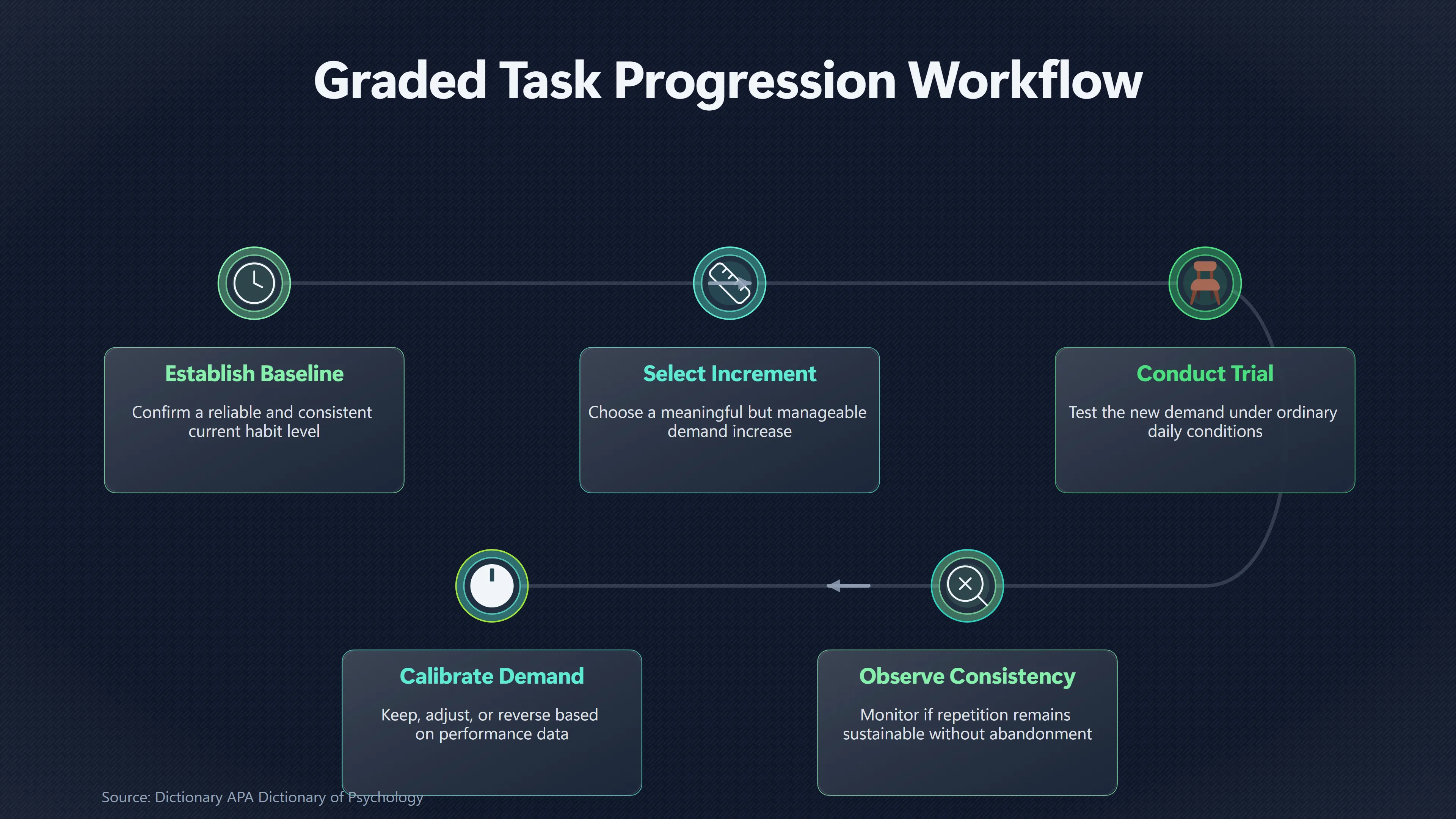
That makes progression a feedback loop: establish a reliable level, raise one meaningful demand, observe repetition, then keep, adjust or reverse the increase. The final goal can be ambitious. The next step only needs to be challenging enough to move towards it without unnecessarily sacrificing the consistency that made scaling possible in the first place.
Amazon book picks
Further Reading
Books and field guides related to How Big Should Your Next Habit Increase Be?. Use these as the next step if you want deeper reading beyond the article.
Atomic Habits
Rating: 3.5/5 from 7 Google Books ratings
The #1 New York Times bestseller. Over 25 million copies sold! Translated into 60+ languages! Tiny Changes, Remarkable Results No matter...
Tiny Habits
Improving your life is much easier than you think. Whether it’s losing weight, sleeping more, or restoring your work/life balance – the s...
Mini Habits
Discover the Life-Changing Strategy of This Worldwide Bestseller in 17 Languages! Lasting Change For Early Quitters, Burnouts, The Unmoti...
The Kaizen Way
Mặc dù cái tên Kaizen nghe có vẻ lạ lẫm nhưng khái niệm những bước đi nhỏ tạo ra sự cải thiện liên tục đã được áp dụng lần đầu tiên một c...
eBay marketplace picks
Marketplace Samples
Live-tested eBay searches with available results related to this page.
Selected fromhabit tracker board oneBay.co.uk.

Endnotes
1.
Source: dictionary.apa.org
Title: Dictionary APA Dictionary of Psychology
Link:https://dictionary.apa.org/method-of-successive-approximations
Source snippet
APA DictionaryAPA Dictionary of PsychologyApril 19, 2018...
Published: April 19, 2018
2.
Source: medium.com
Link:https://medium.com/%40CuriousCatalyst/training-load-strain-understanding-your-wearables-injury-prevention-system-and-its-7c9aa456e53a
3.
Source: pubmed.ncbi.nlm.nih.gov
Link:https://pubmed.ncbi.nlm.nih.gov/41644516/
Source snippet
The effects of graded tasks on physical activity: a systematic review and meta-analysis - PubMedFebruary 5, 2026...
Published: February 5, 2026
4.
Source: tandfonline.com
Link:https://www.tandfonline.com/doi/full/10.1080/17437199.2026.2618195
5.
Source: pmc.ncbi.nlm.nih.gov
Link:https://pmc.ncbi.nlm.nih.gov/articles/PMC12596556/
Source snippet
PubMed Central (PMC)Linking behaviour change techniques to mechanisms of action: Using the Theory and Techniques Tool alongside the Behav...
6.
Source: ncbi.nlm.nih.gov
Link:https://www.ncbi.nlm.nih.gov/books/NBK501960/
Source snippet
An evidence synthesis and economic analysis - NCBI Bookshelf...
7.
Source: pmc.ncbi.nlm.nih.gov
Link:https://pmc.ncbi.nlm.nih.gov/articles/PMC3501420/
Source snippet
PubMed Central (PMC)The Behavior-Analytic Origins of Constraint-Induced Movement Therapy: An Example of Behavioral Neurorehabilitation - PMC...
8.
Source: pmc.ncbi.nlm.nih.gov
Link:https://pmc.ncbi.nlm.nih.gov/articles/PMC5153669/
Source snippet
PubMed Central (PMC)Behavioural Activation Therapy for Depression after Stroke (BEADS): a study protocol for a feasibility randomised con...
9.
Source: ncbi.nlm.nih.gov
Link:https://www.ncbi.nlm.nih.gov/books/NBK546321/?report=printable
Source snippet
Behavioural activation therapy for post-stroke depression: the BEADS feasibility RCT - NCBI Bookshelf...
10.
Source: pubmed.ncbi.nlm.nih.gov
Link:https://pubmed.ncbi.nlm.nih.gov/18568379/
Source snippet
Small changes in nutrition and physical activity promote weight loss and maintenance: 3-month evidence from the ASPIRE randomized t...
11.
Source: pubmed.ncbi.nlm.nih.gov
Link:https://pubmed.ncbi.nlm.nih.gov/35256388/
12.
Source: pmc.ncbi.nlm.nih.gov
Link:https://pmc.ncbi.nlm.nih.gov/articles/PMC9053990/
13.
Source: pmc.ncbi.nlm.nih.gov
Link:https://pmc.ncbi.nlm.nih.gov/articles/PMC10944418/
14.
Source: pmc.ncbi.nlm.nih.gov
Link:https://pmc.ncbi.nlm.nih.gov/articles/PMC5602809/
15.
Source: tandfonline.com
Link:https://www.tandfonline.com/doi/full/10.2147/OAJSM.S231405
16.
Source: pmc.ncbi.nlm.nih.gov
Link:https://pmc.ncbi.nlm.nih.gov/articles/PMC12487117/
17.
Source: pubmed.ncbi.nlm.nih.gov
Link:https://pubmed.ncbi.nlm.nih.gov/19204579/
18.
Source: dspace.stir.ac.uk
Link:https://dspace.stir.ac.uk/bitstream/1893/25978/1/goal%20meta%20%282017.09.25%29.pdf
19.
Source: pmc.ncbi.nlm.nih.gov
Link:https://pmc.ncbi.nlm.nih.gov/articles/PMC6796229/
20.
Source: pmc.ncbi.nlm.nih.gov
Link:https://pmc.ncbi.nlm.nih.gov/articles/PMC5404988/
21.
Source: pmc.ncbi.nlm.nih.gov
Link:https://pmc.ncbi.nlm.nih.gov/articles/PMC13299259/
22.
Source: pmc.ncbi.nlm.nih.gov
Link:https://pmc.ncbi.nlm.nih.gov/articles/PMC13061681/
23.
Source: tandfonline.com
Link:https://www.tandfonline.com/doi/abs/10.1080/17437199.2026.2618195
24.
Source: pmc.ncbi.nlm.nih.gov
Link:https://pmc.ncbi.nlm.nih.gov/articles/PMC12401215/
25.
Source: pmc.ncbi.nlm.nih.gov
Link:https://pmc.ncbi.nlm.nih.gov/articles/PMC12085059/
26.
Source: pmc.ncbi.nlm.nih.gov
Link:https://pmc.ncbi.nlm.nih.gov/articles/PMC11059830/
27.
Source: pmc.ncbi.nlm.nih.gov
Link:https://pmc.ncbi.nlm.nih.gov/articles/PMC10569248/
28.
Source: pubmed.ncbi.nlm.nih.gov
Link:https://pubmed.ncbi.nlm.nih.gov/36853069/
29.
Source: pmc.ncbi.nlm.nih.gov
Link:https://pmc.ncbi.nlm.nih.gov/articles/PMC9375375/
30.
Source: pmc.ncbi.nlm.nih.gov
Link:https://pmc.ncbi.nlm.nih.gov/articles/PMC10511844.1/
31.
Source: pmc.ncbi.nlm.nih.gov
Link:https://pmc.ncbi.nlm.nih.gov/articles/PMC8203669/
32.
Source: pmc.ncbi.nlm.nih.gov
Link:https://pmc.ncbi.nlm.nih.gov/articles/PMC7982309/
33.
Source: doi.org
Link:https://doi.org/10.1111/hsc.13090
34.
Source: doi.org
Title: Shaping | Springer Nature Link
Link:https://doi.org/10.1007/978-3-319-16999
35.
Source: pubmed.ncbi.nlm.nih.gov
Link:https://pubmed.ncbi.nlm.nih.gov/29202850/
36.
Source: pubmed.ncbi.nlm.nih.gov
Link:https://pubmed.ncbi.nlm.nih.gov/28382755/
37.
Source: pmc.ncbi.nlm.nih.gov
Link:https://pmc.ncbi.nlm.nih.gov/articles/PMC10261360/
38.
Source: pmc.ncbi.nlm.nih.gov
Link:https://pmc.ncbi.nlm.nih.gov/articles/PMC4492122/
39.
Source: pubmed.ncbi.nlm.nih.gov
Link:https://pubmed.ncbi.nlm.nih.gov/25633208/
40.
Source: pmc.ncbi.nlm.nih.gov
Link:https://pmc.ncbi.nlm.nih.gov/articles/PMC4862805/
41.
Source: ncbi.nlm.nih.gov
Link:https://www.ncbi.nlm.nih.gov/books/NBK274004/
42.
Source: pmc.ncbi.nlm.nih.gov
Link:https://pmc.ncbi.nlm.nih.gov/articles/PMC3502268/
43.
Source: pmc.ncbi.nlm.nih.gov
Link:https://pmc.ncbi.nlm.nih.gov/articles/PMC3124084/
44.
Source: pmc.ncbi.nlm.nih.gov
Link:https://pmc.ncbi.nlm.nih.gov/articles/PMC3438871/
45.
Source: pubmed.ncbi.nlm.nih.gov
Link:https://pubmed.ncbi.nlm.nih.gov/18194526/
46.
Source: pmc.ncbi.nlm.nih.gov
Link:https://pmc.ncbi.nlm.nih.gov/articles/PMC1986693/
47.
Source: passthebigabaexam.com
Title: Successive approximations
Link:https://passthebigabaexam.com/glossary/successive-approximations/
48.
Source: tandfonline.com
Link:https://www.tandfonline.com/doi/full/10.1080/1750984X.2021.1901298
49.
Source: pubmed.ncbi.nlm.nih.gov
Link:https://pubmed.ncbi.nlm.nih.gov/10495835/
50.
Source: ncbi.nlm.nih.gov
Link:https://www.ncbi.nlm.nih.gov/books/NBK567039/
51.
Source: ncbi.nlm.nih.gov
Link:https://www.ncbi.nlm.nih.gov/books/NBK327618/?report=printable
52.
Source: ncbi.nlm.nih.gov
Link:https://www.ncbi.nlm.nih.gov/books/NBK327613/
53.
Source: ncbi.nlm.nih.gov
Link:https://www.ncbi.nlm.nih.gov/books/NBK564715/?report=printable
54.
Source: pmc.ncbi.nlm.nih.gov
Link:https://pmc.ncbi.nlm.nih.gov/articles/PMC6636886/
55.
Source: pmc.ncbi.nlm.nih.gov
Link:https://pmc.ncbi.nlm.nih.gov/articles/PMC6215922/
56.
Source: pmc.ncbi.nlm.nih.gov
Link:https://pmc.ncbi.nlm.nih.gov/articles/PMC11816013/
57.
Source: pmc.ncbi.nlm.nih.gov
Link:https://pmc.ncbi.nlm.nih.gov/articles/PMC8490751/
58.
Source: asdnetwork.unl.edu
Link:https://asdnetwork.unl.edu/virtual-strategies/shaping/
59.
Source: coventry.gov.uk
Link:https://www.coventry.gov.uk/healthdeterminantsresearchcollaboration/research-projects/behaviour-change-physical-activity
Additional References
60.
Source: youtube.com
Title: Tiny Habits. Big Changes: BJ Fogg
Link:https://www.youtube.com/watch?v=Gsf7AT3itFg
Source snippet
In BJ Fogg's TEDx Talk on Tiny Habits, behavioral scientist BJ Fogg explains the core behavioral design principles behind starting with s...
61.
Source: nature.com
Link:https://www.nature.com/nature-index/topics/l4/activity-management-strategies-in-chronic-pain
62.
Source: nature.com
Link:https://www.nature.com/nature-index/topics/l4/goal-setting-strategies-in-health-behavior-change
63.
Source: youtube.com
Title: B.F. Skinner’s Theory of Shaping Explained
Link:https://www.youtube.com/watch?v=Bjx-kM02DVs
Source snippet
How to Change Your Habits | Katy Milkman | Podcast Episode 345...
64.
Source: academia.edu
Link:https://www.academia.edu/56652185/American_College_of_Sports_Medicine_position_stand_Progression_models_in_resistance_training_for_healthy_adults
65.
Source: researchgate.net
Link:https://www.researchgate.net/publication/334587824_Behavioural_activation_therapy_for_depression_after_stroke_BEADS_a_feasibility_randomised_controlled_pilot_trial_of_a_psychological_intervention_for_post-stroke_depression
66.
Source: researchgate.net
Link:https://www.researchgate.net/publication/362845056_Examining_the_Delivery_of_a_Tailored_Chinese_Mind-Body_Exercise_to_Low-Income_Community-Dwelling_Older_Latinos_for_Aging_in_Place_Pilot_Feasibility_Study_Preprint?_tp=eyJjb250ZXh0Ijp7InBhZ2UiOiJzY2llbnRpZmljQ29udHJpYnV0aW9ucyIsInByZXZpb3VzUGFnZSI6bnVsbCwic3ViUGFnZSI6bnVsbH19
67.
Source: researchgate.net
Link:https://www.researchgate.net/publication/235653976_Progression_models_in_resistance_training_for_healthy_adults_ACSM_position_stand
68.
Source: researchgate.net
Link:https://www.researchgate.net/publication/263504602_The_Behaviour_Change_Technique_Taxonomy_BCTTv1_of_93_hierarchically-clustered_techniques_testing_reliability_of_the_taxonomy_in_specifying_the_content_of_behaviour_change_interventions
69.
Source: researchgate.net
Link:https://www.researchgate.net/publication/321440716_Unique_Effects_of_Setting_Goals_on_Behavior_Change_Systematic_Review_and_Meta-Analysis