Within Habit Timelines
Do Habits Form Faster With the Same Cue?
Repeating a behavior in the same recurring context strengthens the cue-response link that makes action increasingly automatic.
On this page
- How cues become linked to repeated actions
- Why consistent contexts matter more than raw repetition counts
- Ways to attach a behavior to a recurring event
Page outline Jump by section
Introduction
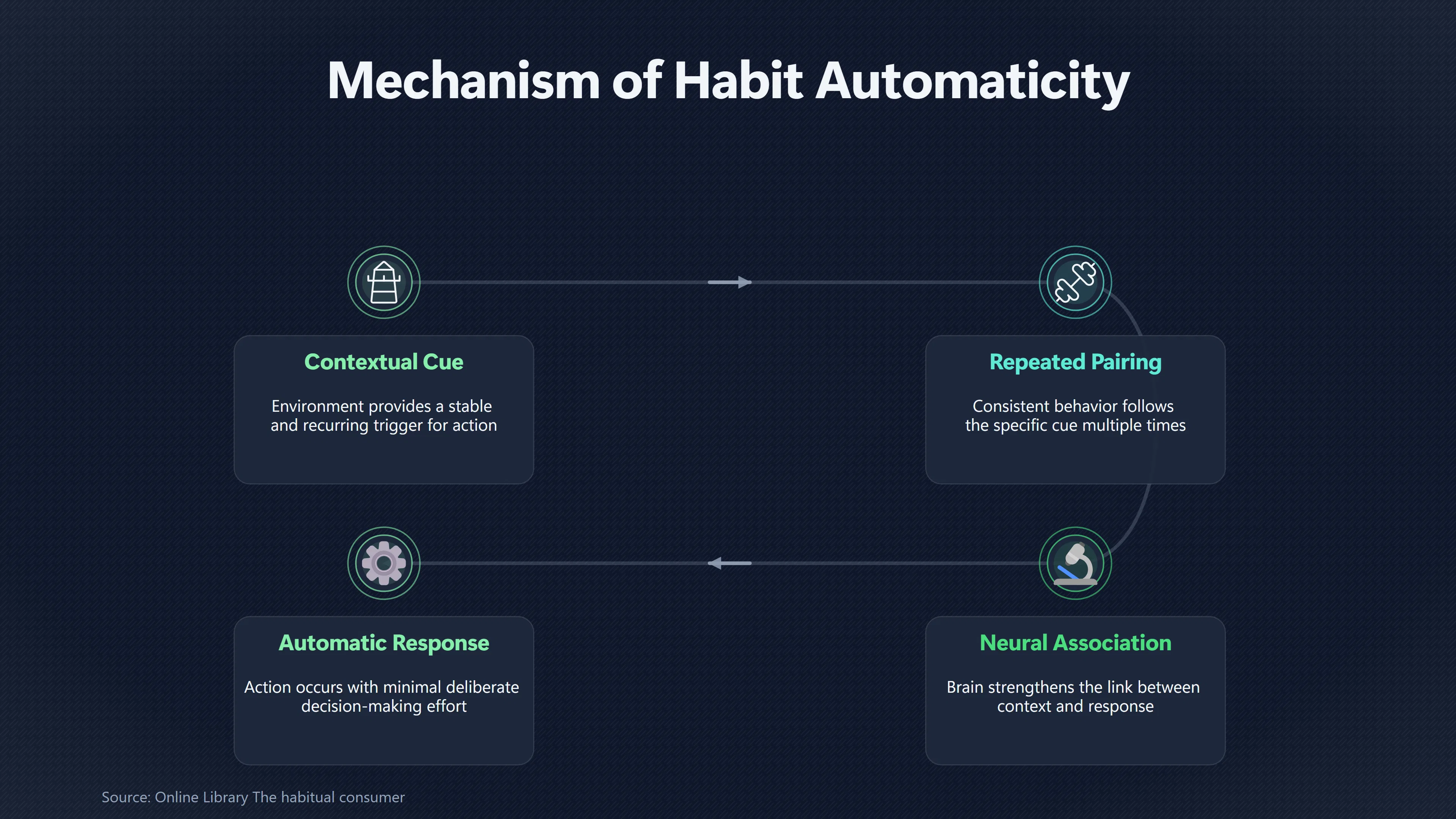
Yes. Habits are more likely to become automatic when the same behaviour is repeatedly performed in response to a stable, recurring cue. The reason is not simply that consistency makes a routine easier to remember. Repeatedly pairing one context with one response strengthens a learned cue–response association, so encountering the cue increasingly prompts the action with less deliberate decision-making. Experimental and longitudinal research supports this basic mechanism, although it does not establish a universal number of repetitions or days by which a stable cue will produce a habit.[nih.gov]pubmed.ncbi.nlm.nih.govPub Med Measuring context-response associations that drive habitsMeasuring context-response associations that drive habits - PubMedDecember 4, 2023…
That distinction matters when thinking about habit-formation timelines. Twenty repetitions scattered across unrelated situations are not necessarily equivalent to twenty repetitions after the same recurring event. Habit learning depends partly on what is being repeated together: the cue as well as the behaviour. This is why a useful habit plan is often not merely “I will do this every day”, but something more concrete such as “after breakfast, I will take my vitamins” or “after I put my toothbrush down, I will floss”.[PubMed Central (PMC)]pmc.ncbi.nlm.nih.govPubMed Central (PMC)Making health habitual: the psychology of ‘habit-formation’ and general practice - PMCDecember 1, 2012…
How cues become linked to repeated actions
In habit research, a cue can be a feature of the situation that reliably accompanies an action: a location, time of day, preceding activity, object or other recurring element of a routine. As the same response repeatedly follows that context, learning builds an association between them. Eventually, encountering the context can activate the practised response without requiring the person to reconstruct the decision from scratch. This context–response account is central to influential psychological models of habit.[Sage Journals]journals.sagepub.comSage Journals Habits—A Repeat PerformanceSage JournalsHabits—A Repeat Performance - David T. Neal, Wendy Wood, Jeffrey M. Quinn, 2006…
Experimental work provides evidence for the mechanism rather than merely the correlation between frequent behaviour and strong habits. In two experiments involving practice of a sequential sushi-making task, greater practice produced stronger measured cue–response associations. Those stronger associations, in turn, predicted better task performance when participants later worked under cognitive load. Practice did not appear to work by strengthening their intentions or motivation; the researchers concluded that repetition created associations through which recurring cues automatically activated practised responses.[PubMed]pubmed.ncbi.nlm.nih.govPub Med Measuring context-response associations that drive habitsMeasuring context-response associations that drive habits - PubMedDecember 4, 2023…
A stable cue therefore does two useful jobs. Initially it provides an identifiable opportunity to act: breakfast ends, the work laptop closes, or tooth-brushing finishes. With sufficient consistent pairing, that same event can become part of the mechanism that prompts the behaviour automatically. The practical shift is from remembering what you intended to do towards responding to a familiar situation. Reviews of habit formation consequently describe context-dependent repetition, rather than repetition alone, as the core learning process.[King's College London]kclpure.kcl.ac.ukKing's College London Promoting habit formationKing's College LondonPromoting habit formation - King's College LondonMay 1, 2013…
This also explains why changing environments can expose how context-dependent an established habit has become. A behaviour that seems effortless in its normal setting may require considerably more thought elsewhere because familiar contextual triggers are absent. Conversely, an old setting can sometimes elicit a habitual response even when it is no longer intended. Habit automaticity is therefore not simply a property stored inside the behaviour; it reflects a learned relationship between an action and the circumstances that have repeatedly accompanied it.[Wiley Online Library]myscp.onlinelibrary.wiley.comOnline Library The habitual consumerWiley Online LibraryThe habitual consumer - Wood - 2009 - Journal of Consumer Psychology - Wiley Online LibraryOctober 2, 2009…
Why consistent contexts matter more than raw repetition counts
Counting repetitions misses an important feature of what the brain is learning. Suppose two people each perform a short study routine 30 times. One normally starts at the same desk at roughly the same point in the day. The other studies in changing rooms and at widely varying times. Both have repeated the target behaviour 30 times, but the first has also repeatedly paired that behaviour with a relatively predictable context. Habit theory predicts that this consistency should make it easier for contextual features themselves to acquire control over the response.[PubMed]pubmed.ncbi.nlm.nih.govPub Med A new look at habits and the habit-goal interfaceA new look at habits and the habit-goal interface - PubMed…
A 2022 study by Marco Stojanovic and colleagues tested context stability particularly directly. In one six-week study, 95 university students building study habits were instructed either to maintain the same place and point in the day or deliberately vary those features. A second dataset covered 308 habits from 218 users of a habit-building app. Across the two datasets, greater context stability predicted greater automaticity and better attainment of the participants’ habit-repetition goals; automaticity partly mediated the relationship between context stability and goal attainment.[PubMed Central (PMC)]pmc.ncbi.nlm.nih.govPubMed Central (PMC)Context Stability in Habit Building Increases Automaticity and Goal Attainment - PMC…
The result adds an important qualification, however. In the experimental study, simply assigning people to the stable-context rather than variable-context condition did not by itself produce every predicted between-group effect. The clearer association appeared among repetitions where context was actually experienced as sufficiently stable. The authors therefore argued that context stability may operate less like an on/off switch and more like a condition that supports smoother automatic performance once sufficient consistency is present.[PubMed Central (PMC)]pmc.ncbi.nlm.nih.govPubMed Central (PMC)Context Stability in Habit Building Increases Automaticity and Goal Attainment - PMC…
Other real-world research points in the same direction while also showing why the claim should not be overstated. In an eight-week study of 199 people trying to make filling half their dinner plate with vegetables habitual, participants with greater average context stability also had greater average habit strength. But day-to-day increases in stability did not reliably predict stronger habit the following day. The study therefore supports stable contexts as one contributor to habit formation without showing a simple rule in which every unusually consistent repetition produces a measurable automaticity gain 24 hours later.[PubMed Central (PMC)]pmc.ncbi.nlm.nih.govOpen source on nih.gov.
There are also findings that do not fit a strong version of the context-stability hypothesis. An ecological momentary assessment study of 104 older adults found relationships between some forms of contextual stability and physical or sedentary activity, but its measures of context stability did not predict self-reported habit automaticity. Context may be harder to define for behaviours such as physical activity, which can legitimately occur in many places and social situations, than for tightly bounded routines such as taking a tablet after breakfast.[PubMed]pubmed.ncbi.nlm.nih.govOpen source on nih.gov.
The safest conclusion is therefore not that “the same cue guarantees a faster habit”. It is that repetition provides stronger habit-learning conditions when repetitions repeatedly connect a recognisable context with the same response. Frequency still matters: without enough enactments there are too few opportunities to learn the association. But frequency and context consistency are not interchangeable quantities. Recent six-month longitudinal research likewise found both behaviour frequency and context stability associated with habit strength, reinforcing the idea that several properties of repetition matter simultaneously.[PubMed]pubmed.ncbi.nlm.nih.govWhat Makes a Habit? Investigating Potential Determinants of Habit Formation - PubMed…

What makes a useful recurring cue?
A habit cue does not have to be an exact clock time. In a randomised trial of 192 adults forming nutrition habits, participants attached their chosen behaviour either to a specific time or to an existing daily routine. Both approaches increased automaticity, with no significant advantage for routine-based over time-based planning. Among those who successfully developed habits, the estimated median time to peak automaticity was 59 days, and repeated enactment of the behaviour in response to the planned cue was a key predictor of automaticity.[PubMed]pubmed.ncbi.nlm.nih.govHabit formation following routine-based versus time-based cue planning: A randomized controlled trial - PubMed…
That finding makes recurring events especially useful in unpredictable lives. “At 7.30 am” may be a poor cue for someone whose mornings vary, whereas “after I make my first coffee” may recur reliably even when the clock time changes. Conversely, someone with a highly regular schedule may find a time cue perfectly workable. The important feature is not whether a cue comes from a clock, a location or another behaviour, but whether it reliably occurs, is easy to identify and can repeatedly be followed by the intended action.[PubMed]pubmed.ncbi.nlm.nih.govHabit formation following routine-based versus time-based cue planning: A randomized controlled trial - PubMed…
Planning can help establish that relationship before it becomes genuinely habitual. Research on implementation intentions — plans specifying when or where a response will occur — shows that such planning can make the selected cue more mentally accessible and strengthen its association with the intended response. A 2024 meta-analysis covering 642 independent tests found implementation intentions beneficial across behavioural, cognitive and affective outcomes, with larger effects when plans used an explicit contingent “if–then” structure and were rehearsed. These plans are not identical to habits, but they can help create the repeated cue-linked performances from which habits can subsequently develop.[PubMed]pubmed.ncbi.nlm.nih.govOpen source on nih.gov.
A small flossing study offers a particularly concrete example of attaching a new action to an established routine. Fifty participants were assigned to floss either before or after tooth-brushing. Those instructed to floss after brushing tended to develop stronger flossing habits and, eight months later, showed both stronger habits and more frequent flossing. The study was exploratory and small, so it should not be read as proof that “after” is universally better than “before”. Its useful lesson is narrower: where a new action sits within an existing sequence can influence how readily that action becomes integrated into the routine.[PubMed]pubmed.ncbi.nlm.nih.govOpen source on nih.gov.
Ways to attach a behaviour to a recurring event
The practical aim is to make the relationship between cue and response specific enough to repeat without making the routine so rigid that ordinary life constantly breaks it. Rather than chasing a perfect number of consecutive days, choose an event that already happens reliably and practise responding to it in the same way.
- Use a completed routine as the trigger. “After I brush my teeth, I will floss” gives the new behaviour an observable preceding event. Established routines can be particularly convenient because they already recur without needing another reminder.[BPS PsycHub]bpspsychub.onlinelibrary.wiley.comOpen source on wiley.com.
- Use a stable location when it naturally fits. A book left beside the chair where you normally drink morning coffee can connect reading with both an event and a place. Location is one of the contextual features repeatedly implicated in habit theory and context-stability research.[Sage Journals]journals.sagepub.comSage Journals Habits—A Repeat PerformanceSage JournalsHabits—A Repeat Performance - David T. Neal, Wendy Wood, Jeffrey M. Quinn, 2006…
- Use time when the time itself is genuinely dependable. A specific daily time can work: the nutrition trial found no overall habit-formation disadvantage for time-based cues compared with routine-based ones.[PubMed]pubmed.ncbi.nlm.nih.govHabit formation following routine-based versus time-based cue planning: A randomized controlled trial - PubMed…
- Define the response precisely. “Exercise more” leaves a decision to be made when the cue arrives; “after I close my work laptop, I put on my trainers and walk for ten minutes” specifies both the triggering situation and the response. Research on implementation intentions indicates that explicit cue–response planning strengthens the accessibility of the cue and its link to the intended action.[BPS PsycHub]bpspsychub.onlinelibrary.wiley.comOpen source on wiley.com.
- Protect the pairing, not a streak for its own sake. If circumstances force a missed repetition, the useful question is whether the next occurrence of the normal cue can again be followed by the intended response. The learning target is the recurring cue–action relationship, not an arbitrary calendar score.
This perspective changes what “forming a habit faster” means. Stable cues cannot promise that a behaviour will become automatic in 21, 30 or even 66 days. They can, however, make repetitions more informative from an associative-learning perspective: instead of repeatedly performing an action in an assortment of circumstances, the person repeatedly teaches the same relationship — when this situation occurs, this is what I do. That is the mechanism through which deliberate self-improvement can gradually require less deliberate effort.[nih.gov]pubmed.ncbi.nlm.nih.govPub Med Measuring context-response associations that drive habitsMeasuring context-response associations that drive habits - PubMedDecember 4, 2023…
Amazon book picks
Further Reading
Books and field guides related to Do Habits Form Faster With the Same Cue?. Use these as the next step if you want deeper reading beyond the article.
Good Habits, Bad Habits
'The world's leading expert on habits' - Matthew Syed, bestselling author of Black Box Thinking and Rebel IdeasWhat if you could harness...
Atomic Habits
Rating: 3.5/5 from 7 Google Books ratings
The #1 New York Times bestseller. Over 25 million copies sold! Translated into 60+ languages! Tiny Changes, Remarkable Results No matter...
Tiny Habits
Improving your life is much easier than you think. Whether it’s losing weight, sleeping more, or restoring your work/life balance – the s...

The Power of Habit
Rating: 4.0/5 from 145 Google Books ratings
Duhigg takes us to the edge of scientific discoveries that explain why habits exist and how they can be changed. Distilling information i...
eBay marketplace picks
Marketplace Samples
Live-tested eBay searches with available results related to this page.
Selected fromhabit tracker board oneBay.co.uk.
Endnotes
1.
Source: myscp.onlinelibrary.wiley.com
Title: Online Library The habitual consumer
Link:https://myscp.onlinelibrary.wiley.com/doi/10.1016/j.jcps.2009.08.003
Source snippet
Wiley Online LibraryThe habitual consumer - Wood - 2009 - Journal of Consumer Psychology - Wiley Online LibraryOctober 2, 2009...
Published: October 2, 2009
2.
Source: bpspsychub.onlinelibrary.wiley.com
Link:https://bpspsychub.onlinelibrary.wiley.com/doi/10.1111/j.2044-8287.2012.02086.x
3.
Source: bpspsychub.onlinelibrary.wiley.com
Link:https://bpspsychub.onlinelibrary.wiley.com/doi/full/10.1348/014466607X267010
4.
Source: bpspsychub.onlinelibrary.wiley.com
Link:https://bpspsychub.onlinelibrary.wiley.com/doi/10.1111/bjop.70065
5.
Source: bpspsychub.onlinelibrary.wiley.com
Link:https://bpspsychub.onlinelibrary.wiley.com/doi/10.1111/bjhp.12637
6.
Source: bpspsychub.onlinelibrary.wiley.com
Link:https://bpspsychub.onlinelibrary.wiley.com/doi/abs/10.1111/bjhp.12637
7.
Source: bpspsychub.onlinelibrary.wiley.com
Link:https://bpspsychub.onlinelibrary.wiley.com/doi/10.1111/bjhp.12509
8.
Source: bpspsychub.onlinelibrary.wiley.com
Link:https://bpspsychub.onlinelibrary.wiley.com/doi/pdfdirect/10.1111/bjhp.12509
9.
Source: bpspsychub.onlinelibrary.wiley.com
Link:https://bpspsychub.onlinelibrary.wiley.com/doi/abs/10.1111/bjhp.12504
10.
Source: bpspsychub.onlinelibrary.wiley.com
Title: j.2044 8287.2012.02086.x
Link:https://bpspsychub.onlinelibrary.wiley.com/doi/abs/10.1111/j.2044-8287.2012.02086.x
11.
Source: bpspsychub.onlinelibrary.wiley.com
Link:https://bpspsychub.onlinelibrary.wiley.com/doi/abs/10.1348/014466607X267010
12.
Source: myscp.onlinelibrary.wiley.com
Link:https://myscp.onlinelibrary.wiley.com/doi/abs/10.1016/j.jcps.2009.08.003
13.
Source: bpspsychub.onlinelibrary.wiley.com
Link:https://bpspsychub.onlinelibrary.wiley.com/doi/10.1348/014466607X267010
14.
Source: bpspsychub.onlinelibrary.wiley.com
Link:https://bpspsychub.onlinelibrary.wiley.com/share/SFKV2IDZIZUZFJF4X9N2?target=10.1111%2Fbjhp.12504
15.
Source: pubmed.ncbi.nlm.nih.gov
Title: Pub Med Measuring context-response associations that drive habits
Link:https://pubmed.ncbi.nlm.nih.gov/38047612/
Source snippet
Measuring context-response associations that drive habits - PubMedDecember 4, 2023...
Published: December 4, 2023
16.
Source: pmc.ncbi.nlm.nih.gov
Link:https://pmc.ncbi.nlm.nih.gov/articles/PMC9226889/
Source snippet
PubMed Central (PMC)Context Stability in Habit Building Increases Automaticity and Goal Attainment - PMC...
17.
Source: pubmed.ncbi.nlm.nih.gov
Link:https://pubmed.ncbi.nlm.nih.gov/42053513/
Source snippet
What Makes a Habit? Investigating Potential Determinants of Habit Formation - PubMed...
18.
Source: pmc.ncbi.nlm.nih.gov
Link:https://pmc.ncbi.nlm.nih.gov/articles/PMC3505409/
Source snippet
PubMed Central (PMC)Making health habitual: the psychology of ‘habit-formation’ and general practice - PMCDecember 1, 2012...
Published: December 1, 2012
19.
Source: pubmed.ncbi.nlm.nih.gov
Link:https://pubmed.ncbi.nlm.nih.gov/33405284/
Source snippet
Habit formation following routine-based versus time-based cue planning: A randomized controlled trial - PubMed...
20.
Source: journals.sagepub.com
Title: Sage Journals Habits—A Repeat Performance
Link:https://journals.sagepub.com/doi/10.1111/j.1467-8721.2006.00435.x
Source snippet
Sage JournalsHabits—A Repeat Performance - David T. Neal, Wendy Wood, Jeffrey M. Quinn, 2006...
21.
Source: pubmed.ncbi.nlm.nih.gov
Title: Pub Med A new look at habits and the habit-goal interface
Link:https://pubmed.ncbi.nlm.nih.gov/17907866/
Source snippet
A new look at habits and the habit-goal interface - PubMed...
22.
Source: kclpure.kcl.ac.uk
Title: King’s College London Promoting habit formation
Link:https://kclpure.kcl.ac.uk/portal/en/publications/promoting-habit-formation
Source snippet
King's College LondonPromoting habit formation - King's College LondonMay 1, 2013...
Published: May 1, 2013
23.
Source: pmc.ncbi.nlm.nih.gov
Link:https://pmc.ncbi.nlm.nih.gov/articles/PMC4566897/
Source snippet
PubMed Central (PMC)A review and analysis of the use of ‘habit’ in understanding, predicting and influencing health-related behaviour - PMC...
24.
Source: pubmed.ncbi.nlm.nih.gov
Link:https://pubmed.ncbi.nlm.nih.gov/20658824/
25.
Source: pubmed.ncbi.nlm.nih.gov
Link:https://pubmed.ncbi.nlm.nih.gov/35756236/
26.
Source: pmc.ncbi.nlm.nih.gov
Link:https://pmc.ncbi.nlm.nih.gov/articles/PMC9372943/
27.
Source: pubmed.ncbi.nlm.nih.gov
Link:https://pubmed.ncbi.nlm.nih.gov/35962435/
28.
Source: pubmed.ncbi.nlm.nih.gov
Link:https://pubmed.ncbi.nlm.nih.gov/33502088/
29.
Source: pubmed.ncbi.nlm.nih.gov
Link:https://pubmed.ncbi.nlm.nih.gov/18096108/
30.
Source: doi.org
Link:https://doi.org/10.1080/10463283.2024.2334563
31.
Source: pubmed.ncbi.nlm.nih.gov
Link:https://pubmed.ncbi.nlm.nih.gov/22989272/
32.
Source: pmc.ncbi.nlm.nih.gov
Link:https://pmc.ncbi.nlm.nih.gov/articles/PMC12318445/
33.
Source: pmc.ncbi.nlm.nih.gov
Link:https://pmc.ncbi.nlm.nih.gov/articles/PMC13355677/
34.
Source: journals.sagepub.com
Link:https://journals.sagepub.com/doi/full/10.1177/01461672261440446
35.
Source: pmc.ncbi.nlm.nih.gov
Link:https://pmc.ncbi.nlm.nih.gov/articles/PMC13114073/
36.
Source: pubmed.ncbi.nlm.nih.gov
Link:https://pubmed.ncbi.nlm.nih.gov/41664442/
37.
Source: pmc.ncbi.nlm.nih.gov
Link:https://pmc.ncbi.nlm.nih.gov/articles/PMC11920387/
38.
Source: pmc.ncbi.nlm.nih.gov
Link:https://pmc.ncbi.nlm.nih.gov/articles/PMC11641623/
39.
Source: pmc.ncbi.nlm.nih.gov
Link:https://pmc.ncbi.nlm.nih.gov/articles/PMC11574773/
40.
Source: pmc.ncbi.nlm.nih.gov
Link:https://pmc.ncbi.nlm.nih.gov/articles/PMC11635918/
41.
Source: pmc.ncbi.nlm.nih.gov
Link:https://pmc.ncbi.nlm.nih.gov/articles/PMC11652125/
42.
Source: pmc.ncbi.nlm.nih.gov
Link:https://pmc.ncbi.nlm.nih.gov/articles/PMC11297519/
43.
Source: journals.sagepub.com
Link:https://journals.sagepub.com/doi/10.1177/20552076241265217
44.
Source: pubmed.ncbi.nlm.nih.gov
Link:https://pubmed.ncbi.nlm.nih.gov/38920777/
45.
Source: pmc.ncbi.nlm.nih.gov
Link:https://pmc.ncbi.nlm.nih.gov/articles/PMC11201238/
46.
Source: pmc.ncbi.nlm.nih.gov
Link:https://pmc.ncbi.nlm.nih.gov/articles/PMC10552348/
47.
Source: pubmed.ncbi.nlm.nih.gov
Link:https://pubmed.ncbi.nlm.nih.gov/36749452/
48.
Source: pmc.ncbi.nlm.nih.gov
Link:https://pmc.ncbi.nlm.nih.gov/articles/PMC10585941/
49.
Source: doi.org
Link:https://doi.org/10.1111/bjhp.12637
50.
Source: doi.org
Link:https://doi.org/10.1186/s12966-022-01343-8
51.
Source: pubmed.ncbi.nlm.nih.gov
Link:https://pubmed.ncbi.nlm.nih.gov/34283681/
52.
Source: pubmed.ncbi.nlm.nih.gov
Link:https://pubmed.ncbi.nlm.nih.gov/35202439/
53.
Source: pmc.ncbi.nlm.nih.gov
Link:https://pmc.ncbi.nlm.nih.gov/articles/PMC8614132/
54.
Source: pmc.ncbi.nlm.nih.gov
Link:https://pmc.ncbi.nlm.nih.gov/articles/PMC8137900/
55.
Source: doi.org
Link:https://doi.org/10.1111/bjhp.12504
56.
Source: pmc.ncbi.nlm.nih.gov
Link:https://pmc.ncbi.nlm.nih.gov/articles/PMC8774291/
57.
Source: pmc.ncbi.nlm.nih.gov
Link:https://pmc.ncbi.nlm.nih.gov/articles/PMC6895142/
58.
Source: pubmed.ncbi.nlm.nih.gov
Link:https://pubmed.ncbi.nlm.nih.gov/31396122/
59.
Source: pmc.ncbi.nlm.nih.gov
Link:https://pmc.ncbi.nlm.nih.gov/articles/PMC6302524/
60.
Source: pubmed.ncbi.nlm.nih.gov
Link:https://pubmed.ncbi.nlm.nih.gov/30572936/
61.
Source: kclpure.kcl.ac.uk
Title: kcl.ac.uk Exploratory study of the impact of perceived reward on habit formation
Link:https://kclpure.kcl.ac.uk/portal/en/publications/exploratory-study-of-the-impact-of-perceived-reward-on-habit-form/
62.
Source: pmc.ncbi.nlm.nih.gov
Link:https://pmc.ncbi.nlm.nih.gov/articles/PMC5827734/
63.
Source: pmc.ncbi.nlm.nih.gov
Link:https://pmc.ncbi.nlm.nih.gov/articles/PMC6105188/
64.
Source: pubmed.ncbi.nlm.nih.gov
Link:https://pubmed.ncbi.nlm.nih.gov/26361052/
65.
Source: pubmed.ncbi.nlm.nih.gov
Link:https://pubmed.ncbi.nlm.nih.gov/26361052/?dopt=Abstract
66.
Source: pubmed.ncbi.nlm.nih.gov
Link:https://pubmed.ncbi.nlm.nih.gov/23864536/
68.
Source: kclpure.kcl.ac.uk
Link:https://kclpure.kcl.ac.uk/portal/en/publications/forming-a-flossing-habit-an-exploratory-study-of-the-psychologica/
69.
Source: doi.org
Link:https://doi.org/10.1111/j.2044-8287.2012.02086.x
70.
Source: pubmed.ncbi.nlm.nih.gov
Link:https://pubmed.ncbi.nlm.nih.gov/15647140/
71.
Source: pubmed.ncbi.nlm.nih.gov
Link:https://pubmed.ncbi.nlm.nih.gov/36437536/
72.
Source: pubmed.ncbi.nlm.nih.gov
Link:https://pubmed.ncbi.nlm.nih.gov/20265941/
73.
Source: kclpure.kcl.ac.uk
Link:https://kclpure.kcl.ac.uk/portal/en/publications/forming-a-flossing-habit-an-exploratory-study-of-the-psychologica/fingerprints/
74.
Source: doi.org
Link:https://doi.org/10.1521/SOCO.2007.25.2.248
75.
Source: journals.sagepub.com
Title: j.1467 8721.2006.00435.x
Link:https://journals.sagepub.com/doi/abs/10.1111/j.1467-8721.2006.00435.x
76.
Source: journals.sagepub.com
Title: j.1467 8721.2006.00435.x
Link:https://journals.sagepub.com/doi/abs/10.1111/j.1467-8721.2006.00435.x?mod=article_inline
77.
Source: cancercontrol.cancer.gov
Title: implementation intentions
Link:https://cancercontrol.cancer.gov/brp/research/constructs/implementation-intentions
Additional References
78.
Source: youtube.com
Title: Good Habits, Bad Habits: Secrets to Making Change Stick with Dr. Wendy Wood
Link:https://www.youtube.com/watch?v=l9d1L7-10f8
Source snippet
How To Actually Get Things Done (implementation intentions)...
79.
Source: youtube.com
Title: The Science of Good and Bad Habits with Dr. Wendy Wood
Link:https://www.youtube.com/watch?v=h71_r9ocI3A
Source snippet
Wendy Wood habit cue automaticity context Wendy Wood: How Habits Guide Behavior...
80.
Source: youtube.com
Title: How To Actually Get Things Done (implementation intentions)
Link:https://www.youtube.com/watch?v=DUAB-BW-gZ8
Source snippet
The Science of Good and Bad Habits with Dr. Wendy Wood...
81.
Source: youtube.com
Title: Wendy Wood: How Habits Guide Behavior
Link:https://www.youtube.com/watch?v=OWiDYOjgEFI
Source snippet
Good Habits, Bad Habits: Secrets to Making Change Stick with Dr. Wendy Wood...
82.
Source: researchgate.net
Link:https://www.researchgate.net/publication/37367696_Implementation_Intentions_and_Goal_Achievement_A_Meta-Analysis_of_Effects_and_Processes
83.
Source: researchgate.net
Link:https://www.researchgate.net/publication/306336048_Testing_the_effect_of_text_messaging_cues_to_promote_physical_activity_habits_A_worksite-based_exploratory_intervention
84.
Source: researchgate.net
Link:https://www.researchgate.net/publication/230878389_Forming_a_flossing_habit_An_exploratory_study_of_the_psychological_determinants_of_habit_formation
85.
Source: diabetesjournals.org
Link:https://diabetesjournals.org/diabetes/article/74/Supplement_1/698-P/159833
86.
Source: sciencedirect.com
Link:https://www.sciencedirect.com/science/article/abs/pii/S0022096516300285
87.
Source: doaj.org
Link:https://doaj.org/article/ddb0abc49adf4c609569451cad728fa3