Within No Magic Formula
When Should a Behaviour Reminder Actually Arrive?
A reminder is more useful when it arrives in a workable moment than when it follows the same schedule regardless of context.
On this page
- Why fixed time prompts often miss the moment
- How context can guide whether and when to intervene
- Balancing timely support with interruption
Page outline Jump by section
Introduction
Adaptive reminders beat fixed daily prompts when the usefulness of a reminder depends strongly on what is happening at that moment. A prompt to walk, practise a skill or complete a reflection is more valuable when there is a genuine opportunity to act and less valuable when the person is already busy, driving, already doing the target behaviour or simply unable to respond. Just-in-time adaptive interventions, or JITAIs, formalise this idea by using changing information such as recent behaviour, time, location and apparent availability to decide whether, when and sometimes what to prompt.[PubMed Central (PMC)]pmc.ncbi.nlm.nih.govPubMed Central (PMC)Just-in-Time Adaptive Interventions: Where Are We Now and What Is Next? - PMCSeptember 12, 2025…

The important qualification is that adaptive is not automatically better. Research shows promising short-term effects and clear evidence that receptivity varies with context, but comparisons do not establish a universal advantage for sophisticated context-aware prompting. Sensors can misread situations, frequent notifications can become burdensome, and simple schedules sometimes work perfectly well. The practical advantage comes from selective intervention: prompting when there is both a reason to intervene and a workable opportunity to respond.[PubMed Central (PMC)]pmc.ncbi.nlm.nih.govPubMed Central (PMC)A systematic review of just-in-time adaptive interventions (JITAIs) to promote physical activity - PMCApril 3, 2019…
Why fixed-time prompts often miss the moment
A daily reminder at 7 pm has one considerable virtue: simplicity. It is predictable, easy to implement and requires almost no personal data. For behaviours naturally tied to a stable time — taking an evening measurement, completing a diary before bed or preparing tomorrow’s lunch — that may be all that is needed.
The weakness appears when the behaviour depends on circumstances that move around. “Take a ten-minute walk” is not equally actionable at 3 pm every day. One day the recipient may be sitting at home after hours of inactivity; another day they may already be walking; on another they may be driving or in a meeting. A fixed schedule treats these very different states as equivalent.
HeartSteps, a much-studied physical-activity JITAI, illustrates the alternative. Its activity suggestions were tailored using time of day, weekday versus weekend, location and weather. More importantly, the system could withhold a suggestion when the participant was judged unavailable — for example, while driving, already walking or running, or immediately after an activity bout. Across 7,540 assessed decision points in the trial, participants were classified as unavailable at 19.6% of them.[PubMed Central (PMC)]pmc.ncbi.nlm.nih.govPubMed Central (PMC)Efficacy of Contextually Tailored Suggestions for Physical Activity: A Micro-randomized Optimization Trial of HeartSt…
That figure captures something a fixed reminder cannot do: sometimes the best reminder is no reminder.
The six-week HeartSteps micro-randomised trial repeatedly randomised 44 adults at potential intervention moments, allowing researchers to estimate the immediate effect of prompting rather than merely compare people who happened to use an app more or less often. Averaged across study days and suggestion types, sending a suggestion was associated with a 14% increase in steps over the following 30 minutes, although this overall comparison narrowly missed conventional statistical significance. Walking-specific suggestions produced a statistically significant 24% increase, equivalent to 59 additional steps on average. Their effects were substantially stronger early in the intervention and declined with time.[PubMed Central (PMC)]pmc.ncbi.nlm.nih.govPubMed Central (PMC)Efficacy of Contextually Tailored Suggestions for Physical Activity: A Micro-randomized Optimization Trial of HeartSt…
That declining effect is important for self-improvement systems. A reminder policy should not assume that because a prompt helped on day three, sending the same kind of interruption indefinitely remains worthwhile. Micro-randomised trials are particularly useful here because repeated randomisation can reveal whether an intervention’s effect changes as someone gains experience with it.[GOV.UK]GOV.UKMicro-randomised trialMicro-randomised trial
How context can decide whether to intervene
A useful adaptive reminder policy separates three questions that fixed schedules tend to collapse into one: Does the person currently need support? Is this a good opportunity for the target behaviour? And can the person realistically engage with this particular prompt?
Recent JITAI research describes the last question as receptivity: the conditions under which somebody can effectively engage with a particular intervention. Receptivity is not simply “the phone is available”. Someone might be perfectly capable of reading a notification but unable to perform what it asks. A walking suggestion during a meeting is therefore different from a one-second informational notification during the same meeting.[PubMed Central (PMC)]pmc.ncbi.nlm.nih.govPubMed Central (PMC)Just-in-Time Adaptive Interventions: Where Are We Now and What Is Next? - PMCSeptember 12, 2025…
Evidence suggests that these conditions really do vary within people. In a six-week study of 189 participants receiving physical-activity interventions through the Ally digital coach, researchers found significant associations between momentary receptivity and contextual factors including day and time, phone interaction, physical activity, location and battery status. Participant characteristics also mattered. Models attempting to detect receptivity improved substantially over a biased random-classifier benchmark, although prediction was far from perfect.[PubMed]pubmed.ncbi.nlm.nih.govPub Med Exploring the State-of-Receptivity for m Health InterventionsExploring the State-of-Receptivity for mHealth Interventions - PubMedSeptember 14, 2020…
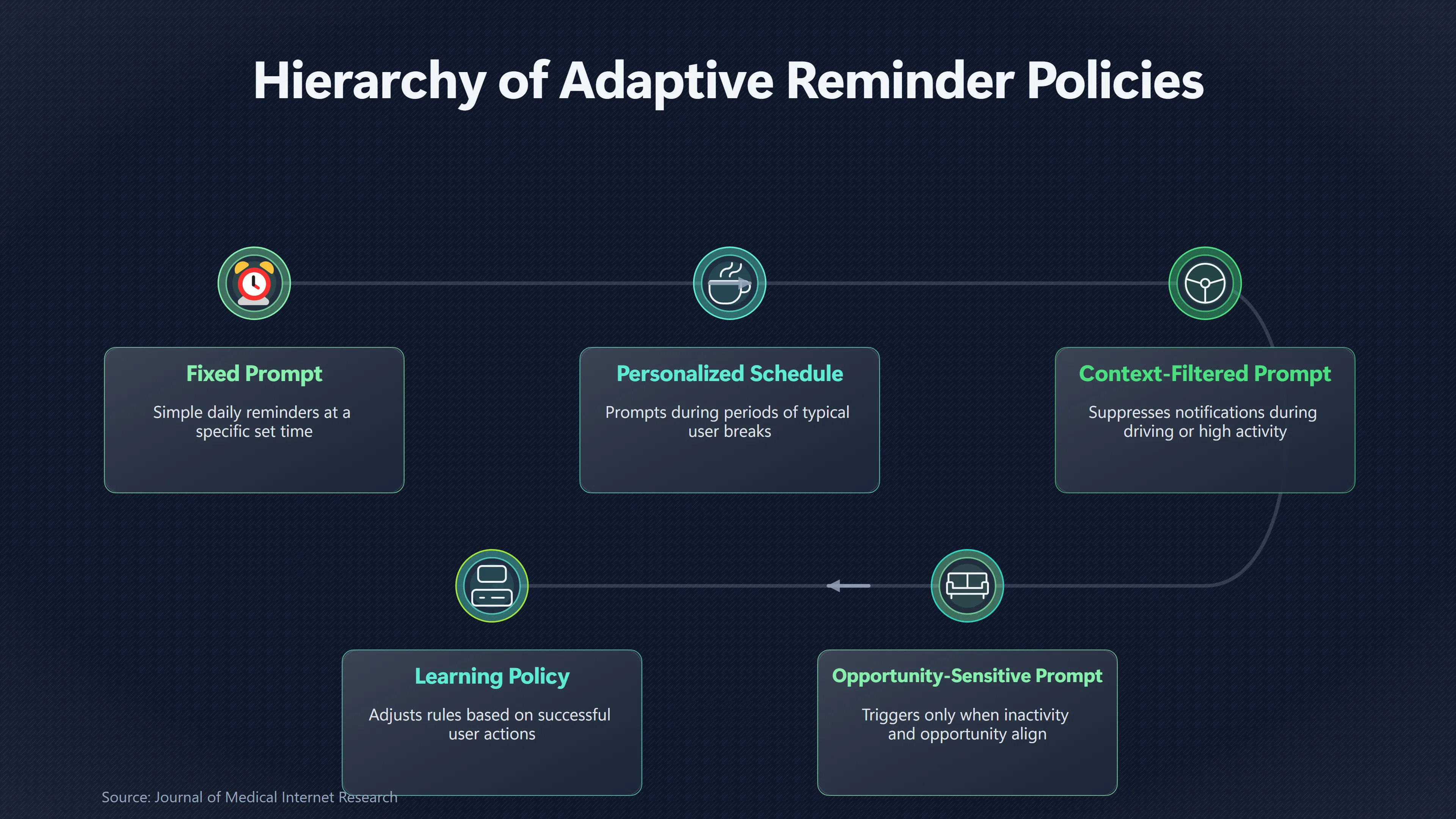
For a practical behaviour system, this points towards a hierarchy of increasingly adaptive policies:
- Fixed prompt: “Remind me to walk at 3 pm.”
- Personalised schedule: “Remind me during the afternoon period when I usually have a break.”
- Context-filtered prompt: “Consider reminding me then, but not if I am driving or already active.”
- Opportunity-sensitive prompt: “Prompt me when I have been inactive and there appears to be a workable opportunity for a short walk.”
- Learning policy: Adjust the decision rule over time according to which kinds of prompts actually lead this individual to act.
The sophistication should earn its keep. The purpose is not to collect as much contextual data as possible; it is to distinguish moments in which intervention has different expected value.
That distinction is supported by the broader evidence base, but with important uncertainty. A 2019 systematic review found 14 distinct physical-activity JITAIs across 19 papers. They commonly triggered sedentary breaks or suggested activity at opportune moments, and users generally found them acceptable, but behavioural effects were mixed and none of the studies was adequately powered to establish effects conclusively. Technological reliability and getting messages there at genuinely timely moments were themselves recurring problems.[PubMed Central (PMC)]pmc.ncbi.nlm.nih.govPubMed Central (PMC)A systematic review of just-in-time adaptive interventions (JITAIs) to promote physical activity - PMCApril 3, 2019…
A larger 2024 systematic review covering 45 studies similarly found considerable variation in how JITAIs were built. Decision points ranged from every minute to once a day, while decision rules ranged from simple conditions involving one variable to more elaborate contextual algorithms. The reviewers judged frequent decision points, device-measured tailoring variables supplemented by user input, preference-tailored intervention options and relatively simple decision rules among the more promising approaches — while also rating the overall quality of most included studies as weak.[JMIR]jmir.orgJournal of Medical Internet ResearchJournal of Medical Internet Research - Just-in-Time Adaptive Interventions for Behavior Change in Physiological Health Outcomes and t…
So “adaptive” should not be confused with “algorithmically complicated”. A rule such as do not prompt if the person has already completed the behaviour is adaptive. So is delaying a walking reminder when the phone indicates that its owner is driving. These simple rules may remove obviously bad interventions without requiring a system to infer somebody’s entire psychological state.
Timely support can still become interruption
Optimising only for response creates a trap. A system could potentially increase the chance that someone notices a notification by sending more of them, but attention is not the same thing as behaviour change, and immediate engagement is not the same thing as sustainable engagement.
The Drink Less app provides a useful example. In a micro-randomised trial involving 350 new users, participants were repeatedly randomised at 8 pm to receive one of two notifications or no notification. Receiving a notification made opening the app during the following hour about 3.5 times as likely as receiving none. Yet the researchers found no significant difference in time to disengagement between policies involving a standard daily notification, no notification or the randomised notification sequence. A powerful immediate nudge therefore did not automatically translate into superior long-term engagement.[PubMed]pubmed.ncbi.nlm.nih.govOpen source on nih.gov.
This is why adaptive systems need a concept of burden as well as opportunity. JITAI design research treats intervention fatigue as something that can fluctuate according to the demands imposed by the intervention, competing demands from everyday life and the person’s available resources. Sending support at every technically eligible moment may eventually undermine the very engagement the system is trying to preserve.[OUP Academic]academic.oup.comOpen source on oup.com.
Nor should context-awareness itself be romanticised. An exploratory trial of a smartphone stress-management intervention found that tailoring notification delivery using location and movement did not clearly improve response or intervention use compared with sending notifications at times assumed in advance to be suitable. The authors concluded that other sensor combinations and better measures of receptivity needed investigation.[PubMed Central (PMC)]pmc.ncbi.nlm.nih.govOpen source on nih.gov.
This is the central implementation lesson: a weak context model can be worse than a sensible schedule. Detecting that somebody is at home does not tell you whether they are relaxing, caring for a child, entertaining guests or handling a crisis. “Available according to the sensor” and “good moment to change behaviour” are not interchangeable.
When adaptive reminders are worth using
Adaptive prompting has the strongest case when the target behaviour has moving windows of opportunity. Physical activity is the obvious example: an intervention can react to prolonged inactivity, progress towards a daily goal, weather and opportunities to move. A feasibility study for older adults, for instance, used recent activity and time windows to choose between feedback for meeting a goal and encouragement when a participant remained below it.[JMIR Formative Research]formative.jmir.orgFormative Research JMIR Formative ResearchFormative Research JMIR Formative Research
The same logic can be applied more generally to self-improvement without assuming that every habit needs continuous sensing. Adaptive reminders become especially attractive when several conditions coincide: the opportunity to act changes substantially through the day; the system can detect at least some of those changes reasonably reliably; badly timed prompts are distracting or routinely ignored; recent behaviour changes whether another reminder is necessary; and the requested action is small enough to perform when a suitable opportunity appears.
Fixed prompts remain competitive at the opposite end of the spectrum. If the desired action should happen at essentially the same time every day, the user already controls that period, missed prompts impose little cost and contextual sensing would add little useful information, adaptation may simply be unnecessary complexity.
This distinction matters because recent reviews still describe an evidence base that is developing rather than settled. A 2025 review of mental-health JITAIs, for example, found that core elements such as genuine adaptivity and receptivity were often missing or only partially implemented, while empirical support for particular decision points and rules remained limited.[PubMed Central (PMC)]pmc.ncbi.nlm.nih.govOpen source on nih.gov. A broader 2026 review of the field likewise distinguishes standard JITAIs, whose rules adapt interventions to changing states but remain predetermined, from newer approaches that attempt to learn and continually personalise the decision rules themselves.[PubMed Central (PMC)]pmc.ncbi.nlm.nih.govPubMed Central (PMC)Just-in-Time Adaptive Interventions: Where Are We Now and What Is Next? - PMCSeptember 12, 2025…
The practical standard should therefore be modest: adapt only where context supplies information that can improve a real decision.

A better reminder policy
For self-improvement, the useful design question is not “What time should my reminder go off every day?” It is “Under what conditions would this reminder make action more likely without creating unnecessary interruption?”
A good adaptive policy can be surprisingly simple. Start with a small number of potential decision windows rather than constant surveillance. At each one, ask whether the behaviour still needs doing, whether an opportunity exists and whether there is an obvious reason not to interrupt. Then vary the prompt only as much as the available evidence justifies.
For a walking goal, that might mean considering a reminder around lunch and late afternoon, suppressing it when the person has recently walked or is driving, and making the suggestion compatible with location and weather. For a learning goal, it might mean prompting during an established free period only if today’s practice has not already occurred. For a reflective routine, it might mean retaining a fixed evening prompt because contextual adaptation adds nothing useful.
There is also a privacy trade-off. More adaptive systems can draw on location, activity, device interaction and other passive sensor information. Researchers have explicitly identified privacy, confidentiality, safety and user welfare as constraints on just-in-time intervention design, and recent reviews note growing ethical questions as passive sensing and automated decision-making expand.[PubMed Central (PMC)]pmc.ncbi.nlm.nih.govOpen source on nih.gov. A reminder that becomes marginally better by continuously collecting sensitive context may not represent a worthwhile improvement.
The broader principle behind personalised behaviour systems is therefore not “replace schedules with artificial intelligence”. It is to make the intervention policy responsive to the behaviour it is supposed to support. Sometimes that requires sophisticated adaptation. Sometimes it requires only one intelligent rule: do not interrupt when the reminder cannot help.
The useful moment matters more than the perfect time
There is no universal “best hour” for a behaviour reminder because the relevant unit is usually not the hour itself. It is the combination of need, opportunity and receptivity at that moment. Research on physical-activity interventions shows that contextually tailored prompts can cause short-term behavioural changes, while receptivity studies confirm that responsiveness varies with changing circumstances. At the same time, systematic reviews show that JITAIs remain heterogeneous, many studies are small or methodologically weak, and more contextual sophistication does not consistently produce better outcomes.[nih.gov]pmc.ncbi.nlm.nih.govPubMed Central (PMC)Efficacy of Contextually Tailored Suggestions for Physical Activity: A Micro-randomized Optimization Trial of HeartSt…
That gives adaptive reminders a narrower but more defensible role than the technological hype sometimes suggests. They beat fixed daily prompts when timing is genuinely part of the behavioural problem: when opportunities move, availability changes, recent behaviour alters the need for support, and a system can recognise enough of those differences to avoid obviously unhelpful interruptions.
The goal is not to maximise reminders. It is to make each interruption justify itself.
Amazon book picks
Further Reading
Books and field guides related to When Should a Behaviour Reminder Actually Arrive?. Use these as the next step if you want deeper reading beyond the article.
Nudge
Rating: 3.5/5 from 29 Google Books ratings
Thaler and Sunstein offer a groundbreaking discussion of how to apply the science of choice to nudge people toward decisions that can imp...
Atomic Habits
Rating: 3.5/5 from 7 Google Books ratings
The #1 New York Times bestseller. Over 25 million copies sold! Translated into 60+ languages! Tiny Changes, Remarkable Results No matter...
Tiny Habits
Improving your life is much easier than you think. Whether it’s losing weight, sleeping more, or restoring your work/life balance – the s...
How to Change
Wall Street Journal bestseller “A welcome revelation.” --The Financial Times Award-winning Wharton Professor and Choiceology podcast host...
eBay marketplace picks
Marketplace Samples
Live-tested eBay searches with available results related to this page.
Selected fromhabit tracker board oneBay.co.uk.

Endnotes
1.
Source: jmir.org
Title: Journal of Medical Internet Research
Link:https://www.jmir.org/2024/1/e54119/
Source snippet
Journal of Medical Internet Research - Just-in-Time Adaptive Interventions for Behavior Change in Physiological Health Outcomes and t...
2.
Source: academic.oup.com
Link:https://academic.oup.com/abm/article/53/6/573/5091257
Source snippet
OUP AcademicEfficacy of Contextually Tailored Suggestions for Physical Activity: A Micro-randomized Optimization Trial of HeartSteps | An...
3.
Source: GOV.UK
Title: Micro-randomised trial
Link:https://www.gov.uk/guidance/micro-randomised-trial
4.
Source: mhealth.jmir.org
Title: m Health and u Health JMIR m Health and u Health
Link:https://mhealth.jmir.org/2023/1/e38342
5.
Source: academic.oup.com
Link:https://academic.oup.com/abm/article/52/6/446/4733473
6.
Source: formative.jmir.org
Title: Formative Research JMIR Formative Research
Link:https://formative.jmir.org/2022/4/e34662
7.
Source: jmir.org
Title: Journal of Medical Internet Research
Link:https://www.jmir.org/2026/1/e84422/
8.
Source: mhealth.jmir.org
Link:https://mhealth.jmir.org/2026/1/e81378
10.
Source: jmir.org
Title: Journal of Medical Internet Research
Link:https://www.jmir.org/2026/1/e78218
12.
Source: preprints.jmir.org
Link:https://preprints.jmir.org/preprint/78218/accepted
13.
Source: formative.jmir.org
Link:https://formative.jmir.org/2025/1/e66885
14.
Source: jmir.org
Title: Journal of Medical Internet Research
Link:https://www.jmir.org/2024/1/e55694
16.
Source: formative.jmir.org
Link:https://formative.jmir.org/2023/1/e43099
18.
Source: preprints.jmir.org
Link:https://preprints.jmir.org/preprint/38342
19.
Source: mental.jmir.org
Link:https://mental.jmir.org/2021/12/e31367
20.
Source: academic.oup.com
Link:https://academic.oup.com/jamia/article/26/3/198/5260831
21.
Source: academic.oup.com
Link:https://academic.oup.com/abm/article/52/6/446/4733473?searchresult=1
22.
Source: jmir.org
Title: Journal of Medical Internet Research
Link:https://www.jmir.org/2017/5/e147
23.
Source: pmc.ncbi.nlm.nih.gov
Link:https://pmc.ncbi.nlm.nih.gov/articles/PMC13217361/
Source snippet
PubMed Central (PMC)Just-in-Time Adaptive Interventions: Where Are We Now and What Is Next? - PMCSeptember 12, 2025...
Published: September 12, 2025
24.
Source: pmc.ncbi.nlm.nih.gov
Link:https://pmc.ncbi.nlm.nih.gov/articles/PMC5364076/
Source snippet
PubMed Central (PMC)Just-in-Time Adaptive Interventions (JITAIs) in Mobile Health: Key Components and Design Principles for Ongoing Healt...
25.
Source: pmc.ncbi.nlm.nih.gov
Link:https://pmc.ncbi.nlm.nih.gov/articles/PMC6448257/
Source snippet
PubMed Central (PMC)A systematic review of just-in-time adaptive interventions (JITAIs) to promote physical activity - PMCApril 3, 2019...
Published: April 3, 2019
26.
Source: pmc.ncbi.nlm.nih.gov
Link:https://pmc.ncbi.nlm.nih.gov/articles/PMC6401341/
Source snippet
PubMed Central (PMC)Efficacy of Contextually Tailored Suggestions for Physical Activity: A Micro-randomized Optimization Trial of HeartSt...
27.
Source: pubmed.ncbi.nlm.nih.gov
Link:https://pubmed.ncbi.nlm.nih.gov/30192907/
Source snippet
Efficacy of Contextually Tailored Suggestions for Physical Activity: A Micro-randomized Optimization Trial of HeartSteps - PubMed...
28.
Source: pubmed.ncbi.nlm.nih.gov
Title: Pub Med Exploring the State-of-Receptivity for m Health Interventions
Link:https://pubmed.ncbi.nlm.nih.gov/36159209/
Source snippet
Exploring the State-of-Receptivity for mHealth Interventions - PubMedSeptember 14, 2020...
Published: September 14, 2020
29.
Source: pmc.ncbi.nlm.nih.gov
Link:https://pmc.ncbi.nlm.nih.gov/articles/PMC9494762/
30.
Source: pubmed.ncbi.nlm.nih.gov
Link:https://pubmed.ncbi.nlm.nih.gov/30943983/
31.
Source: pubmed.ncbi.nlm.nih.gov
Link:https://pubmed.ncbi.nlm.nih.gov/39331951/
32.
Source: pubmed.ncbi.nlm.nih.gov
Link:https://pubmed.ncbi.nlm.nih.gov/37294612/
33.
Source: pmc.ncbi.nlm.nih.gov
Link:https://pmc.ncbi.nlm.nih.gov/articles/PMC5207732/
34.
Source: pmc.ncbi.nlm.nih.gov
Link:https://pmc.ncbi.nlm.nih.gov/articles/PMC11811111/
35.
Source: pubmed.ncbi.nlm.nih.gov
Link:https://pubmed.ncbi.nlm.nih.gov/39935463/
36.
Source: pubmed.ncbi.nlm.nih.gov
Title: Pub Med Just-in-Time Adaptive Interventions: Where Are We Now and What Is Next?
Link:https://pubmed.ncbi.nlm.nih.gov/40939059/
37.
Source: pmc.ncbi.nlm.nih.gov
Link:https://pmc.ncbi.nlm.nih.gov/articles/PMC4732268/
38.
Source: pmc.ncbi.nlm.nih.gov
Link:https://pmc.ncbi.nlm.nih.gov/articles/PMC13374797/
39.
Source: pubmed.ncbi.nlm.nih.gov
Link:https://pubmed.ncbi.nlm.nih.gov/42247635/?fc=20260512171827&ff=20260605184209&v=2.20.0
40.
Source: pmc.ncbi.nlm.nih.gov
Link:https://pmc.ncbi.nlm.nih.gov/articles/PMC13240989/
41.
Source: pmc.ncbi.nlm.nih.gov
Link:https://pmc.ncbi.nlm.nih.gov/articles/PMC13193708/
42.
Source: pmc.ncbi.nlm.nih.gov
Link:https://pmc.ncbi.nlm.nih.gov/articles/PMC12779098/
43.
Source: pubmed.ncbi.nlm.nih.gov
Link:https://pubmed.ncbi.nlm.nih.gov/41027677/
44.
Source: pmc.ncbi.nlm.nih.gov
Link:https://pmc.ncbi.nlm.nih.gov/articles/PMC12481328/
45.
Source: pmc.ncbi.nlm.nih.gov
Link:https://pmc.ncbi.nlm.nih.gov/articles/PMC12274063/
46.
Source: pmc.ncbi.nlm.nih.gov
Link:https://pmc.ncbi.nlm.nih.gov/articles/PMC11583291/
47.
Source: pubmed.ncbi.nlm.nih.gov
Link:https://pubmed.ncbi.nlm.nih.gov/39542743/
48.
Source: pmc.ncbi.nlm.nih.gov
Link:https://pmc.ncbi.nlm.nih.gov/articles/PMC11470223/
49.
Source: pmc.ncbi.nlm.nih.gov
Link:https://pmc.ncbi.nlm.nih.gov/articles/PMC11251861/
50.
Source: pubmed.ncbi.nlm.nih.gov
Link:https://pubmed.ncbi.nlm.nih.gov/38887953/
51.
Source: pmc.ncbi.nlm.nih.gov
Link:https://pmc.ncbi.nlm.nih.gov/articles/PMC10540022/
52.
Source: pmc.ncbi.nlm.nih.gov
Link:https://pmc.ncbi.nlm.nih.gov/articles/PMC11272684/
53.
Source: pubmed.ncbi.nlm.nih.gov
Link:https://pubmed.ncbi.nlm.nih.gov/37521518/
54.
Source: pmc.ncbi.nlm.nih.gov
Link:https://pmc.ncbi.nlm.nih.gov/articles/PMC10373115/
55.
Source: pmc.ncbi.nlm.nih.gov
Link:https://pmc.ncbi.nlm.nih.gov/articles/PMC10337295/
56.
Source: pmc.ncbi.nlm.nih.gov
Link:https://pmc.ncbi.nlm.nih.gov/articles/PMC10450096/
57.
Source: pmc.ncbi.nlm.nih.gov
Link:https://pmc.ncbi.nlm.nih.gov/articles/PMC9755932/
58.
Source: pmc.ncbi.nlm.nih.gov
Link:https://pmc.ncbi.nlm.nih.gov/articles/PMC9643598/
59.
Source: pmc.ncbi.nlm.nih.gov
Link:https://pmc.ncbi.nlm.nih.gov/articles/PMC9030994/
60.
Source: pmc.ncbi.nlm.nih.gov
Link:https://pmc.ncbi.nlm.nih.gov/articles/PMC9276848/
61.
Source: pmc.ncbi.nlm.nih.gov
Link:https://pmc.ncbi.nlm.nih.gov/articles/PMC8680205/
62.
Source: pmc.ncbi.nlm.nih.gov
Link:https://pmc.ncbi.nlm.nih.gov/articles/PMC8918048/
63.
Source: pmc.ncbi.nlm.nih.gov
Link:https://pmc.ncbi.nlm.nih.gov/articles/PMC8439432/
64.
Source: pmc.ncbi.nlm.nih.gov
Link:https://pmc.ncbi.nlm.nih.gov/articles/PMC8887814/
65.
Source: pubmed.ncbi.nlm.nih.gov
Link:https://pubmed.ncbi.nlm.nih.gov/31488002/
66.
Source: pmc.ncbi.nlm.nih.gov
Link:https://pmc.ncbi.nlm.nih.gov/articles/PMC6713230/
67.
Source: pmc.ncbi.nlm.nih.gov
Link:https://pmc.ncbi.nlm.nih.gov/articles/PMC6380673/
68.
Source: pubmed.ncbi.nlm.nih.gov
Link:https://pubmed.ncbi.nlm.nih.gov/27663578/
69.
Source: pubmed.ncbi.nlm.nih.gov
Link:https://pubmed.ncbi.nlm.nih.gov/29184889/
70.
Source: pubmed.ncbi.nlm.nih.gov
Link:https://pubmed.ncbi.nlm.nih.gov/28550001/
71.
Source: pubmed.ncbi.nlm.nih.gov
Link:https://pubmed.ncbi.nlm.nih.gov/28046034/
72.
Source: pmc.ncbi.nlm.nih.gov
Link:https://pmc.ncbi.nlm.nih.gov/articles/PMC4721268/
73.
Source: pmc.ncbi.nlm.nih.gov
Link:https://pmc.ncbi.nlm.nih.gov/articles/PMC4732571/
74.
Source: pubmed.ncbi.nlm.nih.gov
Link:https://pubmed.ncbi.nlm.nih.gov/34926979/
75.
Source: pubmed.ncbi.nlm.nih.gov
Link:https://pubmed.ncbi.nlm.nih.gov/34527853/
76.
Source: cs.dartmouth.edu
Link:https://cs.dartmouth.edu/~dfk/research/papers.html
Additional References
77.
Source: youtube.com
Title: Susan Murphy
Link:https://www.youtube.com/watch?v=T5FN_r3iFTI
Source snippet
Just-in-Time Adaptive Interventions JITAI Video 1: Introduction to JITAI with Susan Murphy...
78.
Source: youtube.com
Link:https://www.youtube.com/watch?v=Ad4q04y_CWg
Source snippet
Susan Murphy - Experimental Design & ML in Mobile Health - The Frontiers of Machine Learning...
79.
Source: youtube.com
Title: Just-In-Time Adaptive Interventions (JITAI) in m Health | DIGIT-MI
Link:https://www.youtube.com/watch?v=iQLhihcfBSY
Source snippet
Webinar - Potentials of Just-in-time Adaptive Interventions (JITAIs)...
80.
Source: nature.com
Link:https://www.nature.com/articles/s41598-026-39518-z
81.
Source: youtube.com
Title: Wearable Tech in Healthcare | Dr. Susan Murphy | Talks at Google
Link:https://www.youtube.com/watch?v=0FdN8gLHGNQ
Source snippet
Just-In-Time Adaptive Interventions (JITAI) in mHealth | DIGIT-MI...
82.
Source: scispace.com
Link:https://scispace.com/papers/efficacy-of-contextually-tailored-suggestions-for-physical-46pn26fji2
83.
Source: researchgate.net
Link:https://www.researchgate.net/publication/358709794_Advancing_Behavioral_Intervention_and_Theory_Development_for_Mobile_Health_The_HeartSteps_II_Protocol
84.
Source: researchgate.net
Link:https://www.researchgate.net/publication/358709794_Advancing_Behavioral_Intervention_and_Theory_Development_for_Mobile_Health_The_Heart_Steps_II_Protocol
85.
Source: researchgate.net
Link:https://www.researchgate.net/publication/319636801_Beyond_Interruptibility_Predicting_Opportune_Moments_to_Engage_Mobile_Phone_Users
86.
Source: researchgate.net
Link:https://www.researchgate.net/publication/280878182_Designing_Content-driven_Intelligent_Notification_Mechanisms_for_Mobile_Applications