Within Sleep Foundation
Why Repeated Short Nights Quietly Erode Attention
Several nights of restricted sleep can steadily worsen attention even when each individual night feels manageable.
On this page
- How attention deficits accumulate across restricted nights
- What the 14 day sleep restriction experiment found
- Why extra waking hours can become a false productivity gain
Page outline Jump by section
Introduction
Repeated short nights can quietly erode attention even when no single night feels disastrous. The important variable is not simply how tired someone feels the next morning, but what happens when a modest sleep shortfall is repeated. Controlled experiments show that restricting sleep night after night can produce progressively more failures of sustained attention, slower responses and less stable performance. Crucially, subjective sleepiness does not always worsen at the same rate, so feeling as though you have “got used to” a short-sleep schedule is not reliable evidence that your attention has adapted.[PubMed]pubmed.ncbi.nlm.nih.govThe cumulative cost of additional wakefulness: dose-response effects on neurobehavioral functions and sleep physiology from chronic…
For self-improvement, that distinction matters. Taking an hour or two from sleep can appear to create more time for work, study or personal goals. But if the same trade is made repeatedly, some of those extra waking hours may be bought at the cost of progressively less dependable attention during the hours that remain. The classic 14-day sleep-restriction experiment makes this accumulation unusually clear.[PubMed]pubmed.ncbi.nlm.nih.govThe cumulative cost of additional wakefulness: dose-response effects on neurobehavioral functions and sleep physiology from chronic…
How attention deficits accumulate across restricted nights
Sleep restriction does not have to mean staying awake all night. In laboratory research, it usually means giving participants a shorter nightly sleep opportunity than they would normally receive and repeating that schedule for several days. This is closer to an ordinary pattern such as staying up late to finish work and still getting up at the usual time.
One of the most sensitive measures of the resulting impairment is the psychomotor vigilance test (PVT). Participants watch for unpredictable signals and respond as quickly as possible. The task is deliberately simple: there is little to learn and few complicated decisions to make. What it exposes is whether someone can maintain stable attention without periodically drifting into abnormally slow responses or lapses. Under repeated sleep restriction, those lapses tend to become more frequent.[PubMed Central (PMC)]pmc.ncbi.nlm.nih.govPubMed Central (PMC)Behavioral and Physiological Consequences of Sleep Restriction - PMCAugust 15, 2007…
This makes chronic restriction different from judging the consequences of one mediocre night. A 2024 systematic review of 44 studies found that even a single restricted night impaired sustained attention on average, increasing both reaction times and attentional lapses, although effects on several other cognitive domains were not statistically significant. Repeated restriction adds another dimension: impairment can continue accumulating as successive short nights are added.[PubMed]pubmed.ncbi.nlm.nih.govImpact of one night of sleep restriction on sleepiness and cognitive function: A systematic review and meta-analysis - PubMedApril…
A separate seven-day dose-response experiment illustrates the same pattern. Sixty-six healthy adults were assigned sleep opportunities of three, five, seven or nine hours a night. PVT performance deteriorated most strongly under severe restriction. With five hours in bed, attentional lapses increased across the restriction period; seven hours produced a smaller impairment in response speed, while the nine-hour group remained around baseline.[PubMed]pubmed.ncbi.nlm.nih.govOpen source on nih.gov.
The precise trajectory therefore depends on the amount of sleep, the measure used and the individual. It should not be reduced to a claim that everyone loses a fixed amount of attention for every hour of missed sleep. There are large, repeatable differences in vulnerability between people. Research involving hundreds of healthy adults has found substantial individual variation in how vigilant attention deteriorates during chronic restriction, and common characteristics such as personality, intelligence, chronotype and several demographic measures have done little to predict who will be most vulnerable.[PubMed Central (PMC)]pmc.ncbi.nlm.nih.govOpen source on nih.gov.
That variability does not overturn the central result. It means that the rate of deterioration differs. Repeatedly reducing sleep still creates a risk that attention is worsening across days, and a person cannot safely assume from ordinary self-observation that they belong to a particularly resilient group.
What the 14-day experiment found
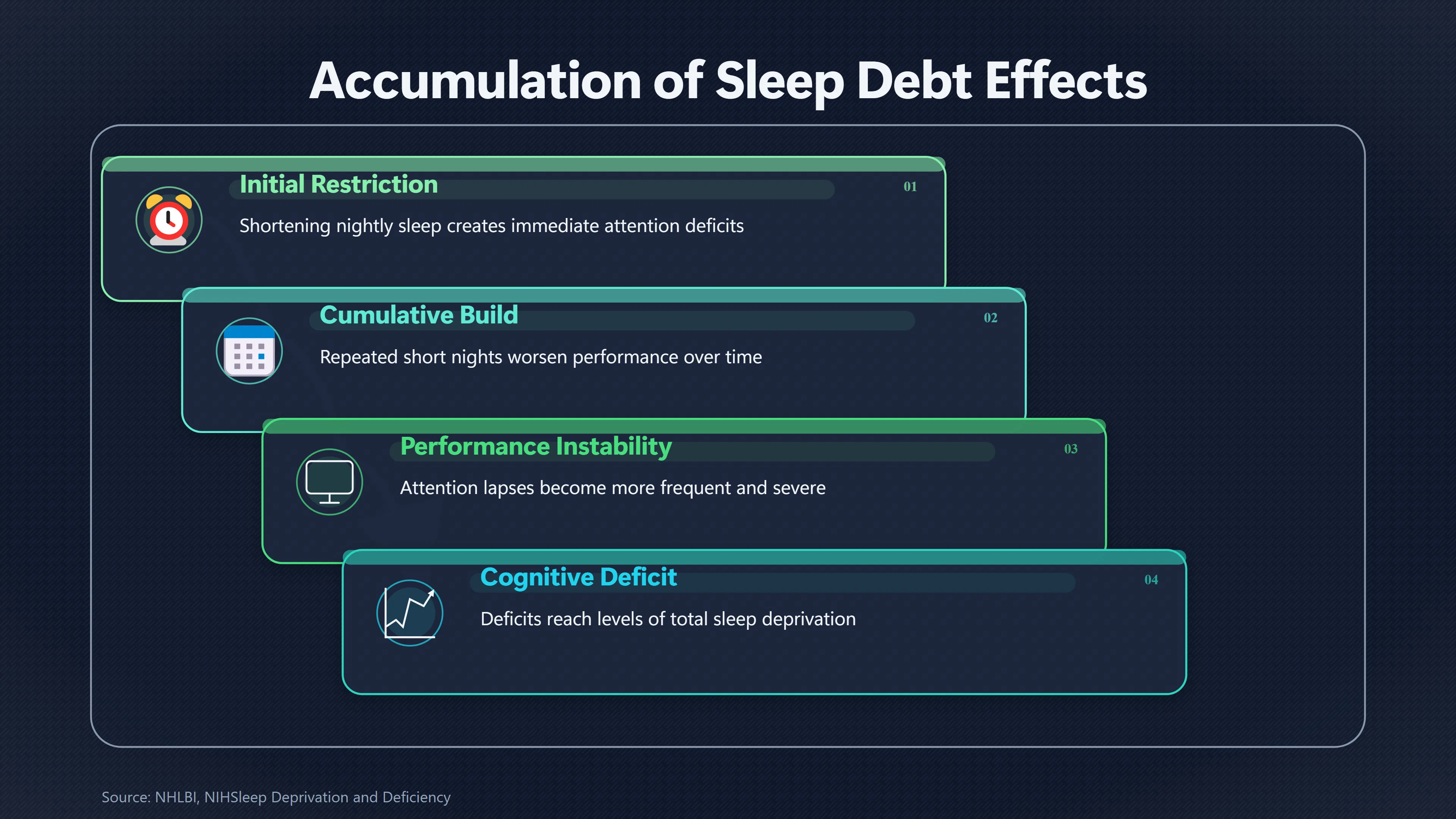
The clearest single case comes from Hans Van Dongen and colleagues’ 2003 laboratory experiment. Forty-eight healthy adults aged 21–38 took part in tightly controlled protocols. In the chronic-restriction experiment, participants were assigned four, six or eight hours of time in bed each night for 14 consecutive days. The researchers repeatedly measured attention and other aspects of cognitive performance and compared the results with a separate experiment involving total sleep deprivation.[PubMed]pubmed.ncbi.nlm.nih.govThe cumulative cost of additional wakefulness: dose-response effects on neurobehavioral functions and sleep physiology from chronic…
The difference between the groups grew with time. Participants given eight-hour sleep opportunities remained comparatively stable, while those restricted to four or six hours developed cumulative, dose-dependent performance deficits. In other words, six hours was not simply associated with one initial drop followed by complete adaptation. Cognitive impairment continued to build over the two weeks. Four-hour nights produced still greater deterioration.[PubMed]pubmed.ncbi.nlm.nih.govThe cumulative cost of additional wakefulness: dose-response effects on neurobehavioral functions and sleep physiology from chronic…
The comparison with all-night sleep deprivation made the size of that accumulation easier to grasp. By the end of the experiment, repeated restriction to six hours or less produced cognitive performance deficits that, depending on the measure and condition, reached levels comparable with as much as one to two nights of total sleep deprivation. This does not mean that six hours of sleep is equivalent to pulling an all-nighter on any particular morning. The finding concerns deficits accumulated over many consecutive restricted nights.[PubMed]pubmed.ncbi.nlm.nih.govThe cumulative cost of additional wakefulness: dose-response effects on neurobehavioral functions and sleep physiology from chronic…
The PVT results were particularly revealing. The researchers’ modelling found that behavioural-alertness lapses were approximately linearly related to cumulative wakefulness beyond about 15.8 hours per day. Their interpretation was that sleep debt could be understood partly as an accumulating cost of additional wakefulness: repeatedly extending the waking day without enough compensating sleep progressively increased vulnerability to attentional failure.[PubMed]pubmed.ncbi.nlm.nih.govThe cumulative cost of additional wakefulness: dose-response effects on neurobehavioral functions and sleep physiology from chronic…
Later experimental work has strengthened the conclusion that short sleep itself matters, rather than the phenomenon being merely a consequence of staying awake for exceptionally long stretches. In a 32-day inpatient study designed to keep individual waking episodes below 16 hours, chronic short sleep still substantially worsened reaction-time performance and increased attention lapses. Participants’ self-reported alertness, meanwhile, did not deteriorate uniformly alongside objective performance.[PubMed]pubmed.ncbi.nlm.nih.govChronic sleep curtailment, even without extended (>16-h) wakefulness, degrades human vigilance performance - PubMed…
The dangerous gap between feeling adapted and performing adapted
Perhaps the most practically important part of the 14-day study was the mismatch between subjective experience and measured performance. Participants reported an initial rise in sleepiness when restriction began, but subjective sleepiness showed relatively little additional increase thereafter. Objective cognitive deficits, by contrast, continued accumulating in the four- and six-hour conditions.[PubMed]pubmed.ncbi.nlm.nih.govThe cumulative cost of additional wakefulness: dose-response effects on neurobehavioral functions and sleep physiology from chronic…
That creates an easily misunderstood form of adaptation. Someone may genuinely feel that a six-hour schedule has become more normal after several days. The mistake is treating that change in feeling as proof that performance has returned to normal. The laboratory evidence indicates that subjective adjustment and cognitive adjustment can follow different trajectories.
Other work points in the same direction. Individual responses to sleep loss are consistent within people, yet researchers have found that objective performance and subjective responses do not necessarily track one another. Someone’s impression of being relatively functional therefore cannot substitute for measuring whether their attention is actually stable.[PubMed Central (PMC)]pmc.ncbi.nlm.nih.govOpen source on nih.gov.
This also helps explain why chronic restriction can be deceptive compared with an all-nighter. An all-nighter provides an unmistakable warning signal: the person knows something unusual has happened. Repeatedly going to bed a little late can feel much less exceptional. The impairment develops against a schedule that increasingly feels routine.

Why extra waking hours can become a false productivity gain
Cutting sleep has an obvious arithmetic appeal. Sleeping six rather than eight hours creates two additional waking hours. Across five nights, that appears to yield ten extra hours for work, study, exercise or other goals.
The problem is that waking time and effective time are not interchangeable. Sleep deficiency is associated with slower reactions, difficulty focusing, more mistakes and longer task-completion times. The US National Heart, Lung, and Blood Institute specifically notes that sleep-deficient people can take longer to finish tasks and make more errors.[NHLBI, NIH]nhlbi.nih.govNHLBI, NIHSleep Deprivation and DeficiencyHow Sleep Affects Your Health | NHLBI, NIH…
The 14-day experiment adds the crucial time dimension: the productivity calculation can worsen as the week progresses. If attention is becoming less reliable each day, the apparent gain from staying awake longer has to be weighed against poorer performance during both the newly created hours and the ordinary working day.[PubMed]pubmed.ncbi.nlm.nih.govThe cumulative cost of additional wakefulness: dose-response effects on neurobehavioral functions and sleep physiology from chronic…
This need not mean dramatic incapacity. The more realistic problem is inconsistency. A person may work effectively for stretches and then lose the thread, overlook something, reread material, respond unusually slowly or make an error that requires correction. Vigilant-attention research describes this as increasing performance instability rather than a simple uniform slowing of the brain.[PubMed Central (PMC)]pmc.ncbi.nlm.nih.govPub Med Central (PMC)Sleep Deprivation and Neurobehavioral DynamicsPub Med Central (PMC)Sleep Deprivation and Neurobehavioral Dynamics
That distinction is particularly relevant to self-improvement projects. Progress often depends less on producing one exceptional hour than on repeatedly executing small intended actions: staying with a difficult reading session, noticing the next step in a piece of work, checking details before submitting something, or continuing a task after its novelty disappears. Accumulating attentional lapses undermine precisely this kind of dependable follow-through.
Why a weekend does not necessarily reset the deficit
A common response to short weekday sleep is to assume that longer weekend sleep wipes the slate clean. Recovery sleep certainly helps, but experiments suggest that restoration of subjective alertness and restoration of objective performance do not necessarily proceed at the same speed.
In one laboratory study, 30 healthy young adults received eight-hour baseline sleep opportunities, followed by six nights restricted to six hours and then recovery opportunities of ten hours. After recovery, subjective and objective measures of sleepiness returned towards baseline, yet PVT performance did not show equivalent recovery. The participants could therefore feel less sleepy before the measured performance deficit had disappeared.[PubMed]pubmed.ncbi.nlm.nih.govOpen source on nih.gov.
Belenky and colleagues likewise found incomplete short-term restoration after seven nights of restriction. Following three recovery nights with eight hours in bed, performance in several restricted groups remained below baseline levels.[PubMed]pubmed.ncbi.nlm.nih.govOpen source on nih.gov.
Longer protocols make the limitation of the weekday-restriction/weekend-recovery strategy particularly visible. A six-week study of high-performing adults allowed five-hour sleep opportunities on weekdays and eight hours at weekends. Vigilant attention declined with accumulating sleep debt, and two weekend recovery nights did not restore the observed deficits. The sample was small—15 people—so the exact effect sizes should not be generalised too broadly, but the result fits the wider evidence that recovery from repeated restriction can take longer than simply feeling refreshed after a lie-in.[PubMed]pubmed.ncbi.nlm.nih.govOpen source on nih.gov.
This does not establish a universal number of recovery nights. Recovery depends on the severity and duration of previous restriction, sleep opportunity and individual vulnerability. The more defensible lesson is narrower: do not assume that one or two longer nights have completely reversed an accumulated attention deficit simply because sleepiness has eased. Reviews of recovery experiments reach the same conclusion.[PubMed Central (PMC)]pmc.ncbi.nlm.nih.govPub Med Central (PMC)Dynamics of recovery sleep from chronic sleep restrictionPub Med Central (PMC)Dynamics of recovery sleep from chronic sleep restriction
The practical lesson from repeated short nights
The evidence changes the way sleep should be counted in a self-improvement plan. A late night is not only an isolated event whose cost can be judged the following morning. Sleep history matters. When restriction is repeated, yesterday’s lost sleep can alter how well attention holds up today, and incomplete recovery can increase vulnerability to the next period of restriction.[PubMed Central (PMC)]pmc.ncbi.nlm.nih.govPub Med Central (PMC)Dynamics of recovery sleep from chronic sleep restrictionPub Med Central (PMC)Dynamics of recovery sleep from chronic sleep restriction
That is why a run of “manageable” short nights deserves more attention than any one of those nights considered separately. The most useful warning signs are not limited to overwhelming sleepiness. Repeated loss of concentration, unusually variable work speed, rereading, missed details, slow reactions and small avoidable errors are compatible with the pattern that laboratory vigilance tests detect under accumulated sleep restriction.[NHLBI, NIH]nhlbi.nih.govNHLBI, NIHSleep Deprivation and DeficiencyHow Sleep Affects Your Health | NHLBI, NIH…
For healthy adults, the American Academy of Sleep Medicine and Sleep Research Society recommend seven or more hours of sleep per night on a regular basis, while recognising individual variation in sleep need.[AASM]aasm.orgOpen source on aasm.org. The important word for this particular issue is regularly. The controlled evidence shows why repeatedly borrowing from sleep is different from looking at a single night in isolation.
The self-improvement implication is therefore not that every short night ruins the following day, nor that everyone responds identically. It is that repeatedly extending the day by shortening the night can create an accumulating deficit that is easy to underestimate. The extra waking hours remain visible on the clock; the gradually increasing lapses of attention are much easier to miss.
Amazon book picks
Further Reading
Books and field guides related to Why Repeated Short Nights Quietly Erode Attention. Use these as the next step if you want deeper reading beyond the article.
Why We Sleep
"Sleep is one of the most important but least understood aspects of our life, wellness, and longevity ... An explosion of scientific disc...
The Promise of Sleep
Sleep better, live longer with the groundbreaking information and step-by-step program in this revolutionary book. Healthful sleep has be...
The Sleep Solution
With cutting-edge sleep science and time-tested techniques, The Sleep Solution will help anyone achieve healthy sleep and eliminate pills...
The Circadian Code
Change your daily routine, transform your health. Circadian rhythms are biological processes or clocks that exist in each one of our cell...
eBay marketplace picks
Marketplace Samples
Example marketplace items related to this page. Use the search link to explore similar finds on eBay.
Selected fromproductivity timer oneBay.co.uk.

Endnotes
1.
Source: pubmed.ncbi.nlm.nih.gov
Link:https://pubmed.ncbi.nlm.nih.gov/12683469/
Source snippet
The cumulative cost of additional wakefulness: dose-response effects on neurobehavioral functions and sleep physiology from chronic...
2.
Source: pubmed.ncbi.nlm.nih.gov
Link:https://pubmed.ncbi.nlm.nih.gov/29784810/
Source snippet
Chronic sleep curtailment, even without extended (>16-h) wakefulness, degrades human vigilance performance - PubMed...
3.
Source: nhlbi.nih.gov
Title: NHLBI, NIHSleep Deprivation and Deficiency
Link:https://www.nhlbi.nih.gov/health/sleep-deprivation/health-effects
Source snippet
How Sleep Affects Your Health | NHLBI, NIH...
4.
Source: pmc.ncbi.nlm.nih.gov
Link:https://pmc.ncbi.nlm.nih.gov/articles/PMC1978335/
Source snippet
PubMed Central (PMC)Behavioral and Physiological Consequences of Sleep Restriction - PMCAugust 15, 2007...
Published: August 15, 2007
5.
Source: ncbi.nlm.nih.gov
Title: NCBIFunctional and Economic Impact of Sleep Loss and Sleep-Related Disorders
Link:https://www.ncbi.nlm.nih.gov/books/NBK19958/
Source snippet
Sleep Disorders and Sleep Deprivation - NCBI Bookshelf...
6.
Source: pubmed.ncbi.nlm.nih.gov
Link:https://pubmed.ncbi.nlm.nih.gov/38759474/
Source snippet
Impact of one night of sleep restriction on sleepiness and cognitive function: A systematic review and meta-analysis - PubMedApril...
7.
Source: pubmed.ncbi.nlm.nih.gov
Link:https://pubmed.ncbi.nlm.nih.gov/12603781
8.
Source: pmc.ncbi.nlm.nih.gov
Link:https://pmc.ncbi.nlm.nih.gov/articles/PMC8152927/
9.
Source: pmc.ncbi.nlm.nih.gov
Link:https://pmc.ncbi.nlm.nih.gov/articles/PMC8754493/
Source snippet
PubMed Central (PMC)Predictors of interindividual differences in vulnerability to neurobehavioral consequences of chronic partial sleep r...
10.
Source: pmc.ncbi.nlm.nih.gov
Link:https://pmc.ncbi.nlm.nih.gov/articles/PMC5668275/
11.
Source: pmc.ncbi.nlm.nih.gov
Title: Pub Med Central (PMC)Sleep Deprivation and Neurobehavioral Dynamics
Link:https://pmc.ncbi.nlm.nih.gov/articles/PMC3700596/
12.
Source: pmc.ncbi.nlm.nih.gov
Link:https://pmc.ncbi.nlm.nih.gov/articles/PMC3944366/
13.
Source: pubmed.ncbi.nlm.nih.gov
Link:https://pubmed.ncbi.nlm.nih.gov/23941878/
14.
Source: pmc.ncbi.nlm.nih.gov
Link:https://pmc.ncbi.nlm.nih.gov/articles/PMC3798707/
15.
Source: pubmed.ncbi.nlm.nih.gov
Link:https://pubmed.ncbi.nlm.nih.gov/33630069/
16.
Source: pmc.ncbi.nlm.nih.gov
Title: Pub Med Central (PMC)Dynamics of recovery sleep from chronic sleep restriction
Link:https://pmc.ncbi.nlm.nih.gov/articles/PMC10108639/
17.
Source: aasm.org
Link:https://www.aasm.org/resources/pdf/adultsleepdurationconsensus.pdf
18.
Source: aasm.org
Title: Adult Sleep Duration Health Advisory
Link:https://aasm.org/advocacy/position-statements/adult-sleep-duration-health-advisory/
19.
Source: aasm.org
Link:https://aasm.org/about/newsroom/
20.
Source: aasm.org
Title: practice guidelines
Link:https://aasm.org/clinical-resources/practice-standards/practice-guidelines/
21.
Source: aasm.org
Title: consensus statements and papers
Link:https://aasm.org/clinical-resources/practice-standards/consensus-statements-and-papers/
22.
Source: pubmed.ncbi.nlm.nih.gov
Link:https://pubmed.ncbi.nlm.nih.gov/41395726/
23.
Source: aasm.org
Title: Sleep Medicine Resources for Medical Students, Residents & Fellows
Link:https://aasm.org/professional-development/choose-sleep/helpful-resources/
24.
Source: pubmed.ncbi.nlm.nih.gov
Link:https://pubmed.ncbi.nlm.nih.gov/38759474/?format=pubmed
25.
Source: pubmed.ncbi.nlm.nih.gov
Link:https://pubmed.ncbi.nlm.nih.gov/37995463/
26.
Source: pubmed.ncbi.nlm.nih.gov
Link:https://pubmed.ncbi.nlm.nih.gov/37193276/
27.
Source: pmc.ncbi.nlm.nih.gov
Link:https://pmc.ncbi.nlm.nih.gov/articles/PMC9389006/
28.
Source: pubmed.ncbi.nlm.nih.gov
Link:https://pubmed.ncbi.nlm.nih.gov/35089345/
29.
Source: pmc.ncbi.nlm.nih.gov
Link:https://pmc.ncbi.nlm.nih.gov/articles/PMC8996029/
30.
Source: pubmed.ncbi.nlm.nih.gov
Link:https://pubmed.ncbi.nlm.nih.gov/35034695/
31.
Source: pmc.ncbi.nlm.nih.gov
Link:https://pmc.ncbi.nlm.nih.gov/articles/PMC8546061/
32.
Source: pmc.ncbi.nlm.nih.gov
Link:https://pmc.ncbi.nlm.nih.gov/articles/PMC8754491/
33.
Source: pmc.ncbi.nlm.nih.gov
Link:https://pmc.ncbi.nlm.nih.gov/articles/PMC8494094/
34.
Source: pubmed.ncbi.nlm.nih.gov
Link:https://pubmed.ncbi.nlm.nih.gov/34580319/
35.
Source: pmc.ncbi.nlm.nih.gov
Link:https://pmc.ncbi.nlm.nih.gov/articles/PMC8476607/
36.
Source: pubmed.ncbi.nlm.nih.gov
Link:https://pubmed.ncbi.nlm.nih.gov/34285617/
37.
Source: pmc.ncbi.nlm.nih.gov
Link:https://pmc.ncbi.nlm.nih.gov/articles/PMC8286723/
38.
Source: pubmed.ncbi.nlm.nih.gov
Link:https://pubmed.ncbi.nlm.nih.gov/33438751/
39.
Source: pmc.ncbi.nlm.nih.gov
Link:https://pmc.ncbi.nlm.nih.gov/articles/PMC8242594/
40.
Source: pmc.ncbi.nlm.nih.gov
Link:https://pmc.ncbi.nlm.nih.gov/articles/PMC6702200/
41.
Source: pubmed.ncbi.nlm.nih.gov
Link:https://pubmed.ncbi.nlm.nih.gov/31176308/
42.
Source: pmc.ncbi.nlm.nih.gov
Link:https://pmc.ncbi.nlm.nih.gov/articles/PMC6879580/
43.
Source: pmc.ncbi.nlm.nih.gov
Link:https://pmc.ncbi.nlm.nih.gov/articles/PMC6457111/
44.
Source: pmc.ncbi.nlm.nih.gov
Link:https://pmc.ncbi.nlm.nih.gov/articles/PMC6519907/
45.
Source: pubmed.ncbi.nlm.nih.gov
Link:https://pubmed.ncbi.nlm.nih.gov/30670158/
46.
Source: pmc.ncbi.nlm.nih.gov
Link:https://pmc.ncbi.nlm.nih.gov/articles/PMC6003377/
47.
Source: pmc.ncbi.nlm.nih.gov
Link:https://pmc.ncbi.nlm.nih.gov/articles/PMC5675465/
48.
Source: pubmed.ncbi.nlm.nih.gov
Link:https://pubmed.ncbi.nlm.nih.gov/28757454/
49.
Source: pmc.ncbi.nlm.nih.gov
Link:https://pmc.ncbi.nlm.nih.gov/articles/PMC6143346/
50.
Source: pmc.ncbi.nlm.nih.gov
Link:https://pmc.ncbi.nlm.nih.gov/articles/PMC6084743/
51.
Source: pubmed.ncbi.nlm.nih.gov
Link:https://pubmed.ncbi.nlm.nih.gov/28123662/
52.
Source: aasm.org
Link:https://aasm.org/sleep-research-2015-year-in-review-read-the-10-most-viewed-papers-from-jcsm-and-sleep/
53.
Source: pmc.ncbi.nlm.nih.gov
Link:https://pmc.ncbi.nlm.nih.gov/articles/PMC4513271/
54.
Source: aasm.org
Title: New report describes methods behind recent sleep duration consensus statement
Link:https://aasm.org/new-report-describes-methods-behind-recent-sleep-duration-consensus-statement/
55.
Source: aasm.org
Title: Sleep duration consensus statement receives national media coverage
Link:https://aasm.org/sleep-duration-consensus-statement-receives-national-media-coverage/
56.
Source: pubmed.ncbi.nlm.nih.gov
Link:https://pubmed.ncbi.nlm.nih.gov/25979105/
57.
Source: pmc.ncbi.nlm.nih.gov
Link:https://pmc.ncbi.nlm.nih.gov/articles/PMC4442216/
58.
Source: aasm.org
Title: AAS M and SRS publish new sleep duration consensus statement
Link:https://aasm.org/aasm-and-srs-publish-new-sleep-duration-consensus-statement/
59.
Source: pmc.ncbi.nlm.nih.gov
Link:https://pmc.ncbi.nlm.nih.gov/articles/PMC4434546/
60.
Source: pubmed.ncbi.nlm.nih.gov
Link:https://pubmed.ncbi.nlm.nih.gov/26039963/
61.
Source: aasm.org
Title: Seven or more hours of sleep per night: A health necessity for adults
Link:https://aasm.org/seven-or-more-hours-of-sleep-per-night-a-health-necessity-for-adults
62.
Source: pmc.ncbi.nlm.nih.gov
Link:https://pmc.ncbi.nlm.nih.gov/articles/PMC4402656/
63.
Source: aasm.org
Title: hypnogram five sessions to attend at sleep 2015
Link:https://aasm.org/hypnogram-five-sessions-to-attend-at-sleep-2015/
64.
Source: pubmed.ncbi.nlm.nih.gov
Link:https://pubmed.ncbi.nlm.nih.gov/25850114/
65.
Source: pmc.ncbi.nlm.nih.gov
Link:https://pmc.ncbi.nlm.nih.gov/articles/PMC3602842/
66.
Source: pmc.ncbi.nlm.nih.gov
Link:https://pmc.ncbi.nlm.nih.gov/articles/PMC3397820/
67.
Source: pmc.ncbi.nlm.nih.gov
Link:https://pmc.ncbi.nlm.nih.gov/articles/PMC3397808/
68.
Source: pubmed.ncbi.nlm.nih.gov
Link:https://pubmed.ncbi.nlm.nih.gov/22294809/
69.
Source: pmc.ncbi.nlm.nih.gov
Link:https://pmc.ncbi.nlm.nih.gov/articles/PMC3190416/
70.
Source: pubmed.ncbi.nlm.nih.gov
Link:https://pubmed.ncbi.nlm.nih.gov/20408942/
71.
Source: aasm.org
Link:https://aasm.org/sleep-extension-improves-alertness-and-performance-during-and-following-subsequent-sleep-restriction/
72.
Source: aasm.org
Title: Journal SLEEP: Short, Long Sleep Duration Associated with Increased Mortality
Link:https://aasm.org/journal-sleep-short-long-sleep-duration-associated-with-increased-mortality/
73.
Source: pubmed.ncbi.nlm.nih.gov
Link:https://pubmed.ncbi.nlm.nih.gov/17803017/
74.
Source: pubmed.ncbi.nlm.nih.gov
Link:https://pubmed.ncbi.nlm.nih.gov/15892921/
75.
Source: pubmed.ncbi.nlm.nih.gov
Link:https://pubmed.ncbi.nlm.nih.gov/15164894/
76.
Source: pubmed.ncbi.nlm.nih.gov
Link:https://pubmed.ncbi.nlm.nih.gov/12683469/?dopt=Abstract
77.
Source: pubmed.ncbi.nlm.nih.gov
Link:https://pubmed.ncbi.nlm.nih.gov/9143071/
79.
Source: pmc.ncbi.nlm.nih.gov
Link:https://pmc.ncbi.nlm.nih.gov/articles/PMC2656292/
80.
Source: pubmed.ncbi.nlm.nih.gov
Link:https://pubmed.ncbi.nlm.nih.gov/19834261/
81.
Source: pubmed.ncbi.nlm.nih.gov
Link:https://pubmed.ncbi.nlm.nih.gov/22044791/
82.
Source: pmc.ncbi.nlm.nih.gov
Link:https://pmc.ncbi.nlm.nih.gov/articles/PMC10204879/
83.
Source: cdc.gov
Link:https://www.cdc.gov/cdi/indicator-definitions/sleep.html
84.
Source: cdc.gov
Link:https://www.cdc.gov/niosh/bulletin/2020/sleep.html
85.
Source: periodicos.capes.gov.br
Title: capes.gov.br Behavioral and Physiological Consequences of Sleep Restriction
Link:https://www.periodicos.capes.gov.br/index.php/acervo/buscador.html?id=W84689042&source=all&task=detalhes
Additional References
86.
Source: youtube.com
Title: PEBL Psychomotor Vigilance Task (PVT)
Link:https://www.youtube.com/watch?v=eG4K4t6RweQ
Source snippet
This talk on fatigue in 24/7 operations by Professor Hans Van Dongen directly explores the primary research showing how repeated sleep re...
87.
Source: youtube.com
Title: Fatigue as a challenge in 24/7 operations
Link:https://www.youtube.com/watch?v=-K3Kkpy73xw
Source snippet
Episode 175: Hans Van Dongen on how fatigue and sleep loss lead to cognitive deficits...
88.
Source: youtube.com
Link:https://www.youtube.com/watch?v=2fVOu_dzt04
Source snippet
Talk 04 - David Dinges: Wakefulness in the 24/7 Society...
89.
Source: youtube.com
Title: Talk 04
Link:https://www.youtube.com/watch?v=2SlDBsR9JXU
Source snippet
Hans Van Dongen: Individual differences in sleep and wake performance...
90.
Source: cdc.gov
Title: Preventing Chronic Disease | Raising Awareness of Sleep as a Healthy Behavior
Link:https://www.cdc.gov/pcd/issues/2013/13_0081.htm
91.
Source: scispace.com
Link:https://scispace.com/papers/patterns-of-performance-degradation-and-restoration-during-37o2i72ygu
92.
Source: scispace.com
Link:https://scispace.com/papers/systematic-interindividual-differences-in-neurobehavioral-2skwplis5y
93.
Source: researchgate.net
Link:https://www.researchgate.net/publication/8541370_Systematic_Interindividual_Differences_in_Neurobehavioral_Impairment_from_Sleep_Loss_Evidence_of_Trait-Like_Differential_Vulnerability
94.
Source: academic.oup.com
Link:https://academic.oup.com/sleep/article-abstract/26/2/117/2709164
95.
Source: academic.oup.com
Link:https://academic.oup.com/sleep/article/44/8/zsab051/6149527