Within Design Around Temptation
Can Extra Checkout Steps Curb Impulse Buying?
Removing saved payments, one-click checkout and retailer prompts can add just enough friction to interrupt automatic spending.
On this page
- Why low friction checkout encourages repeat purchasing
- Which purchasing conveniences are worth removing
- How to add friction without blocking useful shopping
Page outline Jump by section
Introduction
Adding a little friction to online shopping can interrupt an impulse before it becomes a purchase. The principle is straightforward: if saved cards, one-click checkout and retailer prompts make buying almost automatic, selectively reversing those conveniences creates a moment in which the shopper has to decide again. This is not merely intuition. A 35-month study of an online retailer found that adopting one-click buying increased purchasing by making customers buy more often and purchase more items, with effects that persisted over time.[PubsOnline]informs.orgPubs Online Fewer Clicks, More Purchases | Management SciencePubsOnlineFewer Clicks, More Purchases | Management ScienceFebruary 22, 2023
The useful target is therefore not maximum inconvenience. It is a small interruption between wanting and paying: typing payment details, signing back into an account, reviewing a basket or waiting before completing an unplanned order. Experimental research on online shopping also suggests that postponement and reflection can reduce purchase impulsivity in environments containing scarcity and social-proof prompts.[Cambridge University Press]cambridge.orgUniversity Press Dark patterns in online shopping: do they work and can nudges help mitigate impulse buying? | Behavioural Public PolicyCambridge University PressDark patterns in online shopping: do they work and can nudges help mitigate impulse buying? | Behavioural Publi… For someone whose problem is spontaneous rather than necessary spending, carefully chosen checkout friction can make the online environment support the decision they would prefer to make after the immediate urge has passed.
Why low-friction checkout encourages repeat purchasing
Online retailers have good commercial reasons to remove checkout steps. Every forgotten password, form field and confirmation page gives a customer another opportunity to abandon a transaction. But the same efficiency has a behavioural consequence: it reduces the distance between an initial impulse and an irreversible purchase.
The clearest evidence comes from Murat Unal and Young-Hoon Park’s study,[Fewer Clicks, More Purchases]informs.orgPubs Online Fewer Clicks, More Purchases | Management SciencePubsOnlineFewer Clicks, More Purchases | Management ScienceFebruary 22, 2023, published in Management Science. Using quasi-experimental data covering 35 months around an online retailer’s introduction of one-click buying, the researchers found that customers adopting the feature subsequently purchased more frequently and bought more items. The effect was economically significant and persistent rather than a short-lived novelty. Their clickstream analysis also indicated greater engagement with the retailer, including more visits and page views, and purchases spreading across more product categories.[PubsOnline]informs.orgPubs Online Fewer Clicks, More Purchases | Management SciencePubsOnlineFewer Clicks, More Purchases | Management ScienceFebruary 22, 2023
That finding matters because one-click purchasing does more than save a few seconds. With an address and payment method already stored, the sequence can shrink from “I like this” → “Do I want to spend £45?” → “find my card” → “enter the details” → “confirm” into something much closer to “I like this” → “buy”. A consumer trying to reduce spontaneous purchases can use the same mechanism in reverse. Removing a saved payment method does not forbid the purchase; it makes the intention survive one additional test.
There is a second mechanism at work: payment becomes less salient as it becomes more seamless. Research on the “pain of payment” — the psychological discomfort associated with giving up money — has repeatedly found relationships between payment characteristics and spending. Reviews note that less transparent and more psychologically decoupled payment methods can make the financial outflow less prominent during the purchasing decision. The exact psychological mechanism remains contested, however: recent studies have not consistently found that consciously experienced payment discomfort fully explains why cashless methods can increase purchasing.[nih.gov]pmc.ncbi.nlm.nih.govPubMed Central (PMC)Why does mobile payment promote purchases? Revisiting the pain of paying, and understanding the implicit pleasure via…
That qualification is important. There is stronger direct evidence that reducing checkout effort can increase purchasing than there is evidence that deleting a saved card will produce a predictable reduction in any particular person’s spending. The practical strategy is best understood as a plausible reversal of a demonstrated commercial mechanism, not as a guaranteed behavioural treatment.
Which purchasing conveniences are worth removing
The best friction targets are conveniences that disproportionately help with purchases you later question. Removing every useful shopping feature would simply create irritation and encourage workarounds. A better approach is to identify where an impulse currently has an unusually short path to completion.
Remove one-click purchasing first. If a retailer allows an item to move almost directly from product page to confirmed order, disabling that option restores a meaningful decision point. The one-click evidence makes this the most directly supported target: reducing steps increases purchasing, so this is precisely the convenience to question when excessive purchasing is the problem.[PubsOnline]informs.orgPubs Online Fewer Clicks, More Purchases | Management SciencePubsOnlineFewer Clicks, More Purchases | Management ScienceFebruary 22, 2023
Delete stored payment details from high-risk retailers. Having to retrieve a card and enter its details is modest friction, but that is the point. A purchase you planned to make can still be completed in a minute or two. A late-night, boredom-driven or sale-triggered purchase now has time to lose momentum. Where browsers or digital wallets automatically refill payment information, removing the retailer’s saved card alone may not create much friction, so the whole payment path needs to be considered.
Stay signed out of shops associated with habitual browsing. Accounts often combine stored addresses, payment information, order histories, recommendations and rapid checkout. Signing in only when there is something specific to buy separates browsing from purchasing without preventing either.
Turn off retailer-generated purchase triggers. Friction is not confined to the checkout itself. The UK’s Competition and Markets Authority (CMA) identifies prompts and reminders, scarcity messages and personalised offers as forms of online choice architecture capable of influencing consumer behaviour. Its evidence review finds particularly substantial evidence around scarcity and popularity claims, which can increase urgency, purchasing intentions and interaction with products.[GOV.UK]At the trigger:Open source on gov.uk. Unsubscribing from sale emails, disabling retailer push notifications and removing shopping apps that mainly generate browsing occasions therefore complements checkout friction: fewer impulses enter the purchase funnel in the first place.
Do not let a preselected option make the decision for you. UK Department for Business and Trade research examined 558 consumer journeys and found defaults on 49% of the sampled websites and apps. In a subsequent experiment involving 5,889 participants, people encountering a preselected default were 60–70% more likely to choose the more expensive option than those seeing no default; importantly, many observed defaults in the prevalence study actually favoured cheaper or similarly priced choices, so defaults are not inherently harmful.[GOV.UK]GOV.UKThe prevalence and potential harm of defaults in online shoppingThe prevalence and potential harm of defaults in online shopping The practical lesson is narrower: treat preselection as something to review rather than as a recommendation.
This distinction helps prevent “friction” becoming an indiscriminate rule. A saved grocery delivery address used for a planned weekly shop may be useful infrastructure. A stored card on a fashion site repeatedly opened after promotional notifications may be exactly the convenience worth removing.
The interruption has to occur before the urge wins
Checkout friction is valuable because it changes when deliberation happens. Trying to reconsider an impulse after an order confirmation is much harder than inserting a decision before payment. The intervention does not need to persuade someone that the product is bad; it needs to create enough time for the question “Do I still want to do this?” to arise.
Experimental evidence offers some support for this interruption model. A study published in Behavioural Public Policy first tested limited-quantity scarcity, high-demand messages and positive testimonials in a hypothetical online-shopping environment and found greater purchase impulsivity under all three manipulations than in the control condition. A second experiment tested reflection, distraction and postponement interventions against several such designs. Effects varied depending on the intervention and dark pattern, but within-person comparisons showed lower impulsivity after intervention exposure.[Cambridge University Press]cambridge.orgUniversity Press Dark patterns in online shopping: do they work and can nudges help mitigate impulse buying? | Behavioural Public PolicyCambridge University PressDark patterns in online shopping: do they work and can nudges help mitigate impulse buying? | Behavioural Publi…
Postponement is particularly relevant to self-imposed checkout friction. Rather than requiring a permanent “no”, it changes “buy now” into “decide later”. That is useful because online shops themselves frequently try to collapse the decision window. The CMA’s review describes scarcity claims such as low-stock warnings, high-demand notices and limited-time offers as mechanisms that can generate time pressure, encourage quicker purchasing and reduce further searching.[GOV.UK]At the trigger:Open source on gov.uk.
Regulators have also documented how consequential extremely low purchase friction can become. In the US Federal Trade Commission’s case involving Fortnite, the agency alleged that confusing controls and purchases completed with a single button produced unwanted charges. The FTC reported that the company had received more than a million complaints about unwanted charges; internal recommendations included adding confirmation steps, while one stated concern about such changes was that they could reduce impulse purchases. The resulting order required Epic Games to pay $245 million for consumer refunds and change its billing practices.[Federal Trade Commission]ftc.govOpen source on ftc.gov.
That case concerns unwanted and sometimes unauthorised transactions rather than ordinary adult shopping, so it should not be treated as direct evidence for a personal spending programme. It does, however, provide a striking real-world example of the underlying design principle: whether a purchase requires one action or a sequence of deliberate confirmations can materially affect what gets bought.
How to add friction without blocking useful shopping
The most sustainable setup is asymmetric: routine, planned purchases remain reasonably easy, while the purchases most likely to be impulsive encounter an extra step.
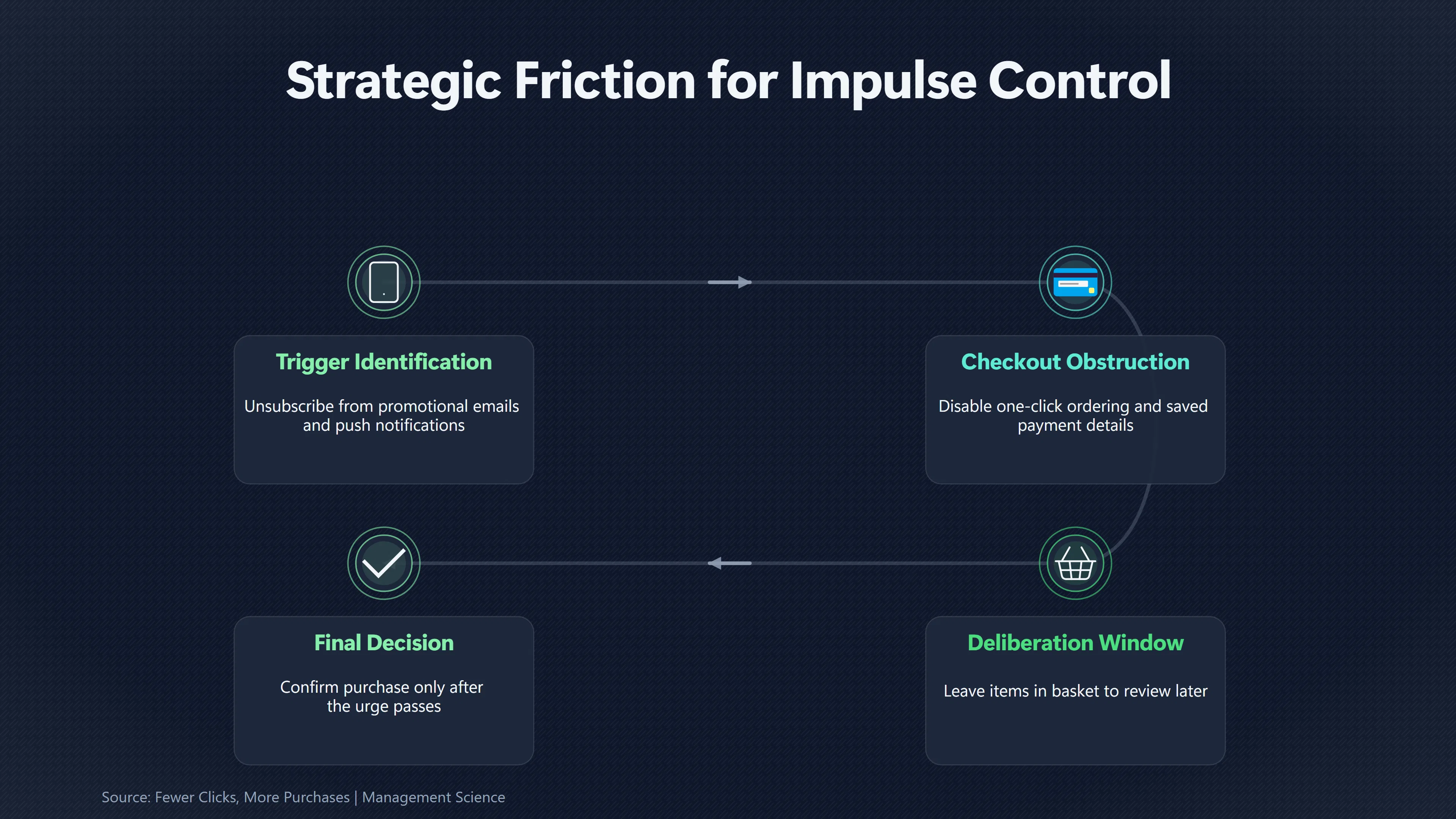
A practical version can be built around three layers:
-
At the trigger: unsubscribe from promotional emails and texts, disable shopping-app notifications and remove retailer apps whose main effect is prompting recreational browsing. The CMA’s evidence review gives reason to take scarcity, popularity messages and reminders seriously rather than assuming that consumers simply ignore them. GOV.UK
-
At the checkout: disable one-click ordering, remove stored payment details from problem retailers and avoid automatic sign-in where it makes buying nearly instantaneous. This directly restores some of the steps that commercial checkout optimisation removes. PubsOnline
-
At the final decision: for an unplanned discretionary purchase, leave the item in the basket or on a wish list and return later. A delay need not be universal or rigid: the point is to prevent a temporary state of urgency from determining the transaction. Experimental work provides some support for postponement as an intervention against impulse-promoting online designs. Cambridge University Press
The amount of friction should match the problem. Someone occasionally buying a £15 item they do not need may require nothing more than deleting a saved card. Someone repeatedly making larger unplanned orders might use a longer delay before discretionary purchases. Conversely, adding repeated barriers to medication, essential household goods or genuinely time-sensitive travel would defeat the purpose. The objective is not to make all commerce unpleasant.
It is also worth keeping the intervention simple enough that it cannot be effortlessly bypassed. Removing a retailer’s stored card achieves little if the browser instantly fills the same details; deleting a shopping app achieves little if promotional emails provide a direct route back. Rather than adding ten minor restrictions, it is often more coherent to identify the shortest route from trigger → product → payment and place one meaningful interruption in that route.
Friction works best as a pause, not a punishment
There is a temptation to make anti-spending systems severe: block every shopping site, delete every account and turn each purchase into an ordeal. That confuses the mechanism with the goal. Friction is useful when it distinguishes a passing impulse from a durable intention. If an item still seems worthwhile after retrieving a card, checking the total and returning after a delay, the extra steps have done their job even if the eventual decision is to buy it.
The broader online environment makes that modest intervention more relevant. Regulators describe digital interfaces as “choice architecture” precisely because presentation, defaults, prompts and effort influence decisions. A 2024 international review of 642 subscription websites and apps found that nearly 76% displayed at least one potential dark pattern and nearly 67% displayed more than one, although the review did not determine that every identified practice was unlawful. Federal Trade Commission The UK CMA similarly warns that digital design can use pressure selling, hidden charges and other techniques in ways that do not benefit consumers. GOV.UK
For self-improvement, the useful response is not to try to become psychologically immune to every interface. It is to recognise that convenience is itself part of the environment. When spontaneous online spending is a recurring problem, removing saved payments, disabling one-click ordering, reducing retailer prompts and inserting a short delay converts an almost automatic action back into an explicit decision. That is a small environmental change, but it targets the purchase at exactly the point where a few extra seconds or steps can matter.
Amazon book picks
Further Reading
Books and field guides related to Can Extra Checkout Steps Curb Impulse Buying?. Use these as the next step if you want deeper reading beyond the article.
Nudge
Rating: 3.5/5 from 29 Google Books ratings
Thaler and Sunstein offer a groundbreaking discussion of how to apply the science of choice to nudge people toward decisions that can imp...
The Psychology of Money
Doing well with money isn't necessarily about what you know. It's about how you behave. And behavior is hard to teach, even to really sma...
Atomic Habits
Rating: 3.5/5 from 7 Google Books ratings
The #1 New York Times bestseller. Over 25 million copies sold! Translated into 60+ languages! Tiny Changes, Remarkable Results No matter...
Scarcity Brain
NEW YORK TIMES BESTSELLER • The author of The Comfort Crisis asks: Are we hardwired to crave more? From food and stuff to information and...
eBay marketplace picks
Marketplace Samples
Live-tested eBay searches with available results related to this page.
Selected frommoney motivation poster oneBay.co.uk.
References
[- Fewer Clicks, More Purchases(https://pubsonline.informs.org/doi/10.1287/mnsc.2023.4716)](#endnote-2 “
Source snippet
DOIFewer Clicks, More Purchases | Management Science")...
Endnotes
2.
Source: doi.org
Title: Fewer Clicks, More Purchases | Management Science
Link:https://doi.org/10.1287%2Fmnsc.2023.4716
Source snippet
Fewer Clicks, More Purchases | Management Science...
3.
Source: doi.org
Title: The pain of payment: A review and research agenda
Link:https://doi.org/10.1002/mar.21825
Source snippet
The pain of payment: A review and research agenda - Reshadi - 2023 - Psychology & Marketing - Wiley Online Library...
5.
Source: GOV.UK
Link:https://www.gov.uk/government/publications/online-choice-architecture-how-digital-design-can-harm-competition-and-consumers
6.
Source: GOV.UK
Title: The prevalence and potential harm of defaults in online shopping
Link:https://www.gov.uk/government/publications/the-prevalence-and-potential-harm-of-defaults-in-online-shopping
7.
Source: ftc.gov
Link:https://www.ftc.gov/business-guidance/blog/2022/12/245-million-ftc-settlement-alleges-fortnite-owner-epic-games-used-digital-dark-patterns-charge
8.
Source: search.ftc.gov
Link:https://search.ftc.gov/news-events/news/press-releases/2023/03/ftc-finalizes-order-requiring-fortnite-maker-epic-games-pay-245-million-tricking-users-making
9.
Source: search.ftc.gov
Link:https://search.ftc.gov/news-events/news/press-releases/2024/07/ftc-icpen-gpen-announce-results-review-use-dark-patterns-affecting-subscription-services-privacy
10.
Source: GOV.UK
Title: Online choice architecture
Link:https://www.gov.uk/government/collections/online-choice-architecture
11.
Source: doi.org
Link:https://doi.org/10.1080/10447318.2026.2662520
12.
Source: doi.org
Link:https://doi.org/10.55041/ijsmt.v2i5.182
13.
Source: GOV.UK
Title: www.gov.uk Providing clear and accurate information about prices
Link:https://www.gov.uk/government/publications/price-transparency-cma209/providing-clear-and-accurate-information-about-prices-summary
14.
Source: GOV.UK
Link:https://www.gov.uk/government/news/cma-launches-major-consumer-protection-drive-focused-on-online-pricing-practices
15.
Source: ftc.gov
Title: Publishers Clearing House, LLC (PCH), FTC v. | Federal Trade Commission
Link:https://www.ftc.gov/legal-library/browse/cases-proceedings/182-3145-publishers-clearing-house-llc-pch-ftc-v
16.
Source: find-and-update.company-information.service.gov.uk
Title: company-information.service.gov.uk Charge
Link:https://find-and-update.company-information.service.gov.uk/company/00026552/charges/sWXswbqM9cks43S-pMgFJuszVOw
17.
Source: GOV.UK
Title: consumer detriment survey 2024
Link:https://www.gov.uk/government/publications/consumer-detriment-survey-2024
18.
Source: findajob.dwp.gov.uk
Title: dwp.gov.uk Head of Analysis | Job details | Find a job
Link:https://findajob.dwp.gov.uk/details/16101510
19.
Source: GOV.UK
Title: www.gov.uk Setting the Personal Injury Discount Rate: A call for evidence
Link:https://www.gov.uk/government/calls-for-evidence/setting-the-personal-injury-discount-rate/setting-the-personal-injury-discount-rate-a-call-for-evidence
20.
Source: GOV.UK
Title: www.gov.uk Groceries: Loyalty prices offer genuine savings, says CMA
Link:https://www.gov.uk/government/news/groceries-loyalty-prices-offer-genuine-savings-says-cma
21.
Source: GOV.UK
Title: www.gov.uk New measures unveiled to crack down on subscription traps
Link:https://www.gov.uk/government/news/new-measures-unveiled-to-crack-down-on-subscription-traps
22.
Source: ftc.gov
Title: Credit Karma, LLC | Federal Trade Commission
Link:https://www.ftc.gov/legal-library/browse/cases-proceedings/2023138-credit-karma-llc
23.
Source: GOV.UK
Title: www.gov.uk CM A cost of living update
Link:https://www.gov.uk/government/publications/cost-of-living-update/cma-cost-of-living-update
24.
Source: GOV.UK
Title: www.gov.uk Testing the impact of algorithmic rankings on consumer choice
Link:https://www.gov.uk/government/publications/testing-the-impact-of-algorithmic-rankings-on-consumer-choice
25.
Source: GOV.UK
Link:https://www.gov.uk/government/publications/unit-pricing-analysis-and-consumer-research/summary-of-consumer-research-and-unit-pricing-analysis
26.
Source: GOV.UK
Link:https://www.gov.uk/government/news/new-laws-set-to-ban-mandatory-hidden-fees-from-online-shopping-saving-money-for-consumers
27.
Source: GOV.UK
Title: www.gov.uk Estimating the prevalence and impact of drip pricing
Link:https://www.gov.uk/government/publications/estimating-the-prevalence-and-impact-of-drip-pricing
28.
Source: ftc.gov
Link:https://www.ftc.gov/news-events/news/press-releases/2023/06/ftc-takes-action-against-amazon-enrolling-consumers-amazon-prime-without-consent-sabotaging-their
29.
Source: consumer.ftc.gov
Title: were you charged amazon prime without your permission
Link:https://consumer.ftc.gov/consumer-alerts/2023/06/were-you-charged-amazon-prime-without-your-permission?page=1
30.
Source: competitionandmarkets.blog.gov.uk
Link:https://competitionandmarkets.blog.gov.uk/2023/03/31/urgency-and-price-reduction-claims-are-your-online-tactics-legal/
31.
Source: GOV.UK
Title: www.gov.uk Using urgency and price reduction claims online
Link:https://www.gov.uk/government/publications/using-urgency-and-price-reduction-claims-online
32.
Source: food.gov.uk
Link:https://www.food.gov.uk/research/behaviour-and-perception/testing-the-impact-of-overt-and-covert-ordering-interventions-on-sustainable-consumption-choices-a-randomised-controlled-trial?print=1
33.
Source: ftc.gov
Link:https://www.ftc.gov/news-events/news/press-releases/2022/12/fortnite-video-game-maker-epic-games-pay-more-half-billion-dollars-over-ftc-allegations
34.
Source: GOV.UK
Title: www.gov.uk CM A investigates online selling practices based on ‘urgency’ claims
Link:https://www.gov.uk/government/news/cma-investigates-online-selling-practices-based-on-urgency-claims
35.
Source: consumer.ftc.gov
Title: how companies manipulate you online what ftc doing protect you
Link:https://consumer.ftc.gov/consumer-alerts/2022/09/how-companies-manipulate-you-online-what-ftc-doing-protect-you
36.
Source: ftc.gov
Link:https://www.ftc.gov/news-events/news/press-releases/2022/09/ftc-report-shows-rise-sophisticated-dark-patterns-designed-trick-trap-consumers
37.
Source: GOV.UK
Link:https://www.gov.uk/find-digital-market-research/online-choice-architecture-how-digital-design-can-harm-competition-and-consumers-2022-cma
38.
Source: GOV.UK
Link:https://www.gov.uk/find-digital-market-research/evidence-review-of-online-choice-architecture-and-consumer-and-competition-harm-2022-cma
39.
Source: competitionandmarkets.blog.gov.uk
Link:https://competitionandmarkets.blog.gov.uk/2022/04/07/online-choice-architecture-how-do-we-end-up-making-decisions-we-dont-want/
40.
Source: GOV.UK
Link:https://www.gov.uk/government/consultations/nhs-pension-scheme-proposed-changes-to-member-contributions/outcome/nhs-pension-scheme-proposed-changes-to-member-contributions-consultation-response
41.
Source: ftc.gov
Title: Bringing Dark Patterns to Light: An FTC Workshop | Federal Trade Commission
Link:https://www.ftc.gov/news-events/events/2021/04/bringing-dark-patterns-light-ftc-workshop
42.
Source: GOV.UK
Title: competition and markets authority annual report and accounts 201718
Link:https://www.gov.uk/government/publications/cma-annual-report-and-accounts-2017-to-2018/competition-and-markets-authority-annual-report-and-accounts-201718
43.
Source: GOV.UK
Title: www.gov.uk HMR C acts to improve customer service
Link:https://www.gov.uk/government/news/hmrc-acts-to-improve-customer-service
44.
Source: GOV.UK
Title: www.gov.uk Money saving ideas for Defence honoured
Link:https://www.gov.uk/government/news/money-saving-ideas-for-defence-honoured
45.
Source: find-and-update.company-information.service.gov.uk
Title: company-information.service.gov.uk Charge
Link:https://find-and-update.company-information.service.gov.uk/company/00026552/charges/isn3tnoCvNRoZVucMRfgc6t4ALI
46.
Source: ftc.gov
Link:https://www.ftc.gov/news-events/news/press-releases/2021/02/ftc-hold-virtual-workshop-exploring-digital-dark-patterns
47.
Source: competitionandmarkets.blog.gov.uk
Link:https://competitionandmarkets.blog.gov.uk/category/online-choice-architecture/
48.
Source: find-and-update.company-information.service.gov.uk
Title: company-information.service.gov.uk LOLLIPO P GROUP LTD overview
Link:https://find-and-update.company-information.service.gov.uk/company/11766971
49.
Source: find-and-update.company-information.service.gov.uk
Title: company-information.service.gov.uk BAAN G LIMITED overview
Link:https://find-and-update.company-information.service.gov.uk/company/09630654
50.
Source: find-and-update.company-information.service.gov.uk
Title: company-information.service.gov.uk SCAVOLIN I S.P.A. overview
Link:https://find-and-update.company-information.service.gov.uk/company/FC032400
51.
Source: find-and-update.company-information.service.gov.uk
Title: company-information.service.gov.uk BE V TRADING LTD filing history
Link:https://find-and-update.company-information.service.gov.uk/company/13068116/filing-history
52.
Source: applytosupply.digitalmarketplace.service.gov.uk
Title: digitalmarketplace.service.gov.uk I G Data Discovery
Link:https://www.applytosupply.digitalmarketplace.service.gov.uk/g-cloud/services/883997783397803
54.
Source: pubsonline.informs.org
Title: Pubs Online Fewer Clicks, More Purchases | Management Science
Link:https://pubsonline.informs.org/doi/abs/10.1287/mnsc.2023.4716
55.
Source: pmc.ncbi.nlm.nih.gov
Link:https://pmc.ncbi.nlm.nih.gov/articles/PMC11444724/
Source snippet
PubMed Central (PMC)Why does mobile payment promote purchases? Revisiting the pain of paying, and understanding the implicit pleasure via...
56.
Source: pmc.ncbi.nlm.nih.gov
Link:https://pmc.ncbi.nlm.nih.gov/articles/PMC13132400/
57.
Source: pmc.ncbi.nlm.nih.gov
Link:https://pmc.ncbi.nlm.nih.gov/articles/PMC12561318/
58.
Source: pmc.ncbi.nlm.nih.gov
Link:https://pmc.ncbi.nlm.nih.gov/articles/PMC12174854/
59.
Source: pmc.ncbi.nlm.nih.gov
Link:https://pmc.ncbi.nlm.nih.gov/articles/PMC11939284/
60.
Source: ablesci.com
Title: Fewer Clicks, More Purchases
Link:https://www.ablesci.com/scholar/paper?id=8z57QLmkE
Additional References
61.
Source: onlinelibrary.wiley.com
Link:https://onlinelibrary.wiley.com/doi/10.1002/cb.2193
Source snippet
Wiley Online LibraryEffects of mental accounting on purchase decision processes: A systematic review and research agenda - Skwara - 2023...
62.
Source: nature.com
Link:https://www.nature.com/articles/s41599-023-02204-w
63.
Source: youtube.com
Title: 10 Unsexy Habits That Save Me Serious Money
Link:https://www.youtube.com/watch?v=B5sFampEvx0
Source snippet
Stop impulse buying friction online shopping How to Stop Impulse Buying Online...
64.
Source: youtube.com
Title: How to Stop Overspending
Link:https://www.youtube.com/watch?v=7aTBJJhwZlg
Source snippet
10 Unsexy Habits That Save Me Serious Money...
65.
Source: youtube.com
Title: How to Avoid Impulse Spending When You Have ADHD
Link:https://www.youtube.com/watch?v=r_3DR6jXzXM
Source snippet
How to Stop Overspending - 5 Tips for Compulsive Buying Disorder...
66.
Source: researchgate.net
Link:https://www.researchgate.net/publication/360474910_Dark_patterns_in_online_shopping_do_they_work_and_can_nudges_help_mitigate_impulse_buying
67.
Source: tookitaki.com
Link:https://www.tookitaki.com/glossary
68.
Source: mdpi.com
Link:https://www.mdpi.com/0718-1876/21/7/227
69.
Source: sciencedirect.com
Link:https://www.sciencedirect.com/science/article/pii/S0747563220302569
70.
Source: sciencedirect.com
Link:https://www.sciencedirect.com/science/article/abs/pii/S1567422323000984