Within Sleep Foundation
Should Sleep Come Before Another Productivity Habit?
Protecting enough sleep can make ambitious routines more realistic by preserving the attention and follow-through they depend on.
On this page
- What adult sleep duration guidance recommends
- Why cutting sleep for productivity can backfire
- How to design routines around adequate rest
Page outline Jump by section
Introduction
For most healthy adults, sleep should usually come before another productivity habit when the new habit would require routinely cutting sleep. The American Academy of Sleep Medicine (AASM) and Sleep Research Society recommend seven or more hours of sleep a night on a regular basis, while the NHS says adults need seven to nine hours on average. Individual needs vary, but a self-improvement plan built around persistent short sleep is asking attention, learning and follow-through to operate under an avoidable constraint.[AASM]Protect a realistic sleep window first.Open source on aasm.org.
This changes how an ambitious routine should be designed. The question is not simply whether an extra hour awake could accommodate exercise, study, meditation or a side project. It is whether taking that hour from sleep leaves the following day’s behaviour reliable enough to make the trade worthwhile. Controlled sleep-restriction research suggests that repeated short nights can progressively impair performance, while people may not accurately appreciate the extent of that deterioration.[PubMed]pubmed.ncbi.nlm.nih.govThe cumulative cost of additional wakefulness: dose-response effects on neurobehavioral functions and sleep physiology from chronic…
The practical rule is therefore to treat adequate sleep as a constraint on the plan, rather than as whatever time remains after everything else has been scheduled.
What adult sleep guidance actually recommends
The widely quoted seven-hour figure is better understood as a lower boundary for regular sleep than as a universal target. The AASM/Sleep Research Society consensus states that adults should regularly obtain at least seven hours to promote optimal health. The panel also emphasised individual variation in sleep need, influenced by genetic, behavioural, medical and environmental factors.[PubMed Central (PMC)]pmc.ncbi.nlm.nih.govPubMed Central (PMC)Recommended Amount of Sleep for a Healthy Adult: A Joint Consensus Statement of the American Academy of Sleep Medicin…
UK guidance is similarly resistant to a one-size-fits-all number. The NHS says everyone needs different amounts of sleep and gives seven to nine hours as the average adult requirement. Persistent daytime tiredness can be a sign that a person is not getting enough.[nhs.uk]nhs.ukInsomniaInsomnia
That distinction matters for self-improvement planning. “I get seven hours” is not proof that sleep has been optimised, just as sleeping less than seven hours does not diagnose the reason for someone’s difficulties. Duration is only one dimension of sleep, and sleep disorders, shift work and other circumstances can complicate the picture. But for an otherwise healthy adult voluntarily trimming an ordinary night’s sleep to make room for more goals, seven hours is a useful warning line rather than an expendable block of time.
There is also a difference between an occasional short night and making sleep restriction part of the operating model. A late evening before a deadline is not equivalent to a routine that requires six hours every weekday. The latter repeatedly exposes the person to the very condition their improvement system is supposed to overcome: reduced capacity to perform consistently.
Why borrowing from sleep can make the plan worse
The seductive arithmetic of sleep sacrifice is straightforward. If waking at 5.30 am creates an extra hour for study or training, that appears to produce seven additional productive hours each week. The problem is that the calculation values waking time while assuming that the quality of those waking hours stays constant.
Laboratory evidence gives good reason not to make that assumption. In a well-known controlled experiment, 48 healthy adults were assigned to four, six or eight hours of time in bed for 14 consecutive nights, with separate participants undergoing total sleep deprivation. Neurobehavioural deficits accumulated across days in the four- and six-hour conditions. Importantly, subjective sleepiness did not track the continuing deterioration in objective performance particularly well.[PubMed]pubmed.ncbi.nlm.nih.govThe cumulative cost of additional wakefulness: dose-response effects on neurobehavioral functions and sleep physiology from chronic…
That finding makes chronic sleep restriction especially relevant to self-improvement. A plan can feel as though it is becoming normal precisely while performance is becoming less dependable. “I have got used to six hours” may describe adaptation to the feeling of the schedule rather than evidence that the cognitive cost has disappeared. The US National Heart, Lung, and Blood Institute explicitly identifies the idea that people can learn to function on little sleep without negative effects as a myth.[NHLBI, NIH]nhlbi.nih.govNHLBI, NIHSleep Deprivation and DeficiencyWhat Are Sleep Deprivation and Deficiency? | NHLBI, NIHMarch 24, 2022…
The most consistent vulnerability is attention. A meta-analysis of 61 sleep-restriction studies found negative effects across cognitive processing, including sustained attention, executive functioning and long-term memory. A newer meta-analysis examining a single restricted night likewise found increased sleepiness, slower sustained-attention responses and more attentional lapses, although several other cognitive outcomes did not show significant deterioration.[PubMed]pubmed.ncbi.nlm.nih.govThe neurocognitive consequences of sleep restriction: A meta-analytic review - PubMed…
That qualification is important. Sleep loss does not make every mental function collapse equally, and it does not mean that every short night destroys productivity. Rather, it makes some of the capacities required for dependable execution less robust. For a self-improvement system, reliability can matter more than peak performance: missing cues, drifting away from a study task or repeatedly making small errors can undermine a routine even if the person remains capable of impressive work for periods of time.
Motivation does not fully solve the problem
The constraint is not purely cognitive. A review of sleep deprivation, effort and performance found evidence that sleep loss can make cognitive performance feel more effortful and reduce willingness to invest effort. Stronger external incentives can induce greater effort and partially compensate for impairment, but they do not simply erase the underlying effects of sleep loss.[PubMed]pubmed.ncbi.nlm.nih.govPub Med Sleep deprivation, effort allocation and performanceSleep deprivation, effort allocation and performance - PubMedApril 3, 2019…
Experimental work has also found reduced willingness to exert cognitive effort following sleep restriction, without an equivalent reduction in physical-effort motivation in that study.[PubMed Central (PMC)]pmc.ncbi.nlm.nih.govOpen source on nih.gov. This is particularly relevant to routines involving studying, writing, deliberate practice or difficult administrative work. A schedule may create more nominal time for those activities while simultaneously making engagement with them less attractive.
Real-world evidence points in the same broad direction, although observational workplace studies cannot establish causation as cleanly as controlled experiments. In a study of 4,188 employees at four US companies, groups classified as having insomnia or insufficient sleep syndrome showed worse productivity, performance and safety outcomes than comparison groups.[PubMed]pubmed.ncbi.nlm.nih.govPub Med The cost of poor sleep: workplace productivity loss and associated costsPub Med The cost of poor sleep: workplace productivity loss and associated costs
The lesson is not that sleep automatically produces achievement. It is that motivation techniques, discipline and productivity systems operate on top of a variable level of cognitive capacity. Repeatedly reducing that capacity and then adding motivational machinery to compensate is an unnecessarily fragile design.
More waking hours are not necessarily more useful hours
This distinction becomes clearest when a routine is considered as a weekly system rather than as a daily timetable. Imagine that someone currently allows eight hours for sleep but wants to add an hour of morning study. Moving bedtime earlier preserves the sleep opportunity; simply moving the alarm earlier does not. Both versions contain the new study session, but only one avoids financing it by reducing recovery time.
Research comparing adequate and insufficient sleep illustrates why that distinction matters. In a randomised crossover study, adults who normally slept seven to nine hours completed six-week conditions involving either stable adequate sleep or a reduction of 1.5 hours a night. Researchers reported improvements in working-memory performance after the adequate-sleep condition beyond expected practice effects, with a similar pattern for an attention and inhibitory-control task.[PubMed]pubmed.ncbi.nlm.nih.govOpen source on nih.gov.
Nor is “I will catch up at the weekend” a complete solution. In a six-week experiment involving 15 high-performing adults, weekday sleep opportunities were limited to five hours and weekend opportunities to eight. Accuracy and vigilant attention declined with increasing sleep debt, and two weekend recovery nights did not restore the affected measures. The study was small, so it should not be treated as a universal estimate of weekend recovery, but it demonstrates why planned weekday deprivation should not automatically be considered harmless simply because longer weekend sleep is available.[PubMed]pubmed.ncbi.nlm.nih.govOpen source on nih.gov.
Consensus guidance on sleep regularity takes a more nuanced position: catch-up sleep on non-work days may be beneficial when weekday sleep has been insufficient, while regular sleep timing itself is considered important for health and performance.[PubMed]pubmed.ncbi.nlm.nih.govOpen source on nih.gov. In other words, recovery sleep can be useful without making deliberate chronic restriction an efficient strategy.

Design the routine around adequate rest
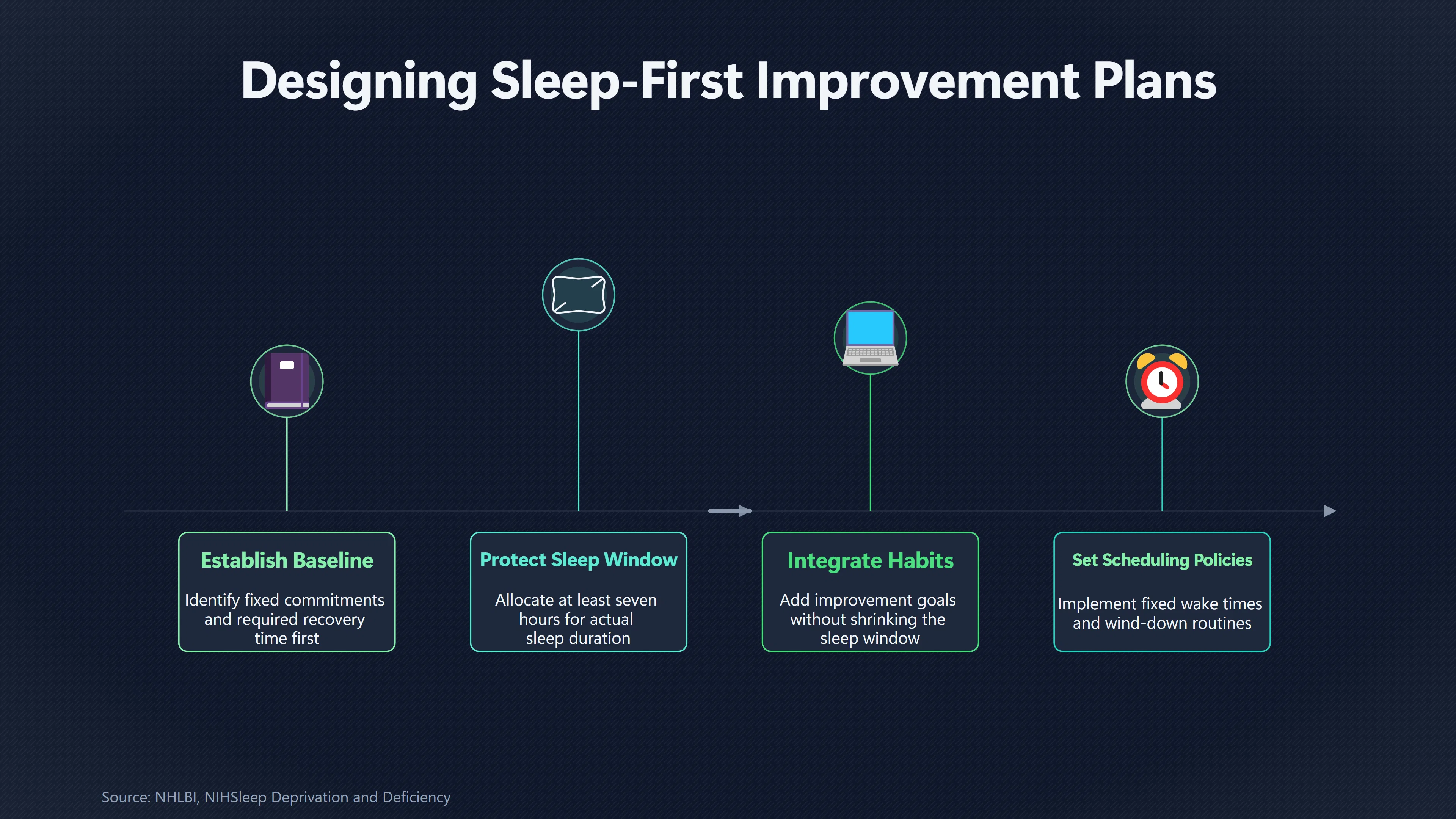
Treating sleep as a constraint does not mean constructing life around a perfect bedtime or abandoning ambitious goals. It means budgeting time in the right order. Start with fixed commitments and a realistic sleep opportunity; then decide how much capacity remains for discretionary improvement activities.
A practical hierarchy looks like this:
-
Protect a realistic sleep window first. For most healthy adults, design around at least seven hours of actual sleep, recognising that many need more and that time in bed is not identical to time asleep. AASM
- Add the improvement habit without silently moving bedtime later or wake time earlier. If the new routine only fits by repeatedly shrinking sleep, reduce its duration, frequency or number of simultaneous goals.
- Prefer a smaller repeatable habit to a larger sleep-funded one. Thirty minutes of study that leaves adequate sleep intact may be a more robust system than a 90-minute session whose cost appears the following day as poorer attention and greater cognitive effort.
-
Give bedtime its own implementation structure. The NHS recommends fixed sleep and wake times and a regular wind-down routine. Those are scheduling policies, not merely relaxation tips: they stop discretionary evening activities from consuming the sleep allocation. nhs.uk
- Reassess when daytime function remains poor. Persistent sleep difficulty or tiredness should not automatically be labelled a discipline problem. The NHS advises seeing a GP when sleep problems have persisted for months or are significantly affecting daily life. nhs.uk
One especially relevant failure mode is bedtime procrastination: voluntarily going to bed later than intended when no external circumstance requires the delay. A systematic review and meta-analysis of 43 studies found bedtime procrastination was associated with shorter sleep duration, poorer sleep quality and greater daytime fatigue, although the authors rated the underlying evidence as low quality and cautioned that causal relationships remain uncertain. PubMed
More recent objective evidence shows why planning can still be useful. A 2025 study of 119 university students found that bedtime plans were uncommon and, when made, were often exceeded by about 46 minutes on average. Nevertheless, days on which participants made a bedtime plan were associated with earlier bedtimes and longer objectively measured sleep; studying and electronic leisure were common reasons for overrunning the intended bedtime. DOI
For someone pursuing self-improvement, that creates an important inversion. The activity stealing sleep may itself look virtuous: another chapter, another training video, another hour of work. The problem is not the value of the activity in isolation. It is that an improvement plan can become internally contradictory when today’s extra effort is repeatedly purchased with tomorrow’s attentional capacity.
When the plan is simply too ambitious
Adequate sleep functions as a useful test of whether a routine is realistically sized. If work, caring responsibilities, commuting, basic household tasks and sufficient sleep already consume nearly all available time, adding several demanding daily habits does not create new capacity. Something has to give.
Sleep is often the easiest item to cut because its opportunity cost is visible while its benefits are diffuse. An hour removed from sleep immediately appears as an hour on the calendar. The resulting costs may emerge later as slower work, attentional lapses, reduced willingness to tackle demanding tasks or the need to redo errors. That asymmetry can make sleep sacrifice look more productive than it is. Research on cognitive effort and chronic restriction provides a plausible basis for exactly this kind of hidden trade-off. PubMed
There is evidence that increasing sleep opportunity is feasible even outside tightly controlled laboratories, although adding time in bed does not translate minute-for-minute into additional sleep. In one randomised pilot study of habitual short sleepers, behavioural sleep advice increased time in bed by about 55 minutes relative to controls but sleep duration by about 21 minutes. PubMed A 2026 intervention in 30 healthy adults habitually sleeping less than 6.5 hours found that asking participants to add two hours of time in bed increased objectively measured sleep by roughly 47 minutes on average. PubMed
Those results discourage another perfectionist mistake: assuming that “prioritising sleep” means instantly achieving an exact nightly number. Sleep cannot simply be commanded. The controllable part of the self-improvement plan is primarily opportunity and scheduling — whether enough time has been protected for sleep to occur.
That leads to a more durable definition of ambition. A demanding routine is not ambitious merely because it contains many activities. It is ambitious and viable when it leaves enough recovery capacity to execute those activities repeatedly. When another productivity habit competes directly with adequate sleep, reducing the habit is often not retreating from self-improvement. It is governance: placing a constraint on the plan so that attention and follow-through remain available for the improvements that matter most.
Amazon book picks
Further Reading
Books and field guides related to Should Sleep Come Before Another Productivity Habit?. Use these as the next step if you want deeper reading beyond the article.
Why We Sleep
"Sleep is one of the most important but least understood aspects of our life, wellness, and longevity ... An explosion of scientific disc...
The Sleep Solution
With cutting-edge sleep science and time-tested techniques, The Sleep Solution will help anyone achieve healthy sleep and eliminate pills...
Sleep Smarter
Shawn Stevenson is a health expert with a background in biology and kinesiology who has helped thousands of people worldwide to improve t...
The Sleep Fix
From Emmy Award-winning ABC News anchor/correspondent and former insomniac Diane Macedo comes a practical, user-friendly guide to getting...
eBay marketplace picks
Marketplace Samples
Example marketplace items related to this page. Use the search link to explore similar finds on eBay.
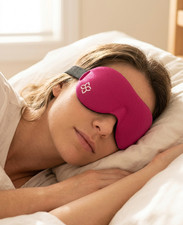
Selected fromsleep mask oneBay.co.uk.


Endnotes
3.
Source: pubmed.ncbi.nlm.nih.gov
Link:https://pubmed.ncbi.nlm.nih.gov/12683469/
Source snippet
The cumulative cost of additional wakefulness: dose-response effects on neurobehavioral functions and sleep physiology from chronic...
4.
Source: pubmed.ncbi.nlm.nih.gov
Link:https://pubmed.ncbi.nlm.nih.gov/28757454/
Source snippet
The neurocognitive consequences of sleep restriction: A meta-analytic review - PubMed...
5.
Source: pmc.ncbi.nlm.nih.gov
Link:https://pmc.ncbi.nlm.nih.gov/articles/PMC4434546/
Source snippet
PubMed Central (PMC)Recommended Amount of Sleep for a Healthy Adult: A Joint Consensus Statement of the American Academy of Sleep Medicin...
6.
Source: pubmed.ncbi.nlm.nih.gov
Link:https://pubmed.ncbi.nlm.nih.gov/26235159/
Source snippet
Joint Consensus Statement of the American Academy of Sleep Medicine and Sleep Research Society on the Recommended Amount of Sleep f...
7.
Source: nhlbi.nih.gov
Title: NHLBI, NIHSleep Deprivation and Deficiency
Link:https://www.nhlbi.nih.gov/health/sleep-deprivation
Source snippet
What Are Sleep Deprivation and Deficiency? | NHLBI, NIHMarch 24, 2022...
Published: March 24, 2022
8.
Source: pubmed.ncbi.nlm.nih.gov
Link:https://pubmed.ncbi.nlm.nih.gov/38759474/
Source snippet
Impact of one night of sleep restriction on sleepiness and cognitive function: A systematic review and meta-analysis - PubMed...
9.
Source: pubmed.ncbi.nlm.nih.gov
Title: Pub Med Sleep deprivation, effort allocation and performance
Link:https://pubmed.ncbi.nlm.nih.gov/31072557/
Source snippet
Sleep deprivation, effort allocation and performance - PubMedApril 3, 2019...
Published: April 3, 2019
10.
Source: pmc.ncbi.nlm.nih.gov
Link:https://pmc.ncbi.nlm.nih.gov/articles/PMC9642807/
11.
Source: pubmed.ncbi.nlm.nih.gov
Title: Pub Med The cost of poor sleep: workplace productivity loss and associated costs
Link:https://pubmed.ncbi.nlm.nih.gov/20042880/
12.
Source: pubmed.ncbi.nlm.nih.gov
Link:https://pubmed.ncbi.nlm.nih.gov/38233280/
13.
Source: pubmed.ncbi.nlm.nih.gov
Link:https://pubmed.ncbi.nlm.nih.gov/33630069/
14.
Source: pubmed.ncbi.nlm.nih.gov
Link:https://pubmed.ncbi.nlm.nih.gov/37684151/
16.
Source: pubmed.ncbi.nlm.nih.gov
Link:https://pubmed.ncbi.nlm.nih.gov/36375334/
17.
Source: doi.org
Link:https://doi.org/10.1016%2Fj.sleep.2025.106556
18.
Source: pubmed.ncbi.nlm.nih.gov
Link:https://pubmed.ncbi.nlm.nih.gov/29381788/
19.
Source: pubmed.ncbi.nlm.nih.gov
Link:https://pubmed.ncbi.nlm.nih.gov/41768370/
20.
Source: nhlbi.nih.gov
Title: diagnosis treatment
Link:https://www.nhlbi.nih.gov/health/sleep-deprivation/diagnosis-treatment
21.
Source: pubmed.ncbi.nlm.nih.gov
Link:https://pubmed.ncbi.nlm.nih.gov/41825236/
22.
Source: aasm.org
Title: consensus statements and papers
Link:https://aasm.org/clinical-resources/practice-standards/consensus-statements-and-papers/
23.
Source: pmc.ncbi.nlm.nih.gov
Link:https://pmc.ncbi.nlm.nih.gov/articles/PMC13094871/
24.
Source: pmc.ncbi.nlm.nih.gov
Link:https://pmc.ncbi.nlm.nih.gov/articles/PMC12947849/
25.
Source: pmc.ncbi.nlm.nih.gov
Link:https://pmc.ncbi.nlm.nih.gov/articles/PMC12698726/
26.
Source: pubmed.ncbi.nlm.nih.gov
Link:https://pubmed.ncbi.nlm.nih.gov/40984126/
27.
Source: pmc.ncbi.nlm.nih.gov
Link:https://pmc.ncbi.nlm.nih.gov/articles/PMC12387293/
28.
Source: pubmed.ncbi.nlm.nih.gov
Link:https://pubmed.ncbi.nlm.nih.gov/40490878/
29.
Source: uclh.nhs.uk
Link:https://www.uclh.nhs.uk/patients-and-visitors/patient-information-pages/sleep-hygeine
30.
Source: pubmed.ncbi.nlm.nih.gov
Link:https://pubmed.ncbi.nlm.nih.gov/39732750/
31.
Source: pubmed.ncbi.nlm.nih.gov
Link:https://pubmed.ncbi.nlm.nih.gov/39700763/
32.
Source: pubmed.ncbi.nlm.nih.gov
Link:https://pubmed.ncbi.nlm.nih.gov/39427809/
33.
Source: pubmed.ncbi.nlm.nih.gov
Link:https://pubmed.ncbi.nlm.nih.gov/39698175/
34.
Source: pmc.ncbi.nlm.nih.gov
Link:https://pmc.ncbi.nlm.nih.gov/articles/PMC11651830/
35.
Source: pubmed.ncbi.nlm.nih.gov
Link:https://pubmed.ncbi.nlm.nih.gov/38759474/?format=pubmed
36.
Source: pubmed.ncbi.nlm.nih.gov
Link:https://pubmed.ncbi.nlm.nih.gov/37995463/
37.
Source: pmc.ncbi.nlm.nih.gov
Link:https://pmc.ncbi.nlm.nih.gov/articles/PMC10591759/
38.
Source: pubmed.ncbi.nlm.nih.gov
Link:https://pubmed.ncbi.nlm.nih.gov/37704562/
39.
Source: pubmed.ncbi.nlm.nih.gov
Link:https://pubmed.ncbi.nlm.nih.gov/37357134/
40.
Source: pubmed.ncbi.nlm.nih.gov
Link:https://pubmed.ncbi.nlm.nih.gov/37354745/
41.
Source: pmc.ncbi.nlm.nih.gov
Link:https://pmc.ncbi.nlm.nih.gov/articles/PMC10108639/
42.
Source: nhlbi.nih.gov
Title: health effects
Link:https://www.nhlbi.nih.gov/health/sleep-deprivation/health-effects
43.
Source: nhlbi.nih.gov
Title: healthy sleep habits
Link:https://www.nhlbi.nih.gov/health/sleep-deprivation/healthy-sleep-habits
44.
Source: nhlbi.nih.gov
Title: why sleep important
Link:https://www.nhlbi.nih.gov/health/sleep/why-sleep-important
45.
Source: pubmed.ncbi.nlm.nih.gov
Link:https://pubmed.ncbi.nlm.nih.gov/34459060/
46.
Source: nhs.uk
Title: www.nhs.uk Fall asleep faster and sleep better
Link:https://www.nhs.uk/every-mind-matters/mental-wellbeing-tips/how-to-fall-asleep-faster-and-sleep-better/?trk=public_post_main-feed-card-text
47.
Source: nhs.uk
Title: www.nhs.uk Sleep problems
Link:https://www.nhs.uk/every-mind-matters/mental-health-issues/sleep/?ac=227391
48.
Source: pmc.ncbi.nlm.nih.gov
Link:https://pmc.ncbi.nlm.nih.gov/articles/PMC8271199/
49.
Source: pmc.ncbi.nlm.nih.gov
Link:https://pmc.ncbi.nlm.nih.gov/articles/PMC8171799/
50.
Source: pubmed.ncbi.nlm.nih.gov
Link:https://pubmed.ncbi.nlm.nih.gov/32360021/
51.
Source: pubmed.ncbi.nlm.nih.gov
Link:https://pubmed.ncbi.nlm.nih.gov/31680171/
52.
Source: aasm.org
Title: Adult Sleep Duration Health Advisory
Link:https://aasm.org/advocacy/position-statements/adult-sleep-duration-health-advisory/
53.
Source: pubmed.ncbi.nlm.nih.gov
Link:https://pubmed.ncbi.nlm.nih.gov/31096123/
54.
Source: pubmed.ncbi.nlm.nih.gov
Link:https://pubmed.ncbi.nlm.nih.gov/29601889/
55.
Source: pubmed.ncbi.nlm.nih.gov
Link:https://pubmed.ncbi.nlm.nih.gov/29776626/
56.
Source: pmc.ncbi.nlm.nih.gov
Link:https://pmc.ncbi.nlm.nih.gov/articles/PMC5972593/
57.
Source: pubmed.ncbi.nlm.nih.gov
Link:https://pubmed.ncbi.nlm.nih.gov/28486056/
58.
Source: pubmed.ncbi.nlm.nih.gov
Link:https://pubmed.ncbi.nlm.nih.gov/28364449/
59.
Source: pmc.ncbi.nlm.nih.gov
Link:https://pmc.ncbi.nlm.nih.gov/articles/PMC6084743/
60.
Source: pubmed.ncbi.nlm.nih.gov
Link:https://pubmed.ncbi.nlm.nih.gov/26194565/
61.
Source: pubmed.ncbi.nlm.nih.gov
Link:https://pubmed.ncbi.nlm.nih.gov/26194576/
62.
Source: aasm.org
Title: Sleep duration consensus statement receives national media coverage
Link:https://aasm.org/sleep-duration-consensus-statement-receives-national-media-coverage/
63.
Source: pubmed.ncbi.nlm.nih.gov
Link:https://pubmed.ncbi.nlm.nih.gov/25979105/
64.
Source: pmc.ncbi.nlm.nih.gov
Link:https://pmc.ncbi.nlm.nih.gov/articles/PMC4442216/
65.
Source: doi.org
Link:https://doi.org/10.5664/jcsm.4758
66.
Source: aasm.org
Title: AAS M and SRS publish new sleep duration consensus statement
Link:https://aasm.org/aasm-and-srs-publish-new-sleep-duration-consensus-statement/
67.
Source: aasm.org
Title: Seven or more hours of sleep per night: A health necessity for adults
Link:https://aasm.org/seven-or-more-hours-of-sleep-per-night-a-health-necessity-for-adults
68.
Source: pubmed.ncbi.nlm.nih.gov
Link:https://pubmed.ncbi.nlm.nih.gov/26039963/
69.
Source: pmc.ncbi.nlm.nih.gov
Link:https://pmc.ncbi.nlm.nih.gov/articles/PMC3600847/
70.
Source: pubmed.ncbi.nlm.nih.gov
Link:https://pubmed.ncbi.nlm.nih.gov/22754046/
71.
Source: pmc.ncbi.nlm.nih.gov
Link:https://pmc.ncbi.nlm.nih.gov/articles/PMC3369235/
72.
Source: pmc.ncbi.nlm.nih.gov
Link:https://pmc.ncbi.nlm.nih.gov/articles/PMC1978335/
73.
Source: pmc.ncbi.nlm.nih.gov
Link:https://pmc.ncbi.nlm.nih.gov/articles/PMC2656292/
74.
Source: pubmed.ncbi.nlm.nih.gov
Link:https://pubmed.ncbi.nlm.nih.gov/3982941/
75.
Source: pubmed.ncbi.nlm.nih.gov
Link:https://pubmed.ncbi.nlm.nih.gov/15018276/
76.
Source: nhs.uk
Title: www.nhs.uk Sleep problems
Link:https://www.nhs.uk/every-mind-matters/mental-health-issues/sleep/?ac=255900
77.
Source: nhs.uk
Title: www.nhs.uk Fall asleep faster and sleep better
Link:https://www.nhs.uk/every-mind-matters/mental-wellbeing-tips/how-to-fall-asleep-faster-and-sleep-better/?wt.tsrc=paid_search
78.
Source: nhs.uk
Title: www.nhs.uk Fall asleep faster and sleep better
Link:https://www.nhs.uk/every-mind-matters/mental-wellbeing-tips/how-to-fall-asleep-faster-and-sleep-better/?=__psv__p_49344716__t_w
79.
Source: guysandstthomas.nhs.uk
Title: Sleep problems
Link:https://www.guysandstthomas.nhs.uk/health-information/sleep-problems
80.
Source: myhealthlondon.nhs.uk
Link:https://www.myhealthlondon.nhs.uk/be-healthier/healthy-lifestyle/sleep/
81.
Source: pictonpcn.nhs.uk
Title: Picton Network PCN
Link:https://pictonpcn.nhs.uk/mental-health-services/sleep-hygiene/
82.
Source: slam.nhs.uk
Link:https://slam.nhs.uk/insomnia
83.
Source: keepingwellnwl.nhs.uk
Link:https://www.keepingwellnwl.nhs.uk/self-help-resources/common-problems/managing-sleep
84.
Source: swlondon-healthiertogether.nhs.uk
Link:https://www.swlondon-healthiertogether.nhs.uk/healthier-me/prehabilitation/waiting-well-preparing-yourself-surgery/sleeping-better
85.
Source: northumbria.nhs.uk
Link:https://www.northumbria.nhs.uk/our-services/your-health-and-wellbeing/sleep
86.
Source: mendipvale.nhs.uk
Title: Sleep SLEE P
Link:https://mendipvale.nhs.uk/services/health-and-wellbeing-coaching/sleep
87.
Source: selfhelp.cntw.nhs.uk
Link:https://selfhelp.cntw.nhs.uk/self-help-guides/sleeping-problems/print/529
88.
Source: nhsinform.scot
Title: Insomnia | NHS inform
Link:https://www.nhsinform.scot/illnesses-and-conditions/mental-health/insomnia/
90.
Source: cdc.gov
Link:https://www.cdc.gov/cdi/indicator-definitions/sleep.html
91.
Source: archive.cdc.gov
Link:https://archive.cdc.gov/www_cdc_gov/healthyschools/sleep.htm
92.
Source: cdc.gov
Link:https://www.cdc.gov/niosh/bulletin/2020/sleep.html
Additional References
93.
Source: youtube.com
Title: Effects of Sleep Deprivation on Attention and Mood
Link:https://www.youtube.com/watch?v=U9SiyStcIU8
Source snippet
Matthew Walker why sleep is essential for productivity Sleep Is Your Superpower | Matt Walker | TED...
94.
Source: youtube.com
Title: Master Your Sleep & Be More Alert When Awake | Huberman Lab Essentials
Link:https://www.youtube.com/watch?v=lIo9FcrljDk
Source snippet
Sleep Toolkit: Tools for Optimizing Sleep & Sleep-Wake Timing...
95.
Source: nature.com
Link:https://www.nature.com/articles/s41746-025-02155-3
96.
Source: nature.com
Link:https://www.nature.com/articles/s41386
97.
Source: youtube.com
Title: Sleep Toolkit: Tools for Optimizing Sleep & Sleep-Wake Timing
Link:https://www.youtube.com/watch?v=h2aWYjSA1Jc
Source snippet
Sleep deprivation and memory problems | Robbert Havekes | TEDxDenHelder...
98.
Source: youtube.com
Title: Sleep deprivation and memory problems | Robbert Havekes | TEDx Den Helder
Link:https://www.youtube.com/watch?v=F39IBJZlsek
Source snippet
Effects of Sleep Deprivation on Attention and Mood...
99.
Source: youtube.com
Title: Sleep Is Your Superpower | Matt Walker | TED
Link:https://www.youtube.com/watch?v=5MuIMqhT8DM
Source snippet
Master Your Sleep & Be More Alert When Awake | Huberman Lab Essentials...
100.
Source: sciencedirect.com
Link:https://www.sciencedirect.com/science/article/pii/S0149763424003981
101.
Source: sciencedirect.com
Link:https://www.sciencedirect.com/science/article/abs/pii/S0165032725002915
102.
Source: sciencedirect.com
Link:https://www.sciencedirect.com/science/article/abs/pii/S1389945726001358