Within Better Habits
Make Good Habits Easier Before You Need Them
Small reductions in effort, delay, or inconvenience can make a desired behaviour much more likely to happen repeatedly.
On this page
- Where friction hides in everyday routines
- Reducing setup and decision costs
- Testing whether convenience changes behaviour
Page outline Jump by section
Introduction
Friction is any small cost that sits between an intention and an action: finding equipment, opening an app, travelling somewhere, making another decision, waiting for a page to load, filling in a form or clearing a workspace before beginning. These obstacles can look trivial, yet behavioural research shows that changing effort can materially change what people actually do. A meta-analysis of 184 field experiments involving more than 2.2 million participants found that interventions altering effort produced stronger behavioural effects, on average, than those aimed at intrinsic motivation, although the authors caution that publication bias may inflate the apparent advantage.[PubMed Central (PMC)]pmc.ncbi.nlm.nih.govPub Med Central (PMC)A meta-analytic cognitive framework of nudge and sludgePubMed Central (PMC)A meta-analytic cognitive framework of nudge and sludge - PMCNovember 29, 2023…
For self-improvement, the practical lesson is not that every good habit should become effortless. It is that unnecessary effort before the useful part of the behaviour can prevent repetition. Removing that effort makes starting more likely; repeated starts in a stable context then give habit formation a chance to occur. Friction reduction is therefore best understood as a mechanism for making good behaviour easier to repeat, rather than as a substitute for repetition itself.[PubMed Central (PMC)]pmc.ncbi.nlm.nih.govOpen source on nih.gov.
Where friction hides in everyday routines
The most obvious friction is physical. Exercise that requires a long journey, cooking that begins with an empty fridge and study that requires clearing a cluttered desk all impose extra actions before the intended behaviour can begin. Those actions consume time and create additional opportunities to abandon the plan.
Distance provides a concrete illustration. In an observational study of an exercise programme for older adults, every additional kilometre between home and the gym was associated with an 8% reduction in the probability of adhering to the programme. Another German study found that greater distance from a gym was associated with lower participation in relevant sporting activities among rural girls, although the relationship was not consistent across all groups or facility types. These findings do not prove that moving a gym closer will automatically create an exercise habit, but they show why travel cost should not be dismissed as a minor inconvenience.[PubMed Central (PMC)]pmc.ncbi.nlm.nih.govPubMed Central (PMC)Adherence to a Community-Based Exercise Program is a Strong Predictor of Improved Back Pain Status in Older Adults: A…
Friction can also be remarkably local. A large workplace field study examined whether employees were more likely to take snacks when the snacks were close to the drinks station they used. Among men, the proportion taking a snack was 23% at the nearer station compared with 12% at the more distant one; among women it was 17% versus 13%. A difference of only a few steps altered behaviour. The important self-improvement lesson is symmetrical: greater friction can suppress an unwanted action, while lower friction can favour a wanted one.[ScienceDirect]sciencedirect.comProximity of snacks to beverages increases food consumption in the workplace: A field study - ScienceDirectAugust 1, 2016…
Not all friction is measured in steps. Setup friction appears when equipment must be found, charged, assembled or prepared. Decision friction appears when the person still has to decide what workout to do, which chapter to study or what meal to cook. Process friction appears when an action requires unnecessary clicks, forms, passwords or intermediate stages. Timing friction appears when the opportunity is badly matched to the day, such as a gym that requires a special journey rather than sitting along the normal route.
These costs can accumulate. “Go for a run” may actually mean find clean kit, locate headphones, decide a route, fill a bottle, change clothes and leave the house. None of those steps is individually difficult. Together, they make the behavioural threshold higher precisely when energy or motivation is low.
Research on people beginning a new daily routine points in the same direction. In a study in which participants took vitamin C for three weeks, people often chose cues partly because they wanted to minimise effort — for example, by keeping the relevant object nearby or visible. The researchers concluded that cue selection is influenced not only by memory but by how easily the behaviour fits the surrounding routine.[PubMed]pubmed.ncbi.nlm.nih.govWhat influences the selection of contextual cues when starting a new routine behaviour? An exploratory study - PubMedMarch 30, 2020…
Reduce setup before the moment of action
The useful distinction is between productive effort and access effort. Productive effort is the work the habit is meant to contain: lifting the weight, practising the scales, solving the problems or writing the paragraph. Access effort is everything required merely to reach that work. Friction reduction mainly targets the second category.
A difficult workout can still be a sensible goal. What need not be difficult is finding your trainers. Challenging study can be valuable; repeatedly searching for notes and deciding what to study is not part of that value. Preparing the environment in advance moves these incidental costs to a time when motivation is less fragile.
In practical terms, that can mean:
- laying out exercise clothes the night before rather than locating them at 6.30 am;
- keeping medication or vitamins beside an existing reliable routine, where appropriate and safe;
- leaving the book being read in the place where reading normally happens;
- opening tomorrow’s working document before finishing today;
- keeping frequently used healthy ingredients available and easy to reach;
- storing distracting devices away from the workspace while keeping necessary tools immediately accessible;
- choosing an exercise venue that lies on an existing route rather than one that requires a separate expedition.
This is more than tidiness. The aim is to alter the sequence of actions so that the desired behaviour occupies the shortest, clearest path.
The importance of accessibility is visible in settings where compliance matters greatly. Hand-hygiene research treats visibility, unobstructed access, proximity to the point of care and placement along the normal workflow as relevant features of sanitiser design.[PubMed Central (PMC)]pmc.ncbi.nlm.nih.govOpen source on nih.gov. The principle transfers cautiously to ordinary habits: put the useful action where the routine already passes, rather than expecting yourself to make a detour for it.
There is an important limit, however. More convenience is not always better once a genuine barrier has already been removed. In a Zurich emergency department where mounted hand-sanitiser dispensers were already available within two metres of every patient bed, giving staff wearable dispensers did not further increase observed hand-hygiene compliance. The extra convenience apparently did little because accessibility was no longer the main constraint; ergonomic issues and other barriers remained.[PubMed Central (PMC)]pmc.ncbi.nlm.nih.govOpen source on nih.gov.
That finding guards against a common mistake in self-improvement: endlessly optimising the environment after the significant friction has already disappeared. Moving a notebook from a drawer to the desk may matter. Spending an hour designing the perfect notebook arrangement may simply become another way of avoiding writing.
Reduce decisions as well as physical effort
Some routines fail not because the action is physically inconvenient but because it still requires a miniature planning session every time.
Consider exercise. “Exercise after work” leaves multiple unresolved questions: where, for how long, which movements, at what intensity and whether today is really suitable. “On Monday, Wednesday and Friday, change into the clothes already in my bag and start the saved 25-minute programme” removes much of that decision work.
The same principle applies to food, study and household routines. A short list of repeatable breakfasts can remove the morning question of what to eat. A preselected next chapter removes the question of where to resume studying. A fixed place for keys removes a recurring search task. The gain is not necessarily that fewer choices are universally superior. Research on choice overload is mixed, and a recent pre-registered field experiment on electricity contracts found that merely expanding the number of options did not have the same harmful effect as experimentally increasing cognitive load.[SSRN]papers.ssrn.comOpen source on ssrn.com. The stronger conclusion is narrower: when a useful action already has a known answer, repeatedly reopening the decision can create unnecessary cognitive work.
This is why advance preparation can outperform exhortations to “be disciplined”. The person is not trying to become incapable of making choices. They are reserving deliberation for occasions when a genuine choice exists.
Administrative research shows how surprisingly consequential such process costs can be. A field study of Los Angeles Police Department recruitment found that simplifying and standardising parts of the application process improved completion and hiring outcomes; one later reduction in perceived burden produced an 8% increase in compliance. Yet eliminating too much friction also kept some ineligible applicants in the process for longer.[Wiley Online Library]onlinelibrary.wiley.comOpen source on wiley.com.
That trade-off matters at an individual level too. Remove steps that serve no useful purpose, but retain steps that provide safety, reflection or quality control. Automatically preparing a study document is sensible. Automatically approving every purchase is not. Friction should be reduced selectively, not worshipped as an end in itself.
Easier repetition is what makes friction reduction valuable
The strongest connection between friction and habits runs through repetition. Psychological definitions of habit emphasise that behaviours become increasingly triggered by recurring contextual cues after repeated performance in stable circumstances. As the cue–response association strengthens, initiation requires less deliberate thought.[PubMed Central (PMC)]pmc.ncbi.nlm.nih.govPubMed Central (PMC)A review and analysis of the use of ‘habit’ in understanding, predicting and influencing health-related behaviour - PMC…
A recent systematic review of health-behaviour habit formation describes the process as moving through several stages: deciding to act, translating the intention into behaviour, repeating it and gradually developing automaticity. There is substantial variation in how long this takes; there is no universal number of days after which a behaviour becomes automatic.[PubMed Central (PMC)]pmc.ncbi.nlm.nih.govOpen source on nih.gov.
Friction reduction operates mainly in the vulnerable middle of that sequence. A person may already have decided to exercise or read. The problem is getting from decision to repeated performance often enough for the behaviour to become familiar and increasingly automatic.
That produces a useful causal chain:
less unnecessary friction → more successful starts → more repetitions in the same context → greater opportunity for automaticity to develop.
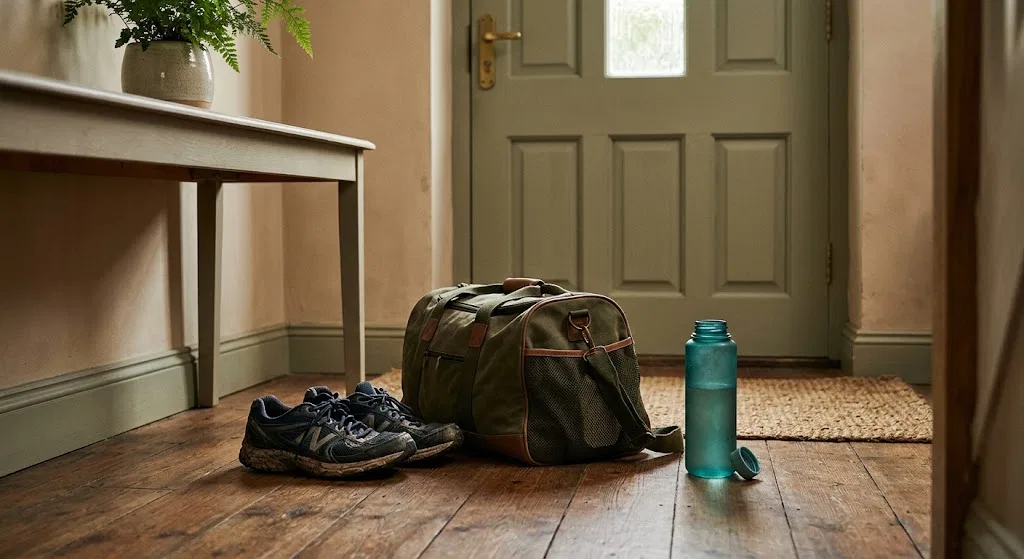
The links should not be collapsed. A pair of shoes beside the door is not itself an exercise habit. A prepared lunch is not automatically a dietary habit. These arrangements matter because they increase the odds that the relevant action is actually performed.
That distinction also explains why friction reduction works best when paired with a stable cue. “Keep the book visible” is helpful. “After making my evening tea, sit in the same chair and read the book already waiting there” supplies both convenience and a recurring context. Habit research consistently emphasises the role of repeated behaviour in response to recognisable cues rather than repetition scattered randomly across circumstances.[PubMed Central (PMC)]pmc.ncbi.nlm.nih.govOpen source on nih.gov.
Test whether convenience actually changes your behaviour
Friction is personal. The barrier an outside observer notices may not be the barrier controlling behaviour. Someone may blame a long gym journey when the real obstacle is uncertainty about what to do on arrival. Another person may buy vegetables regularly but fail to eat them because washing and chopping them at dinner time feels inconvenient. A third may have an ideal study desk yet avoid studying because each session begins without a defined next task.
The simplest way to identify the relevant friction is therefore experimental: change one inconvenience and watch whether behaviour changes.
A useful test runs for long enough to include ordinary tired and busy days, not only enthusiastic ones.
- Choose a behaviour that already matters. Friction reduction cannot create a meaningful goal on its own.
- Record what happens now. Count actual starts or completions for a week or two rather than relying on impressions.
- Locate the point of abandonment. Ask what happens immediately before the missed behaviour: searching, travelling, choosing, preparing, logging in, waiting or being distracted.
- Remove one cost. Prepare the equipment, shorten the route, decide the task in advance or place the cue directly in the normal path.
- Compare behaviour, not feelings. Did the number of successful starts increase?
- Keep changes that alter behaviour. If nothing changes, the bottleneck was probably elsewhere.
This matters because intuitive environmental changes can fail. The wearable-sanitiser study is a useful reminder that reducing a friction which is already small may produce no detectable improvement.[PubMed Central (PMC)]pmc.ncbi.nlm.nih.govOpen source on nih.gov. Conversely, the broader field-experiment literature suggests that small alterations in effort can matter substantially when they target a real bottleneck.[PubMed Central (PMC)]pmc.ncbi.nlm.nih.govPub Med Central (PMC)A meta-analytic cognitive framework of nudge and sludgePubMed Central (PMC)A meta-analytic cognitive framework of nudge and sludge - PMCNovember 29, 2023…
The best sign that a friction change is working is often mundane: the good behaviour begins with less negotiation. The exercise clothes are already there. The next task is already chosen. The ingredients are ready. The useful object sits in the natural path of the routine. There are fewer moments at which “not now” can enter the sequence.
Make the right action the easy default
Friction reduction is powerful precisely because it does not require a dramatic change in personality. It changes the architecture around a behaviour. The desired action becomes quicker to find, simpler to start and better aligned with the routines that already structure the day.
Its value is greatest at recurring points of failure: the journey before exercise, the preparation before cooking, the choice before studying, the search before organising or the device distraction before focused work. Removing those costs does not eliminate the real work of self-improvement. It protects that work from being crowded out by avoidable inconvenience.
The most useful standard is therefore not “make everything effortless”. It is: make the effort belong to the thing you actually want to practise. When unnecessary setup and decision costs are stripped away, more repetitions can occur. And it is those repeated actions, performed in a sufficiently stable context, that create the conditions in which a good behaviour can gradually become easier to start without relying on a fresh burst of willpower every time.[PubMed Central (PMC)]pmc.ncbi.nlm.nih.govPubMed Central (PMC)A review and analysis of the use of ‘habit’ in understanding, predicting and influencing health-related behaviour - PMC…
Amazon book picks
Further Reading
Books and field guides related to Make Good Habits Easier Before You Need Them. Use these as the next step if you want deeper reading beyond the article.
Tiny Habits: The Small Changes That Change Everything
Improving your life is much easier than you think. Whether it’s losing weight, sleeping more, or restoring your work/life balance – the s...
The Power of Habit: Why We Do What We Do in Life & Business
For use in schools and libraries only. Identifies the neurological processes behind behaviors, explaining how self-control and success ar...
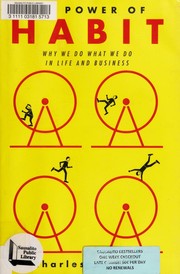
The Power of Habit
Rating: 4.0/5 from 145 Google Books ratings
In The Power of Habit, award-winning business reporter Charles Duhigg takes us to the thrilling edge of scientific discoveries that expla...
Nudge: Improving Decisions About Health, Wealth, and Happiness
Rating: 3.5/5 from 29 Google Books ratings
Thaler and Sunstein offer a groundbreaking discussion of how to apply the science of choice to nudge people toward decisions that can imp...
eBay marketplace picks
Marketplace Samples
Live-tested eBay searches with available results related to this page.
Selected frommotivational wall art oneBay.co.uk.


Endnotes
1.
Source: sciencedirect.com
Link:https://www.sciencedirect.com/science/article/pii/S0195666316301465
Source snippet
Proximity of snacks to beverages increases food consumption in the workplace: A field study - ScienceDirectAugust 1, 2016...
Published: August 1, 2016
2.
Source: papers.ssrn.com
Link:https://papers.ssrn.com/sol3/papers.cfm?abstract_id=7210669
3.
Source: onlinelibrary.wiley.com
Link:https://onlinelibrary.wiley.com/doi/abs/10.1111/puar.13115
4.
Source: sciencedirect.com
Title: ScienceDirect Predicting habit: The case of physical exercise
Link:https://www.sciencedirect.com/science/article/pii/S1469029207000039
5.
Source: sciencedirect.com
Link:https://www.sciencedirect.com/science/article/abs/pii/S0969698926002158
6.
Source: papers.ssrn.com
Link:https://papers.ssrn.com/sol3/Delivery.cfm/0b9f2ee4-2710-4edf-ab77-6a70abfdb913-MECA.pdf?abstractid=7210669&mirid=1
7.
Source: onlinelibrary.wiley.com
Link:https://onlinelibrary.wiley.com/doi/full/10.1002/cb.70194
8.
Source: sciencedirect.com
Link:https://www.sciencedirect.com/science/article/pii/S0272494424001427
9.
Source: sciencedirect.com
Link:https://www.sciencedirect.com/science/article/pii/S0196655323006557
10.
Source: sciencedirect.com
Title: The entrenchment effect: Why people persist with less-preferred behaviors
Link:https://www.sciencedirect.com/science/article/pii/S0749597823000535
11.
Source: onlinelibrary.wiley.com
Link:https://onlinelibrary.wiley.com/doi/full/10.1002/osp4.618
12.
Source: onlinelibrary.wiley.com
Link:https://onlinelibrary.wiley.com/doi/abs/10.1002/osp4.503
13.
Source: sciencedirect.com
Link:https://www.sciencedirect.com/org/science/article/pii/S1438887121003137
14.
Source: onlinelibrary.wiley.com
Title: 1468 0009.12475
Link:https://onlinelibrary.wiley.com/doi/full/10.1111/1468-0009.12475
15.
Source: sciencedirect.com
Link:https://www.sciencedirect.com/science/article/pii/S0195666319309195
16.
Source: sciencedirect.com
Link:https://www.sciencedirect.com/science/article/pii/S0301051118306021
17.
Source: sciencedirect.com
Link:https://www.sciencedirect.com/science/article/pii/S0195666317312655
18.
Source: sciencedirect.com
Link:https://www.sciencedirect.com/science/article/pii/S019188691730274X
19.
Source: sciencedirect.com
Link:https://www.sciencedirect.com/science/article/abs/pii/S0195666316301465
20.
Source: onlinelibrary.wiley.com
Link:https://onlinelibrary.wiley.com/doi/pdf/10.1002/mar.20269
21.
Source: sciencedirect.com
Title: The entrenchment effect: Why people persist with less-preferred behaviors
Link:https://www.sciencedirect.com/science/article/abs/pii/S0749597823000535
22.
Source: sciencedirect.com
Title: Effects of a computer-based, telephone-counseling system on [physical activity]({{ ‘physical-capacity/’ | relative_url }})
Link:https://www.sciencedirect.com/science/article/abs/pii/S0749379702004415
23.
Source: sciencedirect.com
Link:https://www.sciencedirect.com/science/article/pii/S0167268121001888
24.
Source: sciencedirect.com
Link:https://www.sciencedirect.com/science/article/pii/S0950329326001576
25.
Source: pmc.ncbi.nlm.nih.gov
Title: Pub Med Central (PMC)A meta-analytic cognitive framework of nudge and sludge
Link:https://pmc.ncbi.nlm.nih.gov/articles/PMC10685127/
Source snippet
PubMed Central (PMC)A meta-analytic cognitive framework of nudge and sludge - PMCNovember 29, 2023...
Published: November 29, 2023
26.
Source: pmc.ncbi.nlm.nih.gov
Link:https://pmc.ncbi.nlm.nih.gov/articles/PMC11641623/
27.
Source: pmc.ncbi.nlm.nih.gov
Link:https://pmc.ncbi.nlm.nih.gov/articles/PMC4566897/
Source snippet
PubMed Central (PMC)A review and analysis of the use of ‘habit’ in understanding, predicting and influencing health-related behaviour - PMC...
28.
Source: pmc.ncbi.nlm.nih.gov
Link:https://pmc.ncbi.nlm.nih.gov/articles/PMC3274640/
Source snippet
PubMed Central (PMC)Adherence to a Community-Based Exercise Program is a Strong Predictor of Improved Back Pain Status in Older Adults: A...
29.
Source: pmc.ncbi.nlm.nih.gov
Link:https://pmc.ncbi.nlm.nih.gov/articles/PMC3968093/
Source snippet
PubMed Central (PMC)Proximity to Sports Facilities and Sports Participation for Adolescents in Germany - PMC...
30.
Source: pubmed.ncbi.nlm.nih.gov
Link:https://pubmed.ncbi.nlm.nih.gov/27112315/
Source snippet
Proximity of snacks to beverages increases food consumption in the workplace: A field study - PubMed...
31.
Source: pubmed.ncbi.nlm.nih.gov
Link:https://pubmed.ncbi.nlm.nih.gov/32228721/
Source snippet
What influences the selection of contextual cues when starting a new routine behaviour? An exploratory study - PubMedMarch 30, 2020...
Published: March 30, 2020
32.
Source: pmc.ncbi.nlm.nih.gov
Link:https://pmc.ncbi.nlm.nih.gov/articles/PMC8279436/
33.
Source: pmc.ncbi.nlm.nih.gov
Link:https://pmc.ncbi.nlm.nih.gov/articles/PMC6260844/
34.
Source: pmc.ncbi.nlm.nih.gov
Link:https://pmc.ncbi.nlm.nih.gov/articles/PMC3505409/
35.
Source: pubmed.ncbi.nlm.nih.gov
Link:https://pubmed.ncbi.nlm.nih.gov/42204082/
36.
Source: pmc.ncbi.nlm.nih.gov
Link:https://pmc.ncbi.nlm.nih.gov/articles/PMC12583192/
37.
Source: doi.org
Link:https://doi.org/10.1145/3744198
38.
Source: pmc.ncbi.nlm.nih.gov
Link:https://pmc.ncbi.nlm.nih.gov/articles/PMC12379066/
39.
Source: pmc.ncbi.nlm.nih.gov
Link:https://pmc.ncbi.nlm.nih.gov/articles/PMC12208755/
40.
Source: pmc.ncbi.nlm.nih.gov
Link:https://pmc.ncbi.nlm.nih.gov/articles/PMC11897673/
41.
Source: pmc.ncbi.nlm.nih.gov
Link:https://pmc.ncbi.nlm.nih.gov/articles/PMC11346126/
42.
Source: pmc.ncbi.nlm.nih.gov
Link:https://pmc.ncbi.nlm.nih.gov/articles/PMC11188591/
43.
Source: pubmed.ncbi.nlm.nih.gov
Link:https://pubmed.ncbi.nlm.nih.gov/38903965/
44.
Source: pmc.ncbi.nlm.nih.gov
Link:https://pmc.ncbi.nlm.nih.gov/articles/PMC11071338/
45.
Source: pmc.ncbi.nlm.nih.gov
Link:https://pmc.ncbi.nlm.nih.gov/articles/PMC12392820/
46.
Source: pmc.ncbi.nlm.nih.gov
Link:https://pmc.ncbi.nlm.nih.gov/articles/PMC9854224/
47.
Source: pmc.ncbi.nlm.nih.gov
Link:https://pmc.ncbi.nlm.nih.gov/articles/PMC12318445/
48.
Source: pmc.ncbi.nlm.nih.gov
Link:https://pmc.ncbi.nlm.nih.gov/articles/PMC8683893/
49.
Source: pmc.ncbi.nlm.nih.gov
Link:https://pmc.ncbi.nlm.nih.gov/articles/PMC7998331/
50.
Source: pmc.ncbi.nlm.nih.gov
Link:https://pmc.ncbi.nlm.nih.gov/articles/PMC7846383/
51.
Source: pmc.ncbi.nlm.nih.gov
Link:https://pmc.ncbi.nlm.nih.gov/articles/PMC7649318/
52.
Source: pmc.ncbi.nlm.nih.gov
Link:https://pmc.ncbi.nlm.nih.gov/articles/PMC7559399/
53.
Source: pmc.ncbi.nlm.nih.gov
Link:https://pmc.ncbi.nlm.nih.gov/articles/PMC7291462/
54.
Source: pubmed.ncbi.nlm.nih.gov
Link:https://pubmed.ncbi.nlm.nih.gov/32406728/
55.
Source: pmc.ncbi.nlm.nih.gov
Link:https://pmc.ncbi.nlm.nih.gov/articles/PMC6953356/
56.
Source: pmc.ncbi.nlm.nih.gov
Link:https://pmc.ncbi.nlm.nih.gov/articles/PMC6710643/
57.
Source: pmc.ncbi.nlm.nih.gov
Link:https://pmc.ncbi.nlm.nih.gov/articles/PMC6647265/
58.
Source: pubmed.ncbi.nlm.nih.gov
Link:https://pubmed.ncbi.nlm.nih.gov/30951804/
59.
Source: pubmed.ncbi.nlm.nih.gov
Link:https://pubmed.ncbi.nlm.nih.gov/30550894/
60.
Source: pmc.ncbi.nlm.nih.gov
Link:https://pmc.ncbi.nlm.nih.gov/articles/PMC6335384/
61.
Source: pubmed.ncbi.nlm.nih.gov
Link:https://pubmed.ncbi.nlm.nih.gov/30367891/
62.
Source: pmc.ncbi.nlm.nih.gov
Link:https://pmc.ncbi.nlm.nih.gov/articles/PMC5768324/
63.
Source: pubmed.ncbi.nlm.nih.gov
Link:https://pubmed.ncbi.nlm.nih.gov/29183701/
64.
Source: pubmed.ncbi.nlm.nih.gov
Link:https://pubmed.ncbi.nlm.nih.gov/28797048/
65.
Source: pmc.ncbi.nlm.nih.gov
Link:https://pmc.ncbi.nlm.nih.gov/articles/PMC5552216/
66.
Source: pmc.ncbi.nlm.nih.gov
Link:https://pmc.ncbi.nlm.nih.gov/articles/PMC4906733/
67.
Source: pmc.ncbi.nlm.nih.gov
Link:https://pmc.ncbi.nlm.nih.gov/articles/PMC4845232/
68.
Source: pmc.ncbi.nlm.nih.gov
Link:https://pmc.ncbi.nlm.nih.gov/articles/PMC4172973/
69.
Source: pmc.ncbi.nlm.nih.gov
Link:https://pmc.ncbi.nlm.nih.gov/articles/PMC4128832/
70.
Source: pubmed.ncbi.nlm.nih.gov
Link:https://pubmed.ncbi.nlm.nih.gov/23578770/
71.
Source: pmc.ncbi.nlm.nih.gov
Link:https://pmc.ncbi.nlm.nih.gov/articles/PMC3655830/
72.
Source: pmc.ncbi.nlm.nih.gov
Link:https://pmc.ncbi.nlm.nih.gov/articles/PMC3808179/
73.
Source: pmc.ncbi.nlm.nih.gov
Link:https://pmc.ncbi.nlm.nih.gov/articles/PMC1935433/
74.
Source: pmc.ncbi.nlm.nih.gov
Link:https://pmc.ncbi.nlm.nih.gov/articles/PMC1481572/
75.
Source: pubmed.ncbi.nlm.nih.gov
Link:https://pubmed.ncbi.nlm.nih.gov/10154656/
76.
Source: pubmed.ncbi.nlm.nih.gov
Link:https://pubmed.ncbi.nlm.nih.gov/23794696/
77.
Source: pmc.ncbi.nlm.nih.gov
Link:https://pmc.ncbi.nlm.nih.gov/articles/PMC3667400/
78.
Source: pubmed.ncbi.nlm.nih.gov
Link:https://pubmed.ncbi.nlm.nih.gov/20128364/
79.
Source: pmc.ncbi.nlm.nih.gov
Link:https://pmc.ncbi.nlm.nih.gov/articles/PMC2652966/
80.
Source: pubmed.ncbi.nlm.nih.gov
Link:https://pubmed.ncbi.nlm.nih.gov/16418755/
81.
Source: doi.org
Title: What is a habit? Diverse mechanisms that can produce sustained behavior change
Link:https://doi.org/10.1016/j.obhdp.2020.10.002
Additional References
82.
Source: nature.com
Link:https://www.nature.com/articles/s41562
83.
Source: nature.com
Link:https://www.nature.com/articles/s41598-023-50099-z
84.
Source: nature.com
Link:https://www.nature.com/articles/0803217
85.
Source: youtube.com
Title: How to Foster Healthy Habits | Prof. Katy Milkman
Link:https://www.youtube.com/watch?v=Cz_BP1yanLI
Source snippet
Friction habit formation make it easy The Science of Making & Breaking Habits...
86.
Source: youtube.com
Title: The secret habits that control your life | Wendy Wood
Link:https://www.youtube.com/watch?v=Ywec1MbeQDk
Source snippet
How Context Shapes Habits: The Power of Friction with Dr. Wendy Wood...
87.
Source: youtube.com
Title: Forget big change, start with a tiny habit | BJ Fogg
Link:https://www.youtube.com/watch?v=AdKUJxjn-R8
Source snippet
How to Foster Healthy Habits | Prof. Katy Milkman...
88.
Source: researchgate.net
Link:https://www.researchgate.net/publication/376030390_A_meta-analytic_cognitive_framework_of_nudge_and_sludge
89.
Source: researchgate.net
Link:https://www.researchgate.net/publication/321836291_Behavioral_Anomalies_as_Entrepreneurial_Opportunities_An_Experiment_on_Choice_Overload
90.
Source: researchgate.net
Link:https://www.researchgate.net/publication/370374699_Combining_Behavioral_Economics-Based_Incentives_With_the_Anchoring_Strategy_Protocol_for_a_Randomized_Controlled_Trial
91.
Source: researchgate.net
Link:https://www.researchgate.net/publication/392289993_Gym_entry_fees_act_as_a_barrier_to_exercising_in_community_gyms_for_young_adults_with_disability_A_mixed_methods_study