Within Stable Contexts
How Similar Does a Habit Context Need to Be?
Habit cues need recognisable consistency, not identical surroundings, so ordinary changes do not always erase a learned routine.
On this page
- Recognisable consistency versus exact repetition
- Which contextual features may actually serve as cues
- Why travel and schedule changes disrupt some habits more than others
Page outline Jump by section
Introduction
A habit context does not have to be identical every time. What matters is whether enough of the features that have become associated with the behaviour recur for the situation to be recognised, psychologically, as the sort of situation in which that behaviour normally happens. “After breakfast” can remain a useful context even when breakfast is 40 minutes later, the weather is different or somebody else is in the kitchen.

The difficult part is that research does not provide a universal tolerance threshold — no defensible rule says that changing one feature is harmless while changing two breaks a habit. Contexts are bundles of cues, and different behaviours become attached to different parts of those bundles. Physical location is often influential, but time of day, preceding actions, other people and even internal states can matter. The practical question is therefore not “How identical must today be to yesterday?” but “Are the cues that actually predict this behaviour still recognisable?”[frontiersin.org]frontiersin.orgFrontiersFrontiers | Context Stability in Habit Building Increases Automaticity and Goal AttainmentJune 10, 2022…
Recognisable consistency matters more than exact repetition
Habit research sometimes uses phrases such as “stable context” or “same context”, but these should not be read as demanding a perfect replay of previous circumstances. In a 2022 longitudinal study of intentional habit building, Marco Stojanovic and colleagues explicitly defined context stability as the similarity of the current performance context to contexts in which the behaviour had routinely been performed before. Greater stability predicted greater automaticity and better attainment of participants’ repetition goals.[Frontiers]frontiersin.orgFrontiersFrontiers | Context Stability in Habit Building Increases Automaticity and Goal AttainmentJune 10, 2022…
The experiment makes the distinction between ordinary variation and substantial variation particularly useful. Ninety-five university students built study habits for six weeks. Participants in the stable condition were asked to study in the same place and at the same point in the day. Those in the variable condition were told to change both, including using different places and different points in the day across recent repetitions. The manipulation produced a large difference in perceived context stability, and stable-context participants developed more automaticity.[Frontiers]frontiersin.orgFrontiersFrontiers | Context Stability in Habit Building Increases Automaticity and Goal AttainmentJune 10, 2022…
Yet even the deliberately variable group did not experience its contexts as completely unrelated. The researchers noted that changing from a living room to a kitchen could still preserve the broader feature “at home”, just as different clock times might still share a broader context such as “after school”. That is important for everyday self-improvement: people appear capable of representing circumstances at more than one level of specificity. A context can change in detail while retaining a recognisable higher-level structure.[PubMed Central (PMC)]pmc.ncbi.nlm.nih.govPubMed Central (PMC)Context Stability in Habit Building Increases Automaticity and Goal Attainment - PMC…
What the study cannot tell us is exactly how far that flexibility extends. Its authors explicitly identified this as an unanswered question: how far can a context be generalised before its similarity to the learned context disappears? The study compared markedly stable and deliberately variable conditions; it was not designed to discover a precise boundary between “similar enough” and “too different”.[PubMed Central (PMC)]pmc.ncbi.nlm.nih.govPubMed Central (PMC)Context Stability in Habit Building Increases Automaticity and Goal Attainment - PMC…
That limitation matters because simplistic advice can outrun the evidence. It is reasonable to say that consistency assists habit formation. It is not reasonable to claim that a morning routine must happen in the same chair, at exactly 07:30, or within some particular number of minutes of its normal time. Habit science has not established thresholds of that kind.
Which parts of a context actually become cues?
A real-life context contains far more information than a person consciously notices: location, objects, sounds, lighting, people, time, preceding activities, mood and bodily states can all recur alongside an action. Only some need to acquire control over a particular habit.
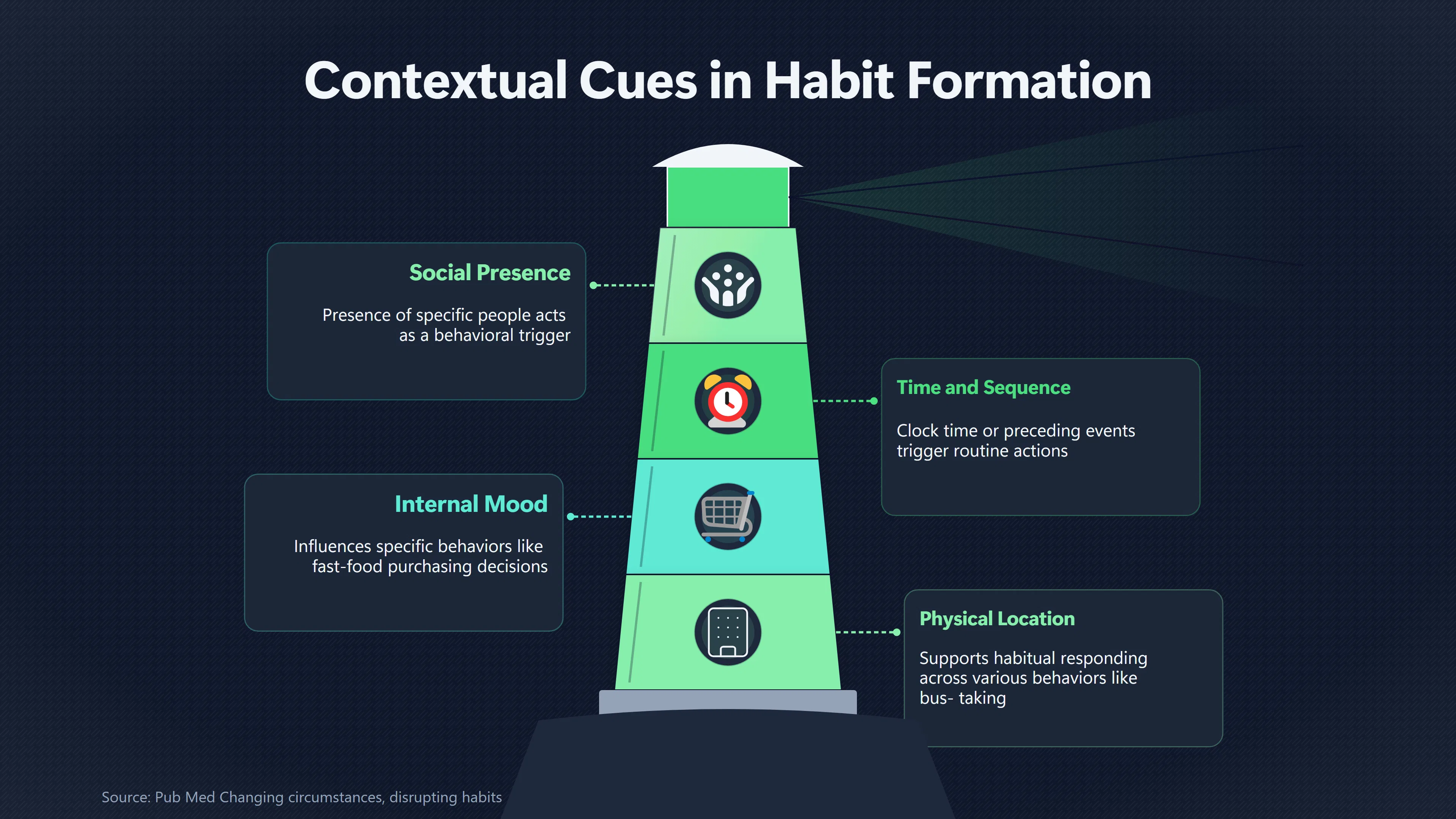
A useful demonstration comes from research by Mindy Ji and Wendy Wood on three familiar behaviours: buying fast food, watching television news and taking the bus. They assessed physical location, time of day, mood and the presence of particular people. Physical location supported habitual responding across all three behaviours, but the other cues differed. Fast-food purchasing was associated with mood; television-news habits were associated with all four types of context assessed; bus-taking was associated with all except mood.[USC Dornsife]dornsife.usc.eduji.wood.2007 habitual purchase and consumptionUSC DornsifeHJCP_17(4).book(HJCP_A_254101.fm)…
This helps explain why asking whether a habit can tolerate “a context change” is slightly misleading. Two changes that look equally large to an observer may not be equally important to the learned routine.
Consider a person who habitually stretches after making their morning coffee. They might successfully perform the routine in a different kitchen because making coffee is the cue that matters. Another person might say that they stretch “in the morning” but actually depend heavily on seeing the exercise mat beside their bedroom door. Moving the mat could therefore be more disruptive than shifting the routine by half an hour.
Research on cue selection reinforces the point. In a study in which 39 participants attempted to take vitamin C daily for three weeks, people commonly chose cues because they were convenient or because similar strategies had worked previously. The researchers found that vague plans and reliance on a single factor could be poor remembering strategies, while combining clearly defined cues could be more useful. People also often had to discover effective cues through trial and error rather than correctly predicting them in advance.[PubMed]pubmed.ncbi.nlm.nih.govWhat influences the selection of contextual cues when starting a new routine behaviour? An exploratory study - PubMedMarch 30, 2020…
There is also reason to distinguish clock time from events in a routine. Habit researchers have argued that event-based cues such as “after breakfast” can be easier to notice naturally than “at 08:15”, which requires monitoring the time. Evidence is not completely uniform: a review of habit-based health interventions notes findings favouring consistency of preceding events for physical-activity habits, but also research in which time- and event-based cue recommendations supported dietary habit development similarly. The broader literature therefore does not justify declaring one cue type universally superior.[Taylor & Francis Online]tandfonline.comTaylor & Francis OnlineFull article: Developing habit-based health behaviour change interventions: twenty-one questions to guide future r…
For flexible habits, this distinction can be valuable. “After I finish breakfast” survives a breakfast that moves from 07:30 to 08:10. “When I arrive at my desk” survives a commute that takes longer than usual. A cue defined by a recurring event can therefore preserve meaningful consistency while allowing irrelevant details to vary.
Why some changes disrupt habits and others do not
The clearest real-world evidence comes from situations in which people’s lives change substantially. Wood, Leona Tam and Melissa Guerrero Witt studied students transferring to a new university and followed behaviours including exercising, newspaper reading and television watching. Previously habitual behaviours were more likely to survive the move when relevant aspects of their performance contexts remained stable. When those circumstances changed, habitual control weakened and behaviour could become more dependent on people’s current intentions.[PubMed]pubmed.ncbi.nlm.nih.govPub Med Changing circumstances, disrupting habitsChanging circumstances, disrupting habits - PubMed…
The important detail is that moving university did not automatically erase every habit. A large life transition contains many simultaneous changes, but habits survived when aspects of their old performance contexts survived too. For example, maintaining the social circumstances associated with newspaper reading could preserve that behaviour despite the wider relocation. This is strong evidence against treating context as a single all-or-nothing variable.[PubMed]pubmed.ncbi.nlm.nih.govPub Med Changing circumstances, disrupting habitsChanging circumstances, disrupting habits - PubMed…
Research on commuting provides a more dramatic version of the same principle. Moving home changes numerous contextual cues at once: the starting location, route, nearby transport options and often journey timing. Studies of “habit discontinuity” find that relocation can weaken established travel habits and create a period in which choices become more open to deliberation. In a UK analysis involving 18,053 people, the relationship between environmental attitudes and reduced car commuting appeared after recent residential relocation and then diminished as time since the move increased.[PubMed Central (PMC)]pmc.ncbi.nlm.nih.govPubMed Central (PMC)Habit Discontinuity, Self-Activation, and the Diminishing Influence of Context Change: Evidence from the UK Understan…
This suggests a continuum rather than a switch. Changing the colour of the coffee mug while retaining the same morning sequence is unlikely to resemble moving house and acquiring an entirely new commute. The latter removes or alters many cues simultaneously. What matters is not merely the number of visible differences but whether the change removes features that previously predicted the habitual response.

Why travel and schedule changes expose fragile cues
Travel is an unusually revealing test of context dependence because it strips away many environmental cues at once. The bed is different, breakfast may happen elsewhere, work begins differently, objects are stored in unfamiliar places and the usual sequence of preceding actions can disappear. A routine that seemed effortless at home may suddenly require remembering.
That does not mean the underlying learning has been erased. A better interpretation is often retrieval failure: the familiar cues that normally activate the response are absent. Context-sensitive learning research more generally shows that changing background circumstances can reduce retrieval of previously learned responding.[PubMed]pubmed.ncbi.nlm.nih.govPub Med Stimulus generalization, context change, and forgettingPub Med Stimulus generalization, context change, and forgetting
This distinction explains a common experience. Someone may exercise almost automatically on working days because leaving the office, passing the gym and having their kit in a bag form a recurring cue bundle. On holiday, none of those cues occurs. Their apparent “discipline” has not necessarily vanished; the circumstances that normally launch the behaviour have.
Schedule disruption can be milder or equally severe depending on the habit. A routine attached narrowly to “07:00 in my bathroom” is exposed when a shift pattern changes. A routine attached to “after brushing my teeth” potentially retains its principal cue even if brushing happens two hours later or in a hotel. Conversely, a commute habit may depend heavily on geography, making a new residence much more consequential than a change in clock time. The Ji and Wood findings caution against assuming that the same contextual dimension controls every behaviour.[USC Dornsife]dornsife.usc.eduji.wood.2007 habitual purchase and consumptionUSC DornsifeHJCP_17(4).book(HJCP_A_254101.fm)…
The practical implication is not that every habit should be made maximally portable from day one. Deliberately varying places and times while a new habit is forming can slow the development of automaticity: that is precisely what the 2022 context-stability experiment found.[Frontiers]frontiersin.orgFrontiersFrontiers | Context Stability in Habit Building Increases Automaticity and Goal AttainmentJune 10, 2022…
Stability and portability involve a real trade-off
There is an appealing idea that practising a behaviour everywhere will make it “context independent”. Some learning research provides a basis for that intuition, but it should not be confused with evidence that maximal variation is best for habit formation.
Experimental learning research shows that practising instrumental responses across multiple contexts can improve transfer to a novel context. One proposed explanation is that multiple-context training associates the response with a wider collection of contextual elements, increasing the chance that some familiar elements will also occur somewhere new.[PubMed]pubmed.ncbi.nlm.nih.govOpen source on nih.gov.
But Mark Bouton’s 2024 review of habit and persistence highlights the important complication. Training across multiple contexts can improve generalisation while simultaneously making conditions less favourable for rapid habit learning. Repeatedly returning to one predictable context strengthens contextual control efficiently; repeatedly changing contexts may preserve more deliberate, goal-directed control for longer. Bouton therefore cautions against treating persistence across contexts and habitual control as if they were the same property. Much of this evidence comes from basic learning research rather than human self-improvement trials, so translating it into precise prescriptions for daily routines would be premature.[PubMed Central (PMC)]pmc.ncbi.nlm.nih.govPub Med Central (PMC)Habit and persistencePub Med Central (PMC)Habit and persistence
This produces a useful distinction for self-improvement:
- Maximum early variation may make a new behaviour harder to automate because no reliable situation repeatedly predicts it.
- Extreme specificity can produce a routine whose most effective cues disappear whenever life departs from its normal pattern.
- Recognisable consistency offers a middle ground: preserve one or several dependable cues while allowing incidental features of the surroundings to change.
For example, reading ten pages “after I get into bed” allows different bedtimes while preserving the preceding event and behavioural setting. Walking “after lunch” can survive variation in what lunch contains or exactly when it occurs. A study routine might preserve “after I sit down at my work desk with my first drink” while tolerating differences in lighting, clothing or background noise.
These examples illustrate the principle rather than experimentally proven recipes. Current research cannot rank every possible cue bundle or specify how much variability produces the ideal balance between automaticity and portability.
How to tell whether variation has gone too far
Because there is no scientifically established percentage or number of context changes that a habit can tolerate, the most useful test is behavioural. A context remains sufficiently similar when the recurring cue still tends to bring the action to mind and starting requires relatively little deliberate reconstruction. When the behaviour repeatedly disappears until a reminder, conscious plan or act of will restores it, an important part of its learned context has probably been lost.
That interpretation also prevents an easy mistake: blaming every missed routine on motivation. A person who consistently performs an action in one setting but forgets it after a schedule or location change may be seeing exactly the context dependence that habit theory predicts. Research on university transfers found that disrupting habitual contexts could return behaviour to intentional control; research on deliberate habit building similarly finds greater automaticity when contexts remain more stable.[PubMed]pubmed.ncbi.nlm.nih.govPub Med Changing circumstances, disrupting habitsChanging circumstances, disrupting habits - PubMed…
For a habit intended to survive normal life, it is therefore useful to distinguish core cues from incidental scenery. The core might be finishing breakfast, entering the office, putting a child to bed or placing a mug beside the laptop. The incidental scenery might include the exact minute, weather, clothes, music or which chair happens to be available. There is little reason to manufacture consistency in incidental details unless experience shows that they genuinely help trigger the behaviour.
The strongest conclusion the evidence supports is modest but useful: habit contexts can tolerate variation, but tolerance depends on what varies. People do not appear to require perfectly repeated surroundings, and broader representations such as “at home” or “after school” may preserve contextual similarity across smaller changes. At the same time, removing cues that actually control a behaviour — particularly several of them at once — can sharply reduce its automaticity. Exactly where that boundary lies remains an open empirical question.[nih.gov]pmc.ncbi.nlm.nih.govPubMed Central (PMC)Context Stability in Habit Building Increases Automaticity and Goal Attainment - PMC…
Amazon book picks
Further Reading
Books and field guides related to How Similar Does a Habit Context Need to Be?. Use these as the next step if you want deeper reading beyond the article.
Atomic Habits
Rating: 3.5/5 from 7 Google Books ratings
The #1 New York Times bestseller. Over 25 million copies sold! Translated into 60+ languages! Tiny Changes, Remarkable Results No matter...
The Power of Habit
Rating: 4.0/5 from 145 Google Books ratings
Duhigg takes us to the edge of scientific discoveries that explain why habits exist and how they can be changed. Distilling information i...
Good Habits, Bad Habits
'The world's leading expert on habits' - Matthew Syed, bestselling author of Black Box Thinking and Rebel IdeasWhat if you could harness...
Making Habits, Breaking Habits
"An accessible and informative guide for readers to take control of their lives" ( Publishers Weekly). Habits are more powerful than will...
eBay marketplace picks
Marketplace Samples
Live-tested eBay searches with available results related to this page.
Selected frommotivational poster oneBay.co.uk.

Current eBay listing
Motivational Quotes Framed Wall Art Poster Canvas Print Picture


Current eBay listing
Gym Motivational Posters Work Out Insperational Quotes Wall Art
Endnotes
1.
Source: frontiersin.org
Link:https://www.frontiersin.org/journals/psychology/articles/10.3389/fpsyg.2022.883795/full
Source snippet
FrontiersFrontiers | Context Stability in Habit Building Increases Automaticity and Goal AttainmentJune 10, 2022...
Published: June 10, 2022
2.
Source: pubmed.ncbi.nlm.nih.gov
Title: Pub Med Changing circumstances, disrupting habits
Link:https://pubmed.ncbi.nlm.nih.gov/15982113/
Source snippet
Changing circumstances, disrupting habits - PubMed...
3.
Source: dornsife.usc.edu
Title: ji.wood.2007 habitual purchase and consumption
Link:https://dornsife.usc.edu/wendy-wood/wp-content/uploads/sites/183/2023/10/ji.wood_.2007_habitual_purchase_and_consumption.pdf
Source snippet
USC DornsifeHJCP_17(4).book(HJCP_A_254101.fm)...
4.
Source: pubmed.ncbi.nlm.nih.gov
Link:https://pubmed.ncbi.nlm.nih.gov/35756236/
Source snippet
Context Stability in Habit Building Increases Automaticity and Goal Attainment - PubMed...
5.
Source: pmc.ncbi.nlm.nih.gov
Link:https://pmc.ncbi.nlm.nih.gov/articles/PMC9226889/
Source snippet
PubMed Central (PMC)Context Stability in Habit Building Increases Automaticity and Goal Attainment - PMC...
6.
Source: pubmed.ncbi.nlm.nih.gov
Link:https://pubmed.ncbi.nlm.nih.gov/32228721/
Source snippet
What influences the selection of contextual cues when starting a new routine behaviour? An exploratory study - PubMedMarch 30, 2020...
Published: March 30, 2020
7.
Source: pmc.ncbi.nlm.nih.gov
Link:https://pmc.ncbi.nlm.nih.gov/articles/PMC7106637/
Source snippet
PubMed Central (PMC)What influences the selection of contextual cues when starting a new routine behaviour? An exploratory study - PMC...
8.
Source: tandfonline.com
Link:https://www.tandfonline.com/doi/full/10.1080/08870446.2021.2003362
Source snippet
Taylor & Francis OnlineFull article: Developing habit-based health behaviour change interventions: twenty-one questions to guide future r...
9.
Source: pmc.ncbi.nlm.nih.gov
Link:https://pmc.ncbi.nlm.nih.gov/articles/PMC4847906/
Source snippet
PubMed Central (PMC)Habit Discontinuity, Self-Activation, and the Diminishing Influence of Context Change: Evidence from the UK Understan...
10.
Source: pubmed.ncbi.nlm.nih.gov
Title: Pub Med Stimulus generalization, context change, and forgetting
Link:https://pubmed.ncbi.nlm.nih.gov/10087934/
11.
Source: pubmed.ncbi.nlm.nih.gov
Link:https://pubmed.ncbi.nlm.nih.gov/29234996/
12.
Source: pmc.ncbi.nlm.nih.gov
Link:https://pmc.ncbi.nlm.nih.gov/articles/PMC5970024/
13.
Source: pmc.ncbi.nlm.nih.gov
Title: Pub Med Central (PMC)Habit and persistence
Link:https://pmc.ncbi.nlm.nih.gov/articles/PMC10842266/
14.
Source: pmc.ncbi.nlm.nih.gov
Link:https://pmc.ncbi.nlm.nih.gov/articles/PMC13295370/
15.
Source: pmc.ncbi.nlm.nih.gov
Link:https://pmc.ncbi.nlm.nih.gov/articles/PMC13059544/
16.
Source: pmc.ncbi.nlm.nih.gov
Link:https://pmc.ncbi.nlm.nih.gov/articles/PMC12957431/
17.
Source: pmc.ncbi.nlm.nih.gov
Link:https://pmc.ncbi.nlm.nih.gov/articles/PMC11297519/
18.
Source: pmc.ncbi.nlm.nih.gov
Link:https://pmc.ncbi.nlm.nih.gov/articles/PMC11161714/
19.
Source: pmc.ncbi.nlm.nih.gov
Link:https://pmc.ncbi.nlm.nih.gov/articles/PMC11201238/
20.
Source: doi.org
Link:https://doi.org/10.1111/bjhp.12637
21.
Source: pubmed.ncbi.nlm.nih.gov
Link:https://pubmed.ncbi.nlm.nih.gov/35962435/
22.
Source: pmc.ncbi.nlm.nih.gov
Link:https://pmc.ncbi.nlm.nih.gov/articles/PMC9372943/
23.
Source: doi.org
Link:https://doi.org/10.1186/s12966-022-01343-8
24.
Source: frontiersin.org
Link:https://www.frontiersin.org/journals/psychology/articles/10.3389/fpsyg.2022.883795/full?infclid=98ed75048fad41069048c53e63b2394c
25.
Source: pmc.ncbi.nlm.nih.gov
Link:https://pmc.ncbi.nlm.nih.gov/articles/PMC12318445/
26.
Source: pubmed.ncbi.nlm.nih.gov
Link:https://pubmed.ncbi.nlm.nih.gov/33174522/
27.
Source: pmc.ncbi.nlm.nih.gov
Link:https://pmc.ncbi.nlm.nih.gov/articles/PMC7230536/
28.
Source: frontiersin.org
Link:https://www.frontiersin.org/journals/psychology/articles/10.3389/fpsyg.2019.01556/full
29.
Source: pmc.ncbi.nlm.nih.gov
Link:https://pmc.ncbi.nlm.nih.gov/articles/PMC6233324/
30.
Source: doi.org
Link:https://doi.org/10.1111/spc3.12323
31.
Source: frontiersin.org
Link:https://www.frontiersin.org/journals/psychology/articles/10.3389/fpsyg.2017.00051/full
32.
Source: pubmed.ncbi.nlm.nih.gov
Link:https://pubmed.ncbi.nlm.nih.gov/27120333/
33.
Source: frontiersin.org
Link:https://www.frontiersin.org/journals/psychology/articles/10.3389/fpsyg.2015.01938/full
34.
Source: pmc.ncbi.nlm.nih.gov
Link:https://pmc.ncbi.nlm.nih.gov/articles/PMC4731333/
35.
Source: pmc.ncbi.nlm.nih.gov
Link:https://pmc.ncbi.nlm.nih.gov/articles/PMC4339261/
36.
Source: pmc.ncbi.nlm.nih.gov
Link:https://pmc.ncbi.nlm.nih.gov/articles/PMC4216661/
37.
Source: pmc.ncbi.nlm.nih.gov
Link:https://pmc.ncbi.nlm.nih.gov/articles/PMC4566897/
38.
Source: pubmed.ncbi.nlm.nih.gov
Link:https://pubmed.ncbi.nlm.nih.gov/1756659/
39.
Source: pubmed.ncbi.nlm.nih.gov
Link:https://pubmed.ncbi.nlm.nih.gov/23357091/
40.
Source: pubmed.ncbi.nlm.nih.gov
Link:https://pubmed.ncbi.nlm.nih.gov/16968135/
41.
Source: pubmed.ncbi.nlm.nih.gov
Link:https://pubmed.ncbi.nlm.nih.gov/20919778/
Additional References
42.
Source: youtube.com
Link:https://www.youtube.com/watch?v=Ogc8JUn-F5I
Source snippet
For a deep dive into how habits rely on contextual cues and environmental stability, Good Habits, Bad Habits with Dr. Wendy Wood breaks d...
43.
Source: nature.com
Link:https://www.nature.com/articles/s44271-026-00408-9
44.
Source: youtube.com
Title: Good Habits Bad Habits Book
Link:https://www.youtube.com/watch?v=MFPxaYdGLMY
Source snippet
Habits: How to be successful every day | Dan Ariely, Gretchen Rubin & more | Big Think...
45.
Source: researchgate.net
Link:https://www.researchgate.net/publication/259287063A_review_and_analysis_of_the_use_of%27habit%27_in_understanding_predicting_and_influencing_health-related_behaviour
46.
Source: researchgate.net
Link:https://www.researchgate.net/publication/223364167_Context_change_and_travel_mode_choice_Combining_the_habit_discontinuity_and_self-activation_hypotheses
47.
Source: sciencedirect.com
Link:https://www.sciencedirect.com/science/article/abs/pii/S0950329315001834
48.
Source: sciencedirect.com
Link:https://www.sciencedirect.com/science/article/pii/S0967070X18302804
49.
Source: sciencedirect.com
Link:https://www.sciencedirect.com/science/article/abs/pii/S0969698924003540
50.
Source: cir.nii.ac.jp
Link:https://cir.nii.ac.jp/crid/1360576121230630784
51.
Source: doaj.org
Link:https://doaj.org/article/5e28c7cd6cc848099ff7ce3a555ff69f