Within Behaviour Goals
Can You Actually Perform Your Goal?
A useful goal turns a desired result into a repeatable action you can deliberately carry out and check.
On this page
- Why measurable outcomes are not always actionable
- How to translate results into controllable behaviours
- Examples from fitness, study, money and work
Page outline Jump by section
Introduction
A goal is actionable when it names something you can deliberately do, rather than merely a result you hope will happen. “Lose 5 kg”, “get a distinction”, “save £3,000” and “win more clients” may all be measurable, but they are still outcomes. You cannot directly perform a kilogram lost, a mark awarded, a bank balance or another person’s decision. You can perform the behaviours that make those outcomes more likely.
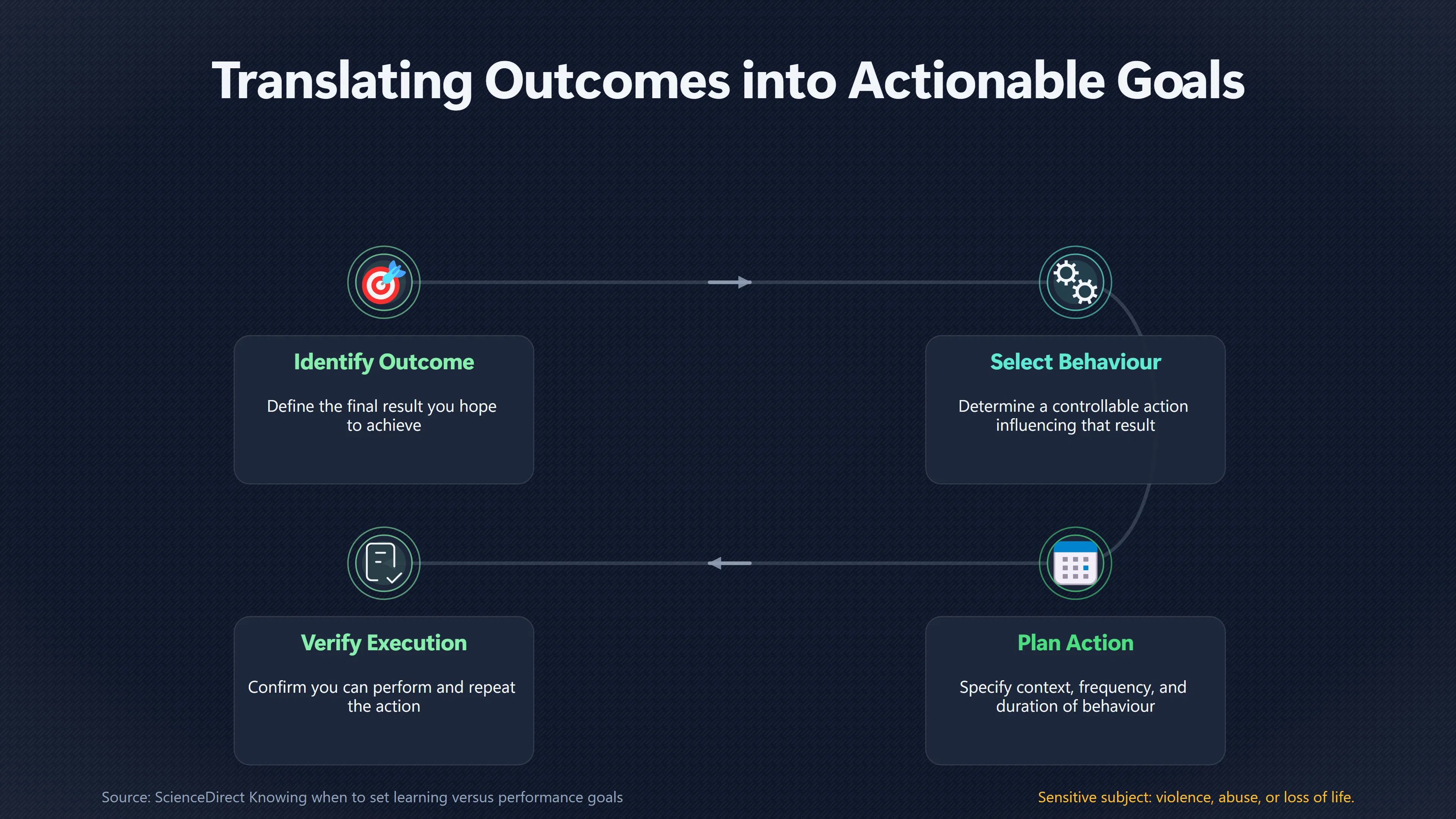
That distinction is more than wordplay. Behaviour-change researchers formally distinguish goals defined by outcomes from goals defined by behaviour, and separately distinguish both from action planning: specifying how, when, where or how often the behaviour will occur.[UCL Discovery]discovery.ucl.ac.ukUCL DiscoveryThe Behavior Change Technique Taxonomy (v1) of 93 Hierarchically Clustered Techniques: Building an International Consensus f… The practical move is therefore to work backwards: desired result → useful behaviour → repeatable action → evidence that you did it.
The outcome still matters. It supplies direction and tells you whether your strategy is working. But for day-to-day self-improvement, the question that makes a goal executable is simpler: Can I actually perform my goal?
Why measurable outcomes are not always actionable
“Make it measurable” is common goal-setting advice, but measurability and actionability solve different problems. A measurable outcome tells you how you will recognise success. An actionable goal tells you what to do next.
Consider “lose 5 kg”. It is specific enough to measure precisely, yet weight is the downstream product of behaviour plus numerous other influences. “Walk briskly for 30 minutes after work on Monday, Wednesday and Friday” is different: when Monday evening arrives, there is a defined action available to perform.
Behaviour-change science preserves this distinction explicitly. The Behaviour Change Technique Taxonomy developed by researchers at University College London classifies “goal setting (behaviour)” separately from “goal setting (outcome)”. It also treats action planning as another technique, requiring planning around features such as context, frequency, duration or intensity.[UCL Discovery]discovery.ucl.ac.ukUCL DiscoveryThe Behavior Change Technique Taxonomy (v1) of 93 Hierarchically Clustered Techniques: Building an International Consensus f… This is useful because it prevents three different questions becoming muddled together:
- What result do I want? “Save £3,000.”
- What behaviour could influence it? “Save part of my income.”
- What can I actually perform? “Transfer £150 to savings on every payday.”
Research supports goal setting as a behaviour-change tool, but not as a magic formula. A systematic review and meta-analysis covering 141 papers, 384 effect sizes and 16,523 participants found a small positive effect of goal setting on behaviour, with an average effect size of d = 0.34.[PubMed]pubmed.ncbi.nlm.nih.govUnique effects of setting goals on behavior change: Systematic review and meta-analysis - PubMed… The important implication is not that every aspiration should simply be given a number. A goal has to direct attention towards useful behaviour.
This becomes particularly clear in sport. A systematic review and meta-analysis of 27 studies distinguished outcome goals such as winning, performance goals based on personal standards, and process goals concerned with the actions used to perform. In that literature, process goals showed the largest estimated performance effect (d = 1.36), compared with performance goals (d = 0.44) and outcome goals (d = 0.09). Those estimates come from a specific sporting evidence base and should not simply be assumed to apply identically to saving, studying or office work, but the contrast illustrates why moving attention towards controllable execution can matter.[Taylor & Francis Online]tandfonline.comTaylor & Francis OnlineFull article: The performance and psychological effects of goal setting in sport: A systematic review and meta-ana…
Translate the result into controllable behaviour
A useful translation starts with the outcome but works backwards from it. Suppose the outcome is “improve my exam result”. Asking “How will I get a better mark?” can produce vague answers such as “study harder”. A stronger question is: What repeated action, under my control, has a credible chance of improving the result?
For studying, that might produce “complete and check 20 retrieval-practice questions four evenings a week”. That is not merely more concrete; it selects an activity with evidence behind it. A systematic review of 50 classroom experiments involving 5,374 learners found that retrieval practice generally improved learning across educational levels, subject areas and testing arrangements, with 57% of reported effects classed as medium or large.[DOI]doi.orgRetrieval Practice Consistently Benefits Student Learning: a Systematic Review of Applied Research in Schools and Classrooms | Educati… A broader review likewise concludes that practising retrieval can slow forgetting and improve later access to learned information.[Annual Reviews]annualreviews.orgAnnual Reviews Practicing Retrieval Facilitates Learning | Annual ReviewsAnnual ReviewsPracticing Retrieval Facilitates Learning | Annual ReviewsJanuary 4, 2021…
The same backwards translation can be applied elsewhere:
Desired outcomeToo dependent on the resultAction you can performImprove fitnessRun 5 km in under 25 minutesComplete the planned three training sessions each weekImprove exam resultsGet at least 70%Complete and mark 20 retrieval questions on four evenings each weekBuild savingsSave £3,000Transfer £150 to savings on every paydayProgress at workGet promoted this yearComplete one high-priority deliverable before routine email each working dayGenerate businessWin five new clientsSend five well-researched prospect approaches each week
The right-hand column is not guaranteed to produce the middle or left-hand result. That is precisely the point. A behaviour goal should be controllable, not guaranteed to succeed. Its job is to identify your contribution to an outcome whose final value may remain uncertain.
A good conversion can be tested with four questions. Can you deliberately start the behaviour? Can you tell afterwards whether you did it? Can you repeat it? Is there a credible reason to believe that repeating it contributes to the desired result? If the answer to the first three is yes but the fourth is no, you have created a trackable activity rather than a useful action goal.
Make the behaviour executable
Even “exercise three times a week” leaves some execution work undone. What counts as exercise? When will it happen? For how long? Behaviour-change research calls the next refinement action planning: specifying the performance of the behaviour through details such as context, frequency, duration or intensity.[UCL Discovery]discovery.ucl.ac.ukOpen source on ucl.ac.uk.
So the translation can become progressively more executable:
Outcome: Improve cardiovascular fitness.
Behaviour: Run regularly.
Action goal: Run for 30 minutes three times each week.
Executable version: Run for 30 minutes after work on Monday, Wednesday and Friday.
This is closely related to implementation intentions: plans that link a relevant situation to a response, commonly expressed as “if situation Y occurs, then I will do behaviour X”. A major meta-analysis of 94 independent tests reported a medium-to-large positive effect on goal attainment (d = 0.65), with evidence that such plans help people initiate goal-directed action when the specified opportunity occurs.[Social Psychology and Motivation]socmot.uni-konstanz.deSocial Psychology and MotivationImplementation intentions and goal achievement: A meta-analysis of effects and processes | Social Psychol… Reviews of health-behaviour planning also find generally favourable effects, while stressing heterogeneity between studies rather than treating planning as universally effective.[PubMed]pubmed.ncbi.nlm.nih.govOpen source on nih.gov.
The mechanism is useful even without turning every goal into a rigid timetable. An outcome asks you to remember what you ultimately want. An executable behaviour reduces the amount of deciding required at the moment of action. “Get fitter” demands another decision every time you encounter an opportunity to exercise. “Run for 30 minutes after work on Wednesday” has already settled much of that question.
Specificity should therefore remove decision ambiguity, not merely add numbers. “Read 20 pages” is specific but may be poorly matched to a goal of mastering difficult material. “Answer 20 practice questions and check every error” specifies both an action and something relevant to learning.
Choose behaviours that deserve to be repeated
Turning an outcome into an action creates a new risk: people can optimise the action they chose even when it is a poor proxy for what they really want.
The problem is easiest to see when a metric captures only one dimension of good performance. In a randomised experiment involving novices learning a surgical ligation task, participants given a speed goal ultimately worked 18% faster than those given a quality goal. But they also produced fewer leak-free ligatures. The goal successfully directed performance — just not towards every aspect of performance that mattered.[PubMed]pubmed.ncbi.nlm.nih.govOpen source on nih.gov.
This is why “send 50 sales emails a day” is not automatically a better goal than “increase sales”. It is more controllable, certainly, but it might encourage indiscriminate messages. “Write 2,000 words every day” may increase volume while harming research or revision. “Spend no money on weekdays” may be measurable and controllable while being completely unsuitable for somebody’s actual financial circumstances.
The strongest behaviour goal therefore combines controllability with relevance. Ask not just “Can I perform this?” but “If I performed it repeatedly and well, would I have a sensible reason to expect progress?”
For unfamiliar or complex work, the best action may even concern learning the method rather than immediately maximising output. Research on complex tasks has found circumstances in which learning goals outperform difficult outcome goals because successful performance first requires discovering effective strategies. In one experiment involving a complex scheduling task, participants assigned a learning goal performed better and used more effective task strategies than those assigned an outcome goal or told simply to do their best.[Sage Journals]journals.sagepub.comOpen source on sagepub.com. Related research likewise links learning goals on moderately complex tasks with discovering and implementing task-relevant strategies.[Wiley Online Library]onlinelibrary.wiley.comOpen source on wiley.com.
That gives a useful correction to simplistic “just focus on the process” advice: the process itself has to be well chosen.
Fitness, study, money and work in practice
The same translation principle looks different once it meets the realities of different domains.
Fitness: from body change to training behaviour. “Lose weight”, “become stronger” or “run a faster 10K” can remain outcome or performance targets for judging progress. The actionable layer specifies training you can perform: for example, “complete my three programmed sessions this week”. Evidence from physical-activity research supports the broader value of goal-setting and planning interventions. A meta-analysis of 52 physical-activity interventions involving 5,912 participants found a medium positive effect for multi-component goal-setting interventions.[PubMed]pubmed.ncbi.nlm.nih.govOpen source on nih.gov. A later review of planning interventions found a smaller but significant improvement in physical activity across randomised trials, while also finding substantial variation between studies.[PubMed Central (PMC)]pmc.ncbi.nlm.nih.govOpen source on nih.gov.
Study: from grades to learning episodes. “Get an A” depends on assessment difficulty, marking and performance on the day. “Complete a closed-book practice quiz, check the answers and revisit mistakes” is performable. The distinction also prevents an easy mistake: substituting hours spent at a desk for effective study. Retrieval-practice research suggests that what the learner actually does during those hours matters.[DOI]doi.orgRetrieval Practice Consistently Benefits Student Learning: a Systematic Review of Applied Research in Schools and Classrooms | Educati…
Money: from a balance to a transfer. “Build a £5,000 emergency fund” is useful as a destination but still does not specify today’s behaviour. “Move £200 into the emergency account on payday” does. Automation can push the idea further by arranging for the behaviour to occur without repeated decisions. The influential Save More Tomorrow programme, for example, asked participating employees to commit in advance to directing part of future pay rises towards retirement saving. Its early implementations reported increases in participant saving rates, although the US Department of Labor’s evidence review rates the causal evidence from the original study as low because participants self-selected into the programme.[RCNi Company Limited]journals.uchicago.eduOpen source on uchicago.edu. The broader lesson is narrower than “automation guarantees saving”: a financial intention becomes more executable when it is attached to a concrete transfer rule rather than left as a desired future balance.
Work: from recognition to deliverables. “Get promoted” and “become a top performer” depend partly on managers, colleagues, organisational opportunities and competition. A behaviour goal moves attention towards contributions you can make: “finish the day’s highest-priority task before processing routine messages”, “request feedback on one piece of substantial work each fortnight”, or “send a Friday update documenting completed work, decisions and blockers”. On complex work, however, crude output quotas can distort attention, so the action should reflect quality or learning as well as volume where those dimensions matter. Research on complex-task goal setting repeatedly shows that task knowledge, strategy and complexity can alter which kinds of goals help performance.[ScienceDirect]sciencedirect.comOpen source on sciencedirect.com.
Track the action and use the outcome as feedback
Once an outcome has been translated into behaviour, the two types of goal can work together rather than competing.
The behaviour answers, “Did I do what I intended?” The outcome answers, “Does this behaviour appear to be taking me where I want to go?”
That distinction makes progress reviews more informative. Suppose someone wants to improve an exam result and sets a goal of completing four retrieval-practice sessions a week. After six weeks, there are several possibilities. If the sessions rarely happened, the immediate problem is execution. If they happened consistently but practice-test performance did not improve, the behaviour itself, its difficulty or the feedback process may need changing. Without separating behaviour from outcome, those two failures can look identical.
Monitoring also has its own evidence base. A meta-analysis of 138 studies involving 19,951 participants found that interventions designed to increase progress monitoring increased both monitoring and goal attainment; the average effect on goal attainment was d = 0.40. Effects were larger when progress was physically recorded or reported publicly.[PubMed]pubmed.ncbi.nlm.nih.govOpen source on nih.gov.
This suggests a simple division of labour. Use outcomes to steer; use behaviours to act. Record the behaviour often enough to know whether you are executing the plan, and check the outcome at intervals appropriate to how quickly meaningful change should appear. Do not continually rewrite a sensible behaviour because an inherently noisy outcome moved the wrong way for a day.
The resulting goal system is more useful than either an aspiration or a checklist alone. “Save £3,000” preserves the reason for acting. “Transfer £150 on payday” makes action possible. Periodically checking the balance tells you whether that contribution is sufficient. The outcome supplies the destination; the behaviour supplies the next move.

The test that matters
A practical goal should survive one final question: Could you point to a moment when you performed it?
You can perform a 30-minute run. You can complete 20 practice questions. You can transfer £150. You can draft a report section, make a prospecting call or ask for feedback. You cannot directly perform “getting fit”, “earning a distinction”, “becoming financially secure” or “being promoted”.
That does not make outcome goals useless. They identify what success means and provide feedback about whether your actions are working. But they become far more useful when translated into behaviours that are controllable, observable, repeatable and genuinely connected to the result.
For self-improvement that has to survive ordinary days rather than merely sound motivating on paper, that is the crucial conversion: keep the outcome as your direction, but make the goal you act on something you can actually do.
Amazon book picks
Further Reading
Books and field guides related to Can You Actually Perform Your Goal?. Use these as the next step if you want deeper reading beyond the article.
Atomic Habits
Rating: 3.5/5 from 7 Google Books ratings
The #1 New York Times bestseller. Over 25 million copies sold! Translated into 60+ languages! Tiny Changes, Remarkable Results No matter...
Tiny Habits
The world's leading expert on habit formation shows how you can have a happier, healthier life: by starting small. Myth: Change is hard....

Succeed: How We Can Reach Our Goals
Do you ever wonder why Asian students are able to achieve so much more than their American counterparts? Even very smart, very accomplish...
The One Thing
- More than 500 appearances on national bestseller lists - #1 Wall Street Journal, New York Times, and USA Today - Won 12 book awards - T...
eBay marketplace picks
Marketplace Samples
Live-tested eBay searches with available results related to this page.
Selected frommotivational poster oneBay.co.uk.

Current eBay listing
Gym Motivational Posters Work Out Insperational Quotes Wall Art


Current eBay listing
Motivational Quotes Framed Wall Art Poster Canvas Print Picture

Endnotes
1.
Source: doi.org
Link:https://doi.org/10.1007/s10648-021-09595-9
Source snippet
Retrieval Practice Consistently Benefits Student Learning: a Systematic Review of Applied Research in Schools and Classrooms | Educati...
2.
Source: sciencedirect.com
Link:https://www.sciencedirect.com/science/article/abs/pii/S0065260106380021
3.
Source: onlinelibrary.wiley.com
Link:https://onlinelibrary.wiley.com/doi/10.1002/job.70
4.
Source: sciencedirect.com
Link:https://www.sciencedirect.com/science/article/pii/S0749597896900023
5.
Source: sciencedirect.com
Title: ScienceDirect Knowing when to set learning versus performance goals
Link:https://www.sciencedirect.com/science/article/pii/S0090261611000751
6.
Source: sciencedirect.com
Title: Better strategies for saving more: Evidence from three interventions in Chile
Link:https://www.sciencedirect.com/science/article/pii/S0304387824001548
7.
Source: onlinelibrary.wiley.com
Link:https://onlinelibrary.wiley.com/doi/full/10.1111/jofi.13404
8.
Source: sciencedirect.com
Link:https://www.sciencedirect.com/science/article/pii/S1743919122005908
9.
Source: onlinelibrary.wiley.com
Link:https://onlinelibrary.wiley.com/doi/full/10.1111%2Fjoms.12342
10.
Source: onlinelibrary.wiley.com
Link:https://onlinelibrary.wiley.com/doi/abs/10.1111/joms.12342
11.
Source: doi.org
Link:https://doi.org/10.2307/256353
12.
Source: sciencedirect.com
Link:https://www.sciencedirect.com/science/article/pii/S0039606016303592
13.
Source: sciencedirect.com
Link:https://www.sciencedirect.com/science/article/abs/pii/S0002961015005978
14.
Source: sciencedirect.com
Link:https://www.sciencedirect.com/science/article/abs/pii/S1931720415002160
15.
Source: iaap-journals.onlinelibrary.wiley.com
Link:https://iaap-journals.onlinelibrary.wiley.com/doi/10.1111/aphw.12017
16.
Source: iaap-journals.onlinelibrary.wiley.com
Link:https://iaap-journals.onlinelibrary.wiley.com/doi/abs/10.1111/aphw.12017
17.
Source: sciencedirect.com
Link:https://www.sciencedirect.com/science/article/pii/S0959475210000411
18.
Source: onlinelibrary.wiley.com
Link:https://onlinelibrary.wiley.com/doi/pdf/10.1002/job.70
19.
Source: onlinelibrary.wiley.com
Link:https://onlinelibrary.wiley.com/doi/10.1002/job.4030110104
20.
Source: sciencedirect.com
Link:https://www.sciencedirect.com/science/article/abs/pii/0749597887900458
21.
Source: sciencedirect.com
Link:https://www.sciencedirect.com/science/chapter/bookseries/abs/pii/S0065260106380021
22.
Source: sciencedirect.com
Link:https://www.sciencedirect.com/science/article/pii/0749597887900458
23.
Source: sciencedirect.com
Link:https://www.sciencedirect.com/science/article/abs/pii/S002210310600028X
24.
Source: sciencedirect.com
Link:https://www.sciencedirect.com/science/article/abs/pii/S0304387817300512
25.
Source: sciencedirect.com
Link:https://www.sciencedirect.com/science/article/abs/pii/0030507376900714
26.
Source: sciencedirect.com
Link:https://www.sciencedirect.com/science/article/pii/S0749597813000423
27.
Source: sciencedirect.com
Title: Goal Setting Effects on Implicit and Explicit Learning of Complex Tasks
Link:https://www.sciencedirect.com/science/article/pii/S0749597896900023/pdf?md5=0b4857da7084b3298a9401ec7c61e74e&pid=1-s2.0-S0749597896900023-main.pdf
28.
Source: sciencedirect.com
Title: Give more tomorrow: Two field experiments on altruism and intertemporal choice
Link:https://www.sciencedirect.com/science/article/pii/S0047272711000764
29.
Source: bpspsychub.onlinelibrary.wiley.com
Link:https://bpspsychub.onlinelibrary.wiley.com/doi/10.1111/bjop.70065?af=R
30.
Source: discovery.ucl.ac.uk
Link:https://discovery.ucl.ac.uk/1400691/
Source snippet
UCL DiscoveryThe Behavior Change Technique Taxonomy (v1) of 93 Hierarchically Clustered Techniques: Building an International Consensus f...
31.
Source: discovery.ucl.ac.uk
Link:https://discovery.ucl.ac.uk/1400691/1/Michie_et%2520al.%2520%28in%2520press%29%2520-%2520BCT%2520Taxonomy%2520v1%2520development%2520paper.pdf
32.
Source: pubmed.ncbi.nlm.nih.gov
Link:https://pubmed.ncbi.nlm.nih.gov/29189034/
Source snippet
Unique effects of setting goals on behavior change: Systematic review and meta-analysis - PubMed...
33.
Source: tandfonline.com
Link:https://www.tandfonline.com/doi/full/10.1080/1750984X.2022.2116723
Source snippet
Taylor & Francis OnlineFull article: The performance and psychological effects of goal setting in sport: A systematic review and meta-ana...
34.
Source: annualreviews.org
Title: Annual Reviews Practicing Retrieval Facilitates Learning | Annual Reviews
Link:https://www.annualreviews.org/content/journals/10.1146/annurev-psych-010419-051019
Source snippet
Annual ReviewsPracticing Retrieval Facilitates Learning | Annual ReviewsJanuary 4, 2021...
Published: January 4, 2021
35.
Source: pubmed.ncbi.nlm.nih.gov
Title: Pub Med Practicing Retrieval Facilitates Learning
Link:https://pubmed.ncbi.nlm.nih.gov/33006925/
Source snippet
Practicing Retrieval Facilitates Learning - PubMed...
36.
Source: pmc.ncbi.nlm.nih.gov
Link:https://pmc.ncbi.nlm.nih.gov/articles/PMC6796229/
Source snippet
goals into...
37.
Source: socmot.uni-konstanz.de
Link:https://www.socmot.uni-konstanz.de/publications/implementation-intentions-and-goal-achievement-meta-analysis-effects-and-processes
Source snippet
Social Psychology and MotivationImplementation intentions and goal achievement: A meta-analysis of effects and processes | Social Psychol...
38.
Source: pubmed.ncbi.nlm.nih.gov
Link:https://pubmed.ncbi.nlm.nih.gov/24591064/
39.
Source: pmc.ncbi.nlm.nih.gov
Link:https://pmc.ncbi.nlm.nih.gov/articles/PMC9223740/
40.
Source: pubmed.ncbi.nlm.nih.gov
Link:https://pubmed.ncbi.nlm.nih.gov/31595825/
41.
Source: journals.sagepub.com
Link:https://journals.sagepub.com/doi/10.1177/1059601196212007
42.
Source: pubmed.ncbi.nlm.nih.gov
Link:https://pubmed.ncbi.nlm.nih.gov/26445201/
43.
Source: journals.uchicago.edu
Link:https://www.journals.uchicago.edu/doi/pdf/10.1086/380085
44.
Source: pubmed.ncbi.nlm.nih.gov
Link:https://pubmed.ncbi.nlm.nih.gov/26479070/
45.
Source: researchportal.scu.edu.au
Link:https://researchportal.scu.edu.au/esploro/outputs/journalArticle/The-performance-and-psychological-effects-of/991013048913602368
46.
Source: tandfonline.com
Link:https://www.tandfonline.com/doi/abs/10.1080/1750984X.2022.2116723
47.
Source: pmc.ncbi.nlm.nih.gov
Link:https://pmc.ncbi.nlm.nih.gov/articles/PMC9403139/
48.
Source: pubmed.ncbi.nlm.nih.gov
Link:https://pubmed.ncbi.nlm.nih.gov/35995541/
49.
Source: pubmed.ncbi.nlm.nih.gov
Link:https://pubmed.ncbi.nlm.nih.gov/35948185/
50.
Source: pmc.ncbi.nlm.nih.gov
Link:https://pmc.ncbi.nlm.nih.gov/articles/PMC9160833/
51.
Source: pmc.ncbi.nlm.nih.gov
Link:https://pmc.ncbi.nlm.nih.gov/articles/PMC9094407/
52.
Source: ucl.ac.uk
Title: Advancing behavioural science | Centre for Behaviour Change
Link:https://www.ucl.ac.uk/behaviour-change/resources/other-resources
53.
Source: pubmed.ncbi.nlm.nih.gov
Link:https://pubmed.ncbi.nlm.nih.gov/31923898/
54.
Source: tandfonline.com
Link:https://www.tandfonline.com/doi/full/10.1080/0142159X.2019.1670342
55.
Source: pmc.ncbi.nlm.nih.gov
Link:https://pmc.ncbi.nlm.nih.gov/articles/PMC6235272/
56.
Source: pubmed.ncbi.nlm.nih.gov
Link:https://pubmed.ncbi.nlm.nih.gov/29385950/
57.
Source: pubmed.ncbi.nlm.nih.gov
Link:https://pubmed.ncbi.nlm.nih.gov/29498547/
58.
Source: pubmed.ncbi.nlm.nih.gov
Link:https://pubmed.ncbi.nlm.nih.gov/29405916/
59.
Source: pubmed.ncbi.nlm.nih.gov
Link:https://pubmed.ncbi.nlm.nih.gov/28351367/
60.
Source: pubmed.ncbi.nlm.nih.gov
Link:https://pubmed.ncbi.nlm.nih.gov/28244173/
61.
Source: pubmed.ncbi.nlm.nih.gov
Link:https://pubmed.ncbi.nlm.nih.gov/26687963/
62.
Source: pubmed.ncbi.nlm.nih.gov
Link:https://pubmed.ncbi.nlm.nih.gov/26395402/
63.
Source: journals.sagepub.com
Link:https://journals.sagepub.com/doi/pdf/10.1177/0146167204271308
64.
Source: pubmed.ncbi.nlm.nih.gov
Link:https://pubmed.ncbi.nlm.nih.gov/27531316/
65.
Source: pmc.ncbi.nlm.nih.gov
Link:https://pmc.ncbi.nlm.nih.gov/articles/PMC8149892/
66.
Source: pmc.ncbi.nlm.nih.gov
Link:https://pmc.ncbi.nlm.nih.gov/articles/PMC12796429/
67.
Source: discovery.ucl.ac.uk
Link:https://discovery.ucl.ac.uk/id/eprint/10160100/
68.
Source: ucl.ac.uk
Link:https://www.ucl.ac.uk/brain-sciences/behaviour-change/resources/advancing-behavioural-science
69.
Source: discovery.ucl.ac.uk
Link:https://discovery.ucl.ac.uk/id/eprint/10163652/
70.
Source: discovery.ucl.ac.uk
Link:https://discovery.ucl.ac.uk/id/eprint/10176196/
71.
Source: ucl.ac.uk
Link:https://www.ucl.ac.uk/brain-sciences/archived-bcttv1-publications
72.
Source: discovery.ucl.ac.uk
Link:https://discovery.ucl.ac.uk/id/eprint/10189254
73.
Source: discovery.ucl.ac.uk
Link:https://discovery.ucl.ac.uk/id/eprint/10154268/
74.
Source: discovery.ucl.ac.uk
Link:https://discovery.ucl.ac.uk/id/eprint/1472961/
75.
Source: discovery.ucl.ac.uk
Link:https://discovery.ucl.ac.uk/1430434/
76.
Source: discovery.ucl.ac.uk
Link:https://discovery.ucl.ac.uk/id/eprint/10209823/
77.
Source: kops.uni-konstanz.de
Link:https://kops.uni-konstanz.de/bitstreams/b4e680e5-bed1-4d7d-87a9-d606826262cb/download
78.
Source: cancercontrol.cancer.gov
Title: implementation intentions
Link:https://cancercontrol.cancer.gov/brp/research/constructs/implementation-intentions
Additional References
79.
Source: youtube.com
Title: Mediocre People Focus on the Outcome. Exceptional People Focus On the Process
Link:https://www.youtube.com/watch?v=gq8-9jSCJr8
Source snippet
Outcome goals vs process goals Process Goals VS Outcome Goals: How to Set Goals You Can Actually Achieve...
80.
Source: youtube.com
Title: Process Goals VS Outcome Goals: How to Set Goals You Can Actually Achieve
Link:https://www.youtube.com/watch?v=tfQftLaQQ7Y
Source snippet
Goal Setting Is a Hamster Wheel. Learn to Set Systems Instead...
81.
Source: youtube.com
Title: Advantages of creating systems and not just setting goals
Link:https://www.youtube.com/watch?v=ROV36xBFD20
Source snippet
Mediocre People Focus on the Outcome. Exceptional People Focus On the Process...
82.
Source: consumerfinance.gov
Link:https://www.consumerfinance.gov/data-research/research-reports/consumer-savings-app-strategies-and-savings-outcomes/
83.
Source: beta.dol.gov
Link:https://beta.dol.gov/research-data/clear/studies/save-more-tomorrowtm-using-behavioral-economics-increase-employee-saving-thaler-benartzi-2004
84.
Source: youtube.com
Title: Goal Setting Is a Hamster Wheel. Learn to Set Systems Instead
Link:https://www.youtube.com/watch?v=x44zEK39GOM
Source snippet
Forget About Setting Goals. Focus on This Instead...
85.
Source: youtube.com
Title: Forget About Setting Goals. Focus on This Instead
Link:https://www.youtube.com/watch?v=QXd6jeDElWM
Source snippet
Advantages of creating systems and not just setting goals...
86.
Source: researchgate.net
Link:https://www.researchgate.net/publication/246424703_Impact_of_process_and_outcome_feedback_on_relation_of_goal_setting_to_task_performance
87.
Source: researchgate.net
Link:https://www.researchgate.net/publication/37367696_Implementation_Intentions_and_Goal_Achievement_A_Meta-Analysis_of_Effects_and_Processes
88.
Source: researchgate.net
Link:https://www.researchgate.net/publication/321440716_Unique_Effects_of_Setting_Goals_on_Behavior_Change_Systematic_Review_and_Meta-Analysis